Be The Climate Change You Want To See

Johannes Urpelainen parses a new report on whether green domestic policy gets us closer to international agreements on climate change:

According to the report, domestic policy action could spill over to international climate negotiations and create a critical mass of key countries willing to commit to emissions reductions. The authors conjecture that ambitious national actions will ultimately prove popular and successful in their countries because they produce co-benefits such as improved energy security and energy efficiency, and this change allows national negotiators to engage in meaningful bargaining without crippling domestic constraints.

At the same time, domestic national actions can also undermine bargaining.

David Victor argues in his recent book Global Warming Gridlock that if countries implement national policies that are unconditional, they give away their bargaining leverage. When the European Union chooses to reduce carbon dioxide emissions regardless of what other countries do, other major emitters have few incentives to negotiate with it. If Europe’s contribution to climate mitigation does not depend on what China and the United States do, the outcome could be that the latter two decide to free-ride on Europe’s actions.

Brian Merchant singles out Obama’s recently announced policy to end funding for coal projects abroad, which resulted in the World Bank and the European Investment Bank following suit:

Just like that, the outlook for coal dimmed. A new Bloomberg report details the ways that those announcements lead to crumbling support for coal financing worldwide. Investors are increasingly leary of backing an energy source that has quickly become a sort of power non grata on the international stage. Furthermore, the writing’s on the wall—climate change is so widely agreed to be a threat that investors know it’s only a matter of time before carbon-curtailing policies will start hampering coal projects, even abroad.

Of course, economic giants like China and India don’t need the World Bank to build coal, so projects will likely continue to come online for the immediate future. Then again, outlets like the South China Morning Post are reporting that it appears that the nation’s coal consumption appears to have peaked.

Update from a reader:

You quote Brian Merchant, who references the South China Morning Post:

Of course, economic giants like China and India don’t need the World Bank to build coal, so projects will likely continue to come online for the immediate future. Then again, outlets like the South China Morning Post are reporting that it appears that the nation’s coal consumption appears to have peaked.

Note that the South China Morning Post actually says the exact opposite, despite a misleading title.  They are saying that the rate of increase of demand has peaked, but demand itself will continue to increase.  The article predicts that demand will increase by “just over 25 per cent from last year to 2020.”  If you remember your maths, they are saying that the rate of acceleration of demand, or 2nd derivative is decreasing, while demand (1st derivative) will continue to increase at least through 2020.

The Rubbish Is Spying On You

High-tech recycling bins in London have recorded data from more than 1 million passing smartphones:

Renew, the startup behind the scheme, installed 100 recycling bins with digital screens around London before the 2012 Olympics. Advertisers can buy space on the internet-connected bins, and the city gets 5 percent of the airtime to display public information. More recently, though, Renew outfitted a dozen of the bins with gadgets that track smartphones. The idea is to bring internet tracking cookies to the real world. The bins record a unique identification number, known as a MAC address, for any nearby phones and other devices that have Wi-Fi turned on. That allows Renew to identify if the person walking by is the same one from yesterday, even her specific route down the street and how fast she is walking.

Why? Advertising, of course:

The scope for new advertising methods offered by this data is remarkable. For example, If Costa Coffee knows that the iPhone with MAC address A8-23-RR-XX usually stops in around 8 in the morning for a coffee and a croissant (don’t forget, this technology could be extended into the stores themselves) is now heading to Pret for a morning pick-me-up, then they might pay to flash an advert on a relevant bin just as the A8-23-RR-XX is approaching, reminding him of a loyalty scheme or a special offer.

Matt Brian is worried about confidentiality:

Renew’s approach is likely to attract attention — both U.K. and E.U. privacy laws require companies to notify consumers they are being tracked and allow them to opt out. Even if the company fixes notices around its trash cans or uses digital signage to warn people walking past it, Renew isn’t able to provide an easy way for them to immediately tell the company that they don’t wish to participate.

David Meyer calls this “yet another reminder of the growing tensions between big data and privacy”:

If you’re trying to harness the vast amounts of data emanating from smartphones and other personal computing devices – even if you anonymize that data once you’ve collected it – it’s very difficult to guarantee that personal data can’t be extracted afterwards. And in this case, the identifying information can’t even be easily stripped out, because it’s the very information the data-gathering exercise is designed to collect.

Lex Berko, who dug up the above promotional video, is just weirded out:

While there are several aspects to this plan that are unsettling, the one that vexes me the most is how little Renew seems to grasp that this idea is unsettling in the first place. On a certain level, it’s understandable—it’s a business and it’s probably not be the best practice for a business to publicly admit that something it’s doing is sneaky. … Renew doesn’t seem to comprehend that most people wouldn’t like to be followed everywhere they go by anything, no matter what it is, let alone by a series of recycling bins with ulterior motives.

Following such criticisms, the bins have been shut down.

A Decade Without Sex

Sophie Fontanel, whose new memoir The Art of Sleeping Alone records a decade spent celibate in France, reflects on the social stigma she faced:

I was discovering conventional behavior in the most liberated milieus: broad-minded people, against any form of censorship or constraint, who boasted about how they pushed boundaries. Well, I blasted them back in the other direction, and they flung their hands up. They had ingested the most useless hodgepodge of drugs, blitzing themselves so completely that they’d forgotten I’d seen them do it, whereas I was mainlining the purest of ideals, of the very highest quality–and this shocked them.

Hanna Rosin reviews Fontanel’s book:

American books about abstinence end with important feminist lessons about dating and advocating for yourself. Fontanel’s ends, of course, with the sudden, final-chapter appearance of a mysterious beau who asks intriguing, loaded questions: What would happen if we fell in love? I suppose we should not be surprised that Fontanel’s ultimate revelation is no revelation at all. She does not emerge more empowered, enlightened, or even necessarily more in control of her own desires or body.

Your Brain On Music

Chuck Bryant extols the benefits of playing an instrument, which among other things has “been proven to actually increase your memory’s capacity as well as your ability to concentrate”:

It’s also great for developing your motor skills, it’s literally good for your ears, and it can improve your cognitive abilities. It’s also been shown to improve your math skills, even if you never learn to read music. And if you do learn to read and write music, [it] will help you in the reading and writing department as well.

And this isn’t just me talking—there are countless studies and a lot of research that back up these truisms. Basically, it’s an all-around great workout for your noodle, like a brainteaser puzzle you have to use your hands (and sometimes feet) to solve.

Learning to play an instrument will also pay off at work, by helping to improve your organizational skills and time management. It takes a while to learn to play an instrument, so figuring out how to fit it into your schedule as well as the payoffs of completing a goal are both valuable. Persistence is a great life quality and you’ll get it in spades if you pick up a guitar with even modest goals in terms of how accomplished you want to be. And if you join a band (also something everyone should try) you’ll get some very real lessons in teamwork, social skills, personality management, and again, tenacity and perseverance. All of these things will help you at your job and in your personal life.

Previous Dish on the neurological effects of music here, here, and here.

Peer-To-Peer Proselytizing

Atul Gawande’s article on how innovations spread has inspired Brett Keller, a global health worker who started as a missionary, to consider how the two fields overlap:

[W]hile I think there are very good general reasons to keep public health and missionary efforts as separate as possible, both in theory and praxis, there are several things we secular liberals can still learn from the more devout.

One example is the never-ending debates amongst evangelists between those who seek technological shortcuts and those who stick with old-fashioned person-to-person contact. This is a frequent topic at missions conferences (if you didn’t know such conferences existed, it might be an interesting Google). You can view the rise of Christian radio broadcasts, followed by Christian TV and televangelists, as the great technological shortcuts: they give a single preacher the ability to reach millions, and if the message is just as good as when delivered in person, why shouldn’t it be just as effective? Some people are persuaded by televangelists, of course, but the effectiveness of the individual doesn’t scale easily to mass media.

Likewise, in recent years there’s been much enthusiasm for social media and its potential to save more souls – but the results rarely pan out.  So despite all of the advances in mass and social media, most evangelists still harp on the importance of individual contact, of building relationships. One of the most effective (in terms of growth rate) groups in the world are Mormons, who, no coincidence, devote years of effort to one-on-one contact.

More Dish on Gawande’s article here.

How Can We Save The Rhino? Ctd

INDIA-MONSOON-WEATHER-FLOODS-WILDLIFE

Lauren Kirchner updates us on the devastating black market for rhino horns:

South Africa, where 75 percent of the world’s rhinos live, [is] at the forefront of a counterintuitive move to legalize the rhino horn trade. If adopted, the new policy would promote safer rhino-horn farming: rhinos could be sedated while parts of their horns were cut off, and then the horns would grow back. A team of Australian conservationists signed on to the idea in March.

Legalization remains highly controversial among animal rights activists and wildlife conservationists.

The World Wildlife Fund, the Environmental Investigation Agency, and the International Fund for Animal Welfare have all been critical of the idea. What if lifting the ban increases demand, as it did in fact following similar, previous experiments with the ivory market? Or what if a legal trade simply establishes a parallel but separate market, while illegal (whole) rhino horns and heads continue to sell underground?

Likewise, would legitimizing the sale of rhino cups encourage and validate the baseless myth that they actually have medicinal properties? Perhaps conservationists’ and governments’ efforts would be better directed toward fighting the very misconception that drives the demand in the first place.

Update from a reader:

Has anyone suggested flooding the market with fake rhino powder? It’s not like there is an FDA certification or Good Housekeeping seal of approval for rhino horn guaranteeing authenticity. If the fake can’t be distinguished from the real, then flood the market with fake. Then the expense of getting the real may make it not worth doing since there’s so much more profit with the fake.

Previous Dish on the subject here and here.

(Photo: Indian forest officials stand near a one horned horn Rhinoceros, which was killed and de-horned by the poachers at Karbi hills near Kaziranga National Park, some 250km east of Guwahati the capital city the northeastern state of Assam on September 27, 2012. A rhino was killed by poachers and its horn removed in the early hours on Thursday, barely a day after one was killed and another left bleeding in the world-famous Kaziranga National Park. By Biju Boro/AFP/Getty Images)

The App Of Your Eye

Ruth Davis Konigsberg points out that, while adults try to limit their kids’ media use, a parent’s own gadget habits are the greatest influence:

For as much as I forbade [my kids] from using electronics, I was awash in them. Two phones (one work, one personal), two laptops (one work, one personal), an iPad and an iPod. With six digital delivery systems for one person, it was inevitable that my kids would start to mimic my own habits, regardless of what kind of limits I thought I was setting. I was the one who ordered a Magic Tree House book on Kindle for iPad, not them. I was the one letting my son practice his math facts on my computer.

When I was a kid, my parents kept our TV in the hall closet, to be brought out for one hour on weekends. As much as I may want to at times, I can’t stash my work iPhone behind the winter coats.

The Best Of The Dish Today

The Colour Run In Beijing

The president welcomed the debate spawned by an alleged traitor and vowed to reform the NSA and FISA courts to be more compatible with the traitor’s goals. Irony here. Reax here.

We got a real inkling of the substance of Pope Francis revolution from one of his confidantes – and it isn’t likely to please the theocons.

There were glimmers of an end to the drug war, which really would be change we can believe in, and more evidence of the decline in mass violence on planet earth.

The beauty of Detroit is captured here; the novelistic skill of Caleb Crain here.

The most popular post of the day was this takedown of the latest column by Maureen Dowd; the second most popular was this description of a feminist Mormon revolt.

See you in the morning.

(Photo: Competitors run through the yellow color throw area during the Color Run at the Beijing International Garden Expo park on August 10, 2013 in Beijing, China. It’s the first time China hosted this event. By Feng Li/Getty Images.)

Suicide Leaves Behind Silence

Kathleen Rooney profiles the poet Matt Rasmussen, whose collection Black Aperture grapples with the suicide of his brother:

“There is a strange anger toward the person who’s committed suicide that might not be present when someone similarly dies unexpectedly,” he said in our email interview. “Certainly there is anger and disbelief when someone tragically dies, but with suicide it’s directed at the person who has died. This anger, however, is tempered with a feeling of remorse or intense sorrow for the person who took his or her own life because no longer are they the person you knew. […] When someone dies of suicide there is a reluctance to talk about them, or remember them, because they are no longer who you thought they were, so I think there tends to be an immense silence that surrounds a suicide.”

In this regard, his elegies are more like those of Ruth Stone, also a frequent elegizer of a suicide: that of her husband Walter. Her poems, too, possess a silence—a suppression of the dead loved one—but also a loudness that happens when the loved one appears again, unbidden, running as an undercurrent through every other activity those left behind have to do just because they’re still alive.

For an example of Stone’s poetry, read “This Is How It Is“. The recent Dish thread on suicide is here.

Stop And Frisk Is Criminal

Stop And Frisk

The NYT reports that a “federal judge has found that the stop-and-frisk tactics of the New York Police Department violated the constitutional rights of minorities in New York, and called for a federal monitor to oversee broad reforms.” Leroy Downs, a Staten Island substance-abuse counselor who took part in a class-action lawsuit against the city, feels vindicated:

This is something that people in the community are going through every single day, so I feel good that the judge affirmed that we’re not lying; we’re not making it up; it’s not that so-and-so witness has a grudge against the police. These things are happening to us and it’s impeding our lives. I just want to be able to go to the store and walk home without being accused of something.

Mayor Bloomberg, who has already announced an appeal, thinks New York City will collapse without stop-and-frisk:

In a good-cop-bad-cop routine with Police Commissioner Ray Kelly, the mayor argued that the court “ignored the real-world realities of crime” and “displayed disturbing disregard for the good intentions of our police officers,” but he really got heated at reporters who dared question his immovable stance. To one journalist – but really to all of them and any critic of stop-and-frisk, however moderate – Bloomberg exclaimed, “You couldn’t be more wrong!”

Jack Dunphy made the same case a little more crudely:

I do not endorse, nor should any police officer endorse, extra-constitutional means to achieve law-enforcement ends, no matter how noble. But in the Bronx, a week ago Sunday, an NYPD officer shot and killed 14-year-old Shaaliver Douse as he, Douse, was attempting to shoot some rival gang member. Would it not be preferable that the police had stopped and frisked Douse before his crime than shot him after? And is there anyone who believes that the added layer of federal bureaucracy over the NYPD, with all its inherent inefficiencies, will make the city safer? Liberals, especially those who would never dare set foot in the Bronx, can rejoice at Judge Scheindlin’s ruling, then watch the bodies begin to pile up.

Jacob Sullum, on the other hand, welcomes the ruling:

The result-oriented approach that Bloomberg takes is inherently hostile to civil liberties, which by design make law enforcement more difficult.

“This case is not about the effectiveness of stop and frisk in deterring or combating crime,” [Judge Shira] Scheindlin writes. “This Court’s mandate is solely to judge the constitutionality of police behavior, not its effectiveness as a law enforcement tool. Many police practices may be useful for fighting crime – preventive detention or coerced confessions, for example—but because they are unconstitutional they cannot be used, no matter how effective.” Police and their boosters tend to lose sight of this distinction, which is why we need judges like Scheindlin to enforce it.

Ta-Nehisi believes that discrimination is inexcusable:

As I’ve noted before Ray Kelly and Michael Bloomberg justify the number of stops by arguing that black and Latino men commit the majority of violent crime. This position intentionally ignores the fact the data which shows, even after controlling for crime rates, the NYPD still discriminates. It’s very important that people interested in this case understand that.

Adam Serwer argues along the same lines:

Inspiring fear in criminals by targeting anyone who shares their racial background was the sometimes unstated subtext of stop-and-frisk, and the reason why many support racial and ethnic profiling from street crime to the war on terror.  It’s also why stop-and-frisk was so clearly unconstitutional. “The goal of deterring crime is laudable,” Scheindlin wrote, “but this method is unconstitutional.” Defenders of stop-and-frisk seemed to know that from the beginning. They just hoped that if they could convince people it worked, it wouldn’t matter.

Philip Bump reviews the numbers:

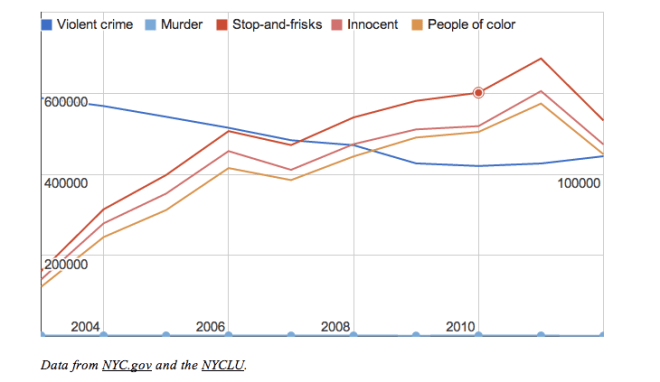
This chart explains why the judge determined that the city’s policy was unacceptable.

Screen Shot 2013-08-12 at 5.19.23 PM

It shows:

• That crime has dropped largely independently of the fluctuations of the number of stop-and-frisks. It began going up in 2011 – alongside more stop-and-frisks.

• The number of murders in 2012 dropped alongside the number of stop-and-frisks.

• In every year, almost all of the stop-and-frisks (red line) were of people who were innocent (yellow line) and / or a person of color (orange line). The gap between the red line and the orange line is the number of those stopped who were not black or Latino.

And Kevin Drum wants further investigation into the causes of New York’s crime drop:

If stop-and-frisk really is the reason crime has dropped so dramatically in the Bronx, then a judge would be justified in weighing this against the legal issues on the other side. Even decisions based on fundamental constitutional rights aren’t rendered in a vacuum. But if reductions in atmospheric lead are the primary reason for the drop in crime, then stop-and-frisk really has no justification at all, and the judge’s decision becomes an easy one. That’s why it’s worth getting a more definitive answer about this. Other cities have seen dramatic crime drops without expanding their stop-and-frisk programs as aggressively as New York, and it would sure be worthwhile to find out how and why that happened.

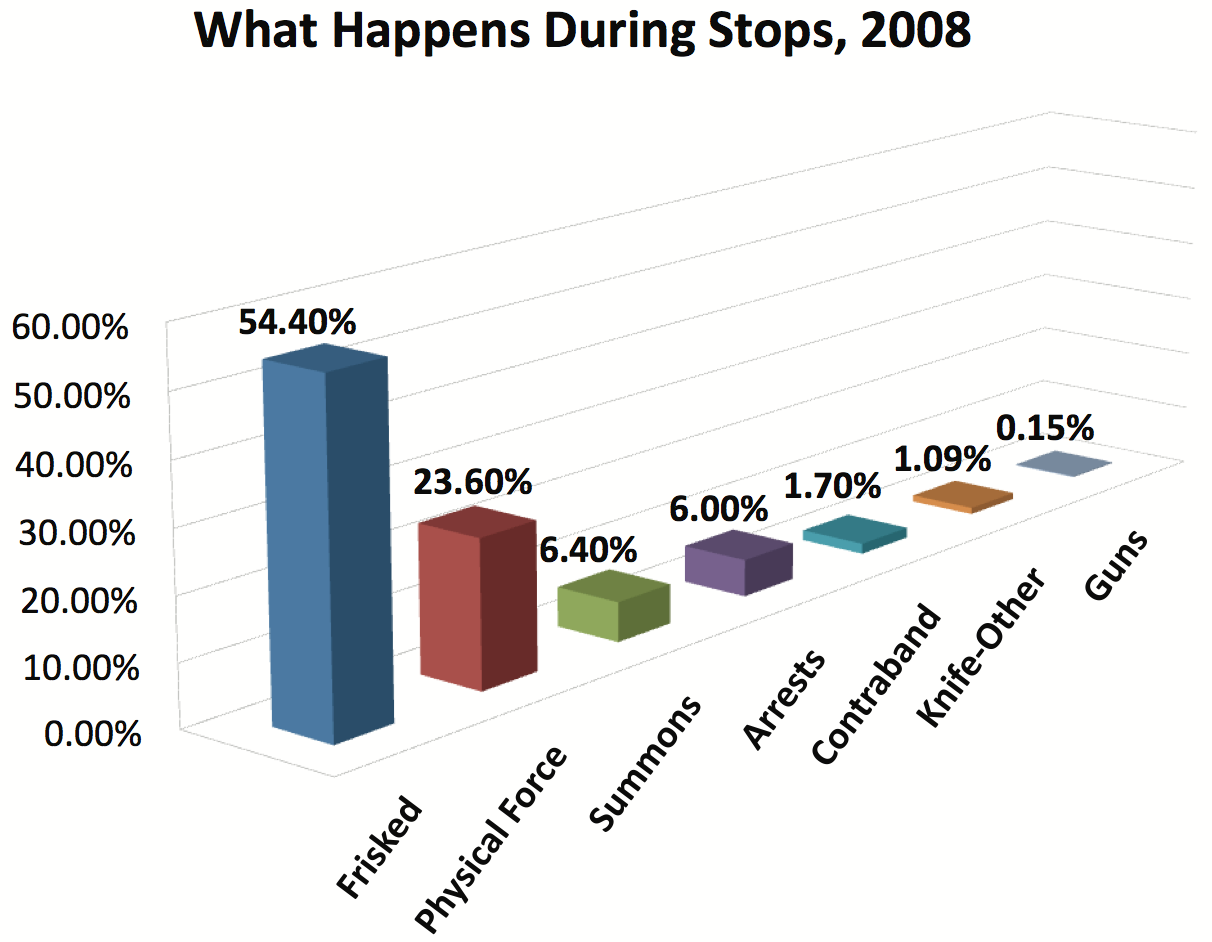
(Chart from a 2010 report (pdf) by the Center On Race, Crime And Justice)