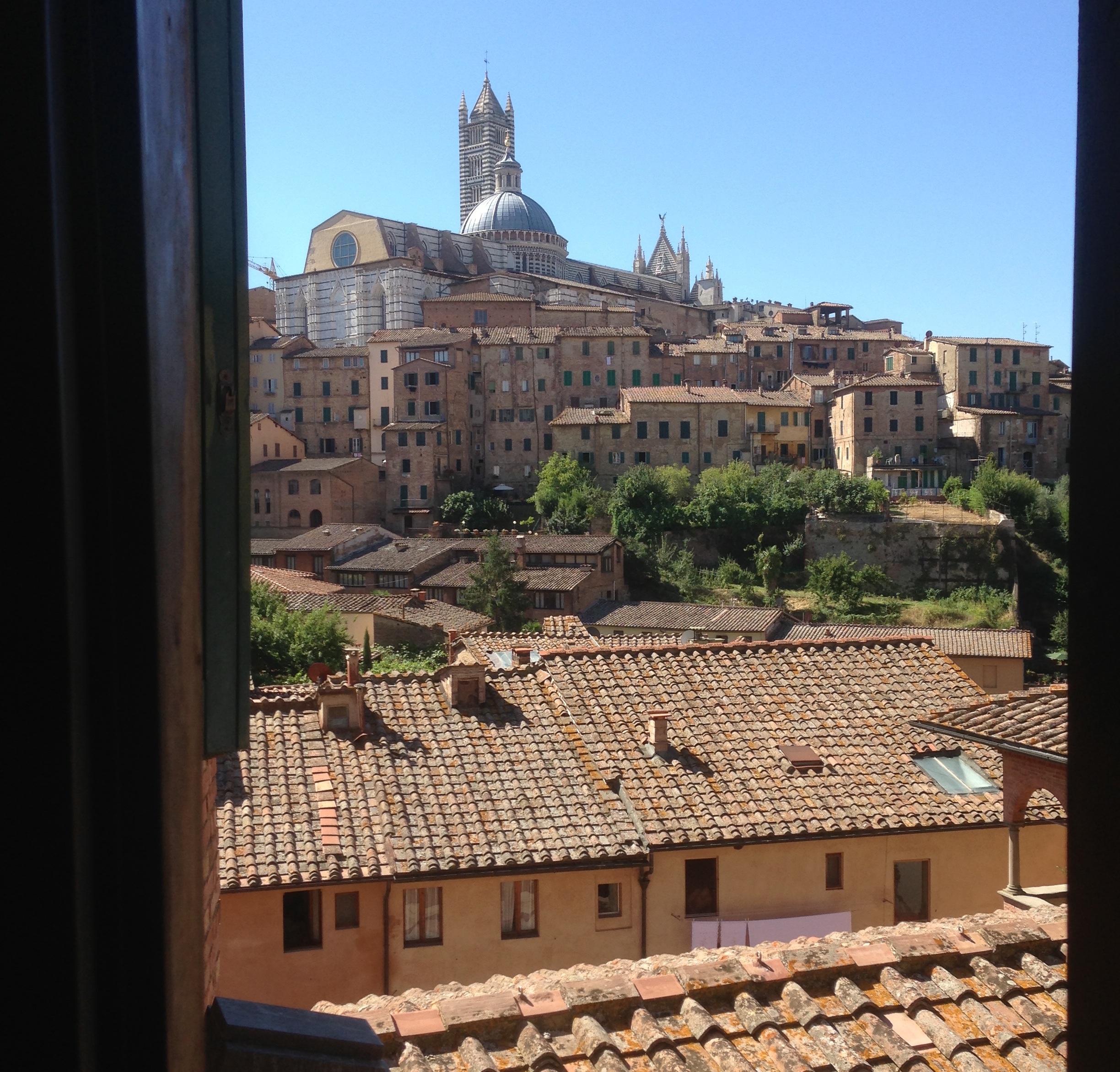
Siena, Italy, 12 pm. The reader writes:
Taken from the WC in room 10 at the Albergo Bernini in Siena, Italy. The Duomo in the background may make it a dead giveaway, but it would be the best picture from the shitter you’ve ever posted I’d wager.
Siena, Italy, 12 pm. The reader writes:
Taken from the WC in room 10 at the Albergo Bernini in Siena, Italy. The Duomo in the background may make it a dead giveaway, but it would be the best picture from the shitter you’ve ever posted I’d wager.
In an interview, “Natalie,” a 23-year-old Mormon feminist, describes how her teenage sexuality collided with her faith:
The thing is, masturbation is a normal thing, but [the community] doesn’t talk to girls about it—I have since learned that they talk to boys about it—because we’re not supposed to desire. So I knew it was something a girl is not supposed to do, which made it even worse. So then it became kind of masochistic for me. It was like, Oh, Natalie ate too much today, she’s going to masturbate. I didn’t want to cut myself, I wasn’t ballsy enough to get drunk, I wasn’t ballsy enough to smoke—it was the biggest thing I could think to do to hurt myself within my religion. Which is really sad, that I was using my sexuality to hurt myself. So that was one of the things that I had to unpack with my therapist.
After that, I put my religion in a box for about a year. I was kind of like, I need to know who I am right now.
She eventually made her way to BYU-Idaho and decided she would give the religion another chance, describing her first two semesters there as her attempt “to be the good Molly Mormon” – an ideal she eventually relinquished. And what, exactly, is a Molly Mormon?
It’s kind of the Mormon idea about how a woman’s supposed to act.
Molly Mormons are women who are so spiritually obsessed that everything has to be by the book. Oh, your dress is not knee length! Oh no! It’s encapsulated by this sense that you have to be modest enough to be deemed attractive but not immodest enough to be deemed sexy. Being blonde and petite is sort of an added bonus. There’s a different type of body shaming that happens within Mormonism. It’s not necessarily the same as you see in Vogue or watching Sex and the City, where it’s like, “I have to be a size 4.” It’s more trying to be this modest female paradigm virtue where you’re supposed to be enticing and attractive but also sweet and naïve.
Alan Jacobs recently made this observation about how we misread Dante:
Dante is not at all interested in placing persons (or as he would see them, ex-persons) in their proper places in the afterlife, nor is he interested in speculating on the precise nature of the sufferings of the damned: he is, rather, interested in exploring the nature of sin. The topic of the Inferno is not Hell but sin, for the Pilgrim must understand what sin is so he can renounce it, and thereby begin to find a way out of that dark, dark wood.
J.L. Wall uses that insight to unpack the meaning of Mad Men, the latest season of which begins with Don Draper reading Dante on the beach – a clue, he thinks, to understanding what the show’s writers are trying to do with their elusive main character:
Don Draper and Mad Men are, like Dante, less concerned with Hell than with sin.
Though the imagery was ratcheted up in this most recent season, questions of sin’s reality or applicability have been present since the show’s beginning. And not only with Don: The second-season character arc for Peggy Olsen, Don’s protege, is dominated by her conservative Catholic mother and a liberal priest both trying to confront her with the reality of sin and steer her off its path.Whether or not Peggy still believes in sin’s reality, Don does—and knows himself to be a sinner. Lying in bed with his neighbor, he shies away from the sight of the crucifix on her neck and ultimately pushes it from sight as they make love. (Her name, Sylvia, is etymologically related to the “dark wood”—selva—into which Don’s voiceover announces he has stumbled.) As much as Don’s flashbacks are dominated by scenes as a child in a whorehouse, they are equally dominated by discussions of sin, purity, penance, and redemption. His memories aren’t dominated by sex, that is, but by the connection between sex and his self-identification as a sinner.
Tim Spector argues that studies of twins are the strongest evidence of a genetic basis for religiosity:
Twin studies conducted around the world in the U.S., the Netherlands and Australia as well as ours in the U.K. show a 40 to 50 percent genetic component to belief in God.
What is striking is that these findings of a genetic basis for belief are consistent even across countries like the U.S. and the U.K., with their huge differences in beliefs and church attendance. For example, in the latest surveys in the U.S., when asked, 61 percent of white Americans say they firmly (ie. without any doubt) believe in God, compared with only 17 percent of firm believers in similar populations in the U.K.–greater than a threefold difference. The opposite scenario of non-belief is also true–only a tiny 3 percent of the U.S. population report being firmly atheist compared with 18 percent in the U.K. As well as belief, participation follows separate trends in the two countries. Some form of weekly church attendance is now nearly three times higher in the U.S. than the U.K.
Skeptics among you might say that the twin studies showing similarity for belief are just reflecting some cultural or family influence that wasn’t properly corrected for in the study design. However in one study of adopted twins, the researchers looked at religious belief in a number of adopted twins raised apart. They found exactly the same result–greater similarity in identical twin pairs, even if raised apart. The conclusion is unavoidable: faith is definitely influenced by genes.

“As for eternal life, that is now. If we don’t see eternity in a grain of sand, when will we ever see it. As for resurrection, as Tillich said, dead men don’t walk. But Christ was surely resurrected in the consciousness of his disciples and is more alive today than the day he was crucified, in the faces of all those who follow his example and who keep him alive.
Many wonder workers have resurrected the dead. I never understood those who think the truth of Christianity hinges on the physical resurrection of Jesus. If that is the test then a lot of nutty religions are also true. Eternal life is here and now. Christians have hardly come to a consensus on life after death. Augustine thought we would join the choir of angels in singing an eternal Hallelujah. Fine with me.
But most Americans who believe in life after death think they will rejoin their dead family members and live happily ever after. A very modern, bourgeois, kind of afterlife, hardly what traditional Christians thought. But I have no interest in destroying the beliefs of others. If thinking one will rejoin one’s loved ones helps bear the pain of death then I’m all for it. I have to look elsewhere, and, with Heraclitus, declare that life and death are one,” – Robert Bellah, the famed sociologist of religion who passed away last week, in a letter to his former student and friend Samuel Porter.
(Photo by Kamil Porembiński)
Liam McLaughlin talks to Clive Aruede and Lola Tinubu, founding members of the London Black Atheists, about embracing godlessness in a community known for its religiosity:
For Lola, the final straw for God and religion came when her religious father visited from Nigeria. It turned out he enjoyed watching popular science TV shows. “That’s the irony of it!” says Lola. “He loves science!” But when he saw how genuinely interested in science she was, he told her “Facts are not the same as truth.” Lola realised that this absurd statement was “cognitive dissonance – he couldn’t reconcile his own beliefs with the facts.”
That was it. First she began asking difficult questions in Bible study. Then she stopped going to church altogether. She also stopped going to other social functions where prayer would form an inevitable part of the program. Her friends would often call, asking where she was, imploring her to come to the next event. But she couldn’t. Her self-imposed absence from a primary social hub of Nigerian culture – church – left her with no friends or social life, and this warm, vivacious woman ended up spending a year in treatment for clinical depression. It is often “a very long journey” for black people to become atheists, she says.
“Nighttime Begins with a Line by Pablo Neruda” by Yusef Komunyakaa:
So my body went on growing, by night,
went on pleading & singing to the earth
I was born to be woven back into: Love,
let me see if I can’t sink my roots
deeper into you, your minerals & water,
your leaf rot & gold, your telling and un-
telling of the oldest tales inscribed
on wind-carved rocks, silt & grass,
your songs & prayers, your oaths & myths,
your nights & days in one unending lament,
your luminous swarm of wet kisses
& stings, your spleen & mind,
your outrageous forgetting & remembrance,
your ghosts & rebirths, your thunderstones
& mushrooms, & your kind loss of memory.
(From The Chameleon Couch: Poems © 2011 by Yusef Komunyakaa. Used by kind permission of Farrar, Straus and Giroux)
Connor Wood thinks so, offering reasons why faith can stifle “openness to new experience and, by implication, creativity”:
The data are clear: religious people are happier with their relationships, more likely to be married (which itself seems to make people happier), more likely to have children, more satisfied with life, more generous with charities (including secular ones), and less likely to get depressed or attempt suicide than secular folks. In other words, they’re more stable.
But here’s the thing: fulfilling all of a religion’s requirements, from attending its services or learning its rituals to organizing the Saturday potluck, takes energy. Like, a lot of it. And the more energy you put into the everyday minutiae of group life, the less energy you have to explore new horizons.
Dreher elaborates:
In past centuries, even creative people pretty much shared the wider society’s metaphysical and religious assumptions. The core beliefs weren’t under constant assault by radical questioning, coming from all angles. Secular modernity, especially in this century, changed all that. Now the religious believer has to devote much of his energy simply to holding ground — I’m talking about within his own mind — that in ages past was not contested. It is emotionally and psychologically exhausting. Religious individuals and communities may be working so hard to hold on to what they have that they see questioning in any sense as a threat to internal and external cohesion, and thus suppress creatives within their community. And, to be fair, it may be true that for people committed to objective metaphysical and religious truth, a time of great cultural flux is not the time to embrace creative experimentation.
What’s more, the broader culture teaches creatives to view religion and a religious mode of thinking with suspicion. We live in a time and a place in which people with creative gifts are enveloped by an ethos of expressive individualism, a way of seeing the world that rejects accepting the disciplines of religion and tradition, and poses them as threats to creativity — which, for the artist, means a threat to his sense of self. The fact that accepting the limits of certain moral and artistic conventions can actually promote creativity by compelling the artist to innovate within established limits is not well accepted. It is a paradoxical truth that imposing restrictions on the free ranging of the creative mind may compel that mind to do its best work. But some creative types only see limits not as rudders, but as anchors. Unfortunately, some religious traditions, suspicious and disdainful of art, buy into this false dichotomy between religion and creativity from the other side.

Mary Karr, the poet, memoirist, and Roman Catholic convert, answers the question:
When I got sober, in 1989—twenty years ago now. Only with prayer could I stop drinking for more than a day or two. Once I made three months clean, but it was a white-knuckled horror show. Call it self-hypnosis, prayer, whatever. To skeptics I say, Just try it. Pray every day for thirty days. See if your life gets better. If it doesn’t, tell me I’m an asshole. People tend to judge a faith’s value based on its dogma, which ignores religion in practice. It’s like believing if you watch enough porn or read enough gynecology books, you’ll know about pussy. For me, being a Catholic is a set of activities. Certain dogma seems nuts to me too. I’m not the Pope’s favorite Catholic.
How she prays:
In times of pressure or anxiety—like when Mother was dying—I’ll do a daily rosary for everybody. Or I’ll light candles and climb in the bathtub, try to put my mind where my body is—the best prayers are completely silent. Otherwise, I do a lot of begging. I just beg, beg, beg, beg like a dog, for myself and those I love. And I do the cursory, “If it’s your will . . .” but God knows that I want everything when I want it. He knows I’m selfish and want a zillion bucks and big tits and to be five-ten. So I’m not fooling him with that “If it’s your will” shit. The real prayer happens when I’m really desperate, like when I was going through a period of illness last year. Amazing what power there is in surrender to suffering. Most of my life I dodged it, or tried to drink it away—“it” being any reality that discomfited me.
(Photo by Myshelle Robinson)
A reader writes:
I loved the post on Holy Communion. As you may know, or have gathered if you read the comments on the piece you linked to, this issue of “communion without/before baptism” is hotly debated in the Episcopal church. The “official” polity of TEC is that “all baptized Christians” are welcome to receive, but like the authors you cited, some practice a more radical hospitality at the Lord’s table. Because we have no centralized authority, practices vary widely. In my diocese (Washington), the bishop supports open fellowship and it is practiced in many congregations, including my own. But in others, bishops have told priests they will be barred from celebrating the Eucharist is they are “caught” engaging in open communion.
Personally, I adopt a simple rule of thumb for debates like these: when the arguments in your church begin to sound like those between Jesus and the religious authorities of his day, try not to come down on the side of the Pharisees.
 The Dish