That Metaphor You Were Searching For

Every now and again, a writer needs to find a new way of expressing the notion that fundamentalism is not actually faith, but a neurosis built on misunderstandings and leading nowhere. And then you just read the AP:

A northern Arizona family that was lost at sea for weeks in an ill-fated attempt to leave the U.S. over what they consider government interference in religion will fly back home Sunday. Hannah Gastonguay, 26, said Saturday that she and her husband “decided to take a leap of faith and see where God led us” when they took their two small children and her father-in-law and set sail from San Diego for the tiny island nation of Kiribati in May.

But just weeks into their journey, the Gastonguays hit a series of storms that damaged their small boat, leaving them adrift for weeks, unable to make progress. They were eventually picked up by a Venezuelan fishing vessel, transferred to a Japanese cargo ship and taken to Chile where they are resting in a hotel in the port city of San Antonio.

Add your own punch-line. It’s too easy.

“All Bad Things Must Come To An End”

Andy Greenwald has a theory about why, despite living in the Golden Age of television dramas, he’s seen great shows struggle with their finales:

In retrospect, I think what confounded and disappointed loyal obsessives of The Wire and The Sopranos wasn’t the specific ways they chose to go out but that the endings had to be specific at all. Both shows transcended their settings to become wide-ranging, rewarding hobbyhorses for the men behind the curtain. Putting a fulfilling period on such magnificent, digressive sentences proved to be nearly impossible. How do you condense the life and death of a major American city into a montage? How to cram the banality and barbarity of modern life into a close-up and an order of onion rings?

Why he believes Breaking Bad will come to a better end:

Breaking Bad, to its enormous credit, isn’t about everything. It’s about one thing and always has been: Walter White’s calamitous path not from Mr. Chips to Scarface but from homeroom to the gates of hell. This framework has provided creator Vince Gilligan with a relentless, furious focus usually only possible after a few hits of the blue. Everything that we’ve seen these past five seasons, from airplane collisions to cartel killings, has spun out from Walter’s initial decision to edge up to the line separating legal from illegal, good from truly awful, and then run right over it behind the wheel of a hideous, taupe, SUV. And every step he has taken — from half-measures to full-on slaughter — we’ve taken right alongside him. We know exactly where we’re going because we’ve never lost sight of where we’ve been.

Miracle Works

dish_notgoya

 
Reviewing a history of art forgery, Charles Hope explains that authenticity had a different meaning in the Middle Ages:

What mattered about objects such as these was not so much whether they were originals or copies, whether they were old or modern, as whether they worked miracles. In this respect they were like relics, for which there was also an enormous demand, met in part by the production of fakes. Such forgery required no technical skill, since what was most often required was a fragment of bone, supposedly human. The church was of course alive to the danger of forgery, and had an elaborate procedure for establishing the authenticity of relics, described in fascinating detail by [author Thierry] Lenain in Art Forgery.

Various types of evidence were used. These included any label attached to the supposed relic, the length of its known history, its source, the beliefs of the local clergy and congregation, and, most important of all, the relic’s ability to work miracles. Apart from this last criterion, these types of evidence have something in common with some of the categories of argument used today to establish the authenticity of works of art. In both cases much weight is given to provenance and to such written evidence as old labels and other documents; and in the case of relics the role of the clergy is comparable to that of art historians, with much importance given to the views of the majority and to tradition.

Even the supposedly miraculous power of the relic has a surprising parallel in discussion of the status of works of art. For the potency of the relic was thought to be generally due to some physical connection with a saint, whether because it was part of his or her body, or had touched a part of the body or some other relic. In much the same way, as Lenain explains, it is widely believed today that an authentic work of art contains in itself some trace of its maker, in a way that a copy, however accomplished, never can.

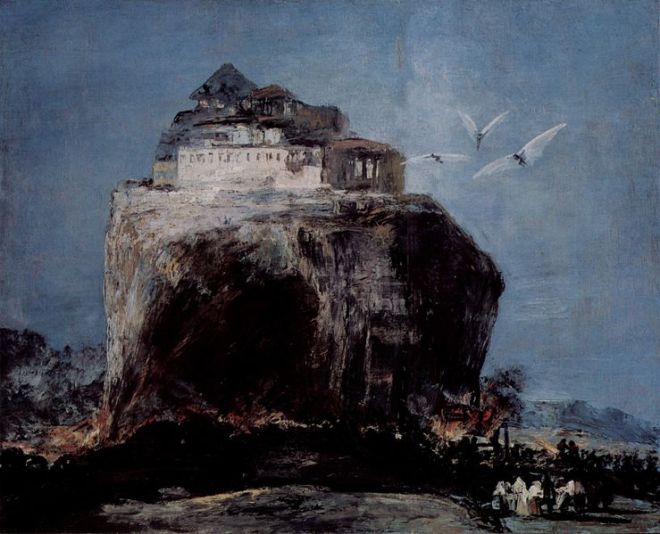
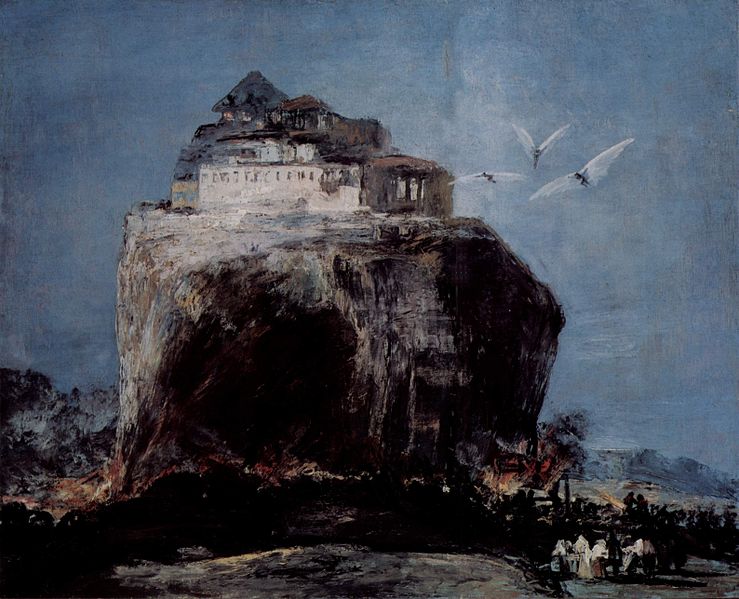
(Image: A City on a Rock, once attributed to Francisco de Goya and now considered the work of his follower Eugenio Lucas, via Wikimedia Commons)
The Perfect Political Slogan

Richard Morris attests to the difficultly of crafting it:

I once sat in a room of about 20 people, where we were invited to write a memorable line to adorn the platform at conference. Entirely predictably, this process was an unmitigated disaster. After an hour of coming up with any number of lines that randomly sorted words like New, Better, Fair, Green, Future, Britain, Fresh, Together and Change into a new order, we all agreed that perhaps it would be better if we got one person to write one memorable line with a single pertinent thought. We then, ahem, “discussed” for another hour who should write it.

He zooms out – and offers some advice:

[W]e’ve all become fixated with “the one great line”. And it’s all Barack Obama’s fault, with “Change we can believe in”. In reality, not even this line stood alone. Other lines dominated the campaign, like “Yes, we can” and the Fairey Posters “Hope” and “Change“. But since 2008, it’s become a “mandatory” – and an obsession – to write a great campaign line. And it takes up an inordinate amount of headspace.

So can I make a suggestion to all the parties. If you want a great line, get a single person to write it. Then get a single person to approve it. Then spend two years and a lot of money saying it over and over again. And get someone to say it with affection, with emotion and with conviction. It’s the only way.

Alone With The Written Word

David Paul Deavel nominates Ben Yagoda’s How to Not Write Bad as a successor to The Elements Of Style. Part of why he’s impressed:

As good as most of his guidance and judgments are, what I like most about Yagoda’s book is the more general advice he gives to those who really want to write better. It primarily involves habits of reading and thinking rather than learning specific rules. Yagoda is skeptical of accounts of the past in which everyone was writing elegant letters with classical and biblical allusions between battles of the Civil War. There may have been great letters, but few were writing them. Today more people than ever are writing on blogs and other social media. The problem is that most of this digital writing is not all that good due to the fact that it is done in a rather mindless fashion. Most people are “multi-tasking,” which is a perfect condition in which to write bad. Precision, accuracy, and diction that avoid ambiguity, vagueness, and cliché will inevitably be sacrificed when one is not “mindful” or concentrated on the difficult task of writing. Yagoda says what my students and I need to hear: Turn off the radio, the phone, and the social media if you want to write something that’s not bad.

Emma Woolf similarly tries to limit distractions when writing:

Isolation is a big part of writing (if you crave constant company then writing’s probably not for you) because you need to be alone simply to get the words down.

But you also need to experience life and people and relationships in order to have something to write about. When I went freelance a few years ago, after a decade in publishing, I found the enforced solitude hard. I missed the banter and time-wasting with colleagues, I even missed the silly office politics. These days I escape writing-at-home madness at the British Library: in its hallowed reading rooms, surrounded by other freelancers, I feel less caged (and you can’t work there in pajamas).

Avoiding the distractions of social media and the Internet is another problem for writers these days. I struggle with this: currently my screensaver is the warning from Jonathan Franzen: “It’s doubtful that anyone with an Internet connection at his workplace is writing good fiction.” It was Franzen who told Time magazine he’d resorted to pouring super-glue into his Ethernet port to deprive himself of Internet access. (He went on to write the novel Freedom, so it obviously worked for him.) Other writers, including Zadie Smith, use applications that prevent them from going online; I haven’t tried this software yet, but I’m considering it.

A Deliberately Slow Reader

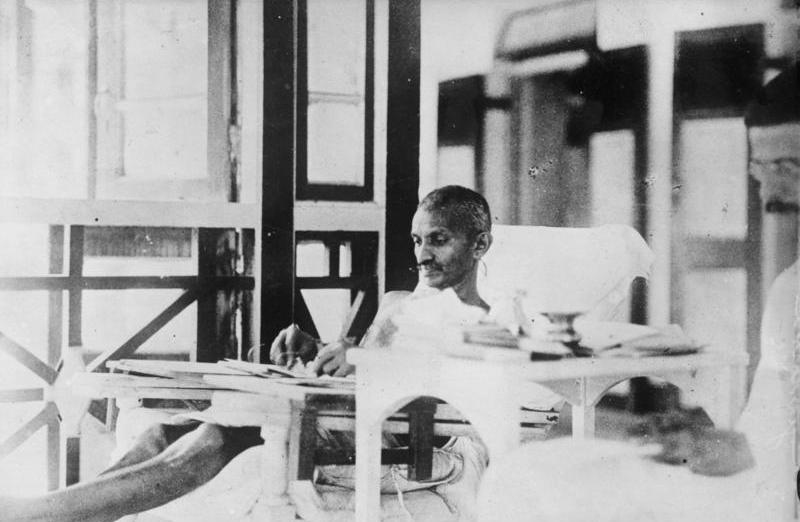
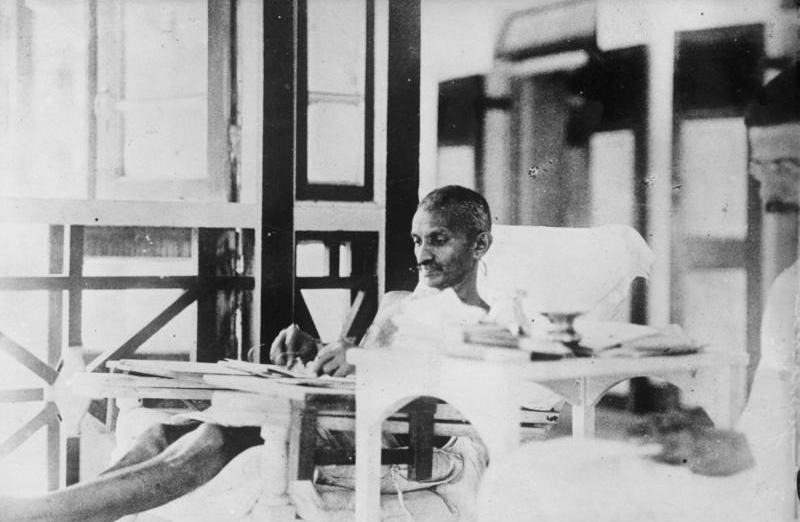
Mahatma Gandhi

Reviewing Gandhi’s Printing Press: Experiments in Slow Reading, C. Christopher Smith emphasizes the way the newspaper Gandhi created, Indian Opinion, aimed to cultivate certain habits of mind and body among its readers, through both its content and form:

The selection and arrangement of extracts in the Indian Opinion, as well as the pamphlets that Gandhi published, served to create a rough surface—in contrast to the smooth macadam of industrialization—that would help readers slow down and contemplate what they were reading. The content that Gandhi offered in his publications was meaty and aimed at promoting the cause of satyagraha. News stories and excerpts from authors such as Ruskin, Tolstoy, and Thoreau, whose work Gandhi saw as essential to the ethics of satyagraha, served to form a slow, attentive community that could resist the empire’s industrial pressure for speed.

How today’s West might learn from Gandhi’s philosophy of reading:

We are in dire need today of practices that shape our identity as a people, and that teach us to slow down and be attentive to the world around us and the power that it exerts upon our desires. As Gandhi’s experiences in South Africa indicate, reading can be an important practice of this sort, but it must be done with intentionality about what we read and how we read it. Committing to practices of reading and conversation (about reading) in our church communities can help to provide the structure we need to begin the challenging process of slowing down. Perhaps our communities will have leaders like Gandhi who can help guide us in these kind of practices, and recommend resources that will help us to read (and live) more slowly and attentively. If we are to bear witness to a different way, then we must seek to apprentice ourselves to practices that—when sustained over many years—will inevitably slow us down.

(Photo of Gandhi at work via Wikimedia Commons)

A Literary Zoo

Alissa Nutting’s debut novel, Tampa, tells the story of Celeste Price, “a young, recently-married, beautiful middle-school teacher — who also happens to be a sociopath who throughout the book recounts her systematic and relentless seduction of a fourteen-year-old student.” In an interview, Nutting differentiates between herself and her deviant main character:

I know that in my case — and I think this is true for so many authors — writing is the place where I mull over the things about the world that are beyond my comprehension: mainly death, sociopathy, and inequality. For me, being a writer is like going to the zoo, holds the same level of otherworldly curiosity — I can stand in front of a gorilla’s cage and have just an inch of glass separating me from fatal danger, yet feel completely safe. I can get right next to all these bizarre creatures I’d never, ever want to be close to otherwise. Writing Celeste was a lot like that. She’s so depraved that I didn’t really worry about people conflating me with her voice in any way… after all, this is a book that indicts the narrator instead of glorifying her. In order to do that, to truly capture the wrongness of what she does, and how much delight she takes in it, I needed to show the grittiest aspects of her transgressions. For the subject matter to be adequately disturbing, I had to push the writing until I’d thoroughly disturbed myself — that was the test I held the writing up to. And I did disturb myself, on a daily basis. I went through an incredible amount of antacid products while writing this book. Celeste is intense, to say the least.

Seduced By The Beauty Of Despair

Dr. Paul Gachet, who treated Vincent van Gogh during the painter’s last days, had a romantic view of melancholy. Gregory Curtis explains:

Dr. Gachet lived in an age when medicine was still considerably more art than science. He 487px-Portrait_of_Dr._Gachethad received his medical degree in 1858 after writing a thesis on melancholy which was not scientific at all but literary. He found melancholia throughout history, from Diogenes in Athens, to Seneca in Rome, to the present day. “One might almost say,” Gachet wrote, “that all the great men, the philosophers, the tyrants, the great conspirators, the great criminals, the great poets, the great artists, were essentially melancholic beings.” In fact he saw melancholia extending throughout nature. There were melancholy animals, melancholy plants, and even melancholy rocks. “Who,” he asked, “has knelt beside a tomb and not seen in the cypress, 
the weeping willow, the poplar the emblem of sadness!” He went on in this vein for a while in his thesis before blaming melancholy in the present day on civilization and progress that broke the laws of nature, a theory with which Vincent would concur.

(Vincent van Gogh’s Portrait of Dr. Gachet, 1890)