What Exactly Is Racist?

Two recent examples spring to mind, because they are representative of the complexity of this kind of issue in a world of such staggering social and cultural change. Here’s a quote from the UKIP member of the European parliament, Godfrey Bloom, on the perils of foreign aid:

How we can possibly be giving a billion pounds a month when we’re in this sort of debt to bongo bongo land is completely beyond me.

That’s a weird formulation – aid is not debt. But the context reveals that the man’s main ire is directed at the European Union, and not just at developing countries:

Mr Bloom, who pointed out he has a Polish wife and Kashmiri staff, said that his comments were not racist. Asked by the BBC where “bongo bongo” land is, Mr Bloom referred to “Ruritania” – a fictional country in Europe that formed the setting for three novels by Anthony Hope.

Does that make him a racist or just a xenophobe? This hilarious interview – dissecting the origins of the term “bongo-bongo-land” – suggests both to me:

But I’m not sure I’d be able to prove that point beyond a reasonable doubt. Sometimes, a racist expression is so foul and unrelated to any broader context that it merits no debate – like this tirade from Eagles player Riley Cooper. The trouble is: racism is often also interwoven with all sorts of other factors. It collides with legitimate resistance to fast cultural change, xenophobia, generational attitudes, and legitimate questions, such as immigration policy, in which one side should not be deemed irrational because of an implied racist motivation. Take this explanation of Smith’s broader point:

When a country has a trillion pounds of debt and we’re cutting our hospitals, our police force and we’re destroying our defense services, that the money should stay at home and people who want to give money to worthwhile charities…what I would argue is that is for the individual citizens. It’s not for the likes of David Cameron to pick our pockets and send money to charities of his choice.

That may in some way be a reflection of racism, but it is also a legitimate political argument. And it’s hard to tackle the latter if you are constantly wrapped up in debates about the former. Then there’s the complex interaction of tradition, culture and social change. So this sure looks like racism on the surface:

But this context – a detail from a similar event in 1994 – is also important:

T.J. Hawkins rolled out the big inner tube, and the bull lowered his head, shot forward and launched into the tube, sending it bounding down the center of the arena. The crowd cheered. Then the bull saw the George Bush dummy. He tore into it, sending the rubber mask flying halfway across the sand as he turned toward the fence, sending cowboys scrambling up the fence rails, hooking one with his horn and tossing him off the fence.

What might be seen as racist in one context – because the president is black – may not be in another. What some may see as a legitimate reclaiming of sovereignty from European bureaucrats can also be motivated by bald “bongo-bongo-land” racism. This is not either-or. And if it’s not either-or, we have to make a decision as to whether to hunt for these manifestations of racism or ignore them and get on with the actual arguments at hand, regardless of their psychological motivation. I favor as a purely pragmatic measure not jumping on every incident like this to yell racism – not because it is never racist, but because that charge cannot truly be proven without peering into opaque human souls, because it diverts potentially constructive debate into moral posturing, and because it is crowding out our discourse with gotchas that don’t really advance substantive debate.

And now I’ve written an entire post about whether certain people are racists. See how the cycle continues?

Kickstart Your Own Adventure

The upcoming book To Be or Not to Be is an illustrated “chooseable-path adventure” version of Hamlet. Cartoonist Ryan North explains his inspiration:

“It occurred to me that [Hamlet’s] favorite speech, ‘To Be Or Not To Be’, is structured like a choice, almost like those old Choose Your Own Adventure books, and I thought, ‘Oh my God, I have to write this.'” North says. So he wrote his version of Hamlet in the style of the classic children’s book series, in which the reader would be prompted to make the main character’s decisions — turn to page 3 for this, turn to page 5 for that — and take the story in many different directions.

Alison Hallett credits the Kickstarter project’s record-breaking $580,905 to North’s business savvy:

[T]hanks to North’s voluble backer updates and creative reward tiers, being a part of his campaign didn’t feel like simply preordering something, as Kickstarter so often does these days; nor did it have the faint whiff of desperation that often comes with artists asking their friends and family for money. This felt like being a part of the creative process, and having a front-row seat to an artist giddily realizing that his biggest dreams are now possible.

And she deems the result is a success:

In Hamlet, the Prince of Denmark has one of the most famous existential crises in literary history, as he ponders aloud whether suicide is worth the risk that whatever happens after death might be even worse than life itself. North’s version puts the being vs. not-being decision square in the reader’s hands, though it turns out choosing “Not to Be: turn to page 17” isn’t much of an adventure at all: It leads to artist Mike Holmes’ illustration of Hamlet chugging from a vial of poison, one pinky lifted genteelly, while Ophelia peeks from behind a curtain. There’s no sign of the terrifying death-nightmares Hamlet’s so worried about; just the words “The End.” But even asking the reader to make the decision highlights how much of the original play—and how much of life itself—revolves around possibly crazy people bumbling through situations they barely understand, possessing a fraction of the information they need to get from one scene to the next.

Questioning The “Good War”

mmw_euroblog_dresden

Keith Lowe explores how historians are increasingly reevaluating idealistic beliefs about World War II. Aaron William Moore, for instance, examines the wartime diaries of Japanese, Chinese, and American soldiers in his book Writing War:

Perhaps most disturbing of all is the way that Moore analyses the actual process of diary writing by these men. In all three countries, he reveals, the thoughts and feelings of soldiers were closely monitored by their superior officers. As a consequence the sentiments they expressed were self-policed: soldiers effectively used their diaries as a way of convincing themselves to act in the way that was required of them by the state.

The implications of this are huge, and draw a question mark over one of our strongest taboos about the war. When Chinese, Japanese or American soldiers spurred themselves on to commit acts of bravery, or atrocity, how much were they expressing their own desires and how much were they resigning themselves to things that were expected of them? Does this – can this ever – at least partially absolve them of the things they did during wartime?

The fact that we can ask such questions says as much about our own time as it does about the second world war. Perhaps we are more comfortable expressing doubt now than we were a generation ago, or even 10 years ago, when we were deeply embroiled in the black-and-white certainties of the cold war or the war on terror. Perhaps the behaviour of our armed forces today – such as the Abu Ghraib scandal – has allowed us also to ask questions about how our soldiers behaved in the past.

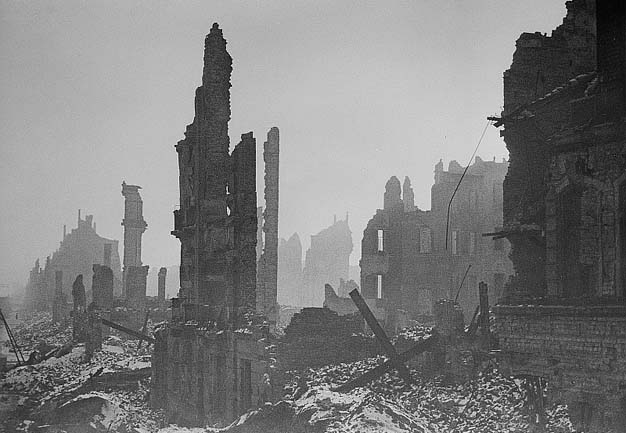
(Photo: The ruins of a firebombed Dresden, circa 1945, via Michael Scott Moore)

When Help Is Not A Choice

Hope Reese interviews Dr. Christine Montross, author of Falling Into the Fire, about the ethics of mandatory psychiatric treatment:

Kendra’s Law, enacted in several states after an untreated schizophrenic man pushed a woman to her death on a subway platform in New York, is a controversial measure that makes outpatient treatment mandatory. What do you think of the ethics here?

Taking away someone’s autonomy is always an uneasy balance. Nonetheless, in my work with the chronically and persistently mentally ill, I’ve all too often seen how periods of treatment nonadherence can extend patients’ symptoms and suffering, and can sometimes put them in real danger. I’ve treated many patients who have been tormented by paranoia or besieged by hallucinations, and without treatment their symptoms simply do not remit. Once court-ordered treatment is implemented, I see people begin to emerge from deep distress, often with great relief because their fear-inducing symptoms diminish, their quality of life begins to increase dramatically. I write about this in Falling Into the Fire in terms of involuntary hospitalization. Compelling patients to obtain treatment is a tool we must use sparingly and only when appropriate to do so. But refusing to ever compel treatment is short-sighted, as doing so can allow a patient’s illness and suffering to persist under the guise of preserving autonomy.

Charting City Lit

dish_chart

Using data from Google N-Gram, the largest database of digitized books, Edgard Barbosa created the above graphic illustrating the frequency of city names over the last two centuries. Kelsey Campbell-Dollaghan comments:

First, the obvious: That English-language books tend to feature English-language cities, like New York and London. But beyond that, things get more interesting. For example, Rome starts off strong—thanks to its strong hold on the Victorian-era imagination—and peters out in contemporary times. Meanwhile, Beijing and Mumbai are nearly absent (with the exception of a few blips during the peak of Britain’s colonial reign) from the 19th century, but explode over the past two or three decades.

In another Google N-Gram study, a scholar has found that the rise of individualistic words and phrases parallels increasing urbanism over the last 200 years:

Use of the words “individual,” “self,” and “unique” all steadily rose over the course of the two centuries, while “obedience,” “authority,” “belong,” and “pray” all gradually declined. The use of the words “feel” and “emotion” also increased, reflecting “the growing importance of psychological expression,” she writes.

Greenfield does not see this as evidence of our ethical decline, but rather an entirely logical shift that reflected the realities of our new environments. In her view, a mindset that values “choice, obtaining things for oneself, child-centeredness, psychological mindedness, and the unique, individual self” is one that is more likely to thrive in an urban area.

In Praise Of Pocket Paperbacks

Dan Kois finds them perfect for summer reading:

There was a time when I spurned mass-market paperbacks. They’re small and flimsy, unbefitting real literature. They’re cheap, and their disposability invites a certain unseriousness in the reader. Whenever I had the chance (and the funds), I replaced the mass-markets in my collection with hardcovers, or at least larger-sized trade paperbacks.

It’s funny how the things that once seemed like bugs now seem like features. Especially that wonderful disposability! If I’m just not that into a book, I want to be able to ditch it. I don’t want to feel beholden to a bad novel just because I spent $35 on the gorgeous hardcover, or because it’s so large and heavy that I couldn’t bring a backup book with me. At 38, with two kids and limited brainpower and scores of shelf-feet of unread books in my house, I am looking for books that I can cast aside without a care if it things don’t work out. On the beach this afternoon, this happens twice. Luckily, I’ve got backups.

Is Driving With A Cell Phone Really That Dangerous?

Werner Herzog has released a 35-minute film, “From One Second to the Next,” about the dangers of driving while texting:

Herzog explains why he wanted to work with AT&T on the project:

“What AT&T proposed immediately clicked and connected inside of me. There’s a completely new culture out there. I’m not a participant of texting and driving — or texting at all — but I see there’s something going on in civilization which is coming with great vehemence at us. … This has nothing to do with consumerism or being part of advertising products. This whole campaign is rather dissuading you from excessive use of a product. It’s a campaign. We’re not trying to sell anything to you. We’re not trying to sell a mobile phone to you. We’re trying to raise awareness.”

Meanwhile, a new study contradicts previous research suggesting that cell phone use while driving increases the risk of accidents:

For the study, Bhargava and the London School of Economics and Political Science’s Vikram S. Pathania examined calling and crash data from 2002 to 2005, a period when most cellphone carriers offered pricing plans with free calls on weekdays after 9 p.m. Identifying drivers as those whose cellphone calls were routed through multiple cellular towers, they first showed that drivers increased call volume by more than 7 percent at 9 p.m. They then compared the relative crash rate before and after 9 p.m. using data on approximately 8 million crashes across nine states and all fatal crashes across the nation. They found that the increased cellphone use by drivers at 9 p.m. had no corresponding effect on crash rates.

Additionally, the researchers analyzed the effects of legislation banning cellphone use, enacted in several states, and similarly found that the legislation had no effect on the crash rate.

(Hat tip: Engadget)

“Are You Still Writing?”

Saying that to Danielle Steele is one way to rile her up:

What [that question] does is that it immediately puts my writing into the category as a hobby. As in, are you still taking piano lessons, doing macrame, have a parrot? … The comment is an immediate put down. It is a way of suggesting that what I do is really not very important. Women NEVER ask me that question. But SOME men do. The men who do, I find, are VERY uncomfortable about my success at what I do, and VERY annoyed by it. … I never say to guys, “So are you still a lawyer? … A doctor? … A brain surgeon?” They would think I’m nuts if I did. But men who are annoyed by women’s success in business have to find a way to put them down. And what better way to insult someone than minimize what they do, imply that it’s really insignificant, and inquire if they’re still doing it?

(Hat tip: Annalisa Quinn)

The Best Of The Dish This Weekend

Clouds

We broke bad before Breaking Bad. A young Mormon woman came to terms with masturbation; and young black Londoners tried to live in their community as atheists.

A Catholic woman recommends prayer as refreshingly as Pope Francis. And Gandhi reminds us of the joy and importance of slow reading.

If you read one quote about the after-life this weekend, the late Robert Bellah provides it. If you read one poem, Yusef Komunyakaa writes it.

The most popular post of the weekend was this heart-breakingly poignant love-letter on Craigslist; followed by the reflections of a “Molly Mormon“.

A personal thank you for the hundreds and hundreds of emails commiserating with me for the loss of Dusty. They meant a huge amount and really helped. I cannot answer every one, so beg your forgiveness. But one of the wonders of running this blog is realizing how many friends you have – especially in the bleaker moments. Thank you.

And see you in the morning.

(Photo by Kamil Porembiński)

MoDo’s Pure Washingtonism

Maureen Dowd Hosts Party For Gioia Diliberto's New Book "The Collection"

Yes, of course it’s the same column. It has a touch of Wieseltieritis:

[Obama] smoothly glided from his previously unassailable position on the matter of surveillance to his new unassailable position on the matter of surveillance.

It couldn’t possibly be that a Democratic president, always liable to be deemed “weak” on terror, waited for domestic opinion to shift before restraining the least ineffective and counter-terrorism strategy, could it? Nah. He’s just “aloof”. That’s been the story-line from long before Day One, when MoDo was giving bad conventional advice to candidate Obama, and she’s sticking to it. More Leonism:

There is no moral high ground that he does not seek to occupy. As with drones and gay marriage, he seems peeved that we were insufficiently patient with his own private study of the matter. Why won’t the country agree to entrust itself to his fine mind?

Oh, please. The first was wound down once it had achieved its primary objective and had begun to become counter-productive. The second was a politician bullshitting a little in order to expedite a civil rights revolution, by taking himself out of the front lines until the critical end-game. And if you don’t regard these political stratagems as a function of Obama’s alleged moral snootiness, but as pragmatic adjustments to shifting objectives, they look a little different, don’t they? Five years into Obama’s term and the entire Afghan al Qaeda franchise was taken out. As for his pathetic weakness on gay rights, he has presided over the end of the military ban – brilliantly maneuvered through Congress by Admiral Mullen – and federal recognition of marriages for gay couples. I’m not sure even being Tip O’Neill could have succeeded more powerfully, do you?

Then MoDo’s warning – even after 2008! – that Obama is not tough enough to counter the malign and crafty Clintons. Now I am second to none in maligning the Clintons. But what Obama grasps and MoDo doesn’t is that politics need not always be zero-sum.

It is not, for example, a threat to Obama that Hillary is already up to her neck in campaign machinations and shenanigans. This is the Clintons’ natural state of rest: machinations and shenanigans in the seeking and holding of power and money. And there is no cost to Obama if Hillary is campaigning to complete Bill’s third term. If she succeeds, then a great deal of Obama’s legacy is secure, and part of it could be the final humiliation of the GOP at his successor’s hands. If she doesn’t succeed – and she has never won a race outside the super-safe New York Senate seat she was bequeathed by her marriage – then …  the story is all about the Clintons’ failure, not Obama’s. The president’s current strategy gives him a chance of winning either way. It’s not high-minded. It’s the most nakedly political position there is.

And what, anyway, is MoDo’s alternative strategy? Win over Eric Cantor with a few Martinis? When Mitch McConnell is fighting for his electoral life because of threats from his right, does MoDo honestly believe Obama’s Capitol Hill schmoozing would help? If John Boehner cannot control the House GOP, is it really the president’s back-slapping skills that are at fault? This is 2013. We could wish the GOP were the same as it was in the 1980s but it ain’t. Then MoDo stumbles onto the truth … and leaves it lying there on the sidewalk:

His White House runs on the idea that if you are virtuous and true and honorable, people will ultimately come to you. (An ethos that sometimes collides with political success.)

That “sometimes” is a classic. It almost reminds me of the Monty Python Life of Brian skit about “what the Romans ever did for us”. Obama’s political style is useless, apart from becoming the first black president,  saving the US from another Great Depression, succeeding at getting universal healthcare, rescuing the American auto industry, presiding over a civil rights revolution, ending two failed wars, avoiding two doomed others (against Syria and Iran), bringing the deficit down while growing the economy, focusing the executive branch on climate change, and killing bin Laden. Yes his ethos “sometimes” “collides” with political success.

But no, he has never obsessed about whom the capitol is buzzing about – i.e. boomers and their Clinton obsession. Which is proof enough of his transformation of American politics. He has transformed it so much that MoDo cannot even understand how he has been so successful.

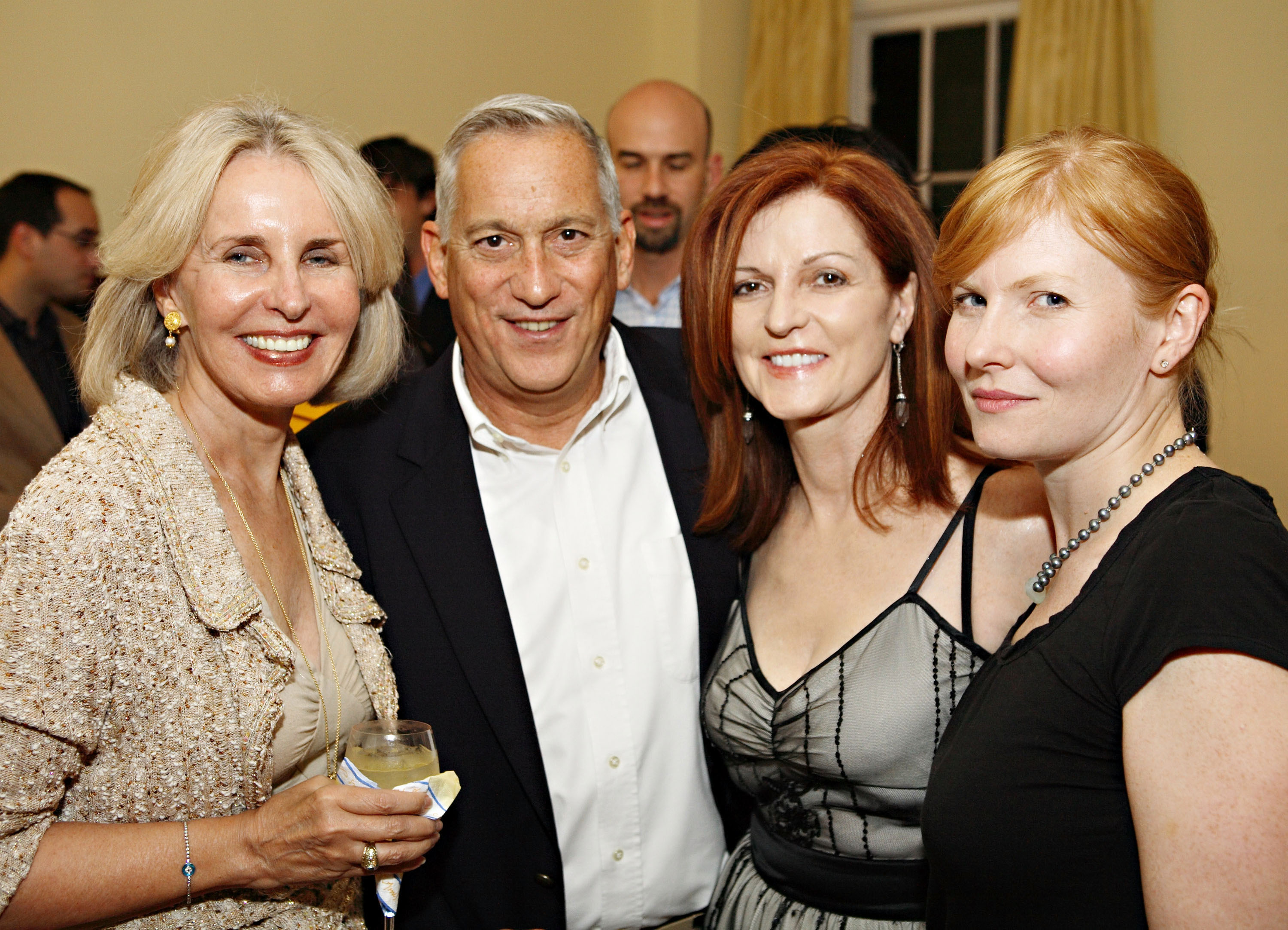
(Photo: Sally Quinn, Walter Isaacson, Maureen Dowd and Ana Marie Cox at the book-signing and reception for Gioia Diliberto’s new book ‘The Collection’ at a private residence on September 15, 2007 in Washington, DC. By Paul Morigi/Wire Image.)