Francis’ Sunlight, Ctd

Pope Francis Attends Celebration Of The Lord's Passion in the Vatican Basilica

There was a real debate about how to interpret the Pope’s recent conciliatory tone toward gay people. Many, like me, saw the tone as substance, seeing no massive overhaul in doctrine, but a revolution in emphasis that necessitates an eventual change in doctrine. By choosing to emphasize the humanity and dignity of gay people seeking God in good faith – “Who am I to judge?” – this Pope was shifting gears away from the counter-revolution of John Paul II and Benedict XVI against the liberation of modernity. Others insisted there had been no change at all – and that the idea of one was a deliberate or misinformed misreading of the Pope’s comments by the secular press.

Well, we could go back and analyze every sentence of the impromptu press conference – as some have done with surprising results:

He did not say that “homosexuals should not be marginalized.” He said “these persons should not be discriminated against, but welcomed (accolte).” He is citing the words of the Catechism here.

And he did not regurgitate other language from the Catechism about gays’ “objective disorder” or “just” and “unjust” discrimination against them. He ignores the former language and expunges the latter. In fact, the more you examine the presser, the more radical its implications seem.

But now we have more confirmation that this was not a gaffe but a strategy. Well, confirmation might be a bit strong – but one of the American cardinals tapped for Francis’ new, reformist group of eight cardinals is Boston Cardinal Sean O’Malley. He has clearly been in touch with the new pontiff and just gave a speech which confirms the theocons’ worst nightmare. It was at the annual Knights of Columbus convention in San Antonio. K-Lo was there and didn’t see anything but the attendants’ desire to evangelize in the developing world and roll back Obamacare, marriage equality, alleged religious repression, and abortion rights. In fact, her opening paragraph is about the Catholic importance of denying gay couples civil equality. Funny that, isn’t it?

But O’Malley’s speech was an eye-opener to anyone who hasn’t decided to be blind for a while.

The context is worth revisiting. It comes after the American hierarchy has insisted that the issues of contraception, marriage equality and abortion are central to religious freedom and to the Catholic faith. American nuns have also been subjected to an inquisition because they were insufficiently vocal about these issues and preferred service to the poor and needy. The inquisition is not over, but its guiding philosophy appears to have been up-ended:

“Some people think that the Holy Father should talk more about abortion,” O’Malley told approximately 2,000 attendees, according to a copy of the remarks posted online. “I think he speaks of love and mercy to give people the context for the Church’s teaching on abortion,” he continued. “We oppose abortion, not because we are mean or old fashioned, but because we love people. And that is what we must show the world.”

In this picture, it is hard not to see Francis’ challenge to the theocons as a version of Jesus’ rebuke of the Pharisees of his day. It’s a return toward humility and service, and away from the authoritarian control and doctrinal obedience mandated by Ratzinger and Wojtila. It’s a recognition that if Christianity’s global reputation is framed as hostile to gays, women and the marginalized, its doctrinal arguments will never succeed, because the only basis for any Christian argument is love. If Christians are seen as haters or discriminators or wielders of government power to enforce their doctrines, they will not only betray their core, but also fail at reaching the people of modernity.

Yes, the arrival of this new Pope increasingly appears as a watershed in the life of the Church. And not a moment too soon.

(Photo: Getty Images)
Look Away!

Greenwald targets his ire at … Bob Schieffer. Which is a bit like mugging your grandma – but more entertaining. And Glenn sure has a point about Michael Hayden. A man who secretly implemented a clearly illegal wire-tapping program at the behest of the executive branch alone, and who has ties to companies that benefit from the national surveillance state, has no business going on Sunday talk-shows as an objective source of reliable judgment.

Is Christie Likeable Enough?

Chait asks why the GOP would “nominate a candidate who looks and sounds like a right-wing ogre but actually isn’t?”

Voters in a general election judge candidates by a combination of personal and ideological characteristics. George W. Bush deflected on his unpopular, regressive tax cut by acting like a gentle, normal guy. The nicer and gentler you seem, the more room you have for an election platform that’s neither nice nor gentle. That’s Paul Ryan’s formula — match a radical program with a soft-spoken persona. Eventually, the contradiction between Ryan’s persona and his agenda became too great to sustain, but Ryan is trying to patch up the problem using the same method. He’s talking about poverty all the time. What he’s not doing is changing his proposals to eviscerate funding for programs for the poor.

Ryan’s method makes sense. As a party, you want to spend your “frighten swing voters” budget on real policies. Spending it on personality is a total waste. Ryan himself may go so far on policy that no amount of aw-shucks Midwestern wholesome I’ve-never-heard-of-foreign-beer-I-drink-Miller-Lite charm can make up for it. But he has the general idea. Christie is the anti–Paul Ryan.

Larison counters:

Chait is confusing his reaction to Christie’s combative style with the way that Christie is perceived outside his home state.Any discussion of polling on whether most Americans like Christie is notably absent from Chait’s post. If he were viewed as “unbearably obnoxious,” his favorability ratings wouldn’t be so good. 52% favorability nationwide for a politician who has only been in state office for one term is quite high. Other national Republican figures would love to be so “unbearably obnoxious” that a majority of Americans across party lines likes them.

Massie recently argued that, above all, voters “need to be able to imagine the candidate sitting behind that big desk in the Oval Office”

Being likeable is one thing but it’s more important for a candidate to be respected. That means they need to project some brand of presidentialism which is not quite the same thing as being able to talk Average Joe even if that quality may also be extremely useful. We don’t know if Christie can do that yet.

Obama’s Surveillance Speech: Reax

Scott Wilson and Zachary Goldfarb lay out the proposals from the president’s speech on Friday:

Obama said he intends to work with Congress on proposals that would add an adversarial voice  effectively one advocating privacy rights  to the secret proceedings before the Foreign Intelligence Surveillance Court. Several Democratic senators have proposed such a measure. In addition, Obama said that he intends to work on ways to tighten one provision of the Patriot Act  known as Section 215  that gives the government broader authority to obtain business phone data records. He announced the creation of a panel of outsiders  former intelligence officials, civil liberty and privacy advocates, and others  to assess the programs and suggest changes by the end of the year.

Tomasky thinks the administration is going in the right direction:

[Obama] took a couple steps away from the imperial presidency. I think that’s the first time since the presidency became imperial after World War II, more or less such a thing has happened. And Obama was, as he claimed Friday, headed down this course before the Snowden leaks. Those began on June 5. But on May 23, he gave a speech at the National Defense University in which he foreshadowed the moves he just announced. Combine all this with John Kerry’s recent announcement that we have a plan for ending drone strikes in Pakistan, and you might have thought liberals would be cheering. I suppose some liberals are. I am. But not civil libertarians. With them, it’s all or nothing. If you’re not signed on to the whole program, you might as well be Joe McCarthy.

Conor vehemently disagrees:

Obama is still lying, obfuscating and misleading the American people. In doing so, he is preventing representative democracy from functioning as well as it might. With the stakes so high, and his performance so dubious in so many places, Friday’s speech has got to be one of the low points of his presidency.

Greg Sargent is cautiously optimistic, and David Ignatius believes some of the proposals could have a “real impact”:

[T]he murkiest of Obama’s surveillance proposals, for a commission that would examine new technologies dealing with surveillance, might actually have the most impact. That’s because some leading technologists believe that there may actually be systems that could enhance privacy rights while also allowing aggressive surveillance in cases where there was a genuine threat to national security.

James Gibney thinks the proposals are too vague:

Obama deserves some credit for recognizing that the grounds for debate on surveillance are shifting. … Really, though, only one of these steps is “specific”: the release of the legal rationale in a white paper, which happened today. The rest, as welcome as they may be, are vague promises, predicated on “work with Congress”  something that he hasn’t had a lot of success with in recent months, or even years.

Shane Harris says Obama didn’t add anything new. Weigel suspects that’s the point:

The president’s mission, as set out on Friday, is to take credit for all the reforms that sound the best, and to re-establish the government as a trusted actor without doing much that’s new. In that May speech at the National Defense University, Obama committed to “a strong Privacy and Civil Liberties Board to review those issues where our counterterrorism efforts and our values may come into tension.” On Friday, he said that he’d “asked the Privacy and Civil Liberties Oversight Board to review where our counterterrorism efforts and our values come into tension.” Created in 2004, on the recommendations of the 9/11 Commission, the board was effectively powerless until three months ago, when it finally got a chairman, and the president’s still bland when it comes to its goals.

Obama also caught heat for saying, “I don’t think Mr. Snowden was a patriot.” As I’ve noted, the pledge to reform precisely those programs Snowden opposed belies that assertion. As Trevor Timm points out:

More than a dozen bills have already been introduced to put a stop to the NSA’s mass phone record collection program and to overhaul the Foreign Intelligence Surveillance Court, which has reinterpreted the Fourth Amendment in secret, creating a body of privacy law that the public has never read. A half-dozen new privacy lawsuits have been filed against the NSA. The Pentagon is undergoing an unprecedented secrecy audit. U.S. officials have been caught deceiving or lying to Congress. The list goes on. … If Congress passes meaningful NSA reform, Snowden may go down in history as the most influential whistleblower in American history. What could be more patriotic than that?

Snowden could be both a hero and a villain, Max Fisher argues:

Snowden has made other leaks that were not discussed at Friday’s press conference, including revealing U.S. espionage programs against China, where he was seeking shelter at the time. Espionage between nations is both legal and an accepted norm of the international system; it’s also a two-way street that China treads quite heavily. Some have argued that the cyberespionage programs that Snowden revealed may have been targeting Chinese arms control, although this is circumstantial and the exact target remains unknown. So does Snowden’s internal motivations in making these leaks, just like his others. But it’s extremely difficult to imagine a way in which these particular leaks were driven by patriotism. That’s not an argument on behalf of considering him a traitor, as some do, but just a reminder that these cases are not always as simple as binary divisions between good or bad, hero or villain.

Meanwhile, Matt Berman and Brian Resnick warn Americans not to hold their breath for any policy change:

Task forces like the one laid out [Friday] don’t have a huge history of recent success. Just look at Vice President Joe Biden’s gun task force, announced by Obama following the shooting in Newtown, Conn., last year. “This won’t be some Washington commission” that goes nowhere, Obama said in December. The task force issued recommendations in January. And aside from a failed Senate amendment, it has not resulted in any tangible change.

Our Era Of Peace

Military Spending

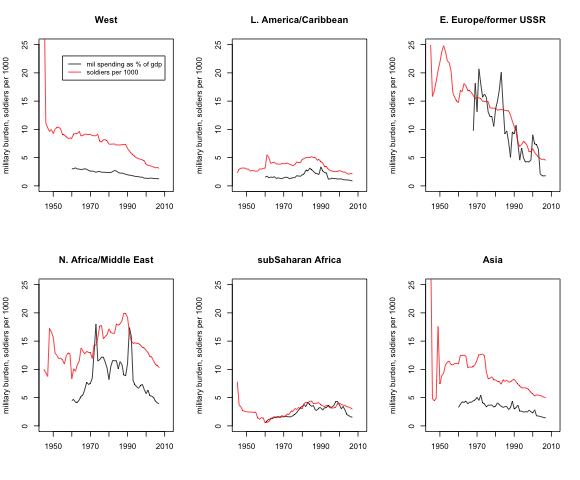
We get distracted by headlines of conflict and awful stories of grotesque war crimes in Syria, Iraq and elsewhere. But it remains true that the globe is devoting a smaller percentage of its income and manpower to war:

The black line is the average across countries of military spending as a percentage of GDP, using the Correlates of War (COW) estimate of total spending divided by World Bank GDP figures (which only start in 1960).  The red line is the average across countries of armed forces per 1,000 population, again using COW estimates.

You see really striking long-run declines in the West, Eastern Europe and the former Soviet Union, and Asia.  In these areas it almost looks as if demobilization from World War II has taken place gradually and over 60+ years.  In Latin America and North Africa/Middle East,  you see pretty striking declines since the end of the Cold War, and perhaps some decline in subSaharan Africa since around 2000.

It is this context that makes a military drawdown not only essential for our future fiscal health – but also less dangerous than it might otherwise have been in terms of global security. And the primary threat – Jihadist terrorism – is not very effectively countered by new aircraft carriers or the impact of occupying troops. We may eventually have to adjust to, you know, reality. But as yet, only the Paulites have truly gotten the message.

Memorializing Motor City

dish_jarmain

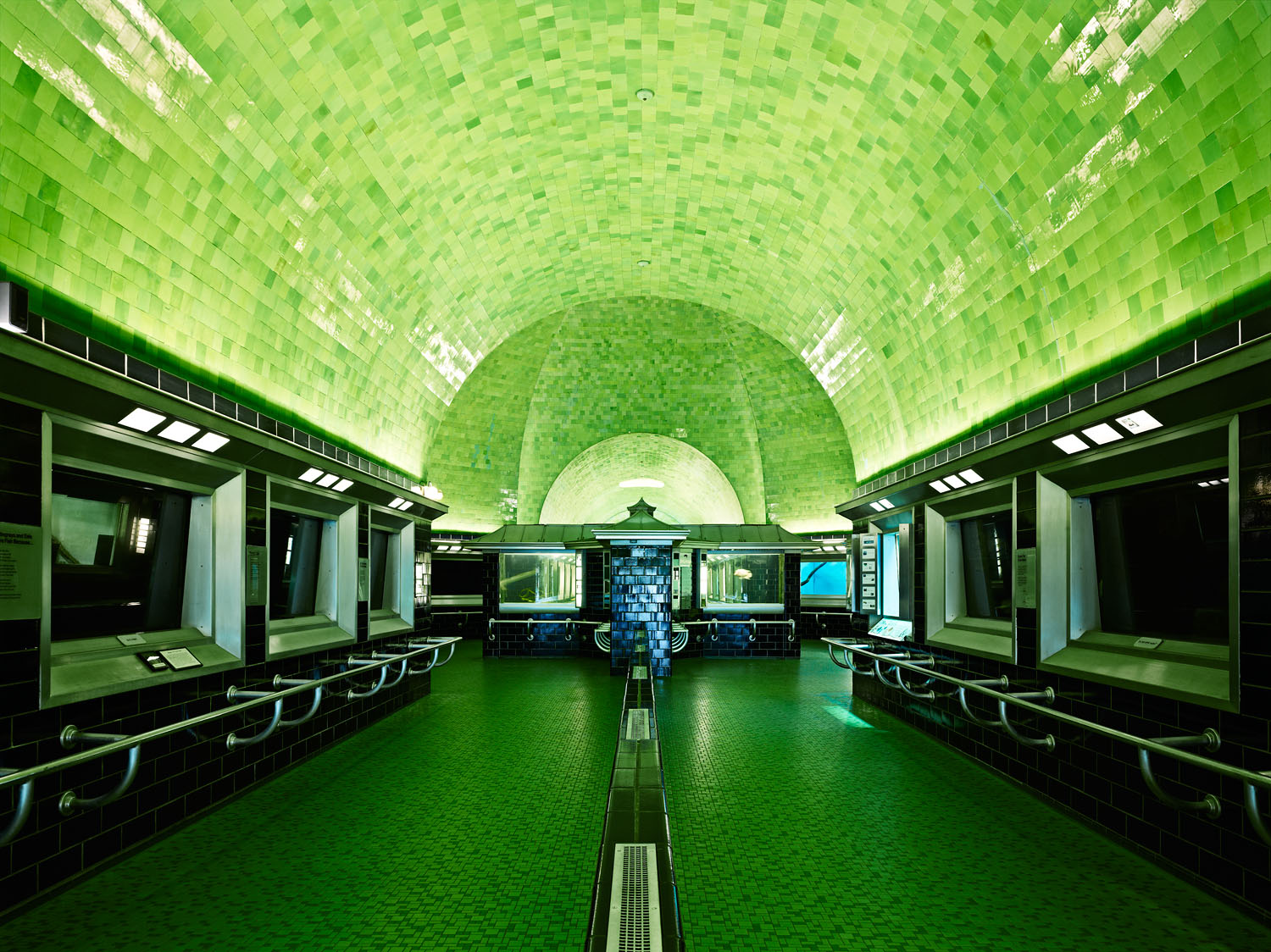
Philip Jarmain’s American Beauty series documents the architectural wonders of Detroit:

“What I’m trying to do is document these buildings carefully and with craft,” Jarmain says. “The buildings are part of a history filled with ingenuity, innovation and entrepreneurship. They’re part of a record that is about brilliant minds coming together to create the capitalist frontier and the middle class of America.” … Many famous architects, such as Albert Kahn, helped the city become an architectural hub, and Jarmain’s title, American Beauty, is named after Kahn’s American Beauty Iron Building. Even though Detroit is shrinking and structures are being destroyed almost daily, it still has one of the country’s best collections of late 19th- and early 20th century buildings.

Jarmain says he tries not to judge the city for demolishing structures in an effort to shrink its enormous urban footprint. He also understands people are stripping the buildings because they desperately need money or supplies. He just wants to make sure he can get as many buildings recorded as he can before they disappear.

(Photo of Kahn’s Belle Isle Aquarium by Philip Jarmain)

Tweet Of The Day

 
That captures the irony of a president who both needs to prevent terror attacks and motivate his counter-terrorism staff and who doesn’t particularly care for the intrusive surveillance state. But it’s an easy irony. It mocks a president caught between two legitimate objectives and waiting on public opinion to nudge him toward reform.

Still, how can one interpret Friday’s confirmation that FISA courts and NSA surveillance are under major review without crediting Edward Snowden and Glenn Greenwald? I was distracted at the end of last week, but it seems inescapable to me now that Snowden leaked information to get reform of the system and succeeded in doing so. The government Snowden hacked has vindicated his goal of greater transparency. That pushes Snowden far closer to the whistle-blower role than the leaker-as-traitor one, doesn’t it? Ezra gets to the nub of it:

Obama’s frustration with Snowden is that he interrupted what could have been “a lawful, orderly examination of these laws; a thoughtful, fact-based debate.” The White House believes Snowden’s leaks — and the drip-drip-drip way the Guardian released them — left the public misinformed. And at times, that’s certainly true. The initial reports on PRISM, for instance, clearly suggested that the program was wider in scope than it actually is.

But the White House could have led that thoughtful, fact-based debate, and despite Obama’s protestations to the contrary, they didn’t. They prevented it. If this conversation, and these reforms, are as positive for the country as Obama says they are, then it’s hard to escape the conclusion that Snowden did the country a real service — even if the White House can’t abide crediting him with it.

If the only reason to treat Snowden as a criminal is that he disrupted Obama’s control-freakiness (in this case, transparently bogus) then the president needs to understand that the public will not stand for it. Least of all his own core base of supporters.

Why Is Russia So Anti-Gay?

Masha Lipman attempts to answer the question:

The country may appear to be fairly conservative, if one looks at its widespread homophobia or public condemnation of irreverence toward Russian Orthodox Church. Yet when it comes to other social habits, such as divorce, abortion, or birth rate, the picture is very different. Russia has one of the world’s highest rates of both divorce and abortion, and some of the most liberal laws on the latter. Russia’s birth rate is not dissimilar from that of secular cultures of western Europe. Premarital sex and single motherhood are fairly common; in one survey, a mere fourteen per cent of respondents said they believed a single parent can’t raise a child properly. And while a large majority of Russians identify themselves as Orthodox Christians, the proportion of those attending services or observing religious rituals in Russia is not dissimilar from many European countries.

A partial explanation of this discrepancy can be found in Soviet history. The early Soviet period involved a radical rejection of the ancien regime, a forced modernization by the Bolsheviks that included universal literacy and suffrage (along with the elimination of political choice, of course), as well as brutally imposed secularization, among other things. But the Soviet Union mostly missed the later, post-war stages of the Western social modernization, and especially the gay-rights movement. In the U.S.S.R., it was a crime to be a gay man. The atmosphere grew much freer for gays in the post-Communist period, yet gay rights have not become a nationwide issue until now, as the government has abruptly moved toward social conservatism.

As always with Masha, it’s a nuanced piece – revealing Russia, like America, as two separate and colliding cultures, in this age of accelerating global change. Unlike America, however, there is no First Amendment and the new anti-gay law specifically criminalizes the right to speech and assembly. I’m not generally in favor of boycotts, but I am in favor of civil disobedience. What we have is an invitation to legitimate protest in Sochi. Unpack your rainbow flags! Get ready to be arrested! Expose the neo-fascist regime’s classic tactics to maintain popular support by demonizing an already despised and marginalized minority.

Putin wants the attention of the world in Sochi. Let’s make sure he gets it.