Douthat recently speculated that Pope Francis might be able to move “U.S. Catholics away from a too-close entanglement with the fortunes and platform of the Republican Party.” Along those lines, John L. Allen Jr. notes that “Francis seems to be repositioning the church in the political center, after a fairly lengthy period in which many observers perceived it to be drifting to the right”:
Veteran Italian journalist Sandro Magister recently observed, “It cannot be an accident that after 120 days of his pontificate, Pope Francis has not yet spoken the words abortion, euthanasia, homosexual marriage,” adding that “this silence of his is another of the factors that explain the benevolence of secular public opinion.”
Yet Francis has imposed no such gag order on himself when it comes to other political topics, such as poverty, the environment and immigration. …
In Rome, the perception is that power brokers associated with moderate positions, such as Cardinal Oscar Rodríguez Maradiaga of Honduras, coordinator of the commission of cardinals, are on the ascendant, while those linked to neoconservative or traditionalist stances, such as Cardinal Raymond Burke of the United States, head of the Vatican’s supreme court, are in decline.
The church may not veer sharply in its political allegiances, but there seems a clear preference for the social Gospel over the culture wars.
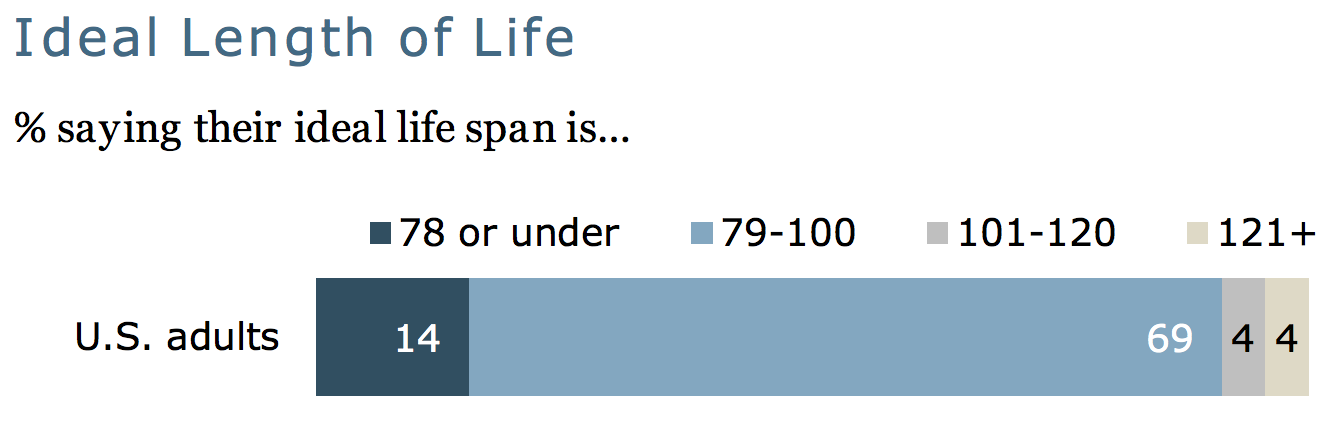
Saletan expects that medical advances would change these numbers:
People don’t want to live past the age at which severe diseases and disabilities are expected. When respondents are asked how long they’d like to live, fewer than 10 percent choose 100 or older. Twenty percent want to live into their 90s. Thirty-two percent want to live into their 80s. Thirty percent don’t want to make it past 80. Why do most people want to die before they reach 90? Probably because being 90 sucks. But that’s true only because of the current rate of physical decline.
If resistance to life extension is based on the assumption that the extra years would be frail and painful, look out. That resistance will dissolve in the face of contrary evidence. If modern medicine learns how to slow aging, making the average 90-year-old feel as good as a 70-year-old feels today, people will recalibrate. Those who in our time would have preferred to die at 80 might be happy to live to 100.
James Surowiecki notes that, in the past, “low-wage work tended to be done either by the young or by women looking for part-time jobs to supplement family income”:
As the historian Bethany Moreton has shown, Walmart in its early days sought explicitly to hire underemployed married women. Fast-food workforces, meanwhile, were dominated by teen-agers. Now, though, plenty of family breadwinners are stuck in these jobs. That’s because, over the past three decades, the U.S. economy has done a poor job of creating good middle-class jobs; five of the six fastest-growing job categories today pay less than the median wage.
That’s why, as a recent study by the economists John Schmitt and Janelle Jones has shown, low-wage workers are older and better educated than ever. More important, more of them are relying on their paychecks not for pin money or to pay for Friday-night dates but, rather, to support families. Forty years ago, there was no expectation that fast-food or discount-retail jobs would provide a living wage, because these were not jobs that, in the main, adult heads of household did. Today, low-wage workers provide forty-six per cent of their family’s income. It is that change which is driving the demand for higher pay.
Surowiecki goes on to propose various ways to raise wages. Ryan Avent imagines the consequences of such actions:
We have a general sense for how this might play out. Economic historian Gavin Wright has described how the New Deal’s high-wage policies forced a complete reorganisation of the South’s low-wage economy. In agriculture and industry there was extensive upskilling and mechanisation, a process that launched the South on a path toward convergence with the rest of the American economy. That was very much a good thing. But it was a very different thing from a process in which wages rose for a set of low-wage workers alongside consumer adjustments. The workers that benefitted, for one thing, were often different from those that initially held the low-wage jobs. Whites displaced blacks in many cases, and the period coincided with a great migration of surplus low-wage labour from the South to the industrial cities of the Northeast and Midwest.
Well of course this discussion reminds me of the episode of Futurama where, in the lost city of “Atlanta”, Fry meets and falls for a mermaid. Of course the deal breaker is that she has fish parts instead of lady parts down below. I couldn’t find the clip from the deal breaker scene, but I did find this mashup with accompanying song that sums the episode up pretty well!
Another sends the above video:
There’s always a gay angle to mermaid sexuality … you’ve probably run across this guy? I think he’s kind of hot. And he’s really talented, because he makes the tails he wears and produces them for movie studios and theme parks.
Another tells a dirty joke:
After a year at sea, a sailor returns to his home port and walks into his favorite bar, and everyone turns to stare at him because his head has shrunk to the size of a grapefruit. Finally, one of his oldest friends asks him what has happened. And the sailor tells this story:
“We were at sea, and it was fine weather with a fair wind, and there wasn’t much to do that day, so I decided to do a little fishing. I felt this immense tug on the line, and when I reeled in my catch, what had I caught but the most beautiful mermaid in all the seven seas!
“And she said to me, ‘Mr. Sailor, sir, please, won’t you let me go! I am a magical mermaid, and I can grant you your very fondest wish if only you’ll release me.’
“And so I said to her, ‘Well, Miss Mermaid, ever since I went to sea, I’ve had only one dream: to make love to a mermaid. So if we can go below … ‘
“But she interrupted me, and said, ‘Alas, Mr. Sailor, I’m sorry, but that’s the one wish I can’t grant, because as you see, I’m a woman from the waist up, but I’m a fish from the waist down.’
“And so I said to her, ‘Well, that’s OK, Miss Mermaid. Why don’t you just give me a little head?'”
Update from a reader:
Some friends were joking about the dick dock in Ptown and someone made a comment about all the semen that must be in the sand. Another quipped, “Where do you think mermaids come from?”
Douthat argues that “racial bias alone can’t explain why the president went from losing non-college-educated white voters by only 18 points in 2008 to being 40 points underwater with that same demographic today”:
The issue matrix matters as well, and over the last five years, this administration and this Democratic Party have consistently tried to mobilize new coalition elements in ways that have very predictably tended to alienate downscale whites.
And that strategy has worked! Energizing “ascendant” constituencies while pushing working-class whites toward the Republicans has represented a form of “positive polarization” for the Democrats, since it’s left them with a presidential-level majority that they did not enjoy before. But like any successful gambit, it’s also created vulnerabilities. The Democrats may not longer need that many working class white votes to win, but they probably can’t actually afford to lose them in a 70-30 split. And in the normal course of political events, it would be entirely reasonable for the opposition party to look at a president’s collapsing ratings with a demographic his party has mostly written off, and focus on that group as a target of opportunity in the next few election cycles.
In one sense, of course, Douthat is right: Obama and the Democrats have turned off white voters with issues like gun control, and with a liberal record on social issues such as abortion and gay marriage. But these issues are not racial issues; it is not as if Obama and the Democrats are, say, trying to pass laws disenfranchising white voters, or prominent Democratic lawmakers are making offensive statements about what white Americans will or won’t contribute to the future of the country.
On the other side of the aisle, Republican racial polarization has taken the form of trying to pass voter ID laws that are clearly aimed at reducing minority turnout, and powerful Congressional Republicans are using a legitimate debate about immigration to make disgusting, racially-charged remarks.
On Sunday, Hassan Rouhani was sworn in the new Iranian president. Abbas Milani thinks his proposed cabinet shows promise:
[I]n spite of dire warnings from websites close to Khamenei and the Revolutionary Guards (IRGC), Rouhani did include in his 18 cabinet nominees (who must be approved by Parliament) some key figures close to the reformists and to Rafsanjani. …
His nominee for foreign minister, Mohammad Javad Zarif, is easily his most important olive branch to the U.S. and the rest of the international community. The American-educated Zarif was the country’s one-time representative to the United Nations, and has extensive ties to American political and financial leaders. Zarif has a well-earned reputation as a consummate diplomat, and is firm in his belief that rapprochement with the U.S. and the West is a key to the regime’s long-term survival and interest. He is, like Rouhani, of the opinion that Iran should safeguard its legal rights under the Non-Proliferation Treaty—including the right of enrichment—but must do so while affording the international community the requisite guarantees that the country’s nuclear program will not be diverted to military use.
Ishan Tharoor also focuses on the potential foreign minister:
Zarif’s appointment won’t thaw relations between Washington and Tehran overnight. “People who are celebrating should be a little more cautious,” says Edward Luck, a former high-ranking U.N. official who is now dean of the Joan B. Kroc School of Peace Studies at the University of San Diego. “We’ll get a better face, better music, but the basic fundamentals of the relationship with the U.S. will be the last thing to change, not the first.”
As Foreign Minister, Zarif of course will have a global agenda, not just an American one, and will enter office at a delicate moment at home.
“He will have to be a little careful, he’ll have to look over his right flank,” says Luck. The Rouhani administration has to wade through an economic mess inherited from Ahmadinejad’s tenure and do damage control in the neighborhood. Relations with key regional players like Saudi Arabia are at the lowest of ebbs. “There’s also the situation with the Arab Spring, conflicts in Syria, tensions in Egypt. The U.S. is not the central part of the conversation,” says Trita Parsi, president of the National Iranian American Council, which seeks to build bridges between Washington and Tehran.
Since his election, Rouhani has repeated the mantra that Iran’s nuclear program is entirely peaceful, declaring, “The nation will only be happy when we neutralize the plots of the U.S. We will protect the nuclear technology alongside any other technology.” Essentially, Rouhani wants us to believe that Iran’s nuclear program is benign simply because he says so. Yet he has given no indication that he will permit the IAEA to thoroughly inspect the nuclear facilities, nor has he even hinted whether Iran will reveal additional secret nuclear installations, such as the underground uranium enrichment plant at Fordow that was exposed by the U.S., British, and French intelligence agencies in 2009.
On the domestic front, Ahmad Alehossein suspects Rouhani faces serious obstacles:
[T]he new government may not even be able to pursue such moderate reforms for some very obvious reasons: (1) further economic liberalization in the context of the existing harsh economic sanctions, falling foreign investment, and international isolation is practically impossible unless Iran’s deep state radically changes its nuclear programme; (2) Iran’s economy is structured around a rentier capitalist system mostly dominated by the military and religious-financial institutions only responsible to the supreme leader. Therefore, further economic liberalization in this context means further monopolization (as has already been the case) which in turn strengthens the deep state; (3) Dealing with a double-digit unemployment, a relentlessly growing inflation rate, and a historically unprecedented inequality requires measures such as substantial investments in infrastructures and participatory planning which are in contradiction with the very basics of Rouhani’s economic doctrine.
Max Fisher watches Rouhani’s first press conference, featured in the above video:
The bad news: Wants the U.S. to make the first big move by lifting sanctions
The dilemma in any peace process is that, often, one side has to make the first concession. But in a conflict like this one, where both sides have felt previously burned by the other, that can be a major sticking point. So it’s unsurprising but not encouraging to see Rouhani set a pretty high bar for “first steps”: he said he wants the U.S. to demonstrate its good faith by raising sanctions. From Rouhani’s perspective, this makes sense because the U.S. can always turn sanctions back on, whereas any cuts that Rouhani makes to the nuclear program will be much tougher to reverse if the peace process falls though. Still, this seems unlikely to happen, in part because Obama is probably not going to want to take the enormous foreign policy and domestic political risk of lifting sanctions, given that he can’t guarantee that Rouhani will both want and be able to reciprocate.
Last week, I had a post that was skeptical of the claim that current law requires the federal government to recognize state civil unions as marriages. Reading through this brief recently filed by the state of New Jersey, I am no longer so sure. (The brief is a defense of New Jersey’s civil union law — which allows same-sex couples to have civil unions with the same legal status as marriage, but not technically marriage itself — but the brief also argues that the federal government is required to recognize the civil unions.)
For one thing, state civil union laws sometimes contain language that defines the word “spouse” to include unioned couples in addition to married couples. (See, e.g., the Illinois civil union law I discussed here.) And some federal provisions use the word “spouse” rather than the word “marriage,” although it is not clear they intended for “spouses” to include people who are not in a “marriage.”
For another thing, it almost looks like New Jersey law already defines civil unions as a form of marriage, by stating that marriage includes civil unions.
Nathaniel Frank points out a contradiction in the state’s brief supporting the status quo:
“To reserve the name of marriage for heterosexual couples,” says the brief, makes sense because “altering the meaning of marriage” would, in the words of the 2006 ruling, “render a profound change in the public consciousness of a social institution of ancient origin.” The definition of marriage has “far-reaching social implications.”
Oops, except then it doesn’t. The brief then does an about-face, insisting that the nomenclature distinctions have no meaning at all—an effort to show that the law is not rooted in anti-gay prejudice.
A “long-standing precedent,” the brief explains, dictates “that courts look to essence, not label.” It cites a 1915 court case finding that a law’s import “lies in the essential nature of the work done rather than the names applied to those engaged in it.” The brief goes to great lengths to drive home this point, even dragging in the Bard: “Shakespeare wondered what’s in a name?; for purposes of federal criminal law, the answer is ‘nothing.’ Substance rather than nomenclature matters.” And: “A rose by any other name is still a rose.” And: “Calling a dog’s tail a leg will not give the dog five legs.”
Let’s imagine for a moment that it’s true that nomenclature doesn’t matter a whit. If that’s right, then it’s the strongest case yet for the other side. If there is nothing in the name “marriage,” then New Jersey’s Civil Union Act has no rational relationship to an important state interest. The label is the single distinction the law makes. How can that both serve a compelling governmental interest and mean absolutely nothing, at the same time?
The brief also “contends that it’s actually the feds who are now blocking gay equality by withholding benefits to civil union partners.” Timothy Kincaid suspects that Christie plans to lose the case:
Christie and his legal team have crafted an argument that, while complete legal nonsense, allows him to position himself as a champion of gay couples. He’s declared that the federal government is obligated to recognize civil unions as marriages. And, if it does not do so, plaintiffs should sue the Obama Administration instead of him.
Despite its chutzpah, it’s astoundingly smart. Christie can shift his presented stance from oppressor to advocate, merely by asserting an absurdity. It is he who wants his state’s gay couples to have federal rights, you see, and it’s the Obama Administration that is refusing equality. And it has the added benefit of positioning him to (as I suspect he will) champion the idea of federal civil unions recognition when he makes his presidential run.
In a courtyard at Lurigancho, one of the most dangerous prisons in South America, convicted kidnapper Alejandro Nuñez del Arco leads more than a thousand of his fellow inmates in Full Body aerobics sessions:
An excerpt from Daniel Alarcón’s 2012 profile of the prison offers a glimpse of daily life there:
Because there are about a hundred inmates for every guard (the average in the United States is six inmates per guard), the authorities tend to look the other way when it comes to contraband like drugs, alcohol, cable television, and cell phones — the sorts of comforts that can make prison life tolerable. Drugs in particular help take the edge off the overcrowding and keep an otherwise restive population in an acquiescent haze. As one trafficker told me, “It’s the only way to control these beasts.” He found it frightening to contemplate Lurigancho without its daily fix. Overdoses are common, but there are only sixty-three doctors for the 49,000 inmates in Peru’s prison system, and just a handful of those are assigned to Lurigancho. Enough food for two scant meals a day is delivered to the prison gates, but everything else — from maintenance to discipline to recreation — is the responsibility of the men inside. Each block is run by a boss, a ranking figure in the Lima underworld, whose authority within the block is unquestioned.

 The Dish