The Smiling Face Of The Church

VATICAN-POPE-AUDIENCE

Lost amidst the discussion of the Pope’s recent remarks on homosexuality was this observation from John Allen: the theme that Francis invokes the most is joy:

Every pope seems to have a signature spiritual idea. For John Paul II, it was courage: “Be not afraid!” was his catchphrase to invite the church to recapture its missionary swagger after years of introspection and self-doubt. For Benedict XVI, it was “faith and reason,” the idea that religious belief and intellectual reflection need one another to remain healthy.

For Francis, the best early candidate for his signature touch is mercy, expressed in his repeated emphasis on God’s endless capacity to forgive…

In a recent essay for the Italian newspaper Corriere della Sera, Enzo Bianchi, founder of the celebrated ecumenical monastery of Bose, offered a statistical analysis of the words used most frequently by Francis since his election. He found that the single most commonly used term was “joy,” more than 100 times, followed closely by “mercy,” which the pope has used almost 100 times.

One that note, it’s worth revisiting Francis’ remarks from a homily he delivered during a Mass celebrated in the Chapel of the Domus Sanctae Marthae at the end of May:

The Pope began by referring to the readings of the day from the book of Zephaniah (3:14-18) and the Gospel of Luke (1:39-56), saying that they “speak to us of joy and happiness: ‘rejoice, shout for joy’, says Zephaniah… ‘The Lord is in the midst of you’… He too will rejoice over us. He, too, is joyful”.

“Everything is joy. But we Christians, we are not used to talking about joy, about happiness. I think that many times we prefer complaints! What is joy? The key to understanding this joy is in the Gospel: ‘Elizabeth was filled with the Holy Spirit’. What gives us joy is the Holy Spirit.

“It is the Spirit who guides us. He is the author of joy, the creator of joy, and this joy of the Holy Spirit gives us true Christian freedom. Without joy we Christians can not become free. We become slaves to our sorrows”.

(Photo: Pope Francis smiles after his weekly general audience in St Peter’s square at the Vatican on June 12, 2013. By Alberto Pizzoli/AFP/Getty Images.)

The Light Inside

dish_turrell

“To understand Turrell’s art … it is necessary to have some familiarity with what Quakers do,” writes Morgan Meis of James Turrell, who was raised as a Quaker:

Quakers worship by getting together and having a meeting. All you need is two Quakers for a meeting, but Quakers are happy to get together in larger groups. Quakers conduct their meetings by sitting silently, usually for about an hour. Talking is allowed, but not encouraged. You talk if you are moved to talk. Otherwise, you sit quietly. It is fair to call this meditation. While Quakers are meditating, they seek what they call the Inner Light. The idea of Inner Light goes all the way back to the early 17th century and to George Fox, the very first Quaker. As a young man, George found himself displeased with religion in its contemporary form. He struggled to find the truth, as sensitive young men and women will do. These were years of darkness and tumult. And then he found peace. In 1647, George heard a voice that said to him, “There is one, even Christ Jesus, who can speak to thy condition.”

Fox remembered that Christ sometimes calls himself “the light” in the Gospels. He decided that light was the key to correct and meaningful religious practice. There is a light inside of all of us, he thought. When you connect to the light, you are also connecting to God. For this reason, Quakers aren’t all that jazzed up about specific religious doctrines. If you are wondering what to do, how to live your life, just sit quietly and try to listen to the Inner Light. That’s all the doctrine any good Quaker needs. The answers are there inside, because God is inside.

Meis particularly sees the influence of Quakerism in “Aten Reign,” Turrell’s current exhibition at the Guggenheim:

I’d like to suggest that the best way to approach and interpret Turrell’s installation at the Guggenheim is to say it is a Quaker meeting. Observe, if you will, what happens when people enter the ground floor of the museum. They stop and look up. They see that the spirals of the Guggenheim have been transformed into a glowing light installation. They roam around for a minute or so looking up. Then they find a space to lie down on the floor. Generally, they stop talking. They watch the glowing lights and the luminescent egg. This silent watching goes on for many minutes. More than ten minutes. More than fifteen minutes for many people, and more than that for others.

In other words, James Turrell has managed to get people in New York City to lie on the floor silently meditating for more than ten minutes. Most of these people have never meditated in their lives. Many of them would not sit still silently for ten minutes if you paid them to do so. But the power of the egg compels them.

(Photo of “Aten Reign” by Flickr user Nika)

The Hard Questions For Christian Pacifists

In an interview, the theologian and ethicist Stanley Hauerwas responds to the most frequent objection to his own Christian pacificism – what about fighting Hitler?

I always answer the challenge of WWII by asking people “Who fought in Hitler’s war?” The people who fought in Hitler’s war were Catholics and Protestants. All I’m trying to do is help Christians be able to recognize what they’ve been given in Christ, which is the ability to say “no” to the Hitlers of the world. Of course, the world would be better without the Nazi regime, but that’s not to say that the war was a good thing. Moreover, it wasn’t a just war as it was not fought on just war principles.

On the near-ubiquitous American flags placed in churches:

I’ve long said that flags being used in churches on the 4th of July is a form of betrayal. It is so because the flag represents for many a more determinative sacrifice than the sacrifice of Christ.

Previous Dish on Hauerwas’ work here and here.

The Beauty Of Bach

Kaya Oakes describes Bach’s last major work:

[N]ever performed in his lifetime, [it] was a full setting of the Latin Mass, the Missa tota. Lutherans had thrown out the Latin Mass; only Catholics practiced the long, elaborate ceremony. Bach presented a couple of chunks of the Mass to the Catholic King of Poland in an attempt to land a gig as the Polish court composer. King Augustus didn’t bite, but Bach later raided his own cantatas to finish the Mass. The shiver-inducing melody of the Agnus Dei is an exact replica of the melody of one of Bach’s earlier church cantatas from the Ascension Oratorio, and snatches of others can be heard throughout the Mass. The Mass in B Minor, like the Saint Matthew Passion, was mostly forgotten until the 18th century. Rediscovered, it became known as one of the towering works of classical music.

Oakes reflects on the distinction between Bach and rock:

The thing about rock music, in all of the forms that I’ve worshipped, is that it’s not about thinking. You have your cerebral performers, but rock music is about the body: the corporeal sensations of fucking, moving, imbibing, ejecting. It is not about the caverns of the mind. And those caverns are where Bach spent his lifetime chasing the intricacies of forms, twisting the ideas of what music can do, wedding it to mathematical possibilities, but never forgetting that, as Keats wheezed, Beauty is Truth. Beauty is the best thing we can point at in order to say “God.”

Face Of The Day

ogle-face

Travel writer Michael Hodson highlights a talented photographer:

Alex Ogle is just one of those Instagramers that has a great eye. He lives and works in Hong Kong as an editor on the AFP Asia-Pacific desk. His photographs are almost entirely of that city and they are wonderful. He can be followed on Instagram here and on Twitter here.

TNR recently published a slideshow of Ogle’s work.

Consider Kindness

Earlier this week, George Saunders provided the NYT a copy of the commencement address he gave this year at Syracuse University:

Here’s something I know to be true, although it’s a little corny, and I don’t quite know what to do with it: What I regret most in my life are failures of kindness. Those moments when another human being was there, in front of me, suffering, and I responded…sensibly. Reservedly. Mildly. Or, to look at it from the other end of the telescope: Who, in your life, do you remember most fondly, with the most undeniable feelings of warmth? Those who were kindest to you, I bet. It’s a little facile, maybe, and certainly hard to implement, but I’d say, as a goal in life, you could do worse than: Try to be kinder.

His thoughts on cultivating a more compassionate life:

There are ways. You already know that because, in your life, there have been High Kindness periods and Low Kindness periods, and you know what inclined you toward the former and away from the latter.

Education is good; immersing ourselves in a work of art: good; prayer is good; meditation’s good; a frank talk with a dear friend; establishing ourselves in some kind of spiritual tradition – recognizing that there have been countless really smart people before us who have asked these same questions and left behind answers for us…

One thing in our favor: some of this “becoming kinder” happens naturally, with age. It might be a simple matter of attrition: as we get older, we come to see how useless it is to be selfish – how illogical, really. We come to love other people and are thereby counter-instructed in our own centrality. We get our butts kicked by real life, and people come to our defense, and help us, and we learn that we’re not separate, and don’t want to be. We see people near and dear to us dropping away, and are gradually convinced that maybe we too will drop away (someday, a long time from now). Most people, as they age, become less selfish and more loving. I think this is true. The great Syracuse poet, Hayden Carruth, said, in a poem written near the end of his life, that he was “mostly Love, now.”

Video of Saunders’ speech can be seen here. Recent Dish coverage of the author here, here, here, and here.

The Minds Of Monks

Christof Koch describes a classic 2008 study that investigated the brains of Buddhist monks:

The cognitive scientists fitted skullcaps with 128 electroencephalographic (EEG) electrodes to the heads of eight long-term Buddhist practitioners and 10 student volunteers. The former were asked to attain a state of “unconditional loving-kindness and compassion” (a form of meditation that does not focus on a single object and is sometimes referred to as “pure compassion”), whereas the volunteers thought about somebody he or she deeply cared about and then tried to generalize these feelings to all sentient beings.

The onset of meditation in the monks coincided with an increase in high-frequency EEG electrical activity in the so-called gamma band (spanning 25 to 42 oscillations a second), which was synchronized across the frontal and parietal cortices. Such activity is thought to be the hallmark of highly active and spatially dispersed groups of neurons, typically associated with focusing attention. Indeed, gamma activity in these monks is the largest seen in nonpathological conditions and 30 times greater than in the novices. The more years the monks had been practicing meditation, the stronger the (normalized) power in the gamma band.

More important, even when the monks were not meditating, but simply quietly resting, their baseline brain activity was distinct from that of the students. That is, these techniques, practiced by Buddhists for millennia to quiet, focus and expand the mind—the interior aspect of the brain—had changed the brain that is the exterior aspect of the mind. And the more training they had, the bigger the effect.

The Human Face Of Holiness

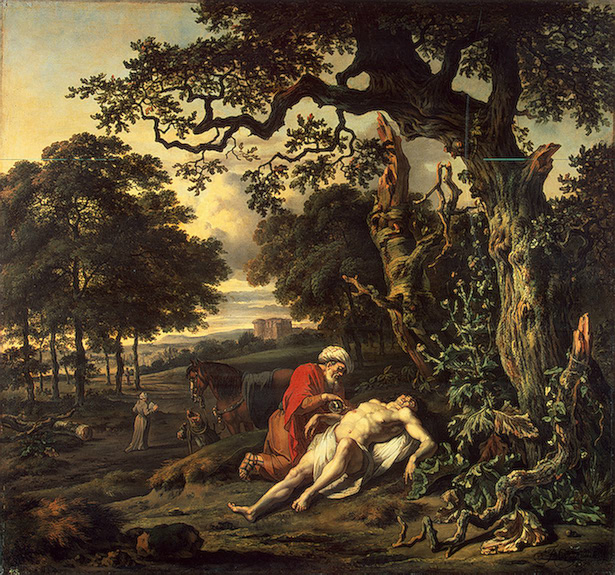
Jan_Wijnants_-_Parable_of_the_Good_Samaritan

In a sermon on the parable of the Good Samaritan, delivered to the Congregational United Church of Christ in Iowa City, Marilynne Robinson concludes with these thoughts on Jesus’ teachings:

The Gospel gives us a scene in which a legal scholar is disputing with a self-taught carpenter about a point of law. A bright fellow, he must have thought, interesting enough to spar with a little. He’s attracting crowds, and that can be dangerous. If I give him a question we specialists have struggled with, I might take him down a peg. No harm in that.

The writers of the Gospels take this carpenter to have been, in fact, the epitome of holiness, the Word made flesh, the universal judge. The lawyer is debating the law with God Himself, whose own commandments are at issue. This makes the scene most remarkable. But it is remarkable for nothing more than for the fact that Jesus, the Christ of Luke’s Gospel, is an ordinary man. On a landscape where prophets have appeared he is taken by some people to be one more prophet. Others have no opinion, or take no notice. But, in light of the utterly singular Presence the writer we call Luke understood him to be, there is the greatest significance in the fact that he really is one of us. He might have been the man lying injured by the side of the road, and he might have been the Samaritan who took him up. His wounds would have bled, his voice and his hands would have comforted, just as theirs did, just as ours do. The deep holiness with which human life is invested, which is so great that the Christ could take on true humanity without the least diminishment of his holiness, should tell us who we are and whom we are among, and why it is that the love of neighbor is “like unto” the love of God.

(Image: Parable of the Good Samaritan by Jan Wijnants, 1670, via Wikimedia Commons)

(Hat tip: Wesley Hill)

Atheists Aren’t That Angry, Ctd

Responding to the much-discussed recent study that parsed the various types of atheists, Herb Silverman spots the categories that were left out:

My biggest disappointment about the study is that it left out the largest category: closeted atheists. They are the elephants in the room and the ones most likely to change the culture by coming out. However, many of them feel they have good reasons not to, including potential ostracism from family and friends as well as loss of income or employment. Another unmentioned category is what I call functional atheists, those who may or may not have vague supernatural beliefs that play no practical role in their lives. They live as if there is no god, just as all atheists do.
An atheist is simply someone without a belief in any deities. But disbelief in gods doesn’t describe individual atheists any more than disbelief in the divinity of Muhammad, Krishna, and Zeus describes individual Christians. Everybody disbelieves in some gods; atheists just disbelieve in more gods than theists do.

Previous Dish coverage of Silverman’s thoughts on atheism here.