In Search Of The Male Pill

dish_sperm

Jalees Rehman investigates research into hormonal contraceptives for men:

One of the largest male contraceptive efficacy trials ever conducted was sponsored by the World Health Organisation (WHO) and CONRAD, the US-based reproductive health research organisation. Called Phase II TU/NET-EN, this landmark multicentre study was designed to answer key questions about the long-term safety and efficacy of male hormonal contraception, and enrolled more than 200 couples between 2008 and 2010. The contraceptive used was a long-acting formulation of testosterone (testosterone undecanoate, or TU) combined with a long-acting progestin (norethisterone enanthate or NET-EN), administered via injections every two months. The trial included an initial treatment phase to suppress sperm production, and a subsequent ‘efficacy phase’ that required couples to rely exclusively on this form of birth control for one year. However, in April 2011, the trial was terminated prematurely when the advisory board noticed a higher than expected rate of depression, mood changes and increased sexual desire in the study volunteers. By the trial’s end, only 110 couples had completed the one-year efficacy phase; their efficacy results should be released in the near future. …

The discontinuation of the WHO/CONRAD trial was a major setback in bringing male contraceptives to the market. It also raised difficult ethical questions about how to evaluate side effects in male contraceptive trials.

Since all medications are bound to exhibit some side effects, what side effects should be sufficient to halt a trial? Female contraceptives have been associated with breakthrough bleeding, mood changes, increased risk of blood-clot formation, as well as other side effects. Why should we set a different bar for male contraceptives?

The twist here is that female contraceptives prevent unintended pregnancies in the person actually taking the contraceptive. Since a pregnancy can cause some women significant health problems, the risk of contraceptive side effects can be offset by the benefit of avoiding an unintended pregnancy. However, men do not directly experience any of the health risks of pregnancy — their female partners do. Thus it becomes more difficult, ethically, to justify the side effects of hormonal contraceptives in men.

Previous Dish on the male pill here.

(Photo by Flickr user AndreaLaurel)

Manipulating Memory

Neuroscientists have demonstrated that mice can be manipulated to “recall” memories of experiences that were only implanted – false memories. Jason Castro considers the implications for humans:

Perhaps it would be possible to rebuild particularly cherished and important memories that have deteriorated with age or disease? Or perhaps, more provocatively, some might even embrace the idea of falsified memory – artificially adding in happiness where there is only remembered pain, or subtracting out enduring despair that’s long outlived its usefulness. These are some ethically tricky situations, to be sure. At the same time, though, it’s hard to not sympathize with someone, say a war veteran or a rape victim, who might want the emotional content of a specific, life-destroying memory modified.

Barbara J. King zooms out:

It’s clear to me that memories, though, don’t live on only in our brains. Just as our story telling and the making of new worlds emerge in a rich social dynamic, so does the process of altering our memories by revisiting them. It is as we talk, laugh, revisit the past, argue and tell jokes with others that our memories alter. And as they alter, might not the ongoing interactions and relationships sometimes alter too?

A World Of Sand

photo-27

Rebecca Willis considers the tiny particles:

“Sand”, [geologist Michael Welland] says, “sculpts the landscapes of our planet and reveals the history of the Earth.” Without it, there would be “no concrete, no glass, no silicon chips and a lot less jewellery”. It is hard to conceive of modern life without sand—and therein lies a problem: we are using sand faster than the planet can replenish it.

“We think of sand as something that’s just there,” he says, “but it is not a sustainable resource.” Whole islands are being wiped off the map as man develops the planet, especially by making concrete and extracting valuable minerals. Fracking—the great energy hope of the moment—devours vast quantities of sand. And most of the world’s beaches are undergoing erosion—partly from natural causes and partly because civilisation in coastal areas is “completely perturbing the natural balance of a highly complex system, by removing dunes, building breakwaters, and replacing sand that is removed … with the wrong kind of sand”.

Welland hoped his book would surprise the reader—and it does—but some of his findings surprised him, too. “The microscopic life in between the grains on the beach is truly astonishing.” Tiny invertebrates called meiofauna live there. “If you pick up a handful of wet sand at the beach, you are holding a miniature zoo. And these little critters keep the bad bacteria on the beach under control and relatively odourless for us. The diversity of life in the spaces between the grains of sand is greater than the diversity in the rainforest.” Beach sand is, literally, full of surprises.

(Photo: The dunes outside Provincetown, MA)

The Ethics Of Scientific Studies

Virginia Hughes describes a study that focused on Romanian orphans:

In 1999, [neuroscientist Charles Nelson] and several other American scientists launched the Bucharest Early Intervention Project, a now-famous study of Romanian children who were mostly ‘social orphans’, meaning that their biological parents had given them over to the state’s care. At the time, despite an international outcry over Romania’s orphan problem, many Romanian officials staunchly believed that the behavioural problems of institutionalised children were innate — the reason their parents had left them there, rather than the result of institutional life. And because of these inherent deficiencies, the children would fare better in orphanages than families.

The scientists pitched their study as a way to find out for sure. They enrolled 136 institutionalised children, placed half of them in foster care, and tracked the physical, psychological, and neurological development of both groups for many years. They found, predictably, that kids are much better off in foster care than in orphanages.

She elaborates on the logic underlying the inquiry:

Perhaps the strangest part of this project was that the fundamental scientific question it posed — Are orphanages bad for kids? — had already been answered. Definitively. Studies going back many decades had shown that orphanages are awful. Research with human subjects is normally considered unethical if it doesn’t tackle novel questions. In this case, though, Nelson’s project was ethically justified because Romanian officials had not paid any attention to those previous studies. Quite the opposite: They had a strong cultural belief that state-run orphanages would protect orphans far better than unstable and untrustworthy foster parents.

This cultural belief persists in various forms, as Hughes explores further here.

Happy And Unhealthy?

A new study suggests that a meaningful life is healthier than a simply happy one:

[Researchers Steve] Cole and [Barbara] Fredrickson found that people who are happy but have little to no sense of meaning in their lives — proverbially, simply here for the party — have the same gene expression patterns as people who are responding to and enduring chronic adversity. That is, the bodies of these happy people are preparing them for bacterial threats by activating the pro-inflammatory response. Chronic inflammation is, of course, associated with major illnesses like heart disease and various cancers.

“Empty positive emotions” — like the kind people experience during manic episodes or artificially induced euphoria from alcohol and drugs — ”are about as good for you for as adversity,” says Fredrickson.

It’s important to understand that for many people, a sense of meaning and happiness in life overlap; many people score jointly high (or jointly low) on the happiness and meaning measures in the study. But for many others, there is a dissonance — they feel that they are low on happiness and high on meaning or that their lives are very high in happiness, but low in meaning. This last group, which has the gene expression pattern associated with adversity, formed a whopping 75 percent of study participants. Only one quarter of the study participants had what the researchers call “eudaimonic predominance” — that is, their sense of meaning outpaced their feelings of happiness.

This is too bad given the more beneficial gene expression pattern associated with meaningfulness. People whose levels of happiness and meaning line up, and people who have a strong sense of meaning but are not necessarily happy, showed a deactivation of the adversity stress response. Their bodies were not preparing them for the bacterial infections that we get when we are alone or in trouble, but for the viral infections we get when surrounded by a lot of other people.

The Fragility Of Degas

Barry Schwabsky focuses on the painter’s interest in instability:

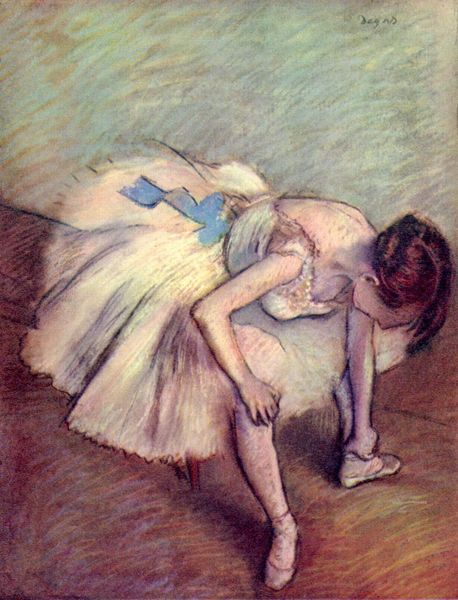
Degas seizes upon moments that [Jean-Auguste-Dominique] Ingres would have found utterly insignificant. In his images of dancers, for instance, he rarely shows the dance itself; what interests him is dish_degas2the rehearsal, or even the warm-up for the rehearsal. Likewise, he will sometimes paint a horse race, but more often he shows the period before the race has started or after it’s over. As [curator Line Clausen] Pedersen says, “Degas chooses unstable moments and situations that are not long-lasting, but not instantaneous either,” ones in which “the figure is preparing for something else—something that lies further out in the future or is perhaps over.”

The allure of ambiguous moments led Degas to reconceive the purpose of drawing: instead of crystallizing a moment, it liquefies a momentary order. A fascination with instability is especially evident in the many small wax or clay figure studies that Degas kept in his studio. The only sculpture of his own that he ever exhibited was the famous Little Dancer Aged Fourteen, but after his death, seventy-four others that he’d made were cast in bronze. (The Ny Carlsberg Glyptotek is one of the few institutions to own a complete set of them, and Pedersen has put them to excellent use in the exhibition.) Not only do they often represent unbalanced poses, but the sculptures themselves are also unbalanced: their original wax or clay forms required external as well as internal armatures to keep them upright. These sculptures were not meant to bear their own weight.

The exhibition “Degas’ Method” runs through September 1st at the NY Carlsberg Glyptotek in Copenhagen.

(Image of a dancer by Edgar Degas, 1881-1883, via Wikimedia Commons)

An Ode To English Majors

Mark Edmundson pens one:

Real reading is reincarnation. There is no other way to put it. It is being born again into a higher form of consciousness than we ourselves possess. When we walk the streets of Manhattan with Walt Whitman or contemplate our hopes for eternity with Emily Dickinson, we are reborn into more ample and generous minds. “Life piled on life / Were all too little,” says Tennyson’s “Ulysses,” and he is right. Given the ragged magnificence of the world, who would wish to live only once?

The English major lives many times through the astounding transportive magic of words and the welcoming power of his receptive imagination. The economics major? In all probability he lives but once. If the English major has enough energy and openness of heart, he lives not once but hundreds of times. Not all books are worth being reincarnated into, to be sure—but those that are win Keats’s sweet phrase: “a joy forever.” …

What [the English major] feels about language most of the time is wonder and gratitude. For language is a stupendous gift. It’s been bequeathed to us by all of the foregoing generations. It is the creation of great souls like Shakespeare and Chaucer to be sure. But language is also the creation of salesmen and jive talkers, quacks and mountebanks, hookers and heroic warriors. We spend our lives, knowingly or not, trying to say something impeccably. We long to put the best words in the best order. (That, Coleridge said, is all that poetry really comes down to.) And when we do, we are on the lip of adding something to the language. We’ve perhaps made a contribution, however small, to what the critic R.P. Blackmur called the stock of available reality. And when we do, we’ve lived for a moment with the immortals.

The Best Of The Dish This Weekend

sunsetstorm

How is porn sex different than real sex? How can you truly defend pacifism without addressing the Hitler question?

How Bach is the opposite of rock. We juxtaposed the simple faith of Quakers with the complicated faith of the doubter. And we celebrated the extraordinary contribution gay men have made to the art of the Catholic church.

This is Ernest Hemingway’s idea of Heaven.

The most popular post remained “The GOP Calls Its Own Bluff,” followed by this post on a Tumblr that uses porn GIFs to advertize furniture.

See you in the morning, if I can sleep tonight.

(Photo: a summer storm at dusk in Provincetown Harbor, today.)

Broadcasting Bereavement, Ctd

photo (20)

A reader writes:

Your Broadcasting Bereavement post caught me in the throat. For me, it coalesces with The Last Lesson We Learn From Our Pets, a Dish thread I followed eagerly and with dread as my precious little dog, Georgia, was dying from congestive heart failure.

She died eight days ago, at home, in my arms. I asked my partner to take a picture of me holding her. I’m not sure why. I think it was because I didn’t want to let her go and thought a photograph would give me a way to hold her forever. I don’t use Twitter or Facebook, so I sent news of her passing via text message. But I wanted to share more than the news of her death. I wanted to share the news of my grief. I find it’s difficult to convey with words the enormity of such things, so I sent the photo too, which I’ve attached here as well.

What, then, is the last lesson our beloved pets teach us? I think it’s this: until the moment of death arrives, live – explore a new cushion on the floor, rub your nose in the grass, sniff the night air.

Alas, I’m a lousy student. One would think I’d be an expert by now, since Georgia is the 13th companion animal I’ve lost. Hopefully this time I’ll find a way to think more about how Georgia (indeed all of them) lived, and less about how much it hurts to lose them.

Friday was the first day in her life that my beloved Dusty didn’t wolf all her food down. She creaked out of her crate, meandered toward it and then began to walk back. It’s been like that every morning and evening since. The growth in her bladder seems to be constraining her more and more: she now seems permanently thirsty and proportionately incontinent. She peed through her diaper and entire bed the other night. This morning, we woke up to puke everywhere. This is happening more and more.

And yet, this afternoon, as we took her for a walk on the beach, and there was a little skip, a slight wander into the very edge of the water, and then, back home, playtime on the lawn. There are moments when she snaps back to normal, and makes me feel like a monster to take even a second of life from her. But those moments are getting fewer and fewer, and the incontinence and thirst and warts and growths cloud more of her hours and days. We talked it over and have decided that the discomfort will only get worse, dehydration could take hold, and then pain and suffering.

We’re going to let her go tomorrow if we can find a vet to come to our home. Your emails were so supportive and helpful I know many of you know where Aaron and I are right now. I’m just a little shocked at how totally gutted I feel – to end the life of this little being who has been with me longer than anyone else, whom I held in my hands at a couple of months old, who, right now, is lying in her crate, looking up at me typing. She has had 15 glorious summers on this beach; and she has loved this one. It’s just time, she is telling us.

Sweet Jesus this is hard.