A Prohibition Rubicon

dish_marijuana

An entire country – Uruguay – is now poised to end prohibition of a plant much less dangerous to your health than alcohol or nicotine:

Under the legislation, Uruguay’s government would license pot-growers, sellers and consumers, and update a confidential registry to keep people from buying more than 40g a month. Carrying, growing or selling marijuana without a licence could bring prison terms, but licensed consumers could grow up to six plants at a time at home. Growing clubs with up to 45 members each would be encouraged, fostering enough marijuana production to drive out unlicensed dealers and draw a line between marijuana smokers and users of harder drugs.

That makes it the first country to allow free cultivation of marijuana for recreational use and the first to set up a legal and regulatory framework to manage it. A lot rides on the outcome, but Tim Padgett was optimistic only recently:

Uruguay over the past decade has proved to be one of Latin America’s more competent states. (A few years ago, in fact, a U.S. diplomat told me, “It’s a shame Uruguay’s Presidents don’t head a bigger country.”) It has one of the strongest economies on the continent as well as one of the highest rankings on the U.N. Human Development Index and Transparency International’s corruption gauge. And as the pragmatic [President José] Mujica pointed out last week, experiments like this are often best undertaken by smaller nations like Uruguay and Portugal, which can serve as more-controlled laboratories for larger countries to study.

Sadly, the US is leading globally from behind on this (via Washington and Colorado). But the direction across South America is becoming quite clear. The prohibition of marijuana is now a much bigger problem than marijuana itself. If you really want to tackle the chaos of the drug cartels, reduce their range of products.
The Meter vs Ads

The NYT has reported slowing subscription sales, but only from a truly remarkable increase from a low base. But the striking thing to me is that the meter is now bringing in $150 million a year to the NYT:

To put that $150 million in new revenue in perspective, consider that the Times Company as a whole will take in roughly $210 million in digital ads this year. And that $150 million doesn’t capture the paywall’s positive impact on print circulation revenue. Altogether, the company has roughly $360 million in digital revenue. Digital ads were again the weak spot (beyond print ads, which goes without saying). They declined 3 percent in the quarter—something that has to be turned around somehow.

The percentage increase in subscription revenue is exactly the same as the percentage drop in ad revenue:

Circulation revenues in the second quarter of 2013 rose 5.1 percent over the same period the year before, a company earnings report says. Advertising revenue fell 5.8 percent over the same period. Overall, revenue was down by .9 percent.

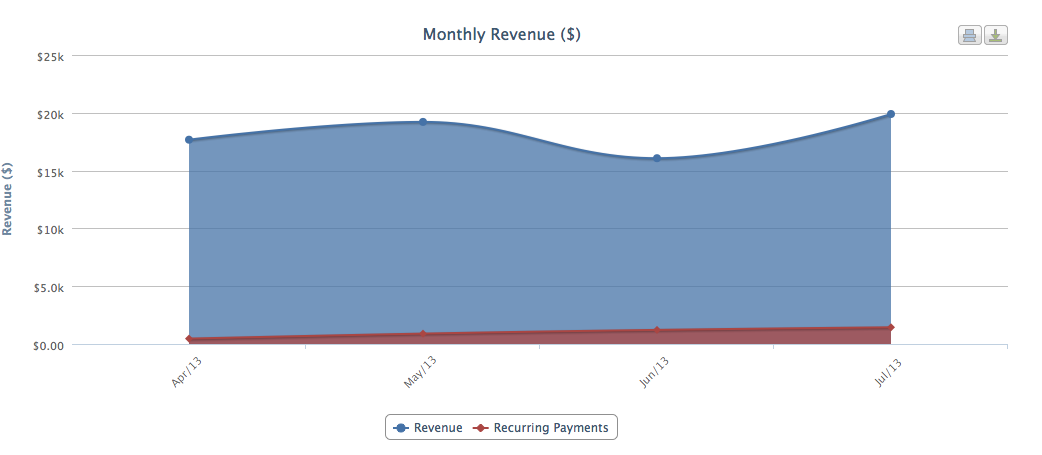
As for the Dish, only seven months into a subscription model, we’re seeing steady increases in subscriptions since the big bang of subscriptions that happened when we went independent in February. Here’s the graph for subscription revenue since the end of March:

Screen Shot 2013-08-01 at 5.38.57 PM

We still have the tough problem of getting all our original January – March 2013 subscribers to renew next year, since we couldn’t put you on auto-renewal when we launched the new site because we were still on the Daily Beast platform, and we had yet to develop the full subscription system that is now in place for all new Dishheads. So the beginning of next year may be a little nerve-wracking – even though I’m pretty confident that our earliest strongest supporters are the most likely to renew of anyone.

As for total revenue, we’re now at $736k toward our original goal of $900k by next February 1 ($900k being the total budget we had at the last year at the Beast). If subscriptions keep coming in at the current rate, we look set to come close. Conversion rates (the percentage of total readers who choose to subscribe) look pretty steady too at around 2.3 percent, a smidgen higher than the industry average:

Screen Shot 2013-08-01 at 5.45.24 PM

The total number of subscribers is now 28,271 as of 5.45 pm today. 11,000 more of you are now on expired meters – having used up all your read-ons. If you all decided to [tinypass_offer text=”subscribe today”], we’d be able to make some serious, solid plans for future investment in the site. So [tinypass_offer text=”please do”]. If you’ve clicked through to the max on all your devices, you really are a Dishhead. The cost is only $1.99 a month or $19.99 a year as a minimum. And if more of you [tinypass_offer text=”subscribe”], we may even be able to avoid advertizing altogether – meaning more signal and less noise to your website.

Subscribe [tinypass_offer text=”here”]. It takes [tinypass_offer text=”two minutes max”]. And [tinypass_offer text=”help shift”] the direction of new media toward quality rather than ad-driven pageviews.

An A-List Worth Ignoring

Zachary Seward notes a growing trend in movie names, especially among video-on-demand titles:

Film studios have figured out that, all else being equal, it’s better for a movie to appear toward the top of the A-to-Z listings where people increasingly pick what they’re going to watch next.

“We call it alpha-stacking,” says Paul Bales of the Asylum, an independent studio that specializes in straight-to-video horror films. Last year, the company generated $16 million in revenue with movies that included Adopting TerrorAir CollisionAlien OriginAmerican Worships, and Abraham Lincoln vs. Zombies.

But movie studios aren’t the first to play this game:

Phonebooks are typically front-loaded with small businesses that all seem enamored of the letter “A.” Authors writing under pseudonyms have been known to pick names that appear closer to the start of fiction shelves in bookstores. But it’s worse for digital media, with seemingly endless supply but few good ways of navigating among the competitors. Companies depend on their products to appear in hand-selected feature menus, crowdsourced most-popular lists, or algorithmic picks. (Netflix recently said that 75% of viewing on the service is driven by its personalized recommendations.) Short of that, it comes down to tricks. People who make mobile apps, for instance, admit to naming conventions they hope will compete alphabetically in crowded app stores.

Update from a reader:

My friend’s dad growing up was the president of a bank named BancFirst, and I was told it was so it would appear in front of all those loser banks that used the “K”.

Quote For The Day II

“Reza Aslan’s book is an educated amateur’s summary and synthesis of a particularly skeptical but quite long-established line of New Testament scholarship, presented to us as simple fact. If you like that kind of thing, Zealot will be the kind of thing you like,” – Alan Jacobs in an interesting post discussing the debate about whether Jesus was literate or not. Yes: a debate.

Dissents Of The Day

A reader writes:

You’re overplaying the Snowden matter. After all, the Russians only gave him a temporary permit on the basis of him receiving asylum in another country – this isn’t such a big deal in the overall scheme of things. But that Putin is trying to push Obama’s buttons – no doubt about it. I think it’s right that the U.S. should do something to respond, but not because of the Snowden nonsense. The U.S. should act because of the conviction of Navalny, the absurd posthumous conviction of Magnitsky (a victim of extreme cruelty by the Putinistas, and a direct reaction to U.S. legislation punishing the perpetrators by placing them under a travel ban), and the ridiculous anti-gay legislation that Putin has championed. Plenty of good reasons to do something symbolic. Snowden? Not so much, actually.

Another reader:

“I cannot see how it benefits Snowden.” What? He’d be better off living in an airport the rest of his life? Coming back to the U.S. with no guarantee that he’d see a fair trial or avoid torture? If the U.S. didn’t prevent his traveling to Venezuela or another country that offered him asylum, Snowden wouldn’t be in Russia now at all.

Torture? I’d dismiss the idea out of hand if it were not for the disgraceful, sadistic abuse of Bradley Manning by the US military, as he waited trial.

To Russia With Asylum

Snowden is already getting job offers in his new host country. Julia Ioffe speaks to the leaker’s lawyer:

“[H]is father is coming [to Moscow] soon, his American lawyer is coming. He won’t be left to face his fate alone.” He added, “He has American friends here. So everything will be okay.”

It is unclear who those “American friends” are, and how Snowden, who has not had visitors for 39 days, and has never been to Moscow, made them. What we do know is that Moscow is still crawling with American spooks—as we learned from the CIA agent nabbed in Moscow while wearing an obscene blond wig—so maybe those are his American friends in Moscow. Likely, though, Snowden will live in an apartment that is bugged to the hilt, as any of my American (and British) friends in Moscow can tell you. They’d also likely tell you about how the Russian security services will regularly pay visits your apartment, usually when you’re not there, and leave overt “we were here” clues behind: missing rugs, opened emails, a ladder in the bedroom, a gun on your welcome mat. It may not be as excruciating as intercom announcements from a world now closed to you, but it’s a close second, believe me.”

Well, Snowden wanted to protest a surveillance state, so we await his resistance to the full metal version in Russia. Or will he stay mum? Is it only when the US engages in surveillance that he is troubled? A week ago, Ioffe imagined what life would be like for Snowden in Russia:

The reality that lies before [him] is not that of a Petersburg slum or a cherry orchard. More likely, he will be given an apartment somewhere in the endless, soulless highrises with filthy stairwells that spread like fields around Moscow’s periphery. He will live there for five years before he will be given citizenship. He’ll likely be getting constant visits from the SVR (the Russian NSA) to mine the knowledge he carries in his brain. Maybe, he will be given a show on Russia Today, alongside the guy who got him into this pickle to begin with, Julian Assange. Or he, like repatriated Russian spy Anna Chapman, might be given a fake job at a state-friendly bank where he will do nothing but draw a salary. (Chapman, by the way, recently tweeted this at Snowden: “Snowden, will you marry me?!”) Maybe he will marry a Russian woman, who will quickly shed her supple, feminine skin and become a tyrant, and every dark winter morning, Snowden will sit in his tiny Moscow kitchen, drinking Nescafe while Svetlana cooks something greasy and tasteless, and he will sit staring into his black instant coffee, hating her.

Update from a reader:

Maybe I’ve read too many spy thrillers (and I adore “The Americans” on FX) but what if this all an elaborate plot by the US to plant Snowden in Moscow as a spy! He’s a double double agent!

Streaming Your Shrink

Amanda Palleschi profiles blogger-turned-therapist John Kim, whose practice is conducted on a site called The Angry Therapist:

After logging years in L.A. coffee shops working on a screenplay, [Kim] decided to become a licensed therapist. He began a Tumblr blog chronicling career change and post-divorce struggles. One day, a Tumblr follower wrote him an email asking for advice on how to cope with a recent breakup. Kim wrote an insightful email back. The girl followed up, sending Kim an unsolicited $20 bill. Not long after, she became Kim’s very first client, and the site acquired a donation button. The rest is every blogger’s fever dream: He quit his day job, had to start a waiting list of clients, started hiring a team to assist with marketing and product development as well as run his online groups.

Nearly one million page views, over 100 clients and over 3,000 tumblr “followers” later, Kim hopes he is giving talk therapy a needed image tune-up.

[Both patient Charlene] Corpus and Kim say today’s twenty- and thirty-somethings are more open to therapy and self-improvement practices than their parents’ might have been, and that, paired with their tech know-how, could change the market of psychotherapy. A one-on-one Google Hangout session with Kim runs around $90 an hour and group sessions are $25 (like many therapists in brick-and-mortar offices today, Kim does not accept health insurance), but it costs just $9 a month to become a “member” of The Angry Therapist’s “community”: a word Kim uses often when describing the goals of his practice. Clients find Kim online – through their own tumblr blogs, through friends’ referrals on Facebook, through someone posting an Instagram of a quote from his blog. Kim’s clients are all over the U.S. and abroad. They are college kids with eating disorders, young professionals going through breakups and divorces, busy business travelers, even high-class escorts.

Palleschi points out, “Experts believe that 80 to 90 percent of all therapy will be done remotely within 10 years” but therapists like Kim also face unknown regulatory hurdles. Since I moved to New York, almost my entire talk-therapy has been via phone, as it always is when I’m in Provincetown. It works for me, but I’m not sure if it would if I hadn’t spent an intensive amount of time in her office in her presence for several years. Sometimes, especially with issues like transference, you need to be physically with a therapist. But sometimes, depending on the type of therapy, you don’t. I can see the logic of expanding online shrinkage.

The View From Your Airplane Window

san-francisco-bay

San Francisco Bay, 1.50 pm. “A water treatment plant, I think.” Update from a reader:

Actually, these are the famous salt evaporation ponds near Redwood City, used to manufacture a significant quantity of America’s industrial salt.  The different colors come from the different amounts and types of algae which thrive in each pond according to its level of salinity.  An amazing sight on the way into SFO!

Many more airplane views after the jump:

a paris photo

Paris, France, 8.30 am

IMG_9629

Matazal Wilderness Area, Arizona, 5.46 pm

IMG_0432

Koh Samui, Thailand, 12.30 pm

photo (43)

Manhattan, 11.08 am

mt-shasta-1317

Mt. Shasta, CA, 1.17 pm

nwt

Our reader captions:

In a Twin Otter flying over the Mackenzie Mountains on route to the Nahanni River in Canada’s Northwest Territories. After taking this photo, we passed another mountain that was much, much closer.

Browse all the Dish’s VFYAWs here.