Peg Nelson is a nurse practitioner experienced in palliative care, helping patients and their families deal with dying. In an interview, she describes what her role can teach us about our lack of control:
Once you admit to yourself that dying, like birth, is not something you can control, it frees you up to use your compassion to help people. For example, we can usually make dying patients comfortable and help them find ways to make the most of their remaining days. We are less like surgeons performing an operation ourselves than coaches helping someone else. And there is a lot we can control. We can always listen—really listen—to patients and families. We can always be with them—really with them—in the moment. And we can always care—really care for them—throughout the experience.
What she says to those just beginning to grapple with their impending deaths:
There are some phrases that we tend to use a lot. I can’t tell you how many times I have said, “I wish things were different,” or “I’m so sorry.” Of course, you must not only say it but mean it. And even in the midst of shock and anger and despair, there are always healing things you can say. For example, I often hear myself saying, “You have such a beautiful family,” or “I am feeling a lot of love in this room.” It is not only pointless but harmful to pretend that dying is not happening.
On the other hand, if you do it right you can help people find lasting meaning—even something beautiful in it. More important than anything we say is to listen—asking questions, being quiet and present.
Love Actually is interesting because it is a story about the different aspects of love, not just romance. New love (Jack and Just Judy). Old love in a rut (Emma Thompson and Alan Rickman). Unadulterated lust (Collin). A parent’s love, as well as love for and duty to a deceased partner (Liam Neeson). Siblings (Laura Linney). Unrequited love (Mark and Juliet). Love between friends (Billy Mack). Love with obstacles (Jamie and Aurela). Love you try to deny but can’t (HG and Natalie). I really like the fact that it isn’t a traditional love story.
Relating to the point of work required for a relationship, while Liam Neeson’s character displays this in the care and devotion he shows the son of his departed wife, it was best illustrated by a storyline left on the cutting room floor. In the deleted scenes, there is a story about the principal of the posh elementary school where Emma Thompson’s children are enrolled. The principal has her own love story, providing hospice care to her beloved longtime partner, and dealing with the grief over her loss.
Another reader:
The rabid fans of Love Actually I know are all chronically, unhappily single. I know some coupled folks and happy singles who like the movie well enough. But it is the unhappy singles who spontaneously post their adoration of the movie on Facebook or will at the slightest provocation tell you their favorite scenes in great detail. Far be it from me to suggest that the inability of these people to form the sort of meaningful relationship they so desire and the movie’s unrealistic portrayal of how love is found, won, built and sustained is anything more than sheer coincidence.
Another:
It certainly isn’t a how-to for romance. Some of the relationships are entirely inappropriate. No one recommends buying an expensive piece of jewelry for a flirtatious coworker instead of your wife or declaring your love to your best friend’s new wife.
But I think the central running theme here is about allowing your heart to run and giving up self-censorship.
That’s the fundamental romanticism of the film. And like all romanticism it’s not realistic; it’s emotional. The one character who doesn’t release her self-censorship (Laura Linney) misses her chance. The others get the chance to at least express their emotions, which is refreshing in an emotionally stilted culture. I like the movie and I will probably watch it again in the next week, not because I need pointers on how to cheat on my wife, but because I want to enter into the emotion that causes these people to do profoundly stupid things.
Another:
I just love the movie and find it to be an uplifting paean to love and the yearning for connection. It seems to me that this movie displays how the world does look to someone who is actually in love, particularly in the first flush of romance. When in love, we see mostly good and as love matures, we are given the opportunity to work with the difficult as well as the easy. This film does display some of the challenges that may occur in relationships, as reflected in the characters played by Emma Thompson and Alan Rickman, and what happens after the death of a loved one for Liam Neeson’s character. Also we have Laura Linney’s character, her mentally ill brother, and her delicious co-worker, as another representation of love and yearning for connection but involving difficult choices.
One more point. I find this movie especially interesting because it displays the pursuit of love mostly from a male point of view, one not often portrayed in films. I do think that this film can be unsettling to some men since it does reveal that most men do have a deep sensitivity to love and a desire for real connection with someone, whether the preference be female or male. This deep sensitivity carries with it an anxiety about potential rejection from the desired individual and, as revealed in this film, guys are as vulnerable to this as women are. But most films do not display that aspect in men’s lives. And most men have been culturally trained to not let this vulnerability show. It is not macho.
So I would recommend that people just “lighten up” and try to balance joy with all of the intellectual analyses of this film. This film presents us with a beautiful invitation to get out of our head and into our heart.
Another points to the above scene:
The best part of Love Actually is the last minute or so, where the filmmakers simply show real people meeting loved ones at the airport (to a soundtrack of the Beach Boys’ “God Only Knows”). I defy anyone not to be moved!
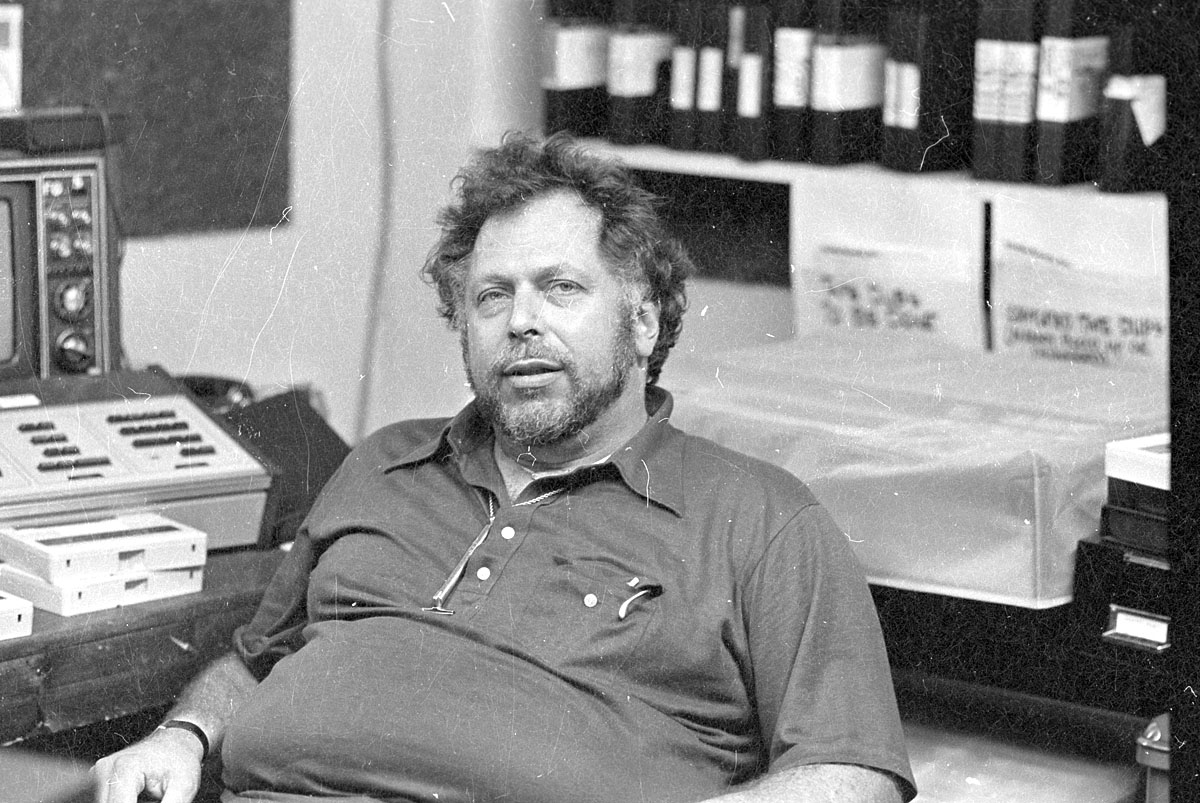
That’s what Will Sloan calls the creator of Screw magazine, Al Goldstein, who died earlier this month:
Goldstein launched Screw, his “weekly sex review” of New York, in 1968. United States courts were regularly redefining what constituted obscenity and what passed for “redeeming social value,” but from the beginning, Goldstein said, “a hard-on is its own redeeming social value.” Unlike Playboy, the publication to which Screw stood in contrast, there was no attempt to flatter the reader’s sense of sophistication, or to depict sex as anything but a physical act. “The word love is alien to us,” said Goldstein in his 1974 Playboy interview. “Who needs love? Yuck! We deal with masturbation, the most common sex activity for most people, in graphic words and pictures.” …
Playboy had the debonair, sophisticated WASP Hefner; Screw had the obese, crass, and very ethnic Goldstein. Hefner often shot the early Playboy pictorials himself, leaving articles of his clothing in the background to hint that he’d seduced the women; Goldstein admitted (or perhaps bragged) that he could rarely get laid unless he paid for it. Hefner lived a lifestyle that his magazine urged readers to strive for; Goldstein was proudly in the muck with the rest of us. Screw gained enough counterculture credibility in the late ’60s and early ’70s to score interviews with Henry Miller, Salvador Dali, and John and Yoko (during their Montreal bed-in), but Goldstein was the kind of interviewer who could bring anyone down to his level. He got Jack Nicholson to admit he used the magazine to masturbate.
The difference between Peakman and Bering is one of position. While Bering uses humour to take a vertical plunge into the depths of the psyche, Peakman stays horizontal, giving an overview of all the nonsense that has been written about sex from the ancient to the modern worlds, and adding some of her own: “It is not so much that the internet has contributed to sex in the 21st century; to a large extent it is sex.” Neither book makes easy reading: Peakman’s because it is lazily written and she has no rapport with the reader, and Bering’s because he takes us into the worlds of those who have not so much been hiding in the closet as quivering in the panic room of a building in a David Lynch film.
But the reader faces other challenges too.
Some of us (or all, if Bering has his way) might feel uncomfortable stirrings of desire as we recognise our secret selves on the page; most will feel disgust or the urge to laugh. Once “the disgust factor” kicks in, Bering argues, social intelligence disappears. Desire and disgust are antagonists but they are also bedroom playmates; disgust towards the object of desire is a not uncommon post-coital reaction. As de Sade wrote, “Many men look upon the sleeping woman at their side with whom they have just had intercourse with a feeling as if they could at least thrash [her].” The secret to our success as a species, for Bering, is the way we have kept our disgust under control in the face of bodies that snore, smell, leak, swell and sprout unsightly hairs. As the open-minded millionaire Osgood Fielding III puts it in Some Like It Hot, when told he has mistakenly proposed to a man, “Well, nobody’s perfect.”
In an interview, novelist Allan Gurganus shares his thoughts on writing about sex:
I think one reason people now seem afraid to write about sex, they’re afraid to write about good sex. There is so much porn on the web and in the air, young writers bypass sex for fear they will make byproduct porn by accident. But you need not have gym bodies in your stories. All sex is not all good… And yet, for fiction’s sake, all sex is good. People talk about not being willing to risk bad sex on the page or between the sheets. I want to say, “Yeah, I know you have high standards. But it’s Saturday night and I’ll just go ahead and take my chances.” The right answer to most questions is usually Yes, All the Above.
All artists have to be whores, really. They really have to just get down, get on that thing, and work it — whatever that thing is for you and yours. [Laughs] I really encourage writers, when they’re writing about two people — or three, or six — entering erotic circumstances, to refrain from pulling back into the frozen Presbyterian safety of good taste. Good taste is our enemy. Good taste is what our middle-class upbringings have done to us. It makes us and everything be beige. It holds us back from some unbelievably essential material. We have a responsibility to our characters to allow them a sexual life such as we have. Or have had. Just because we’re living in a puritanical, sex-hating country doesn’t mean we should hold ourselves to its bogus standard. Subvert, subvert.
In a 1924 essay from TNR‘s archives, Virginia Woolf ponders what might have awaited the novelist had she lived past the age of 42:
She would have stayed in London, dined out, lunched out, met famous people, made new friends, read, travelled, and carried back to the quiet country cottage a hoard of observations to feast upon at leisure. And what effect would all this have had upon the six novels that Jane Austen did not write?
She would not have written of crime, of passion, or of adventure. She would not have been rushed by the importunity of publishers or the Battery of friends into slovenliness or insincerity. But she would have known more. Her sense of security would have been shaken. Her comedy would have suffered. She would have trusted less (this is already perceptible in Persuasion) to dialogue and more to reflection to give us a knowledge of her characters. Those marvelous little speeches which sum up in a few minutes’ chatter all that we need in order to know an Admiral Croft or a Mrs. Musgrove forever, that shorthand, hit-or-miss method which contains chapters of analysis and psychology, would have become too crude to hold all that she now perceived of the complexity of human nature. She would have devised a method, clear and composed as ever, but deeper and more suggestive, for conveying not only what people say, but what they leave unsaid; not only what they are, but (if we may be pardoned the vagueness of the expression) what life is. She would have stood further away from her characters, and seen them more as a group, less as individuals. Her satire, while it played less incessantly, would have been more stringent and severe. She would have been the forerunner of Henry James and of Proust—but enough. Vain are these speculations: she died “just as she was beginning to feel confidence in her own success.”
A poet? A rock star? Something else entirely? Dana Stevens argues (NYT) that “creative activity at a certain level renders genre categorization moot”:
Dylan’s songs at their best seem to originate from some primal foundry of creation, a Devil’s crossroads where Delta blues, British folk ballads, French Symbolism and Beat poetry (to name only a few of his early influences) converge and fuse. But his music reaches forward in time, toward more modern art forms, as well. There’s something distinctly cinematic, for example, in the crosscutting and temporal leaps of a narrative ballad like “Tangled Up in Blue,” which compresses a feature film’s worth of images, locations and encounters into four and a half minutes of bravura storytelling. If it’s a kind of sung movie, “Tangled Up in Blue” is one that, like so many Dylan compositions, consciously aspires to the condition of literature. In one verse, an erudite topless-bar waitress hands the first-person narrator — or in some versions of the song, a third-person stand-in — a life-changing volume of verse by “an Italian poet / From the 13th century.”
The Dylan songs I keep returning to are the ones that spin out images like a surrealist or expressionist film, like Buñuel’s “Andalusian Dog” crossed with “The Cabinet of Dr. Caligari.” Something is happening here, but you don’t know what it is, do you, Mister Jones? “Visions of Johanna” may be our most accurate, haunting evocation of the semi-hallucinatory insomnia that can be an unfortunate side effect of love. Perhaps I have a weakness for songs about the apocalypse (another favorite is Exuma’s “22nd Century,” performed by Nina Simone), but I’ve always admired “A Hard Rain’s a-Gonna Fall,” Dylan’s images cascading in the cadence of a children’s rhyming game: a partridge in a pear tree in a post-nuclear hell. Dylan is a master not only at translating rage into song (“Positively 4th Street” and “Idiot Wind” come to mind), but also at convincing us we’ve felt exactly the same kind of anger he’s describing.
He’s the heir, the unlikely offspring of Arthur Rimbaud and Walt Whitman. But he’s neither Rimbaud nor Whitman. He’s Bob Dylan. Is he a poet or a songwriter? The same answer applies: He’s Bob Dylan. I find myself falling back (again!) on Emily Dickinson’s remark: “If I feel physically as if the top of my head were taken off, I know that is poetry.” Dylan’s songs can make us feel that pleasurable shock of being partially decapitated by beauty.
Shot over a period of 18 months, Italian photographer Gabriele Galimberti’s project Toy Stories compiles photos of children from around the world with their prized possessions—their toys. Galimberti explores the universality of being a kid amidst the diversity of the countless corners of the world, saying, “at their age, they are pretty all much the same; they just want to play.”
But it’s how they play that seemed to differ from country to country. Galimberti found that children in richer countries were more possessive with their toys and that it took time before they allowed him to play with them (which is what he would do pre-shoot before arranging the toys), whereas in poorer countries he found it much easier to quickly interact, even if there were just two or three toys between them.
Toy Stories will be published by Abrams Books on March 24. Explore more of Galimberti’s work here.

 The Dish
