On Interactive Reading

Scholarly writers, William Germano argues, should count on readers’ collaboration, just like a blogger does:

I’m advocating for a riskier, less tidy mode of scholarly production, but not for sloppiness. I’m convinced, though, that the scholarly book that keeps you awake at night thinking through ideas and possibilities unarticulated in the text itself is the book worth reading. It may be that the best form a book can take—even an academic book—is as a never-ending story, a kind of radically unfinished scholarly inquiry for which the reader’s own intelligence can alone provide the unwritten chapters.

Let every writer reflect on Rilke’s famous line: “Du musst dein Leben ändern.” You must change your life. Books are life-changing for writers­—but often only for the scholars who write them. In the new order of scholarly production, let’s double down on Rilke’s dictum: You must change their lives, too.

Alan Jacobs’ recommendation on how to accomplish this:

Even in my most theoretical work, I’ve tried to think of my task as that of attracting and keeping the attention of thoughtful readers, telling them stories, doling out fascinating details that make them want to read more, keeping them to some degree in suspense until the end of any given tale. Storytelling is, for me, the fundamental mode of writing; it’s the foundation on which everything else is built. In that sense I don’t think of writing works of literary theory as being different altogether in kind from writing a personal narrative. It’s all about trying to reach human readers, writing to them as their fellow human being. Insofar as I have had any success as a writer, I really do think that it is primarily due to my keeping that goal in mind.

The Deepening, Disgusting Stain Of Gitmo

dish_gitmo library

Charlie Savage has created a tumblr of detainee reading material. Dan Colman notes:

According to news reports, the library currently has 3,500 volumes on pre-approved topics. Prisoners have to order books in advance. (They can’t just wander through the stacks.) And the most popular books include Agatha Christie mysteries, the self-help manual Don’t Be Sad; The Lord of the Rings; and, of course, Harry Potter.

I’m relieved the president reiterated his support this morning for closing one of the most potent recruiters for Jihad against the US on the planet. I await his executive decision to release the innocent Yemeni prisoners to their country of origin. Or is this more bullshit/impotence? But Gitmo’s awful impact on American soft power is nothing compared to its potency as a toxin against the Constitution. Read Joe Nocera on a man captured at the age of 20, with no proof of his involvement in Jihad, and now destined to live a life sentence, if the US Congress has its way. Life-long detention without ever having committed any actual crime? That’s now the meaning of America, as represented by the Congress? Yes, it is. This is America, as recorded in a must-read diary from GTMO. In August of 2003, after days of “interrogation”, a prisoner was seized from his cell and taken out on a boat in the Caribbean:

My first thought was, they mistook me for somebody else. My second thought was to try to look around, but one of the guards was squeezing my face against the floor. I saw the dog fighting to get loose. I saw [——-] standing up, looking helpless at the guards working on me. “Blindfold the motherfucker! He’s trying to look—” One of them hit me hard across the face and quickly put goggles on my eyes, earmuffs on my ears, and a small bag over my head. They tightened the chains around my ankles and my wrists; afterward I started to bleed. All I could hear was [——-] cursing, “F-ing this and F-ing that.” I thought they were going to execute me.

The other guard dragged me out with my toes tracing the way, and threw me in a truck, which immediately took off. The beating party would last for the next three to four hours, before they turned me over to another team that would use different torture techniques. “Stop praying, motherfucker. You’re killing people,” [——-] said, and punched me hard on my mouth. My mouth and nose started to bleed, and my lips grew so big that I technically could not speak anymore. The colleague of [——-] turned out to be one of my guards; [——-] and [——-] each took one of my sides and started to punch me and smash me against the metal of the truck. One of the guys hit me so that my breath stopped and I was choking. I felt like I was breathing through my ribs. …

Inside the boat, [——-] made me drink salt water, I believe it was direct from the ocean. It was so nasty I threw it up. They put an object in my mouth and shouted, “Swallow, motherfucker!” I decided inside not to swallow the organ-damaging salt water, which choked me as they kept pouring the water in my mouth. “Swallow, you idiot!” I contemplated quickly, and decided for the nasty, damaging water rather than death.

[——-] and [——-] had been escorting me for about three hours in the high-speed boat. The goal of such trip was, first, to torture the detainee and claim that the “detainee hurt himself during transport,” and second to make the detainee believe he is being transferred to some far faraway secret prison. We detainees knew all about this; we had detainees who reported flying four hours and finding themselves in the same jail where they started.

If I had read this in my teens, I would have assumed this was a description of a Soviet Gulag or a South American fascist dictatorship. But this is America – and it tells you everything you need to know about the profound corruption in the ship of state that the man who authorized all of this was just feted by all living former presidents. As for accountability, here’s who has been held accountable: [——–].

After Medical Marijuana, Medical Psilocybin?

Fresh Colombian magic mushrooms legally on sale in Camden market London June 2005

Greg Miller reports from the third annual Psychedelic Science meeting in Oakland, California:

[Brazilian neuroscientist Dráulio Barros de Araújo and his team] found that ayahuasca reduces neural activity in something called the default mode network, an web of interconnected brain regions that fire up whenever people aren’t focused on any specific task. It’s active when people daydream or let their minds wander, for example. The default mode network has been a hot topic in neuroscience in recent years. Scientists don’t really know what it does, but they love to speculate. One interpretation is that activity in this network may represent what we experience as our internal monologue and may help generate our sense of self.

Last year, British scientists reported that psilocybin, the active ingredient in magic mushrooms, like ayahuasca, reduces activity in the brain’s default mode network. The researchers proposed that interfering with the default network could be how psychedelic drugs cause what users often describe as a disintegration of the self, or even a sense of oneness with the universe.

That effect, compounded with “a growing sense of frustration over the lack of promising new psychiatric drugs in the pipeline,” had attendees intrigued:

Several scientists at the conference pointed to findings that activity in the brain’s default mode network is elevated in people with depression. Because psilocybin and ayahuasca seem to dampen activity in this network, perhaps they could help. It’s hard to connect those dots without a strong dose of speculation, but one idea is that the elevated activity in the default mode network reflects too much attention directed inward. People in the grips of depression, the thinking goes, are trapped in an endless cycle of critical self-examination, and a little neural desynchronization might help them reboot.

But it’s ever-so-hard to bring science to bear on these promising compounds when they are still fucking illegal. In Britain’s case, mushrooms with psilocybin were only banned eight years ago. Instead of examining the properties that could help humans, we have decided to ban them because they might cause someone somewhere a modicum of pleasure and even peace.

(Photo: Fresh Colombian magic mushrooms legally on sale in Camden market London June 2005 before such sales became a crime. By Photofusion/Universal Images Group via Getty Images.)

When The Rubber Hits The Road

David Masciotra is a straight shooter:

If we’re honest, many of us do see condoms as robbing us of pleasure, stealing some excitement and spontaneity from intimacy, and dulling the intensity of sexuality. It’s okay to say that. These factors are the primary reasons that still only 60 percent of teenagers claim to use condoms. These factors warrant acknowledging. From there, condom usage declines as people grow older. The number one reason we have seen given time and again for refusal to wear condoms is the reduction of pleasure.

It is politically incorrect to acknowledge the truth and simplicity of the condom’s inadequacy. Criticism of the condom opens one to righteous demonization and condemnation. Condom defenders often stifle honest and helpful discussion about sexuality, unplanned pregnancy, and sexually transmitted infections.

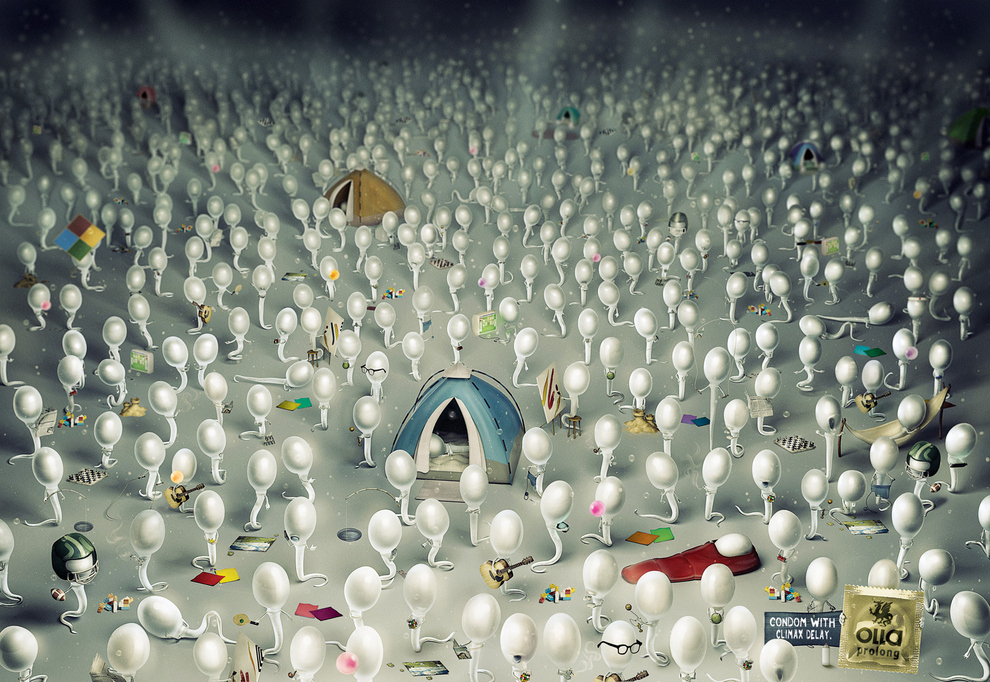
It’s amazing to me that the simple fact that covering your penis in rubber desensitizes it is somehow a taboo topic, too risky to say in case some men use it as an excuse to be rid of them, or demand their female partners use contraception rather than them. On the other hand, many men need the extra protection from premature ejaculation, as these 22 condom ads (including the one above) illustrate. Masciotra touches upon another taboo:

[T]he chance of pregnancy by pre-cum is so remote that it is a statistical nonfactor. … Sex researcher Dr. Rachel Jones at the Guttmacher Institute recently published a study in the journal Contraception that found that the “withdrawal method of birth control is nearly as effective as condoms in preventing pregnancy.” By the study’s measures, “pulling out” had a failure rate of four percent, while condoms had a failure rate of two percent.

Shhhh.

Why Launch Another War?

Syria_Interest

Judis wants to use force in Syria to prevent further use of chemical weapons:

[S]ome people have argued that the United States should not do anything that might help the opposition win the war because that would help the Jihadis. The U.S., they argue, is better off with a bloody stalemate. But the Jihadis have benefited from the stalemate in Syria and from the perception that the United States is indifferent to Syria’s fate. By keeping its word to prevent the regime from using poison gas, the U.S. will help the opposition and will be in a better position to influence the eventual outcome without being responsible for it. It will, if anything, have halted the shift in power from the Free Syrian Army to the Jihadis.

I understand and respect John’s point. Mine is simply this – and I tangled with John McCain on CNN on the matter last night, prompting him to call me rude. (Being called hot-tempered by John McCain is, well, insert your own punch line).

This embed is invalid


Syria is an immensely complex sectarian civil war, just like the one George W. Bush kick-started in neighboring Iraq that is once again gathering steam after the rank failure of the “surge” to do anything but get us out of there.

We do not have a clue what we are doing. It’s their country and we involve ourselves at our peril. Once we directly intervene in defense of one nebulous faction, we will deeply alienate another. We will be injecting the US into a brutal religious and ethnic civil war. If there is one guarantee that will bring more Jihadism to America, it will be another intervention in a complex Muslim country. The idea that we can win favor in that region by intervening is insane.

Doug Bandow is also aghast at the lack of any historical memory among the liberal hawks:

Some analysts apparently believe that starting America’s third war in a Muslim country in a dozen years would enhance the nation’s reputation in the Middle East. Wrote Princeton’s Anne-Marie Slaughter, a failure to act means Barack Obama “will be remembered as a president who proclaimed a new beginning with the Muslim world but presided over a deadly chapter in the same old story.” Actually, the war in Iraq was supposed to make Muslims the world over love the U.S. Unfortunately, something went wrong along the way.

Ya think? Judis also argues that, if “the Obama administration were to ignore its own ‘red line’ in Syria, that would send a message not only to the Assad regime, but also to North Korea and Iran that it could ignore American threats.” Well, they do ignore US threats, and have done so for a very, very long time. And one reason is that after Iraq and Afghanistan, the idea of credible long-term domestic support for bombing North Korea or Iran or arming a movement losing momentum to al Qaeda in Syria is simply not going to be there. So sorry, McCain and Butters. You can’t have your Iraq catastrophe somehow erased from our memory. Americans are amnesiacs but not etch-a-sketches. Larison notes the hyperbole involved:

Judis’ argument requires us to pretend that there is no difference in severity between nuclear proliferation and the uncertain reports of possible chemical weapons use. According to him, the U.S. must start a war in response to a small, possibly accidental use of sarin if its readiness to attack Iran can be believed. To state this argument plainly is to discredit it.

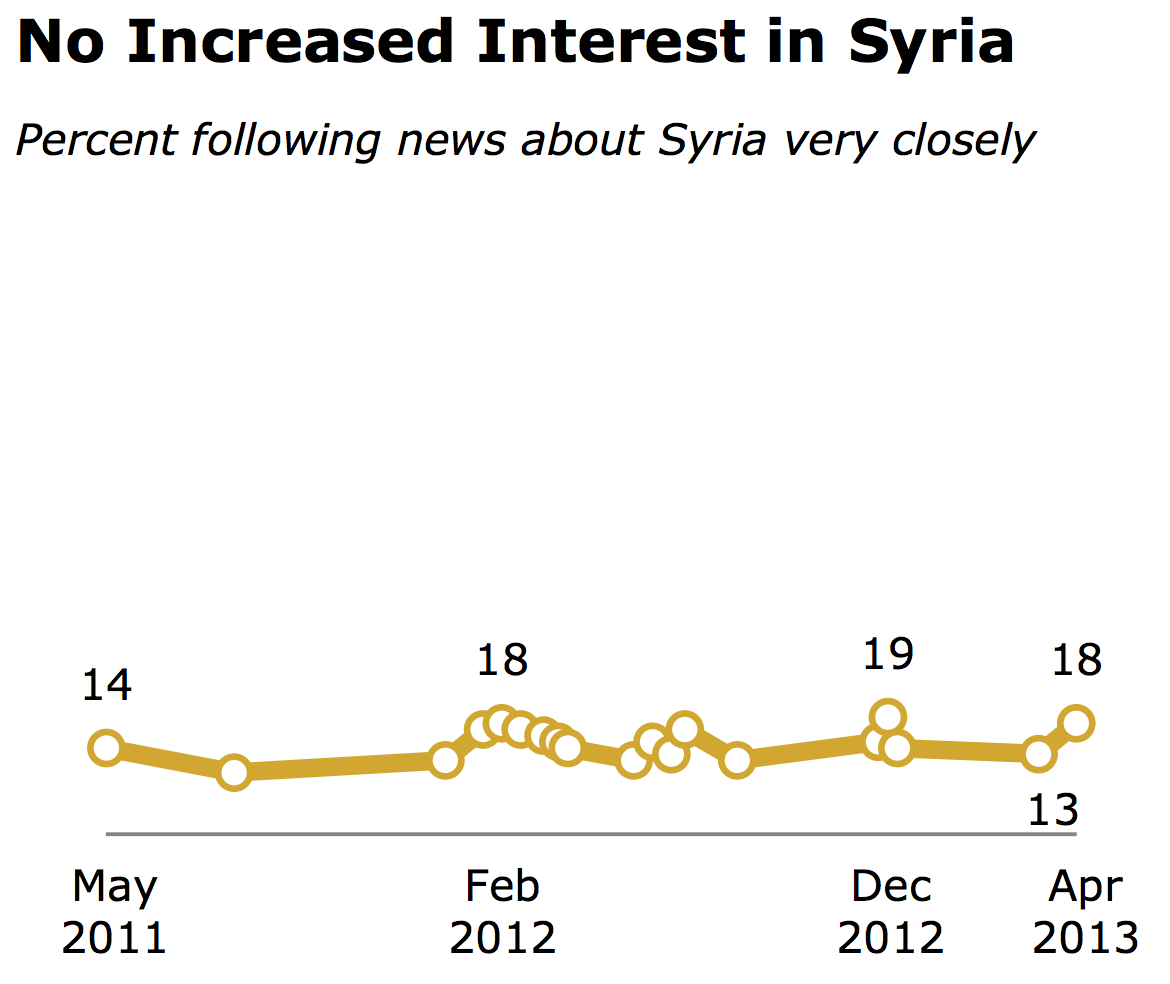
David Kenner reviews public opinion on Syria. His conclusion:

If he has incontrovertible proof of Assad’s chemical weapons use, there is reason to believe he could initially cobble together a majority in favor of intervention. But given Americans’ relative apathy toward the conflict, there is also reason to believe that they would sour on the conflict if it dragged on or incurred significant costs. What the president needs is a quick, low-cost intervention that would allow the United States to take a backseat to other international partners. Whether that’s a realistic possibility, given the reality in Syria, is very much an open question.

(Chart from Pew (pdf), which finds that few Americans are paying attention to Syria)

The View From Your Window Contest: Winner #151

Screen Shot 2013-04-27 at 3.09.02 AM

A reader writes:

This appears to be the view of Pico from Faial, both central islands in the Azores. While not exactly tropical, the climate is warm enough to sustain the odd palm tree. I believe you can see the town of Horta smack in the middle of the snapshot.

Another:

Long-time follower, first time responding! I believe this picture was taken from somewhere on the eastern side of the Azorean island Faial. The mountain in the background looks to be Mount Pico, on the nearby island of Pico. I’m sure someone else will be much more exact, but my best guess is that it was taken somewhere on the outskirts of the city of Horta, possibly Conceição?

Since I can’t offer too much more detail, let me add a personal anecdote about Faial. My family is originally from mainland Portugal and my grandfather originally applied for a visa to come to the US in 1947, but didn’t get one until 1960. It took a series of volcanic eruptions in 1957/58 on the western side of Faial to finally open the door for my family and thousands of others to enter the US.  The eruptions led to Congress passing the Azorean Refugee Act of 1958 (co-sponsored by then Senator John F. Kennedy), which greatly  increased the amount of visas provided to Portuguese, both from the Azores and the mainland.

Another:

This looks like it might be Nevis in the distance, the island that is very close to St. Kitts. The country is St. Kitts Nevis, Nevis is so-called because Columbus thought that the peak was covered in snow, or nieves in Spanish, but it was just clouds.  There are no snow capped islands in the West Indies.  Nevis is just south of St. Kitts, which was named by Columbus for his patron saint.

Another:

It could be any tropical, volcanic region in the world, so most likely Central America or Southeast Asia. With that in mind, I’m guessing that this was taken from the port town of Balingoan on the north coast of Mindanao in the southern Philippines, looking across to Camiguin Island which is famous for its volcanoes.

Another:
krak small

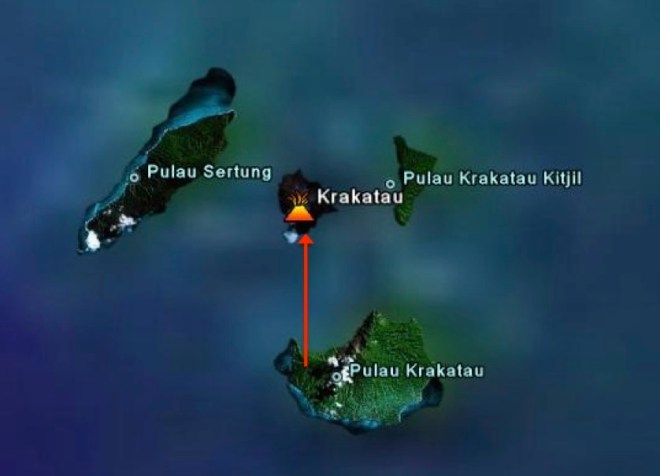
Well, this week’s contest was too easy, as Anak Krakatoa Island is the subject of the photo. (Even were it not for the profile of the famous volcano, the red tile/metal roofs in the tropical paradise setting clearly suggest an Indonesia-like locale.)  The photographer has to be a tourist visiting Anak Krakatoa (Child of Krakatoa), with accommodation on one of the three islands that make up the remnants of the original Krakatoa island obliterated in 1883.

Another:

Well, we’re looking at a volcano in the tropics, sitting near a body of water.  Could be a lot of different places (it quite reminds me of my recent trip to Arenal volcano in Costa Rica), but searching Indonesia alone would take hours, I’m going to make an educated guess that we’re looking at Mayon Volcano in the Philippines, known for its majestic symmetry.  It sits on a body of water, the Albay Gulf, and there’s the little town of Manito right across the gulf from Mayon, so that’s what I’m guessing. (Watch, the volcano will probably turn out to be Concepcion in Nicaragua, or something in Indonesia and I’ll be off by thousands of miles.)

Another:

Costa Rica? Overlooking the Tenorio volcano, from Tilaran, or somewhere close? My husband and I went to Costa for our honeymoon in January and I’ve been dying to go back and this has the look, from the palms, architecture, terrain. Might be another volcano, but definitely Central America.

Another:

I spent the winter holiday cruising down the Pacific coast and stopped in both Guatemala and Nicaragua. Volcanoes in both places, but I’m guessing Guatemala.  Is that Lake Atitlan in the foreground? I don’t expect I’ll ever win the book – I’m just not computer savvy enough to do the calculations and draw the intersecting vector lines and give GPS data … but fuck it, let’s say this is taken from the top of the chicken coop on the farm of Pedro Zacapa on the outskirts of Santa Catarina Palopo, Guatemala.

Another:

Back in the 1980s, when I lived in Guatemala, Panajachel on Lake Atitlan was one of the places I’d go for a respite. At that time there were few tourists and even on Peace Corps wages I could stay in a decent hotel. I believed and still believe that it is one of the most beautiful places on earth. And the people were as beautiful as the land. Many of the villages on the lake were considered too dangerous to visit, but I would go anyway. Stupid youth. There was a Catholic mission in one village that was very welcoming. I had tremendous respect for the work of these people – nuns, priests, and others – doing such good work in a troubled place. I would visit the orphanage to get my hug quota fulfilled. The only negative was that many were from Minnesota and I had to withstand a barrage of Iowa jokes whenever I stopped by.

Another gets the right country:

I have never dared to respond to the VFYW contest before but the most recent one just screams Central America to me, and since I lived for a year and a half in Nicaragua, I’m going to go with that. The mix of vegetation, the layout of the house, the rusty corrugated tin roof, and the volcano on the lake is the spitting image of Mombotombo. The bricks in the foreground even look like the type made by all the towns along the Highway from Managua to Leon. I’m getting some serious nostalgia just typing this. So I’m going to take a guess based on the towns around Lake Managua and say this was taken outside either La Esperanza or Nagarote. Let’s just go with Nagarote. Thanks for the blast from the past!

Another nails the exact location:

Screen shot 2013-04-27 at 10.29.19 AM

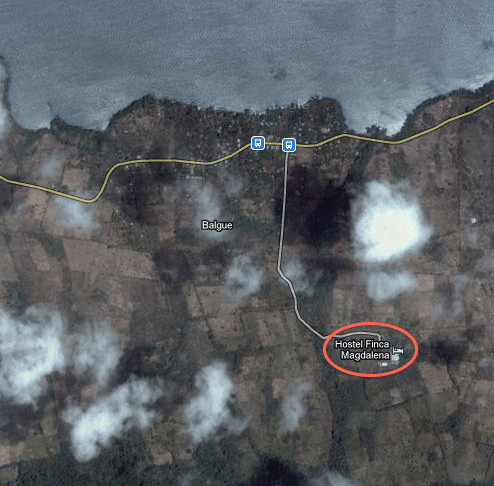
A Google image search using the phrase “volcano island” quickly serves up a variety of candidates, including Volcan Concepcion, on the island Ometepe, in Nicaragua, with a cone-like shape similar to the mountain in the contest photo.  A subsequent search on “Ometepe” turned up photos so strikingly similar to the contest photo that they must have been taken from the same window. It didn’t take long to find the location by looking at Ometepe accommodations on Tripadvisor. The location is the Finca Magdalena guest house, near the town of Balgue, on the island of Ometepe, in Lake Nicaragua, Nicaragua.
Screen shot 2013-04-27 at 10.28.57 AM

Another:

On Google maps, my wife and I started moving north along the Venezuelan coastline in search of islands just off the mainland.  Eventually we reach Central America, and Nicaragua.  At this point one might notice a rather large lake set in Nicaragua named Lake Nicaragua, and set in the middle of that lake is … a volcanic island called Isla Ometepe.  In the lake.  Like a motherf*cking Bond villian lair.  It’s the coolest thing ever and I never knew it existed and it’s shit like this that keeps me doing this contest every week.

Another focuses on the hostel:

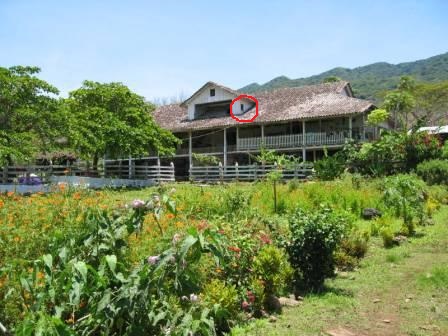
I am afraid this one will generate a lot of correct results, based on the fact that I found it rather quickly (20 minutes).  Clearly Caribbean landscape, but no island volcanoes seem to match the geography. I found some links to Costa Rica volcanoes and expanded my search to include Central America, which immediately produced several photos almost identical to this weeks view, all with the same outbuildings and varying degrees of cloud cover and snow on Volcán Concepción. Anyway, I believe the photo was taken from the upper floor of the Finca Magdalena Hostel on Isla de Ometepe in Lake Nicaragua. Judging by the angle and the window frame in the photo, I am pretty sure it was take through the small side window circled:
red-circle

Another:

I have never been there, but my Brooklyn-dwelling daughter traveled there last year, visiting a friend and climbing the other volcano, Maderas, which is dormant. She reported spectacular wildlife and loved hiking up through the rainforest; it is a nature preserve and a UNESCO Biosphere preserve.

Another:

This place is fantastic if you like troops of howler monkey. As a monkey enthusiast myself this locale was great for sneaking into the woods up the hill and grabbing a quick pic of the monkeys. We stayed monkeyhere one night on our way around the island back in 2010, since we’d heard they’d had this great fried mango food like Mango French Fries!  The whooping and screeches of the monkeys did not thrill most residents during the night, but boy was I wooed by their subtle songs. Just Beautiful! It had a great little restaurant style bed and breakfast feel, and there was a fantastically cute pet raccoon tied to tree. He did little tricks for food throughout the meals, although he didn’t seem too happy about the leash. Not sure how they got him – are raccoon’s common pets in “Nici”? I need get one of these!

But back to the monkeys! Howler monkeys can be heard from over three miles away. Amazing! We went all around the island listening for them. I felt like Jane Goodall or something finding these monkeys! HUZAAAAHHH!!! There they were! They mostly enjoyed the slopes of the volcano, which – woooweee – are a little steep for my legs. I practically fell right off of Conception. I’m not great at sketching but tried my hand at it – getting sooo much better at anatomical sketches. Probably should write my own book on this stuff.

Another:

When I saw this week’s VFYW, I nearly had a heart attack. Finally, a VFYW that I’d seen with my own eyes! This is the Finca Magdalena, a rustic farmhouse inn on an organic coffee farm, where I stayed with my husband and our three-year-old daughter, Isabel, several years ago. The Finca was our last destination on our trip to Nica. The ride in was rather complicated, hopping from ferry to bus to motorbike, but let me tell you, it was worth it. My husband and I loved the simplicity of the food, the staff, and most of all, the COFFEE! Nothing like some caffeine to get you up those steep Nica hikes! We ditched some clothes just to leave room in our suitcases to bring home as much coffee as possible.

The kind staff even introduced our Isabel to their “mapachito”, the cutest little raccoon they keep tied to a nearby tree. He was friendly as ever. Needless to say, this was the highlight of Isabel’s trip, and she played with him constantly. Talk about a free babysitter ;)

Another:
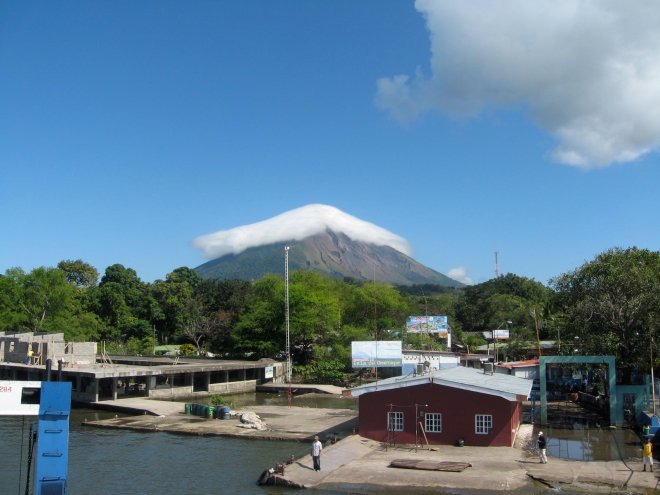
Arriving to volcano island

During a winter break in law school, I traveled to Nicaragua with one of my best friends.  As I’m sure most tourists would be, we were intrigued by the existence of a volcano in the middle of a lake.  We set aside a couple of days of our whirlwind tour of the country to travel to Isla de Ometepe.  On our only full day on the island, we spent an exhausting eight hours scaling the muddy slopes of Volcan Concepcion.  We brought our cameras for what we believed would be the incredible views on top.  Unfortunately, we had not thought through the implications of the term “cloud forest.”  As the moniker would suggest, the top of Concepcion is entirely banked in by clouds and thick mist at almost all times (as the entry photo depicts).  Despite having no views, the slopes were still a wonderfully dense jungle of packed vegetation, tangled tree limbs, and howling monkeys.

Another:

I knew this one immediately, not because I’d been there but because growing up we constantly had Ometepe coffee around the house.  The distinctive shape of the volcano was printed on the coffee bags.

About a third of the roughly 150 entries correctly identified Ometepe, and seven of those were from readers who have identified difficult views in the past without winning (“difficult” being defined as a view in which only 10 or fewer readers correctly answer it).  To break that tie, the reader among the seven who has participated in the most contests (11) is the winner this week:

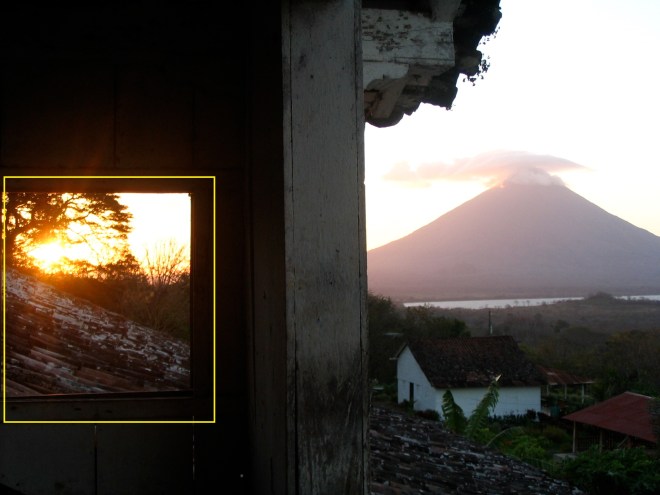
This week’s view is from the top (mansard) floor of the Finca Magdalena Hostel. It is located on Ometepe Island, which rises out of Lake Nicaragua. Two volcanoes dominate the island: Concepcion, seen in the original view, is the taller, more symmetric one; and Maderas is the flatter one on the right at the link above. The hostel is on its northern slope. I knew this had to be in the Americas, since there is a cactus in the foreground, on the roof (all cacti but one are native to the Americas). I tried ‘volcano island Central America’ as a search phrase and Ometepe was the top result. I found this almost identical image on Panoramio and then the building it was taken from. (The window in question is the small one on the right.)

One more view:
VFYW Ometepe Interior Actual Window - Copy

(Archive)

The Legacy Of “Yellow Cake”

The Syrian government is denying reports that they have deployed chemical weapons against rebel groups:

[They add that] the United States lacks credibility. Obviously, that’s exactly what you would say if you has used chemical weapons on your own people, because no country would admit to such a horrific war crime. But the American history with foreign weapons of mass destruction also plays right into the Syrian strategy, as Information Minister Omran Al-Zoubi accused the U.S. of trying “to repeat the Iraq example.”

Obama was cautious at a press conference today:

The president said that while evidence suggested that chemical weapons were used in Syria – thereby crossing the “red line” Obama had established in the Syrian conflict – more details were needed, namely about who used those weapons, and when.

The neocons are being hoisted on their own Iraq petard. But the real difficulty is figuring out what we could do even if we wanted to. I see no scenario that doesn’t contain more risks than gains.

The Death Of Blogs? Or Of Magazines?

photo-22

As part of his “eulogy for the blog”, Marc Tracy touches upon the evolution of the Dish – which he praises as “a soap opera pegged to the news cycle”:

[T]oday, Google Reader is dying, Media Decoder is dead, and Andrew Sullivan’s The Daily Dish is alive in new form. This year, Sullivan decided that he was a big enough brand, commanding enough attention and traffic, to strike out on his own. At the beginning of the last decade, the institutions didn’t need him. Today, he feels his best chance for survival is by becoming one of the institutions, complete with a staff and a variety of content. What wasn’t going to work was continuing to have, merely, a blog.

We will still have blogs, of course, if only because the word is flexible enough to encompass a very wide range of publishing platforms: Basically, anything that contains a scrollable stream of posts is a “blog.” What we are losing is the personal blog and the themed blog. Less and less do readers have the patience for a certain writer or even certain subject matter.

I wish he had some solid data to back that point up. Of course, blogs have evolved – and this one clearly has from its early days. What began as one person being mean to Maureen Dowd around 12.30 am every night is now an organism in which my colleagues and I try to construct both a personal and yet also diverse conversation in real time. But that doesn’t mean the individual blogger – small or large – is disappearing. Our entire model requires, as it did from the get-go, links to other sites and blogs – and we have not detected a shortage.

One reason we have had to grow and evolve – and this started as far back as 2003 – is that the web conversation has grown exponentially since this blog started (when Bill Clinton was president). Yes, many bloggers now get employed by more general sites, or move on to more complex forms (think of Nate Silver, a lone blogger when the Dish first championed his work and now part of an informational eco-system). But every page on the web is equally accessible as every other page. Blogs will never die – but they might form a smaller part of a much larger online eco-system of discourse.

My own view is that one particular form of journalism is actually dying because of this technological shift – and it’s magazines, not blogs. When every page in a magazine can be detached from the others, when readers rarely absorb a coherent assemblage of writers in a bound paper publication, but pick and choose whom to read online where individual stories and posts overwhelm any single collective form of content, the magazine as we have long known it is effectively over.

Without paper and staples, it doesn’t fall apart so much as explodes into many pieces hurtling into the broader web. Where these pieces come from doesn’t matter much to the reader. So what’s taking the place of magazines are blog-hubs or group-blogs with more links, bigger and bigger ambitions and lower costs. Or aggregated bloggers/writers/galley slave curators designed by “magazines” to be sold in themed chunks. That’s why the Atlantic.com began as a collection of bloggers and swiftly turned them all into chopped up advertizing-geared “channels.” That form of online magazine has nothing to do with its writing as such or its writers; it’s a way to use writers to procure money from corporations. And those channels now include direct corporate-written ad copy, designed to look as much like the actual “magazine” as modesty allows.

Adam Gopnik has a wonderful paragraph at the top of his review of National Geographic over the decades that captures the centrifugal force turning magazines into anachronistic forms of writing:

Magazines in their great age, before they were unmoored from their spines and digitally picked apart, before perpetual blogging made them permeable packages, changing mood at every hour and up all night like colicky infants—magazines were expected to be magisterial registers of the passing scene. Yet, though they were in principle temporal, a few became dateless, timeless. The proof of this condition was that they piled up, remorselessly, in garages and basements, to be read . . . later.

Or never. Alyssa likewise thinks blogs are evolving, not dying:

Obviously, it’s true that the first-mover advantage for blogging is gone, and that fewer people are coming online as individual bloggers. … The key technology now is less the publishing platforms that let people write short posts and publish them in a continuous stream, and more the ability to cross-post, so a piece can live both on an author’s individual page, or in the feed on a relevant subject or for a relevant section. …

And I think this is a situation that signals less the decline of blogs than their evolution. Readers can continue to follow the feeds of individual writers they prefer, or whole sections that they find interesting, depending on whether they’re interested in a particular perspective or a larger news feed. If blogging started out as a way to accommodate the way writers wanted to publish their work, it’s now come to serve a different end in giving readers flexibility in how they curate what they want to read, and publications the ability to accommodate them. That’s not death, precisely. It’s more like metamorphosis.