Obama’s Economic Paralysis

“Instead of deep, across-the-board cuts in many important investment programs, ranging from infrastructure to research and development, we need to protect those initiatives while adjusting our social welfare programs to live within our means and protect the truly needy,” – Steve Rattner, making the kind of sense the current GOP doesn’t want to understand.

There are all sorts of arguments to be made about if and whether a Grand Bargain on entitlements, defense and taxes is possible, given the near-pathological refusal of the GOP to raise any serious revenue. But my fear is that it is precisely the failure to come close to the broad Bowles-Simpson framework that has imposed the ridiculously crude sequester that has clearly boomeranged on Obama – and made recovery much weaker. We can all enjoy hindsight, but I wonder if Obama had actually embraced the full Bowles-Simpson when it came out, broke with his 042913austerity11party, and ran for re-election on it, he wouldn’t be in a much stronger position than he is today. This is his mistake – but not his fault, if that distinction makes any sense. It’s his mistake because he lacked the daring to grasp Bowles-Simpson when it could have mattered; but it is not his fault that even if he had done the right thing, the GOP (and the Democratic base) would have turned around and accused him of slashing entitlements, or raising taxes, and success may have been as elusive as it turned out to be, but include his humiliation.
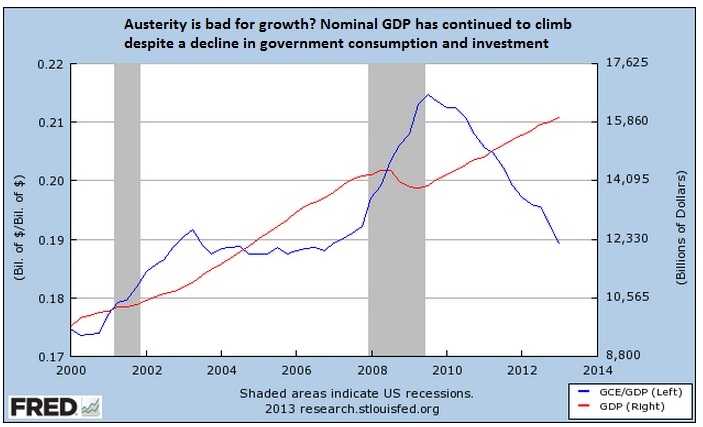
What’s left is a gnawing sense that there is no functioning rational government in Washington. Obama may not want this, and may not be primarily responsible for this, but it will stick to him, as it already has with the younger generation. Many Democrats hated Bowles-Simpson; but they may look back one day and realize it was essential to getting government back from effective permanent bankruptcy to do the things it truly must do – infrastructure, research, education. Maybe the sequester’s grim onslaught – and its effect on current growth and defense spending – will force Washington’s hand. But the private sector is still chugging along sufficiently not to force a crisis (see chart from Pethokoukis) – and after Obama caved so swiftly on the FAA, I get the sinking feeling that the rank and harmful partisanship of today’s politics will not end under his watch. That hope, it may turn out, was too audacious.

Ask Josh Fox Anything: Joining The Fight Against Fracking

In our first video from filmmaker Josh Fox, he explains how he came to take on hydraulic fracturing and the natural gas industry, culminating in his 2010 Oscar-nominated documentary, Gasland:

Last week, Sarah Laskow summarized the evolution of both the anti-fracking movement and Josh’s involvement in it:

When Fox first started this project five years ago, he was an avant-garde theater writer and director. After his family received an offer from a gas company to lease his land, he spun his own questions about fracking into a powerful investigative film. Now, three years after Gasland became a sensation, he’s one of the leading activists in the fight against fracking.

In the years between Fox’s two films, that fight has intensified. Big environmental groups (like the Sierra Club) that once worked with the natural gas industry started pushing back against fracking. The Obama administration strengthened its support for the development of natural gas resources. New York keeps delaying its decision on whether to allow fracking; Pennsylvania keeps letting the industry get away with doing pretty much whatever it wants. Whether to frack or not is no longer a good-faith policy debate. The two sides are engaged in “a war for who was going to tell this story,” as Fox puts it, and it’s escalating.

Gasland Part II just premiered at Tribeca and will air on HBO this summer. Ask Anything archive here.

Cannabis Light, Ctd

A Medical Marijuana Operation In Colorado Run By Kristi Kelly, Co-Founder Of Good Meds Network

The market is responding to demand:

Under Washington State law, marijuana is defined as cannabis with a THC concentration greater than 0.3 percent. Anything with less THC is not marijuana under state law; it is simply unregulated cannabis. Thanks to Initiative 502, we no longer prohibit this unregulated cannabis, which includes such commodities as industrial hemp, edible pot sprouts, and seeds.

But THC, the molecule primarily responsible for the psychoactive effects of pot, is just one of at least 85 known cannabinoids in the plant, and it turns out some people aren’t looking for THC. Many dispensaries report that patients often want pot that is high in other medicinal compounds—like cannabidiol (CBD), which is thought to have a greater effect on pain.

One such strain found locally is called M’Otto, and with 0.23 percent THC and nearly 11 percent CBD, it is not technically marijuana under state law. It certainly looks like marijuana, smells like marijuana, and smokes like marijuana. But around here, it is only unregulated cannabis. “Since we’ve had it in for about a year, I would say it’s the fifth or sixth fastest-moving strain we carry,” says Muraco Kyashna-tocha from the Green Buddha Patient Co-op.

The CBD-heavy marijuana is also one of the more promising medical aspects of the near-miraculous plant.

(Photo: Pots of cannabis inside a medical cannabis cultivation facility in Denver, Colorado, U.S., on Monday, March 4, 2013. By Matthew Staver/For The Washington Post via Getty Images)

Shot Down

DL Cade spotlights an unusual photo series on airplane crashes:

For his project “Happy End,” German photographer Dietmar Eckell has travelled all over the world to find and photograph abandoned airplane wreckages with positive endings. That last part may seem like a paradox, but all of the 15 wreckages Eckell has shot actually do have happy endings: no one on board died, and they were all rescued from the remote locations where they crash landed.

He has started an IndieGogo campaign to publish a book on these “miracles in aviation history.”

End Of Life Over-Treatment

Rauch covers it:

The U.S. medical system was built to treat anything that might be treatable, at any stage of life—even near the end, when there is no hope of a cure, and when the patient, if fully informed, might prefer quality time and relative normalcy to all-out intervention.

He talks with Angelo Volandes, who creates informational videos about medical interventions: 

Volandes shows me some of the footage he plans to use. We watch a patient with advanced Alzheimer’s being fed through a tube that has been surgically inserted into her stomach. An attendant uses a big syringe to clear the tube, then attaches a bag of thick fluid. Over the footage, Davis’s voice will say, Often, people hope tube feeding will help the patient live longer. But tube feeding has not been shown to prolong or improve the quality of life in advanced dementia. Tube feeding also does not stop saliva or food from going down the wrong way.

… “Let me ask you this,” Volandes says. “Suppose I’m having a conversation with you about whether your father would want this. And I said ‘feeding tube,’ and you’re thinking to yourself, Food, yeah, I could give food to my mom or dad. We just want to make sure that regardless of the way the gastroenterologist is presenting the procedure, the patient’s loved ones know this is what we’re talking about.”

From Decapitations To Celebrity Portraits

Laetittia Barbier traces the macabre origins of the wax museum all the way to the foot of the 18th century guillotine:

Behind the scaffolds, a 32-year-old woman undertook the gruesome labor of casting in wax the severed heads of the enemies of the [French] Revolution. The effigies were then paraded on picks in the streets as symbolic sacraments of the people’s victory. The dilligent wax manufacturer’s name was Marie Grosholz, a name she promptly changed after her wedding to become Madame Tussaud.

(Photo: “Madame Tussaud making wax likenesses of guillotine victims in Paris” at the Royal London Wax Museum by Herb Neufeld)

Are Drones Worth It?

Steve Coll takes a long view:

Drone strikes have surely thinned Al Qaeda’s ranks on the Afghanistan-Pakistan border, and reduced pressure on American forces fighting the Taliban. But has the program made America safer? Political relations between the United States and Pakistan, a nation of nearly a hundred and eighty million people, with a fast-growing nuclear arsenal, have collapsed. Today, the United States has surpassed India as the most hated nation in Pakistan. There are many causes, but drones are a major one. Just as Eisenhower failed to think through the consequences of his push-button interventionism, Obama seems unwilling to confront the possibility that drone strikes may be creating more enemies than they’re eliminating.

America’s drone campaign is also creating an ominous global precedent. Ten years or less from now, China will likely be able to field armed drones. How might its Politburo apply Obama’s doctrines to Tibetan activists holding meetings in Nepal?

The Climate Change Narrative

Daniel Kramb reviews Beacons: Stories for Our Not So Distant Future, a forthcoming collection of speculative fiction. Kramb feels that “fiction writing is one of the greatest aides we will have in our collective coming-to-terms with climate change”:

[C]ompanies and governments of all persuasions are using the adjective “green” to describe even their smallest (and often bogus) efforts to become more sustainable, loading the word with so many different meanings, it has lost almost all of them. [Author] Holly Howitt provides a dazzling twist to this: in her story, “Green people” are those living in a zone where mankind has learned to control the weather (“You press this button, it rains. You press this one, the sun shines”). The controlled environment allows them to keep growing food—to the detriment of those living in the “sandtowns” next to them, where people are perishing. “Don’t tell me you believe in being Green now?” a furious wife shouts at her pragmatic husband, who, for their newborn baby’s sake, has just accepted employment as a “weatherman.” “You can’t be that stupid. Or that shallow.”

The story poses another uneasy question: What does it really mean to care for the next generation? To give your daughter a good life (by playing the system), or to fight the injustice the system is based on (to her detriment, probably)? Tensions like this are what make climate change such a challenge for the environmental movement. The unique nature of the situation—that we have to drastically change our ways now to prevent something becoming truly terrible in the future—is one of the hardest messages to get across.

(Hat tip: 3QD)

Cities Don’t Have A Reset Button

Tim Fernholz distills lessons about urban planning from the new version of SimCity:

While playing, it’s easy to solve your early economic problems by zoning more land and collecting more taxes. But soon you run out of land, your budget is in the red, pollution is becoming a problem, and your industries are running out of workers. As the city grows and more services are demanded, density becomes your watchword. This is a true nod to the realities of urbanism, where building up is the only way to efficiently capture the economic benefits of new residents.The most important lesson of SimCity, and of the real Detroit, is that growth is the only successful urban policy. But the brilliant decisions of the past become traps as you realize how they limit new development. It makes for an engaging, obsession-creating game, and a troubling reality.

The game also allows for maneuvers that real cities do not: 

One common rap against young market urbanists today is that they are too impatient with the human realities of politics. It’s true that SimCity takes politics out of the picture, but there are moments in the game when this very absence is instructive, eerie, and conspicuous: When a poorly planned city of my design ran out of residential space—and workers—it became clear that only massive restructuring would save the city from failure. An entire neighborhood would need to be wiped out and re-zoned for the greater whole to thrive. My digital bulldozers wasted no time. Obviously, the real world doesn’t work that way.

That’s partially the point. In his 1994 critique of the SimCity’s simulated approach to politics, Starr concluded that the best simulations work to expose their assumptions. What cities need to do to survive can be a political mess.