Flagging Flagella

Male fertility is on the decline. Some startling statistics:

In 1992, Danish scientists published a meta-analysis of 61 studies on semen quality from around the world, concluding that the average sperm concentration had declined by nearly 50 percent over a 50-year period, from 113 million to 66 million sperm per milliliter. “Every man sitting in this room today is half the man his grandfather was,” reproductive biologist Lou Guillette told Congress in 1993. “Are our children going to be half the men we are?” …

In 2000, American researchers not only confirmed results from the original Danish semen quality study, they found sperm density in the United States and Europe to be falling at an even faster clip: by 1.5 to 3 percent per year. And last summer, an Israeli study noted a steady decline in semen quality at one local bank over the past 15 years. A full 38 percent of all sperm-donation applicants are now rejected, up from one-third prior to 2004. That year, the bank lowered its minimum sperm count for acceptance to widen its net for donors. Under those more stringent standards, 88 percent of contemporary samples would have been rejected.

Sperm-bank rejects aren’t necessarily infertile. But if the downward trend continues, by 2030 the researchers predict that even above-average men will reach “subfertility” levels. Globally, an average of 15 percent of men are considered infertile, up from 10 percent 20 years ago.

Neologism Watch

Anne Curzan spots a growing trend among her undergrads:

[S]ome students are also using slash to introduce an afterthought that is also a topic shift, captured in this sample text from a student:

12. JUST SAW ALEX! Slash I just chubbed on oatmeal raisin cookies at north quad and i miss you

This innovative conjunction (or conjunctive adverb, depending on how you want to interpret it) occurs, students tell me, even more commonly in speech than in writing. And in writing, it is often getting written out as slash, even in electronically mediated communication, where one might expect the quicker punctuation mark (/) rather than the five-letter word slash.

Slash is clearly a word to watch. Slash I do mean word, not punctuation mark. The emergence of a new conjunction/conjunctive adverb (let alone one stemming from a punctuation mark) is like a rare-bird sighting in the world of linguistics: an innovation in the slang of young people embedding itself as a function word in the language. This use of slash is so commonplace for students in my class that they almost forgot to mention it as a new slang word this term.

John McWhorter also discussed the rise of “slash” while unpacking the linguistics of texting.

Not Your Father’s Cannabis

Marijuana Potency

Gavin McInnes tried some high-potency pot, had a bad trip, and wrote an article about it while baked. The conclusion:

I have always been pro-legalization, but what I just endured has made me reconsider the whole discussion. When they talked about legalization in the 80s and 90s, they kept saying it was just like having a few beers and it was. Today, while advocates push the medicinal angle, the benign drug they’re defending has morphed into a heavy drug. It’s been an hour and a half since I looked death in the face and cried. I am obviously still incredibly high. I’m so high, in fact, that I no longer see legalization of marijuana as such a no brainer. The debate has shifted to, “Should we legalize a really, really heavy drug?”

It’s never a good idea to write and publish something while stoned. Mike Riggs rolls his eyes:

I can’t bring myself to feel bad for McInnes. He hadn’t used marijuana in years, and yet he intentionally chose “a very strong strain” and to consume it by taking a “big rip off a bong,” not in spite of his colleagues telling him pot is stronger than it used to be, but because they told him that. If he just wanted to take this new marijuana for a spin, he could’ve nibbled a bit of edible, taken a modest pull off a vaporizer, or bought a milder strain. Instead, he chose the equivalent of butt-chugging two shots of Bacardi 151, and then turned that bad decision into a disjointed screed against legalization, when really it’s just a cautionary tale about over-doing it.

(Chart from a White House fact-sheet (pdf) on marijuana)

Yes The Internet Enables Democracy

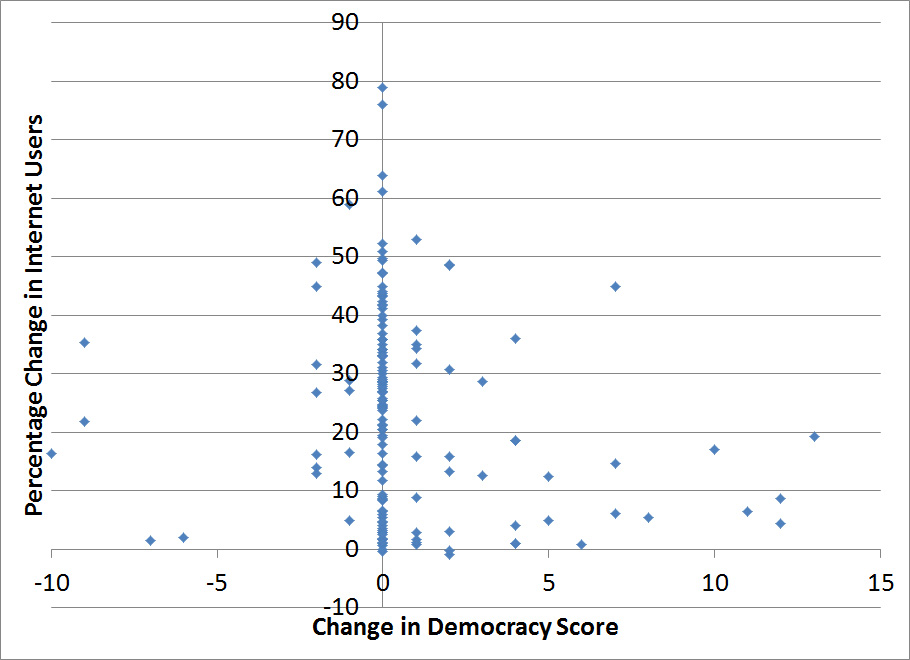
Internet_Democracy

Leon Wieseltier’s favorite curmudgeon/sock-puppet, Evgeny Morozov, demanded a graph showing that web interaction undermines autocracy. Philip N. Howard obliges (see above). The bottom line:

There are still no good examples of countries with rapidly growing internet populations and increasingly authoritarian governments.

A thought experiment for what it’s worth. The core truth about the Internet is that, unlike previous media, it truly rewards non-zero-sum interaction.

When I ran a dead-tree magazine, I was always aware of the competition, feared it, tried to beat it, saw its interests and ours (The New Republic back in the day) as opposed. With the Dish, every other website is a way to find new interesting material, direct more eyeballs toward it, and thereby encourage readers to use the Dish as a hub for other material. And that, in turn, helps us.

It’s even more salient now we’re independent and not even reliant on a parent media company’s home-page. Our major sources of new readers? Today: search engines, reddit, Twitter, Facebook and Google are our top five referrers. We need them the way they need us. Linking to other sites is essential to making your own part of the conversation. It’s a little thing – but it has definitely shifted my own psyche to more non-zero-sum interactions. Which is a fancy way of saying generosity and sense of our interconnectedness. I can see why the spread of that mindset – remember how many hours a day we now spending existing and communicating virtually – might help democratic civic culture.

The Last Blood Libel Trial

One hundred years later, David Mikics recounts the last recorded trial of blood libel in the West—Mendel Beilis, falsely accused of draining the blood of a young boy killed by gangsters, in Kiev:

In his trial, Beilis was defiant when he needed to be. He answered one of the judge’s opening questions, “To what religion do you belong?” with, he remembered [in his memoir], “something approaching a shout”: “I am a Jew.” As the trial went on, the prosecution’s case collapsed. The workers that Beilis supervised testified to his honesty; they knew he was incapable of murder. A 10-year-old boy, a friend of the dead [victim] Andrei, had been primed by the Tcheberiak gang to testify that Andrei had often played near the brick factory and had been chased off the factory grounds by Beilis. Instead, the boy stated that Andrei had never gone near the factory. The student who had distributed the anti-Semitic leaflets at Andrei’s funeral fainted when he took the stand. Then, in a moment of high drama, the lamplighter who had originally said that Beilis had chased Andrei from the brickyard recanted his testimony, proclaiming, “I am a Christian and fear God. Why should I ruin an innocent man?”

An Unscientific Ad

A male version of Dove’s latest ad campaign:

Virginia Postrel criticizes Dove’s “social experiment”:

Gil Zamora, the forensic artist, is indeed a well-respected professional who worked for many years doing composite sketches for the San Jose, California, Police Department. But, unlike his interview subjects, he knew the point of the exercise going in.

The “experiment” wasn’t double-blind. Zamora’s knowledge matters because a verbal description of any given feature allows a lot of interpretative leeway, and he could have unconsciously biased his drawings. “This is a social experiment,” he said in an interview, repeating the Dove mantra. “We were trying to show how women are their own worst beauty critics and how they see themselves and how others see them.” Right.

Exacerbating the potential for bias, Zamora deviated from his standard procedure, which includes giving the witness a chance to review the sketch and correct any misinterpretations. There are two possible sources of error in a composite sketch: the witness’s memory of what the person looked like and how that memory gets translated from impression to words to drawing. One witness’s “round face” is fat but oval, another’s is round and not especially fleshy, while another’s is what an artist would call square. Proportions mean different things to different people. And some people simply have limited vocabularies.

Release The Torture Report!

Joe Biden is now on board with getting the most authoritative of the investigations into the Bush-Cheney war crimes out in the open. You’d think the veep and the Senate Intelligence Committee would be enough to over-rule the CIA’s bed-wetting. But the CIA seems to me increasingly a shadow government, immune to the constraints and governance of the real one. We’re going to get the truth about them once we seize it from their cold and bloodied hands.

The Strange Hush Of Freezing To Death

Withstanding bears, frostbite and potential madness, Brian Phillips recently tracked the Iditarod by land and air. At one point his plane, named “Nugget”, froze up on the ground during a visit to the Diomedes Islands, the border between Russian and US territory:

We were stranded out there for three hours. It was the first time I ever understood why freezing to death is sometimes described as peaceful or soothing or just like falling asleep, descriptions that had always Blizzard Blankets Xinjiang In Northwest Chinaseemed to hint at some unfathomable mind-transformation within the freezing person, some power extreme cold had to enchant the brain’s basic mechanisms of homeostasis. It didn’t feel violent, that was the thing. Even with the wind ripping past you. It was like certain parts of your body just accrued this strange hush. Like you were disappearing piece by piece. I thought I’d be warmer outside and walking around than inside Nugget, so I would sort of exaggeratedly move one limb at a time, my left arm or whatever, and while I was concentrating on my left arm my right leg would start to be erased.

More than affecting my sense perceptions, though, the cold seemed to affect the way I thought about my sense perceptions. I’d take my glove off to adjust a zipper and lose feeling in my hand almost immediately and instead of thinking Holy no I need to get my glove back on right this second I’d sort of pause and go My, how interesting that my hand feels as though it’s visibly translucent. Then my brain’s inbox would gently ding. PLEASE DON’T DIE.

A personal anecdote: the priest who gave me my first Holy Communion and Sacrament of Reconciliation, and whom I served as an altar boy, died a couple of years’ ago. He was walking home on a cold night and was discovered the next day dead on the street. He had died of hypothermia. He was one of the gentlest priests I ever knew – a quietly devout and simple fellow – and it seemed horrifying that this man died on a street, alone, perhaps after a fall. But it’s also a relief to think that freezing to death is not as painful and as wretched as one might imagine. One reason I have not given up the faith is because of the kind of humility and sincerity I saw in that first priest. Others were not so lucky. But we shouldn’t let evil obscure the great good so many priests do every day, in ways others will never know about, but that, bit by bit, begin to heal the broken world.

(Photo: A herdsman whose fingers were injured by frost bite lies in a hospital January 9, 2006 in Fuyun County of Altay Prefecture, Xinjiang Uygur Autonomous Region, northwest China. A blizzard that swept in from Siberia and plunging temperatures to as low as 43 degrees below zero centigrade forced the evacuation of almost 100,000 people and stranded a further 220,000 in Xinjiang, according to the National Disaster Reduction Centre. By China Photos/Getty Images)

Spain’s Great Depression

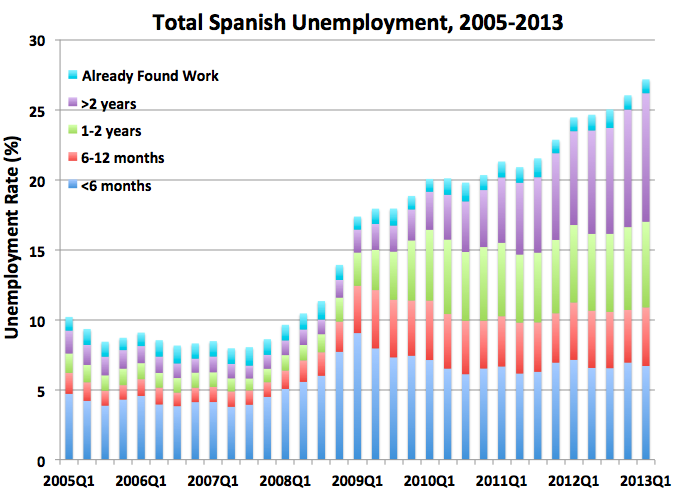
Spanish Unemployment Total

Matthew O’Brien fears that “Spain is beyond doomed”:

Spain’s labor market problems fall into two big buckets: too much regulation, and not enough education. It’s almost impossible for companies to get rid of older workers, which creates a horribly bifurcated labor market. There are permanent workers who can’t be fired, and temporary ones who can — and are. Indeed, as Clive Crook points out, about a third of Spain’s workforce are temporary workers who enjoy few protections and fewer opportunities. Companies go through these younger workers without bothering to invest much in their human capital, because why would they? These temporary workers will be let go at the first sign of economic trouble. Young people get stuck in a never-ending cycle of under-and-unemployment since firms are always hesitant to hire permanent workers who will always be on their books.

But it gets worse. The housing bust hasn’t just cast a shadow over household and bank balance sheets; it’s cast one over young people’s educations too. At its peak, building made up a whopping 19 percent of Spain’s economy, which, as Tobias Buck of the Financial Times points out, lured many young men into dropping out of school for well-paying construction gigs. But now that building has gone into hibernation, all of those young men are left with no work and no education to fall back on. And, again, even if they can find temporary jobs, it’s not as if the companies will spend money to develop their skills.