Yglesias Award Nominee

“Sarah Palin is an example of what can happen when a person is consumed by bitterness and grievances. It has a corrosive effect, and over the last several years she has, if anything, become even more brittle and embittered. From a human standpoint it’s a shame. And from a political standpoint it’s precisely the countenance and bearing conservatism and the GOP need to avoid,” – Pete Wehner on Palin’s latest phony outrage at the White House Correspondents’ Dinner, something she eagerly attended not so long ago (because there was a terrifying moment when I nearly ran into her).

No, I didn’t go this year. No media entity wanted me to; and the Dish has no White House correspondent, unless you call me one, and we’d rather spend our money on, well, journalism.

Ending The Gay Ban One Troop At A Time

The Boy Scouts of America recently announced that it plans to end its ban on gay Scouts but keep the ban on gay troop leaders. EJ Graff suggests an alternative:

Instead of accepting the gay-okay-till-21 recommendation, here’s my hope: that the Scout assembly at large will instead find a way to move forward on the earlier trial-balloon policy. A few months back, the Scouts let out the suggestion that perhaps each troop could decide its policy on gay members and leaders for itself. That was, I thought, a brilliant compromise, a kind of federalism that would allow each troop to remain in sync with its community’s attitudes.

Such a policy would make it possible for individuals locally to lobby and educate their neighbors and friends. Mormon-sponsored troops could live by their own strictures, while the Unitarians or some other group could independently sponsor a gay-welcoming troop across town. That policy would allow the Scouts’ ban to fade slowly, along with antigay attitudes, until they were ready to flush it away as an embarrassment. In the meantime, yes, individual gay kids would be marooned in hostile troops as they realize that they might be, you know, like thatbut no matter the policy, you know that those troops (and the families that are putting their kids in them) are not yet going to be welcoming, no matter what the Scouts’ official policy might be.

Meditation As Self-Defense

Sam Harris, a practitioner of meditation and Brazilian jiu-jitsu, connects the two:

Almost all our suffering is the product of our thoughts. We spend nearly every moment of our lives lost in thought, and hostage to the character of those thoughts. You can break this spell, but it takes training just like it takes training to defend yourself against a physical assault. You are thinking every moment and not aware of it, and the initial experience of anyone who seriously tries to meditate is one of discovering how incessant this cascade of thoughts is.

Graeme Wood sparred with Sam:

Harris likened training with an expert fighter to “falling into deep water without knowing how to swim.” He sees BJJ as a cycle of mock death and resurrection, wherein an expert may kill you many times per session. “To train in BJJ is to continually drown—or, rather, to be drowned, in sudden and ingenious ways—and to be taught, again and again, how to swim.”

Having read all this, I asked Harris to drown me.

I am several inches taller and several pounds stockier than Harris, who is 5 foot 9 and weighs 165 pounds, and I am undefeated in single combat—though only because I have never been in a fight and flee anytime I see anyone who looks even vaguely threatening. …

I soon found myself in what BJJ practitioners call a “rear naked choke,” which, while less alarming than it sounds, is lethal if applied unmercifully. At one point, I resisted by pushing my jaw between Harris’s elbow and my throat. That didn’t help. “He can choke your whole jaw into your throat,” [instructor Ryron Gracie] said. “It affects the carotid—through the jaw!” He said this with an air of Isn’t that cool? Later, once Harris had let me go, I had to agree: Yes, very cool.

A Lifetime Of Status Updates

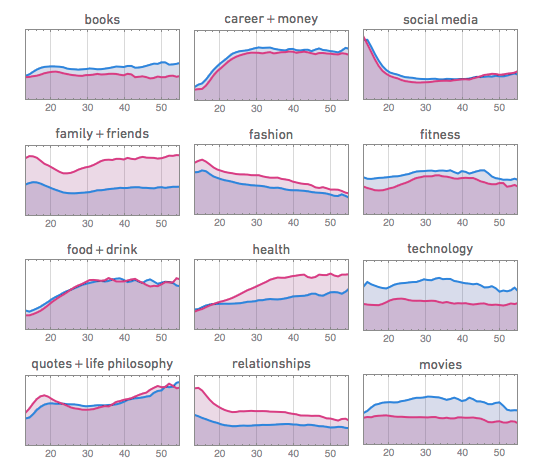
Stephen Wolfram extensively unpacks data from the Wolfram|Alpha Personal Analytics for Facebook, with more than a million submissions. The above charts visualize the popularity of subjects on Facebook, by age and sex:

It’s almost shocking how much this tells us about the evolution of people’s typical interests.

People talk less about video games as they get older, and more about politics and the weather. Men typically talk more about sports and technology than women—and, somewhat surprisingly to me, they also talk more about movies, television and music. Women talk more about pets+animals, family+friends, relationships—and, at least after they reach child-bearing years, health. The peak time for anyone to talk about school+university is (not surprisingly) around age 20. People get less interested in talking about “special occasions” (mostly birthdays) through their teens, but gradually gain interest later. And people get progressively more interested in talking about career+money in their 20s. And so on. And so on.

Some of this is rather depressingly stereotypical. And most of it isn’t terribly surprising to anyone who’s known a reasonable diversity of people of different ages. But what to me is remarkable is how we can see everything laid out in such quantitative detail in the pictures above—kind of a signature of people’s thinking as they go through life.

Optimum Diversity

A recent study found that societies “flourish when their populations have just enough genetic diversity, but not too much”:

Of the 145 nations considered in the 2000 comparison, Bolivia, one of the world’s poorer countries, was the most genetically homogenous. The authors calculated that if Bolivia’s level of genetic diversity were just one percentage point higher, its current per capita income would be 41 percent greater.

Ethiopia, where the first modern humans emerged 150,000 years ago, lies at the other end of the spectrum. There, extreme genetic diversity has led to crippling poverty. A drop in heterozygosity of just one percentage point would result in a 21 percent bump in contemporary income per capita, the authors found. … The nation that came closest to the ideal level of post-industrial genetic diversity? According to Ashraf and Galor’s calculations, it was the United States.

Leave Them Kids Alone

Jay Griffiths emphasizes the need for adventure in a risk-averse society:

William Golding’s Lord of the Flies is cited as if it were documentary evidence, as if, without the authority of adults, children will become vicious little monsters. Children are made to read this malignant propaganda against their childhood selves, and its message is beloved by those who believe that the opposite of obedience is disobedience. But these are false opposites. The true opposite of obedience is not disobedience but independence. The true opposite of order is not disorder but freedom. Most profoundly, the true opposite of control is not chaos but self-control. …

For there actually has been a real-life Lord of the Flies incident, and the result was the opposite of what is portrayed in the novel.

One day, in 1977, six boys set out from Tonga on a fishing trip. They left safe harbor, and fate befell them. Badly. Caught in a huge storm, the boys were shipwrecked on a deserted island. What do they do, this little tribe? They made a pact never to quarrel, because they could see that arguing could lead to mutually assured destruction. They promised each other that wherever they went on the island, they would go in twos, in case they got lost or had an accident. They agreed to have a rotation of being on guard, night and day, to watch out for anything that might harm them or anything that might help. And they kept their promises—for a day that became a week, a month, a year. After fifteen months, two boys, on watch as they had agreed, saw a speck of a boat on the horizon. The boys were found and rescued, all of them, grace intact and promises held.

How To Adjust Your Taste Buds

According to Joseph Bennington-Castro, “we don’t just eat foods because we like them, we like them because we eat them”:

After birth, your preferences continue shaping for the next two years. “Up until the age of 2 you will eat anything,” [psychologist Elizabeth Phillips] says. But then you become neophobic — that is, you don’t like new food. So if you hadn’t already been exposed to a certain flavor by the time you hit your terrible twos — whether through amniotic fluid, breast milk or solid food — chances are you won’t like it. At this point, most parents make a big mistake. “They think, ‘Oh my child doesn’t like this,’ but it’s actually anything new that they don’t like,” Philip says. So parents typically stop trying to feed their child that food and the kid ends up apparently hating it for years to come. “They don’t know that if they just keep giving it to their child, they’ll eventually like it.”

The key, then, is to make the food not new. Basically, you’ll like a new or previously hated flavor if you’re repeatedly exposed to it — studies suggest that it takes 10 to 15 exposures. “So if there’s something you don’t like, just eat it over and over and over again,” Philip says.

The Weekend Wrap

tintenfrass03

This weekend on the Dish, we took a break from politics to provide our usual eclectic mix of religious, books, and cultural coverage. In matters of faith, doubt, and philosophy, Gary Greenberg questioned psychiatry’s claims to be scientific, Barry Schwartz told us why we should settle for good enough, and Thomas de Zengotita offered an incisive critique of evolutionary psychology. Anne Kingston examined the mainstreaming of Buddhist mindfulness, Shel Silverstein described what God’s love feels like, and Richard Wolin pondered the dangers of monotheism. Christopher Hutton argued that to doubt is Christian, Vatican doctors gave their stamp of approval to JPII’s second miracle, Jim Holt thought the was universe wasn’t beautiful, and Adam Gopnik reflected on a parent’s love.

In literary coverage, Ernest Hemingway ruminated on the writer’s life, Flannery O’Connor noted why Southern writers love freaks, and Terrence Malick assigned books to his cast and crew. Mary Mann praised the cantankerous writing style of Max Beerbohm, Daniel Matthew Varley compared William Styron and DFW on despair, and wine turned out to be connected to writing in more ways than we realized. Will Glovinsky considered on attitudes toward crowds in literary history and digital modernity, Robert Frost didn’t hit it off with Ezra Pound, and Tony Hoagland suggested changes to the poetry curriculum. Victorian marriages were not something to aspire to, John McWhorter analyzed the linguistics of texting, and Jennifer Szalai investigated the various iterations of Oprah’s book club. Read Sunday’s poem here.

In assorted news and views, Viola Gad chemically-enhanced her dating life, researchers connected attractive voices to what they might indicate about the rest of a person’s body, and Jim Giles appraised Wikipedia’s demographics. Adam Baer reviewed the new Hummingbird music-notation system, Francie Diep reported on a creative way to increase the efficiency and bring down the cost of solar power, the U.S. government hoarded narcotics in the lead-up to WWII, and J. Hoberman saw a new installation at the Metropolitan Museum of Art, Street. MHBs here and here, FOTDs here and here, VFYWs here and here, and the latest window contest here.

– M.S.

(Image by Dr. Manfred Anders, from Wikimedia)
The Scourge Of Wiki-PR-News

The Sunlight Foundation’s new site, Churnalism, helps hunt it down. Rebecca J. Rosen explains:

“The tool is, essentially, an open-source plagiarism detection engine,” web developer Kaitlin Devine explained to me. It will scan any text (a news article, e.g.) and compare it with a corpus of press releases and Wikipedia entries. If it finds similar language, you’ll get a notification of a detected “churn” and you’ll be able to take a look at the two sources side by side. You can also use it to check Wikipedia entries for information that may have come from corporate press releases.

The worst culprit? Science writing:

In general, according to Devine, “science press releases seem to get more plagiarized than others.” For example, the Sunlight Foundation points to a CBS News article from last fall which shares several phrases — typically information-laced descriptions such as the list “found in hard plastics, linings of canned food, dental sealants” — with a press release from EurekaAlert!, as the Churnalism tool’s results show. Devine speculates that science journalism may run into this problem more frequently because “the language around the findings in those is so specific that it becomes very hard to reinterpret it.”

Is Grad School Worth It?

Joshua Rothman reflects on the question:

What does it mean to say that a decade of your life is good or bad? That it was worthwhile, or a waste of time? Barring some Proustian effort of recollection, a long period of years, with its vast range of experiences and incidents, simply can’t be judged all at once. The best we can do is use what psychologists call “heuristics”: mental shortcuts that help us draw conclusions quickly.

One of the more well-understood heuristics is called the “peak-end rule.” We tend to judge long experiences (vacations, say) by averaging, more or less, the most intense moment and the end. So a grad student’s account of grad school might not be truly representative of what went on; it might merely combine the best (or worst) with how it all turned out.

The most wonderful students will be averaged with the grind of the dissertation; that glorious summer spent reading Kant will be balanced against the horrors of the job market. Essentially, peak-end is an algorithm; it grades graduate school in the same way that a software program grades those essays on the S.A.T. Sure, a judgment is produced, but it’s only meaningful in a vague, approximate way. At the same time, it raises an important conceptual question: What makes an experience worthwhile? Is it the quality of the experience as it’s happening, or as it’s remembered? Could the stress and anxiety of grad school fade, leaving only the learning behind? (One hopes that the opposite won’t happen.) Perhaps one might say of graduate school what Aeneas said of his struggles: “A joy it will be one day, perhaps, to remember even this.” Today’s unhappiness might be forgotten later, or judged enriching in other ways.