No Women On The Road, Ctd

A reader writes:

In response to Vanessa Vaselka’s thoughtful essay on the lack of female road narratives, there is, of course, Zora Neale Hurston’s Their Eyes Were Watching God, which is a quest narrative in the long tradition of Western quest narratives that also addresses issues of gender roles and expectations about female sexuality. There are also many travel narratives written by female authors which also raise Vaselka’s concern about rape and violence. While there are many other kinds of exploration based upon careful attention and observation – I’m thinking about Dickinson and Marianne Moore, for example – these writers reinforce Vaselka’s point in other ways. Katherine Anne Porter’s short story “Flowering Judas,” about an American woman active in revolutionary politics in Mexico in the early 1920’s, yet intensely self-protective against male sexual advances and potential sexual assault, also speaks to Vaselka’s concerns.

Another reader suggests:

While it lacks the fame of Huck Finn, there is a really weird and wonderful book about the world’s greatest hitchhiker, a beautiful woman with massive oversized thumbs called Even Cowgirls Get The Blues by Tom Robbins. Sissy meets all sorts of people from a fashion designer to Jack Kerouac to a bunch of Lesbian Cowgirls and the sex guru/hermit that watches over them the hills of the badlands.

The trailer for the film adaptation is seen above.
The Most Caffeinated Countries

The US isn’t one of them:

Lindsey Bolger, director of coffee for Green Mountain Coffee Roasters, says if you measure the amount of coffee consumed per coffee drinker, the world champions live in Nordic countries. “Depending on which country, they’re up to eight cups of coffee per person, per day. In the U.S., we’re at maybe 2 or 2.5 cups of coffee per day,” she says. Americans actually used to drink a lot more coffee. Per person, we drank almost twice as much during World War II.

Quote For The Day

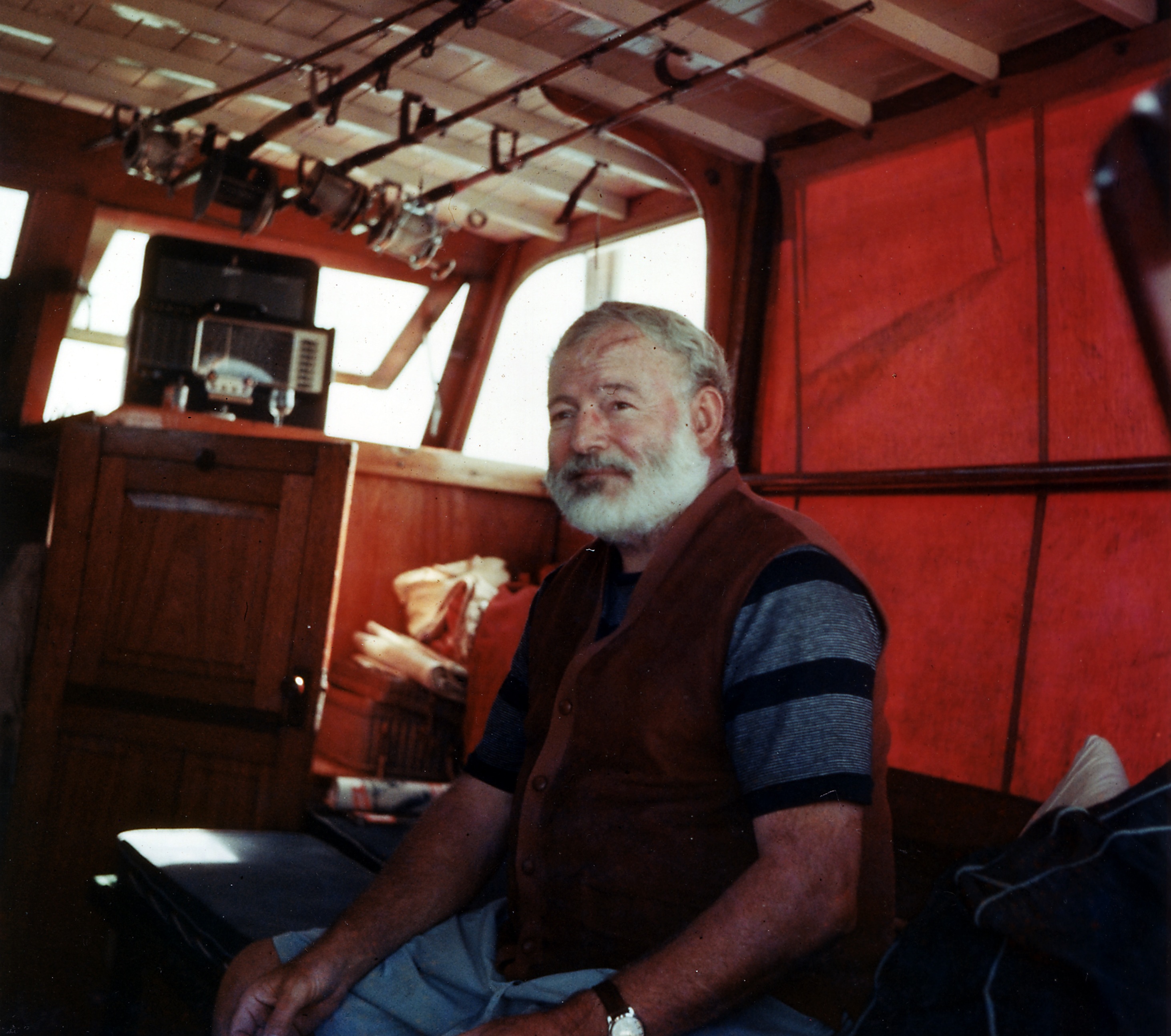
Ernest_Hemingway_1950

“Writing, at its best, is a lonely life. Organizations for writers palliate the writer’s loneliness but I doubt if they improve his writing. He grows in public stature as he sheds his loneliness and often his work deteriorates. For he does his work alone and if he is a good enough writer he must face eternity, or the lack of it, each day.

For a true writer each book should be a new beginning where he tries again for something that is beyond attainment. He should always try for something that has never been done or that others have tried and failed. Then sometimes, with great luck, he will succeed.

How simple the writing of literature would be if it were only necessary to write in another way what has been well written. It is because we have had such great writers in the past that a writer is driven far out past where he can go, out to where no one can help him,” – Ernest Hemingway, 1954 Nobel Prize Speech

(Hemingway circa 1950, via Wikimedia Commons)

The Haunted South

A quote from Flannery O’Connor’s essay, “Some Aspects of the Grotesque in Southern Fiction”

Whenever I’m asked why Southern writers particularly have a penchant for writing about freaks, I say it is because we are still able to recognize one. To be able to recognize a freak, you have to have some conception of the whole man, and in the South the general conception of man is still, in the main, theological. That is a large statement, and it is dangerous to make it, for almost anything you say about Southern belief can be denied in the next breath with equal propriety. But approaching the subject from the standpoint of the writer, I think it is safe to say that while the South is hardly Christ-centered, it is most certainly Christ-haunted. The Southerner, who isn’t convinced of it, is very much afraid that he may have been formed in the image and likeness of God. Ghosts can be very fierce and instructive. They cast strange shadows, particularly in our literature. In any case, it is when the freak can be sensed as a figure for our essential displacement that he attains some depth in literature.

Mike Springer finds audio of O’Connor reading from the same essay.

A Poem For Sunday

oldtruck

“Twenty-Year Marriage” by Ai:

You keep me waiting in a truck
with its one good wheel stuck in the ditch,
while you piss against the south side of a tree.
Hurry. I’ve got nothing on under my skirt tonight.
That still excites you, but this pickup has no windows
and the seat, one fake leather thigh,
pressed close to mine is cold.
I’m the same size, shape, make as twenty years ago,
but get inside me, start the engine;
you’ll have the strength, the will to move.
I’ll pull, you’ll push, we’ll tear each other in half.
Come on, baby, lay me down on my back.
Pretend you don’t owe me a thing
and maybe we’ll roll out of here,
leaving the past stacked up behind us;
old newspaper’s nobody’s ever got to read again.

(From The Collected Poems Of Ai © 1973 by Ai. Used by permission of W.W. Norton & Company, Inc. Photo by Flickr user Xiong)

How Scientific Is Psychiatry?

Not very, according to Gary Greenberg:

A detailed understanding of the brain, with its hundred billion neurons and trillions of synapses, remains elusive, leaving psychiatry dependent on outward manifestations for its taxonomy of mental illnesses. Indeed, it has been doubling down on appearances since 1980, which is when the American Psychiatric Association created a Diagnostic and Statistical Manual of Mental Disorders (D.S.M.) that intentionally did not strive to go beyond the symptom. In place of biochemistry, the D.S.M. offers expert consensus about which clusters of symptoms constitute particular mental illnesses, and about which mental illnesses are real, or at least real enough to warrant a name and a place in the medical lexicon. But this approach hasn’t really worked to establish the profession’s credibility. In the four revisions of the D.S.M. since 1980, diagnoses have appeared and disappeared, and symptom lists have been tweaked and rejiggered with troubling regularity, generally after debate that seems more suited to the floors of Congress than the halls of science. The inevitable and public chaos—diagnostic epidemics, prescription-drug fads, patients labelled and relabelled—has only deepened psychiatry’s inferiority complex.

The Nature Of The Crowd

Will Glovinsky reflects on attitudes toward crowds in literary history and digital modernity:

[A]mid the talk of “the riffraff” and the pervasive anxiety that from this rabble the revolution might spontaneously recur, [19th century French poet] Charles Baudelaire stood apart with his famous dictum épouser la foule (literally, “marry the crowd”). Baudelaire could register as well as anyone the terror of the crowd, but what made him different was his wish to be truly at home in the dirty, swarming city, and to do that he needed to embrace the frisson of crowds. Above all, it was Baudelaire’s willingness to explore the often erotic allure of anonymity and the pleasure of suppressed individuality that allowed him to investigate the logic of crowds — a logic that bears equally on our digital throngs.

In particular, Baudelaire was acutely sensitive to the fantasy of escape into otherness that crowds provide. In one of his prose poems he writes that the man who marries the crowd “adopts as his own all of the professions, all of the joys and miseries that circumstances present to him.” The person in the crowd takes up cares, pleasures, and tasks without a thought of one’s personal business or even one’s credentials. The bricklayer fights in the revolution; the butcher helps dislodge a cart from the mud; and so too the Redditor plays detective by heatedly comparing the eyebrows and jawlines of Tripathi and Tsarnaev….

For denizens of the digital space, the lesson of épouser la foule is not that we should all spend more time in the bowels of Reddit, but rather that we must recognize that we, like Baudelaire, wish to be at home in our new, crowded world. This entails coming to terms with not just the wisdom but also the idiocy, hyperbole, and prejudice of crowds. It means that we need to know beforehand the feverish, speculative nature of the virtual crowd, so that when a slanderous rumor is tweeted at least established news outlets will check their sources.

Despair On The Page

Daniel Matthew Varley reads William Styron’s Darkness Visible alongside David Foster Wallace’s writings on depression, finding the latter the more able guide to despair:

With Styron, we got the sense that he went through something terrible, came out of it and then wrote about it a head-scratching way as if describing some alien spaceship that fell in his backyard. Wallace comes off as someone going through it, describing something that was and always be inside of him. Wallace writes because he needs our support just as much as we need his. We identify with Wallace’s pain, and it enables us to conceive of others identifying with our own. That is powerful and full of beautiful incandescent meaning and creates a crazy-glue bond between an author and reader.

It also comes back to human nature, I guess. Who wants to hang out with the know-it-all who’s got his life together, writing his perfected prose on the back of a doily? Or would you rather be with the the guy who’s a lot more like you, still figuring things out, having moments of brilliance interspersed with royal fuck-ups but still searching for grace? If you answered the latter, you’re probably like a lot of other people who feel a strong bond to Wallace.