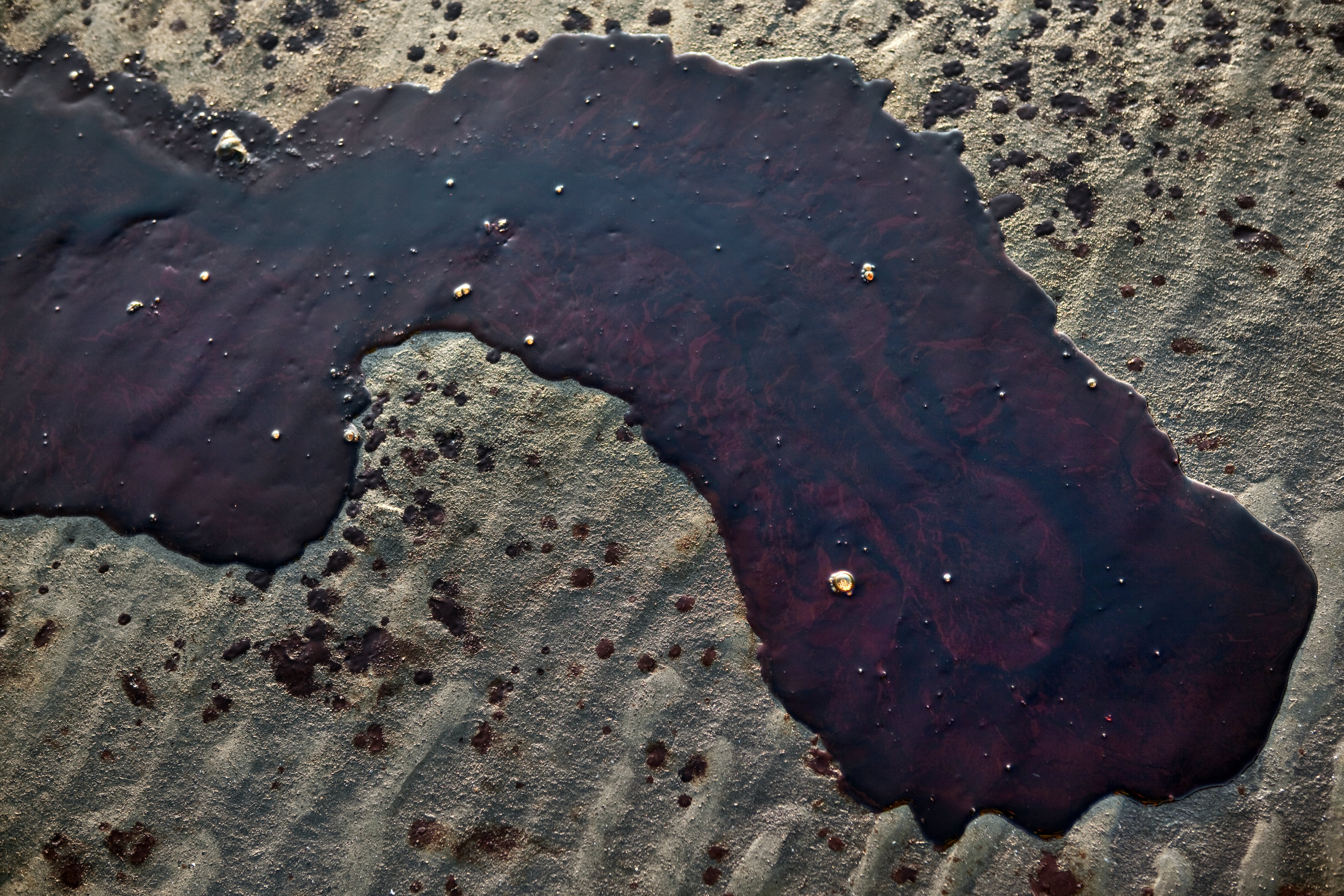
The Deepwater Horizon Legacy

British Petroleum's Oil Spill

Brian Merchant marks the three-year anniversary of the rig explosion by checking in on the damage:

Billy Nungresser, the president of Plaquemines Parish, which covers the part of Louisiana most heavily hit by oil after the initial spill, says that the oily fallout continues to this day. Just yesterday, Nungresser told a local TV news station that “oil is still washing ashore in places like Bay Jimmy.”

Meanwhile, fishermen say their catch is still drastically lower than it was before the spill—and the onslaught of chemical dispersants BP used to try to contain it. “The damage is still ongoing right now. My shrimp is down 40 percent and my oysters are down 93 percent,” George Barisich, president of the United Commercial Fisherman’s Association, recently told Eyewitness News. He believes that the dispersant—a proprietary cocktail called Corexit that is believed to be comprised of butoxyethanol, organic sulfonates, and a small concentration of propylene glycol—interrupted the reproductive cycle of the shellfish in the region.

Mark Hertsgaard focuses in on the controversy surrounding Corexit at the time:

Wilma Subra, a chemist whose work on environmental pollution had won her a “genius grant” from the MacArthur Foundation, told state and federal authorities that she was especially concerned about how dangerous the mixture of crude and Corexit was: “The short-term health symptoms include acute respiratory problems, skin rashes, cardiovascular impacts, gastrointestinal impacts, and short-term loss of memory,” she told GAP investigators. “Long-term impacts include cancer, decreased lung function, liver damage, and kidney damage. (Nineteen months after the Deepwater Horizon explosion, a scientific study published in the peer-reviewed journal Environmental Pollution found that crude oil becomes 52 times more toxic when combined with Corexit.)

BP even rebuffed a direct request from the administrator of the Environmental Protection Agency, Lisa Jackson, who wrote BP a letter on May 19, asking the company to deploy a less toxic dispersant in the cleanup. Jackson could only ask BP to do this; she could not legally require it. … Knowing that EPA lacked the authority to stop it, BP wrote back to Jackson on May 20, declaring that Corexit was safe.

Meanwhile, Shiva Polefka is disappointed by Congress’ inaction since the accident:

[T]he legislative branch has yet to pass a single law strengthening federal oversight of offshore oil and gas development. Congress did enact the RESTORE Act which allocates 80 percent of BP’s civil penalties to the affected Gulf Coast states, so they can apply it directly the environmental restoration and economic recovery. …

[O]ther than the RESTORE Act, Congress has done “nothing about the many other critical issues the Commission identified to improve safety and environmental protection.” A year ago, my colleagues at the Center for American Progress highlighted the need for Congress to raise the absurdly low $75 million limit on spill liability that oil companies currently face. While BP voluntarily excluded itself from the cap, the cleanup cost for Deepwater Horizon to date stands at over $14 billion, demonstrating starkly the fiscal as well as environmental risk to the American public from Congressional inaction. Similarly, Congress has refused to codify any new safety standards for offshore drilling. As a result, the gains made through Obama administration rulemaking, and voluntary industry efforts, could easily be easily lost to the whims of the next administration.

(Photo: Crude oil released following the sinking of the BP Deepwater Horizon drilling rig, washes ashore on June 9, 2010 on Grand Terre Island, Louisiana. By Benjamin Lowy/Edit by Getty Images)
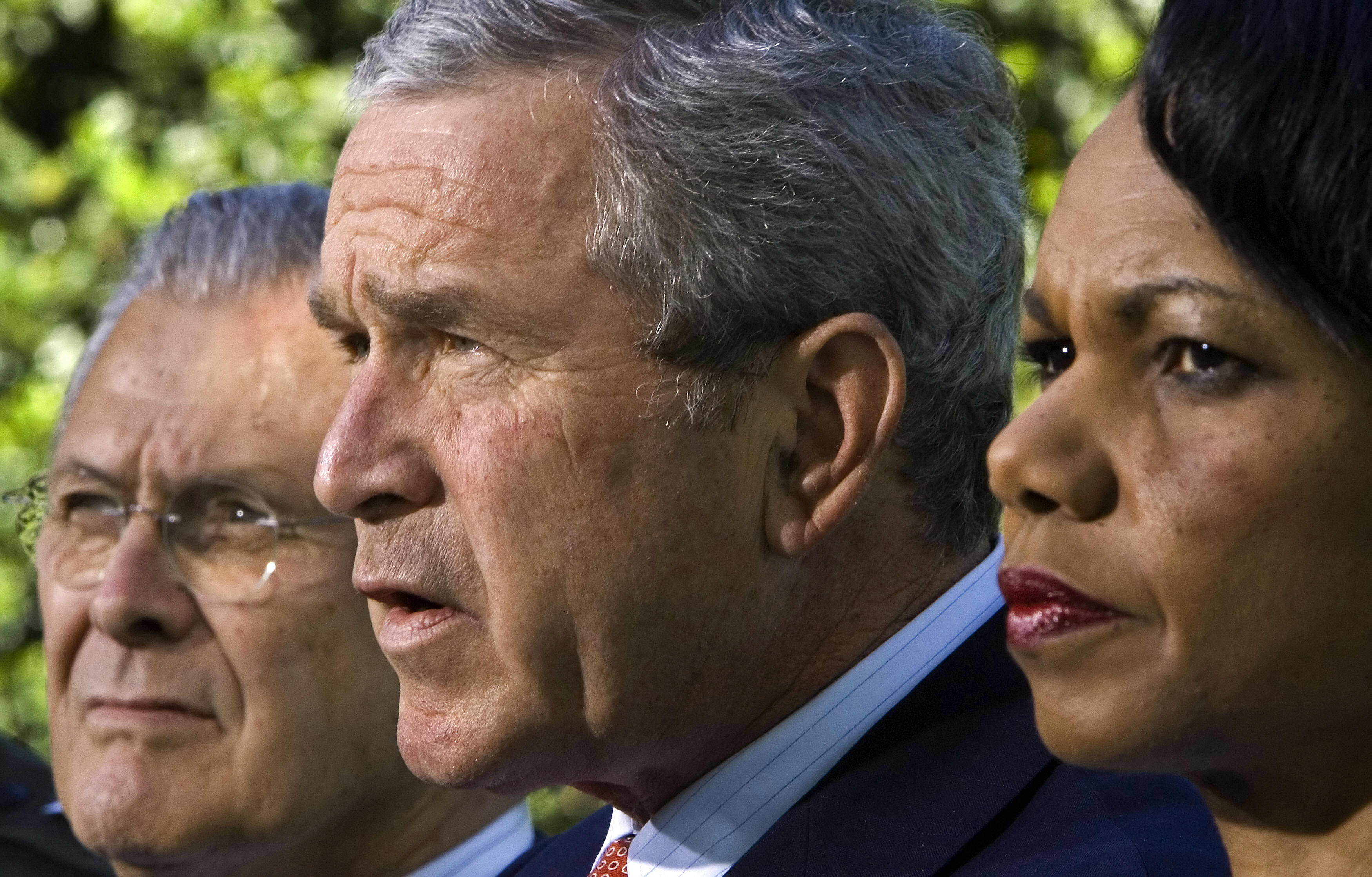

W In The Rearview Mirror

US President George W. Bush (C) delivers

Daniel McCarthy attributes the bump in Bush’s favorability to nostalgia:

Republicans have reason to be a little wistful for the Bush years. And there’s a feeling among centrists that whatever his mistakes, the party Bush led wasn’t as nasty as it has since become.

Larison suspects it’s a function of politics in the present:

If I had to guess, I’d say that Bush’s higher approval mostly comes from people that want to express their disapproval of the current president, and this includes quite a few people who disapproved of Bush while he was in office. One way to do that is to affirm that Bush did a good job. If we look at the results by party identification and ideology, that tells us part of the story. 84% of Republicans and 45% of independents say they approve of how Bush “handled his job as president.” Both figures are much higher than they were in 2008. This reflects the perverse rally effect that causes some people to embrace their disastrous leaders simply because people on the other “side” keep attacking him.

Weigel agrees after speaking to the Tea Party crowd:

In February 2010, a Tennessee lawyer named Judson Phillips put on a miraculously successful National Tea Party Convention, and he became, for a while, a movement spokesman. “The Tea Party movement does not defend George W. Bush,” said Phillips in February 2010, promoting the convention. “George W. Bush is not exactly one of my favorite people.”

Today, Phillips follows the “Obama was worse” line. “The one factor, other than just the passing of time that is helping Bush,” he says, “is the way people remember the economy of the Bush years versus what I like to call the Great Obama Depression. If you compare the Bush economy to the Obama economy, I think a lot of people look back wistfully saying, ‘I was better off 10 years ago than I am today.’ ”

This is just desperate counter-factual denialism. Some were blaming the debt Bush’s wars, spending and Wall Street collapse almost as soon as Obama took office! And that kind of denialism is not a way out of the Republican hole but burrowing deeper into it. Bouie argues that Republicans need to make a clear break with Dubya or perpetually suffer guilt by association:

[T]his is a recipe for failure. The GOP’s losing streak, from the 2006 wave election to Obama’s re-election victory in 2012 (with a brief respite in 2010), has everything to do with George W. Bush, and Iraq in particular. It’s what gave Democrats the House and the Senate in 2006, and it’s a large part of what gave Barack Obama the presidency in 2008. And for as much as election fundamentals could predict the outcome of last year’s election, it’s also true that Democrats got a lot of traction out of tying Republicans to the “failures of the past.” Americans still remember the Bush years, and as long as Republicans are committed to same policies, they’ll still hesitate to give them the reins of state.

Joan Walsh advises the right to keep Bush out of the spotlight:

Bush’s ratings only improved because he went away. His comeback campaign is likely to remind people of the disaster he left in his wake, and backfire on him, his brother and his party.

Recent Dish on George Bush revisionism here.

(Photo: US President George W. Bush delivers remarks 01 May 2006 from the South Lawn of the White House in Washington, DC on the recent trip to Iraq by US Secretary of Defense Donand Rumsfeld and US Secretary of State Condoleezza Rice. Three years after his famous photo-op before a banner hailing ‘Mission Accomplished’ in Iraq, Bush declared that the war-torn country had finally turned a corner in establishing security and democracy. By Paul J. Richards/AFP/Getty Images.)

Bill Keller Won’t Correct An Error Of Fact

The former executive editor of the New York Times recently wrote the following sentence on his blog:

The editors (I was one at the time) argued that what constituted torture was still a matter of debate, that this issue was not just linguistic but legal and had not yet been resolved by a court, and that the word was commonly applied to such a range of practices as to be imprecise.

This is untrue. As I subsequently pointed out, there is a plethora of court cases that deal with the techniques Bush and Cheney authorized, and all of them found them to be torture. None had even the slightest equivocation about it. In fact, the one torture tactic that both former president Bush and former veep Dick Cheney have openly bragged about – waterboarding – has been ruled torture by domestic and international courts for decades. You could argue that there was a debate about some of the techniques, but not waterboarding in any way shape or form. If you were squeamish, you could have used the term “torture and other brutal interrogation techniques” in the NYT to describe the policies of the US government under Bush and Cheney. But Keller didn’t. Even that was too daring for him.

A factual untruth is still sitting on the blog of the former executive editor of the NYT. He has now written a subsequent post without any correction of the previous one, and not responded to the mountain of comments taking him to task. He appears to be compounding his cowardly refusal to use the English language when editing the paper with uncorrected factual untruth on his blog. And people wonder why journalists are held in such low regard.

If the former editor of the NYT doesn’t bother correcting the record, why should anyone else?

Could The FBI Have Prevented The Marathon Bombing?

While members of Congress continue to question whether or not the FBI properly handled its 2011 investigation of Tamerlan, Eli Lake explains Russia’s likely ulterior motives:

Russia’s intelligence service, the FSB, warned the FBI in 2011 about a young Chechen named Tamerlan Tsarnaev, who they believed had become radicalized and was prepared to join an underground organization in Russia. The FBI interviewed the man, searched its databases and found nothing, and closed the case the same year. … But there were good reasons that the tip didn’t trigger a more aggressive American investigation, current and former intelligence and law-enforcement officials tell The Daily Beast.

Those officials pointed to the FSB’s habit of treating much behavior by Chechens as suspicious, and nearly all such behavior as terror-related. The Tsarnaev request, they speculated, was likely triggered by the FSB’s concern that he would participate in or provide support to Chechen insurrectionists in Russia, rather that by any sense of a threat to American interests.

Hunter Walker speaks with a former FBI counterterrorism executive who further details why the US has to be suspicious of such requests from foreign governments:

“Generally speaking, certain foreign governments try to keep track of their expatriates, especially those who are outspoken on human rights issues,” the former [FBI] executive explained. “Countries will submit names to us and will say, you know, this guy’s a bad guy, a terrorist, or a drug trafficker, or whatever. And what you have to be careful about is, you may be being used as a proxy by a foreign government or a foreign intelligence agency to keep track of or to report back on their expatriate community in the United States. Their intent may not be as straightforward as determining whether or not they’re a terrorist or not.”

The Seedy Side Of The Little Prince

little-prince

On the 70th anniversary of the famous children’s book, Amy Benfer criticizes the prince’s understanding of love:

He is driven off his home planet when made half mad over the love of a flower, a rose described as vain, weak, emotionally manipulative, “contradictory,” and given to “silly pretensions,” and who often coughs to hide her lies. “You must never listen to flowers,” confides the prince. “You must look at them and smell them.” This unflattering portrayal of romantic love seems even less appealing when one considers that the prince’s rose is widely considered to be a stand-in for [author Antoine de Saint-Exupéry’s] wife, Consuelo Sunsin, a tempestuous beauty from El Salvador (like the prince’s planet, home to three volcanoes), whom he often left alone during his travels, while he engaged in frequent adultery — the sin so singular to adulthood it shares its name.

Consuelo was no shy flower herself, but the portrait she created of their marriage in her posthumous memoir The Tale of the Rose: The Love Story Behind the Little Prince, published days before the centennial celebration of Exupéry’s birth in 2000, was damning enough to put quite a damper on the festivities.

Despite the devout love it has inspired in generations of impressionable teenagers about to cross over into courtships of their own, Le Petit Prince is not a particularly convincing love story. It is better at describing the platonic friendship between equals that sustain men wandering away from their women: the prince and the fox; the pilot and the prince. The prince protects his rose, shields her behind glass, but never understands her. In a grisly twist, the souvenir he brings back to his planet to commemorate his travels — the sheep in the box — may or may not kill her.

(Photo: Graffiti of the Little Prince in Bratislava by Flickr user bekassine)

The Immigration Reform Calculus

Emily Schuletheis claims that the “immigration proposal pending in Congress would transform the nation’s political landscape for a generation or more — pumping as many as 11 million new Hispanic voters into the electorate a decade from now in ways that, if current trends hold, would produce an electoral bonanza for Democrats and cripple Republican prospects in many states they now win easily.” She imagines what would have happened if illegal immigrants could have voted in 2012:

Key swing states that Obama fought tooth and nail to win — like Florida, Colorado and Nevada — would have been comfortably in his column. And the president would have come very close to winning Arizona.

Republican Mitt Romney, by contrast, would have lost the national popular vote by 7 percentage points, 53 percent to 46 percent, instead of the 4-point margin he lost by in 2012, and would have struggled even to stay competitive in GOP strongholds like Texas, which he won with 57 percent of the vote.

Harry Enten finds these calculations laughable. His analysis:

All told, it would seem that only about 1.7 million new Latino voters would be added if undocumented immigrants were granted citizenship. Nationally, this would be a net of about 775,000 votes. This would increase Obama’s vote margin, but not to 7pt; it would only go up to about 4.4pt – in other words, half a point from where it actually was in November 2012. Even adding in new Asian voters, who vote at a lower rate than even Latinos, and other undocumented immigrants (and controlling for the percentage who apply for citizenship, percentage of citizens who vote, and the percentage who voted for Obama), the margin probably only goes up to, at most, 4.6pt.

The amount this would shift individual states in elections is debatable. Take Nevada, where, at last count, there were 190,000 undocumented immigrants – the highest percentage of any state population. Most of them are Latino. Apply the same math we did above, Obama would have gained about 17,000 votes. It would have increased his state margin of victory by 1.4pt. That’s not nothing, but we’re talking about the state with the largest percentage undocumented immigrants.

Nate Cohn’s math is similar. Bouie’s read on the situation:

Democrats do stand to strengthen their advantage with Latino and Asian American voters. What Republicans gain, on the other hand, is a chance to compete. Which, given their current poor standing, is far better than nothing.

“Are You Gay?” Is A Valid Question

This embed is invalid

Kevin Sessums explains why he has no problem asking closeted celebrities about their sexuality:

In the past I was like, Never out anybody. I was very adamant about that and at some point I sort of switched. I thought, You know what? I’m not going to buy into somebody else’s shame. They can deny it. I don’t give a shit. That’s fine. But I’m not going to be denied the question like it’s something shameful. Also, I’m not asking them what they do in their bedroom. I’m not asking them if they are a top or a bottom or what their sexual proclivities are. If someone is straight, that part of their life infuses all aspects of who they are. They talk about it all the time, and it’s not about being private.

I understand if you’re a movie star, you’re selling an image and people have to be able to project things onto you, especially if you are a romantic lead. I understand all of that in the abstract. But I’m not an adjunct to their career completely. I’m there as someone who’s got a job to do. I’m there to have a conversation. I’m not their agent. I’m not their PR person. That’s not my job. My job is to have conversations with them as people.

I remember the first time I was asked this. It was in the back of a cab filled with former Yalies. Rich Blow (my then house-mate and now called Richard Preston Bradley) was in the passenger seat and looked over his shoulder and asked the question as if it were the equivalent of “are you asthmatic?” It floored me (I think I was around 22).

In a casual conversation, it was jarring – almost thirty years ago. But now, in the context of a consensual interview, it seems to me to be as valid an inquiry as “Are you straight?” It’s not outing someone if it’s a question, asked out of mere curiosity and non-judgment. It’s outing someone if it’s a statement made without their consent, as an act of public shaming.

The Secret To Marriage Is Not Winning

According to Tom Junod:

A fight to the finish is what finishes a marriage. That’s because over the course of married life, people supply their spouses with precisely what’s required to finish them off. The question is not who can win, because anyone can win if they’re willing to go far enough — if they’re willing to win at the cost of love and respect. The question is who can abstain from winning, who can resist the temptation of winning, which, like any other marital temptation, is always there.

But how do you do that? Well, you don’t go to sleep angry, as the old saying goes. And you don’t say what can’t be unsaid. And you don’t fight drunk, because not only will you then say what can’t be unsaid; you will find out what it is.

A very wise man.