Chart Of The Day

Bullying

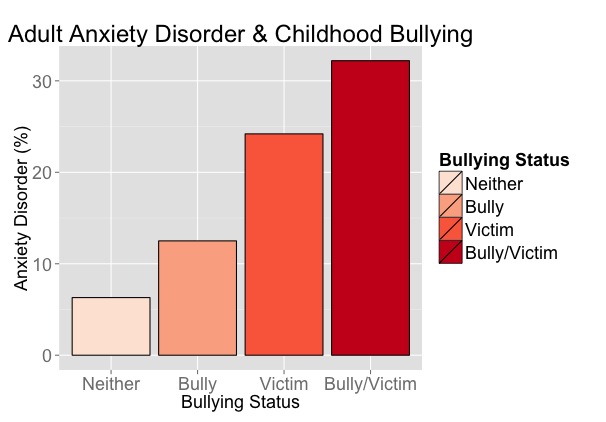
Bullying has long-term consequences:

The first column represents the rate of anxiety disorders in the adults who were neither bullies nor victims in childhood. The second and third are those who were just bullies or just victims, and the last is the rate of disorder among adults who were both bullies and victims of bullying. Although anxiety is a universal experience, an anxiety disorder is a severe and potentially disabling condition. The rate of such disorders is almost four time as high among victims as among those with no experience of bullying, and nearly five times as high among those who were both bullies and victims.

Yes, Of Course It Was Jihad, Ctd

Dreher notes why extremist Islam may be even more susceptible to violent expression than other religions that have proven extremely bloody in the past:

When a Christian murders, as many have done, sometimes with church sanction, he acts in direct contravention of Christ’s example and command. When a Muslim murders, he sometimes carries out Muhammad’s command, which is to say, Allah’s. … Obviously many, many Muslims choose less bloodthirsty interpretations of these verses, and this is the sort of thing that non-Muslims should encourage, for the sake of peace. Nevertheless, the existence of these verses, and the extremely high regard Islam has for its holy book, makes it harder to come against those who wish to kill in the name of Islam.

Millman counters:

If we were to test the proposition, “Islam is inherently more violent than other religions,” we’d need to compare Islamic civilization across time and space to other civilizations (and control properly for other factors). Are Dreher and Sullivan quite sure of what the result of such a comparison would be? Are they quite sure that, say, things like cousin marriage, or a burgeoning population of underemployed males, or the legacy of Cold War-era arms races, or the coincidence of massive oil wealth in the hands of a particularly puritanical sect on the Arabian peninsula, or the intrusion of Zionism, or the demographic decline of Christian Europe (and Russia), or the ructions of modernization meeting a subordination of women that pre-dates Islam, or . . . well, there’s a long list of theories for why Islam’s borders are bloody now. Are we quite sure that those theories are less-correct than the theory, “they are getting their ideas from a bad book?”

But Millman is completely misrepresenting my post, the third sentence of which is the following:

All religion, including Christianity, is susceptible to the violence associated with tribalism and fundamentalism. Christianity’s murderousness through the ages is a matter of historical fact, from the Crusades to the Inquisition and beyond.

That was also the core point of the essay I wrote over a decade ago and linked to this week and stand by:

[Osama bin Laden’s theology has] roots in an extreme and violent strain in Islam that emerged in the 18th century in opposition to what was seen by some Muslims as Ottoman decadence but has gained greater strength in the 20th.

I have long believed that this kind of Internet-based, tradition-free, radical Islam is a creation of modernity – not integral to the faith as lived by countless Muslims for centuries. I have long put it in the historical context of Islam’s long heritage of peaceful governance and human charity. And in many ways, Christianity has more to account for than Islam over the centuries.

After all, it takes a lot more evil to turn a radical non-violent homeless pacifist like Jesus into the cause for a murderous Crusade than it does to select justifications of violence from the Koran and re-enact them. But my reader’s point about the unique challenge modernity poses to religions that claim territory as sacred and that insist that doctrines cannot be altered one iota from texts written centuries ago is a real one. Christianity has reason and clear doctrines of nonviolence to guard against this. But is bombing abortion clinics Christianist terrorism? Abso-fucking-lutely. Freddie reframes the debate:

To me … the question isn’t whether Tamerlan Tsarnaev believed he was waging jihad. The question is, what’s the difference for our next step? How and why would a religious motivation matter? Where the question of Islamic extremism is made relevant is in our perception that there is a larger network of extremists who are eager and able to launch violent attacks against this country. As you know, I’m a skeptic about the size and destructive ability of that network. But it is ancillary to the conversation, because all of our current best evidence suggests that the Tsarnaev brothers worked alone, and had no connection to Al Qaeda or any other anti-American group. The analogy for the Tsarnaev brothers shouldn’t be to the 9/11 hijackers but to the Fort Hood shooter or the DC snipers. Sure: individuals or small groups have the ability to be inspired (in whole or in part) by Islam, along with personal anger and feelings of inadequacy and grievance against American foreign policy and plain old sociopathy. And because of the reality of modern technology, these people have the ability to kill other people. What they do not have, and should not be mistaken for having, is the ability to represent a serious threat to the basic security and prosperity of this or any other country.

On that I am in total agreement. I don’t think there’s much we can do to stop this kind of thing, except constitutional surveillance, public vigilance, and withdrawal of our troops from Muslim countries. The Tsarnaev brothers do not represent a resurgence of al Qaeda; they represent the permanent threat religious fundamentalism poses to modernity, especially if that religion believes itself under siege and has texts that sanction the murder of infidels and apostates. Of course, this threat may be magnified by psychological distortion, personal history, contingent events, and pure chance. But that does not mean it is a chimera. The blood on the streets of Boston was real and red enough.

Original Content Pays Off

For Netflix:

The company added more than 3 million subscribers (2 million in the U.S.) last quarter, which, at $7.99 per subscription, means revenue nearly equaled the full price of the $100 million “House of Cards” series that debuted early this year.

Did “House of Cards” lure 2 million more people, alone? No. We don’t know how many Netflix subscribers watched the series, and we certainly don’t know what share of the new subs joined just specifically because of the Kevin Spacey vehicle.

So what did “House of Cards” really buy? Allegiance. Nearly 90 percent of Netflix subscribers said “House of Cards” made them less likely to cancel, according to a survey by Cowen and Co.

Notice how content matters commercially. People will pay for good stuff – not listicle crack. Zachary M. Seward points out that “Netflix now has 29.2 million people in the US subscribed to its $8-a-month streaming plan, which is, for the first time, greater than HBO’s domestic subscription base of 28.7 million”:

The comparison between Netflix and HBO isn’t perfect, but they increasingly appear to be on similar trajectories. Both started by offering only movies that had long been out of theaters, then ventured into original programming—HBO in 1997 with Oz and Netflix earlier this year with House of Cards. Meanwhile, all of HBO’s customers buy it as an add-on to existing cable TV subscriptions, but HBO Go now offers all of the network’s programming over the internet, like Netflix. At the moment, it’s just a free perk for existing subscribers, but executives at HBO parent Time Warner have been hinting at a future when HBO Go is sold directly to consumers.

“The goal is to become HBO faster than HBO can become us,” Ted Sarandos, Netflix’s chief content officer, put it recently.

(Video: Trailer for the Netflix Original Hemlock Grove, which has gotten bad reviews but appears to be popular with Netflix users.)

Yes, Of Course It Was Jihad, Ctd

Explosions At 117th Boston Marathon

Greenwald goes another round:

The only evidence [Andrew] can point to shows that the older brother, Tamerlan, embraced a radical version of Islam, something I already noted. But – rather obviously – to prove that someone who commits violence is Muslim is not the same as proving that Islam was the prime motive for the violence (just as the aggressive attack by devout evangelical George Bush on Iraq was not proof of a rejuvenation of the Christian crusades, the attack by Timothy McVeigh was not proof of IRA violence, Israeli aggression is not proof that Judaism is the prime motivator of those wars, and the mass murder spree by homosexual Andrew Cunanan was not evidence that homosexuality motivated the violence).

Islam or some related political ideology may have been the motive driving Tamerlan, as I acknowledge, but it also may not have been. You have to produce evidence showing motive. You can’t just assert it and demand that everyone accept it on faith. Specifically, to claim this is terrorism (in a way that those other incidents of mass murder at Aurora, Sandy Hook, Tucson and Columbine were not), you have to identify the “political or social objective” the violence was intended to promote: what was that political or social objective here? Andrew doesn’t have the slightest idea.

I have much more than the slightest idea. I have massive amounts of evidence, outraged testimonies from the family, a horrifying web history, bombs that follow to the letter instructions from an al Qaeda publication, public, extremist spats with his own mosque, and on and on. And this is slippery language:

[T]o prove that someone who commits violence is Muslim is not the same as proving that Islam was the prime motive for the violence …

But Tamerlan was not just a Muslim. He was an extremist, fanatical Muslim who had quite obviously self-radicalized. I have made that distinction repeatedly. If all we had was evidence that he attended a mosque and called himself a Muslim, I’d agree with Glenn. But we have a mountain of evidence that Tamerlan was far more extremist than 99.9 percent of the entire American Muslim population. Why will Glenn not acknowledge this?

His other point is a much more interesting one:

“[T]errorism” does not have any real meaning other than “a Muslim who commits violence against America and its allies”, so as soon as a Muslim commits violence, there is an automatic decree that it is “terrorism” even though no such assumption arises from similar acts committed by non-Muslims. That is precisely my point.

He means, I think, by “terrorism” how terrorism is viewed by the majority in contemporary America. And there is some truth to this point – unfortunately. But does Glenn ever wonder why? Extremist Islam has developed quite a reputation in the last couple of decades, wouldn’t you think? When an al Qaeda enthusiast and religious fanatic decides to bomb the Boston Marathon, is it really outrageous to infer some connection? If he were a Tim McVeigh type, with a web history of black helicopter paranoia, do you think we’d be hemming and hawing about his motives? These terrorist events are designed for maximal media exposure, and they deploy random civilian mass-murder to publicize a cause. They are rational plots.

So to take Glenn’s other examples, they are all hideous killing sprees by gunmen with grudges and fantasies and mental illness. There seemed to be no deeper motive. Fort Hood is a more interesting case – a gun attack on fellow soldiers, while yelling Allah. That seems to me to be clearly at core a terrorist event – but fused with what we can see were workplace issues. He was a Muslim, but the US government continues to describe the attack as an act of workplace violence – not terrorism. I think the evidence points to a confluence of religious radicalism and “going postal.” He attacked his own base and had previously given out cards calling himself a “soldier of Allah.” We have no such workplace frustration to ascribe to Tamerlan: he picked a classic terror target – a televised public event, symbolizing he unity of all people and all faiths in the simple act of running.

Extreme Islamism is a threat to us all. That does not mean we empower it more with Cheney-esque over-reaction or anti-Muslim bigotry (which can create more self-radicalized mass murderers). We can make the distinction between this kind of violent fundamentalism and mainstream Islam, practiced by 99.9 percent of American Muslims. We can stop invading Muslim countries. We can defuse the drama by trying one of the accused in a civilian court. We can ensure that next year’s Boston Marathon is overwhelmed with participants. We should not torture Tsarnaev the way Bush and Cheney did Padilla – on much flimsier grounds. And we can do all this without slipping into the see-no-evil denial that Glenn has, sadly sunk into.

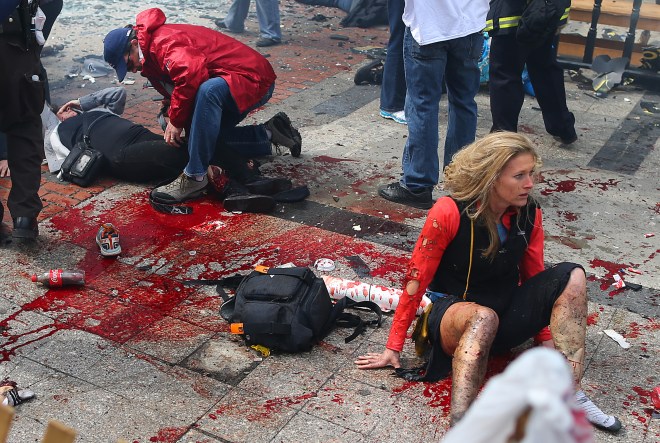
(Photo: Victims are in shock and being treated at the scene of the first explosion that went off near the finish line of the Boston Marathon. By John Tlumacki/The Boston Globe via Getty Images)
The Sequestered Skies

Andrew Stiles, who makes Rush Limbaugh seem bipartisan, wonders if the Obama administration is “trying to maximize the pain of sequestration”:

The FAA has insisted these cutbacks are unavoidable, but the administration has a clear political interest in maximizing the public’s outrage, so critics aren’t buying it. The airline industry has complained that it is caught in the middle of the political fight over sequestration and that the FAA risks interrupting services more than necessary. One industry insider tells National Review Online that the airlines are being used as a “political football” in this debate and suggests that the FAA’s cuts don’t “really have to be done in this way.”

Good try. But wrong

[A]ir traffic control slowdowns were totally predictable. At least 70 percent of FAA’s expenses are personnel-related so it was inevitable that the 5.1 percent across-the-board sequester cut would be felt in everything the agency does including — or especially — in its primary function: managing air traffic. When you set up a system like sequestration that requires an agency or department to cut every program, project, and activity by the same percentage, and when an agency’s spending is mostly for salaries and other compensation-related expenses, it’s not hard to see from the start that there has to be an impact on the number of people doing that agency’s work.

No amount of outraged statements from Senate and House Republicans changes that budget reality.

Recent Dish on the sequester here.

Ask Brill Anything: Hospitals Running Up The Tab

Here he details how non-profit hospitals have become so profitable, with a follow-up explaining how difficult it was for him to decode medical bills:

While on the subject of hospital revenues, just last week a maddening new study came out indicating that hospitals make even more profit when they screw up:

The study is based on a detailed analysis of the records of 34,256 people who had surgery in 2010 at one of 12 hospitals run by Texas Health Resources. Of those patients, 1,820 had one or more complications that could have been prevented, like blood clots, pneumonia or infected incisions. The median length of stay for those patients quadrupled to 14 days, and hospital revenue averaged $30,500 more than for patients without complications ($49,400 versus $18,900). Private insurers paid far more for complications than did Medicare orMedicaid, or patients who paid out of pocket. …

The study does not imply that hospitals intentionally complicate surgeries to bring in more revenue. Most surgeries, about 95 percent, go off without a hitch. What it does suggest to the surgeon, writer and Harvard professor Atul Gawande is that hospitals now see little reason to invest in technologies that would reduce complications when the only prize at the end would be lower income.

Yesterday, Steve gave an overview of why US healthcare is so expensive. You can also go here, here and here to read our coverage of his must-read Time cover-story, “Bitter Pill: Why Medical Bills Are Killing Us”. Ask Anything archive here.

Terrorism Knows No Race

Peter Beinart notes that, despite what you might hear from certain Republicans, “the Tsarnaevs hail from the Caucasus, and are therefore, literally, ‘Caucasian.'”:

At base, the reason it’s so hard for people to accept that the Tsarnaevs are white is because, since America’s founding, being white has meant, both culturally and legally, being “one of us.” And since 9/11, in particular, being Muslim has meant the opposite. As a light-skinned Muslim, Dzhokhar Tsarnaev straddles that divide. But he straddles it in other ways too. He was a pothead, a devotee of hip hop, a lifeguard, a high school wrestler, an aspiring dentist. And yet he became, it appears, a murderer on behalf of a fanatical species of Islam. He’s a type that has reappeared again and again in our history, from every faith and in every shade: an American at war with America, both intimately familiar and frighteningly alien at the same time.

This was American-born Jihad – emboldened, according to the younger brother, by America’s wars in Iraq and Afghanistan. The neocons’ drive for yet another war on a Muslim country, Iran, will bring alienated Shiites into the loony mix. Fanatical Islam is the culprit here. But we unwittingly compounded that with neoconservatism, generating even more hatred that can then come at us from within.

This is emphatically not to argue that we should blame America first. But we have not helped ourselves by the way we responded under Bush and Cheney. Which is why it is surreal to hear some neocons seeming to believe this validates their worldview, rather than damning it.

A Brain-Damaged Bomber?

Boston Marathon Bombing Suspect Tamerlan Tsarnaev Boxing Pictures

Travis Waldron encourages medical examiners to check Tamerlan’s corpse for chronic traumatic encephalopathy (CTE), the brain disease suffered by boxers and football players who take repeated blows to the head:

[I]t’s worth exploring every angle, including the possibility that brain injuries and CTE may have compounded problems Tsarnaev was already experiencing. CTE has, after all, been found in boxers as young as 17, and it has been linked to changing behaviors, depression, and dementia. And though it may seem like a diversion to investigate its role in Tsarnaev’s personality, CTE was an immediate consideration in recent tragic deaths like the murder-suicide committed by Kansas City Chiefs linebacker Jovan Belcher and the suicide of Hall of Fame linebacker Junior Seau.

Anything but Jihad. Yes, we can explore every angle, but this is almost a parody of liberal wish-mongering. Tamerlan’s brain was damaged by religious fanaticism and fundamentalism.

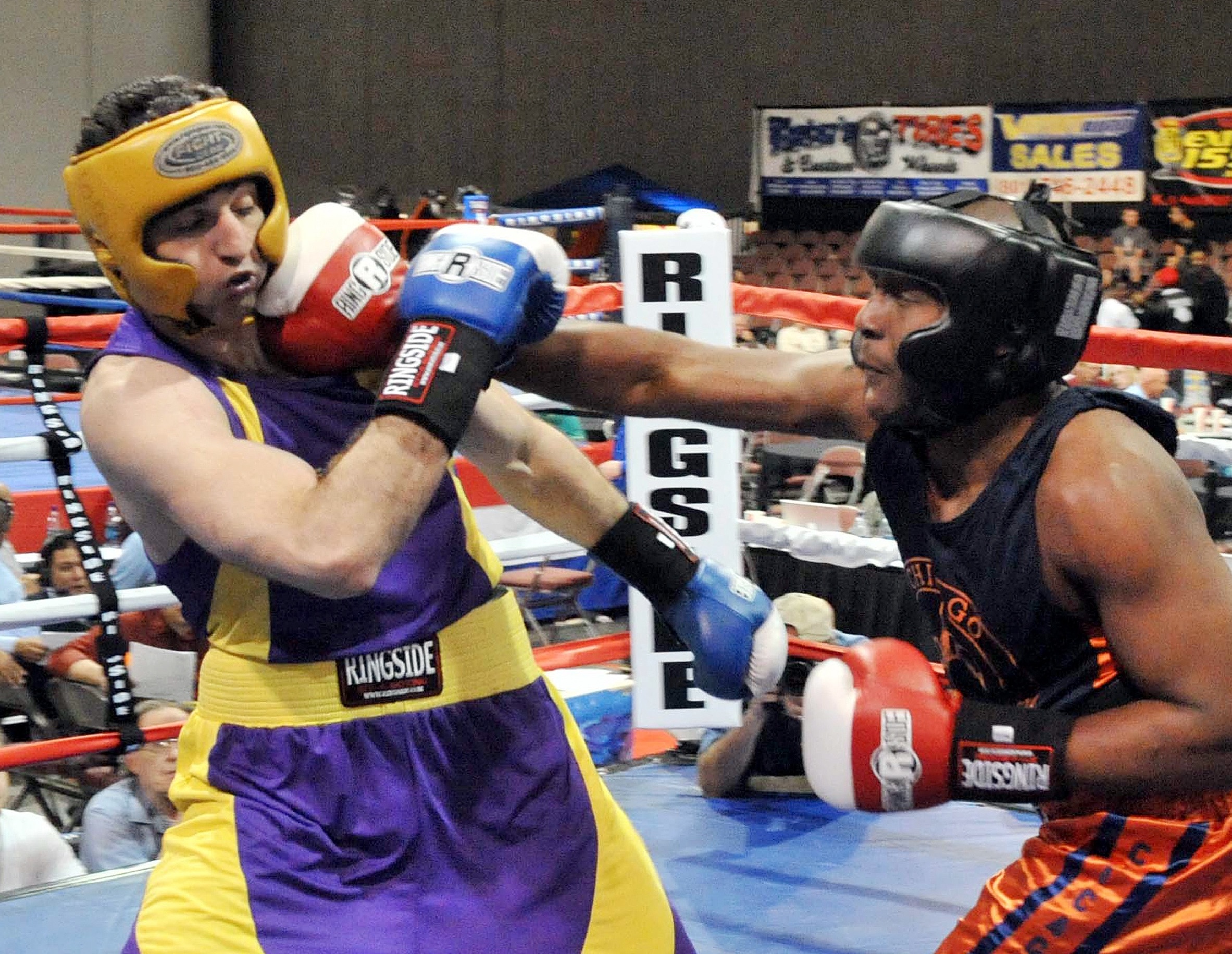
(Photo: Tamerlan Tsarnaev (L) fights Lamar Fenner (R) during the 201-pound division boxing match during the 2009 Golden Gloves National Tournament of Champions May 4, 2009 in Salt Lake City, Utah. By Glenn DePriest/Getty Images)

A Home With A Smaller Footprint

Lisa Margonelli spells out the benefits of mobile homes:

An elaborate 2012 report published by ROC USA and underwritten by HUD found that mobile homes use, on average, far less energy and water than conventional homes or condos (the mobile homes in the study were 940 square feet, larger than those at Pismo Dunes). While models built before 1976, when federal regulations kicked in, sometimes have exorbitant utility bills, newer models made to Energy-Star efficiency standards can reduce the combined costs of electricity, gas, and water to well below $1,000 a year, even in the hottest and coldest parts of the country. And manufacturing the homes in factories cuts construction waste by 30 percent. The efficient layout of a mobile-home park helps conserve water and reduces storm runoff. And in some locations, residents are able to share vehicles, or get around without them, which saves money.