Alex Berezow finds that, “when we consider countries that are similar to the United States, a strong correlation exists between the number of guns per capita and the gun-related homicide rate.” Tom Hartsfield takes issue with Berezow’s analysis:
Gun control might reduce the number of firearm homicides but cause an increase in non-firearm homicides. Countries with gun control might be more developed, safer, and have less violent crime for other reasons, just as countries with high numbers of guns might have more crime due to more guns. Robbery or assault rates might increase without private citizens being able to use a firearm to protect themselves.
Incorporating data on non-homicide violence, Hartsfield finds that “you are no less likely to be a victim of violent crime in a country with fewer guns”:
First, there is no correlation between the number of guns per capita and the overall homicide rate. So people who believe fewer guns will reduce the homicide rate may be wrong.
Second, there is no correlation between the number of guns per capita and the rate of assaults and robberies. So people who believe guns make society safer by reducing overall crime may be wrong, too.
It’s the Sidney Hillman Award for opinion and analysis for yours truly and the Dish as a whole. The awards are given “to journalists whose work highlights important social and economic issues and helps bring about change for the better.” I’m truly honored. The award usually goes to progressives and liberals, so I am a particularly grateful outlier. The citation:
Sullivan’s leadership in the fight for marriage equality is the principal reason he has earned a Hillman Prize. But this is not a single-issue award. Though there are many areas of disagreement between Sullivan and the Hillman judges, we commend, among numerous other things, his fierce condemnations of torture and the impunity granted to its perpetrators, his critique of the cruelties of the failed drug war and the policy of marijuana prohibition, his opposition to all forms of intolerant religious fundamentalism (including the American variety he correctly calls Christianism), and his campaign for reform and accountability in the hierarchy of his own beloved Catholic Church.
We commend him, too, for the creation and nurturing of a sturdy and consistently innovative journalistic institution—one that has recently embarked on a brave experiment: seeking to sustain itself purely on subscriptions from its devoted readers, without advertising or corporate backing. For those readers, The Dish is a source of almost addictive pleasure as well as a forum for stimulating discussion and a uniquely energetic and intelligent collator of news and opinion.
For courage and constancy in the struggle for marriage equality, for the defense and advocacy of humane values, and for imagination and creativity at the digital cutting edge, we honor Andrew Sullivan and The Dish with the Hillman Prize for Opinion & Analysis Journalism.
So I share this award with everyone else at the Dish (especially Patrick and Chris, my indispensable colleagues for the past few years) and with you, who have made this experiment in self-sustaining new media viable. Thanks.
And if you really want to help us celebrate, [tinypass_offer text=”subscribe!”]
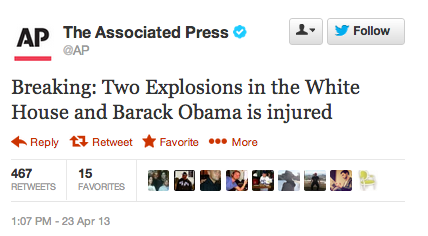
Hackers infiltrated the AP’s account this afternoon and deployed this:
Supporters of the Syrian dictator have claimed responsibility. While no news outlets took the tweet seriously, Wall Street did momentarily:
U.S. stocks and the dollar briefly plunged Tuesday afternoon and U.S. Treasury bonds and gold prices soared, after a tweet from the Associated Press’s Twitter account claimed that there were two explosions in the White House and that President Barack Obama had been injured.
Markets quickly swung back after the Associated Press said on its corporate website that its account had been hacked. The White House confirmed that there had been no incident. The Dow Jones Industrial Average dropped 145 points between 1:08 p.m. EDT and 1:10 p.m., following the erroneous tweet. Stocks soon recovered, regaining broad gains that put the major benchmarks on track for a third day of gains.
Observers said the episode highlights the growing use by players in financial markets of social media such as Twitter and Facebook, FB +0.15% and underscores the dangers of security breaches at a time when many investors are quick to trade on news.
News organizations are a particularly attractive target thanks to their reach and influence.
The Twitter accounts of CBS’ (CBS, Fortune 500) 60 Minutes and 48 Hours were compromised over the weekend. In July 2011, News Corp.’s (NWS) Fox News account — followed by more than 2 million people — was hacked and tweeted that President Obama had been assassinated. That same month, eBay’s (EBAY, Fortune 500) PayPal United Kingdom Twitter feed was hacked, and the profile photo was changed to a pile of excrement. Comcast’s (CMCSA) NBC News account was also compromised two months later, falsely tweeting that a plane had crashed into the Ground Zero area of Manhattan. In February of this year, both the Burger King (BKW) and Jeep Twitter accounts were hacked during the same week. …
After years of hacks that typically involved little more than obscene language, Twitter’s subpar security measures have now caused serious real-world consequences. Many hacks happen when account owners use guessable passwords or access Twitter over public Wi-Fi and shared computers. If one person who tweets from a corporate account loses his or her phone, an entire corporation’s Twitter account could be at risk.
The Bipartisan Policy Center has called it a “slow-motion train wreck” that would deprive the economy of about a million jobs over two years. That prediction is broadly consistent with other forecasts, by such independent experts as Macroeconomic Advisers and the experts at the Congressional Budget Office. And it’s not like the recovery is strong enough to absorb such a hit easily.
But will voters link slower growth—and fewer jobs—to the sequester? Will they ask why it’s a better alternative than the budgets President Obama and the Democrats have proposed—budgets that would undo the cuts and make up some of the difference through higher taxes on the wealthy? And will lobbyists for affected industries, from medicine to defense, force Congress to pay attention to them? So far, the answer to all three questions has been “no,” to the surprise of many (including yours truly). That means the sequester cuts going into effect now, for this fiscal year, are likely to stay in place.
Flights were delayed by up to two hours across the country on Monday, the first weekday that the nation’s air traffic control system operated with 10 percent fewer controllers. Pilots, gate agents and others were quick to blame furloughs caused by mandatory across-the-board budget cuts, but the Federal Aviation Administration said it was too soon to tell.
Spencer Ackerman notices the instant emergence of claims of the Tsarnaevs’ innocence and a cover-up in Boston:
The #freejahar hashtag on Twitter is about what you’d expect after the most highly publicized manhunt in the country. It’s a mix of conspiracy theories, sympathy for Tsarnaev and skepticism of the official narrative surrounding the 19-year old’s arrest. Much of it is consumed with an effort to crowdsource Tsarnaev’s exoneration, pointing to photos from the scene and speculating about them — similar to what took place on 4Chan and Reddit to hunt the bombing perpetrators.
“He’s fucking innocent. If he were “guilty”, it wouldn’t take this long to fucking prove it, and there would actually be evidence,” says one supporter, although the government has yet to charge the incapacitated, hospitalized Tsarnaev with a crime.
Meanwhile, in contrast, the anti-American extremists are laying low:
[Online extremism researcher Jarret] Brachman and others believe that the unclear motivations of the bomb suspects place a damper on the online jihadi forums’ ability to claim Boston as a success. That’s despite the mystique of the young Tsarnaev nearly escaping a huge Friday manhunt; and, if he is proven to be one of the culprits, the ability to construct bombs that killed three and wounded over 180. But the U.S. government has to be similarly cautious about how to combat any popular mythos, like the hashtags, developing around Tsarnaev.
“We are dealing with conspiratorially minded individuals who don’t believe anything the government says anyway,” says Thomas Hegghammer, a terrorism researcher at Stanford University. “The simplest and most effective strategy is probably to highlight the suffering caused by the bombs. Let them see the injured women and children. The most hardcore extremists won’t care, but some fence-sitters might.”
Hill staffers involved in the 2007 immigration fight recall the overwhelming consensus that appeared to greet the bill — President George W. Bush and Sen. Ted Kennedy and Sen. John McCain! — and attribute the law’s eventual defeat to the effort, mounted by Sen. Jeff Sessions and others, to slow it down, mobilize the conservative grassroots, and use unpopular or divisive parts to undermine the once-unstoppable whole. That will be the strategy this time, too.
The main question is whether a bill that passes the Senate, which seems highly probable, can get a vote in the House. If it does, it can probably pass, with mostly Democratic votes and a handful of Republicans. Will Boehner let that bill come to a vote? Costa quotes a Republican insider, who tells him, “All of the conservatives, they think they have frozen Boehner; he’s in their pocket.” On the other hand, the pro-reform contingent thinks he will allow a bipartisan vote. Roll Call reports, “Even while they say there is no explicit commitment from Boehner, members and aides who are part of or close to the bipartisan group seem to have confidence, even cockiness, that Boehner secretly has their back.”
Muhammad brought down from heaven and put into the Koran not religious doctrines only, but political maxims, criminal and civil laws, and scientific theories. The Gospels, on the other hand, deal only with the general relations between man and God and between man and man. Beyond that, they teach nothing and do not oblige people to believe anything. That alone, among a thousand reasons, is enough to show that Islam will not be able to hold its power long in ages of enlightenment and democracy, while Christianity is destined to reign in such ages, as in all others.
This is a parallel point to the question of violence, or at least Tocqueville is not directly addressing the issue of violence, but it’s not hard to make the connection. Politics is a realm of coercion; the state has a monopoly on violence, as we’re taught in introductory political science courses. Jesus opts out of that whole system. He never sought political power. He never was a law-giver. He founded no political regime. He claimed no direct authority over any land or people. Indeed, he was sacrificed at the hands of the reigning political power.
Tocqueville’s point is that because Jesus was in this sense apolitical (along with not pronouncing on matters of science), Christianity has no intrinsic reason to be in conflict with modernity.
Because Jesus laid down no precise pattern for political order, it need not fear the coming of democracy. Because Jesus taught love, rather than scientific theories, nothing Jesus said contradicts what we know through the advance of science. Followers of Jesus, for Tocqueville, can adapt, can engage the age in which they live with a certain openness, rather than hunker down with rage and suspicion. He thought that this wasn’t the case for Islam, not because it was intrinsically violent (neither he nor you are arguing for that) but because the circumstances of Islam’s founding set in motion certain problems that were bound to be exacerbated by modernity.
It always is difficult, even foolish, to draw a straight line from the origins of a religious tradition to contemporary events. But it also is a mistake to pretend a religion’s point of departure matters not at all. For Christians, however hypocritically or poorly they follow Jesus, the witness of Jesus in the Gospels really is a rebuke to violence and political striving. It always is there as a corrective, and throughout Church history, however corrupt Christian institutions have become, Jesus’s life has inspired movements of renewal and repentance. That is worth noting, as you have. It’s not entirely clear such an unambiguous witness from Islam’s founder exists to perform the same function.
Joyner theorizes why lesbian athletes are able to come out with little controversy but gay male athletes are not:
Part of the answer is the intermixture of sexuality and gender are different. We’re just barely at the point where extreme athletic prowess—especially in a body that’s unusually tall or muscular—in a women is compatible with general notions of femininity. Indeed, not all that long ago, women who were particularly strong and engaged in traditionally male activities like basketball were presumed to be lesbians. Conversely, while our notions have thankfully evolved tremendously, there’s still a widespread notion that gay males are less than manly. And, of course, male athletes are considered the height of masculinity. So, there’s a paradox at work for male athletes that doesn’t exist for their female counterparts.
No shit, Sherlock. But there’s also the issue of team sports versus individual sports. Openly gay male athletes are more common in, say, swimming and diving than in football or baseball. The culture of heterosexuality in all-male teams, especially teams united by a common goal of winning games, can be overwhelming – especially given the dynamics Joyner notes. It’s by no means insuperable. It just takes a lot of courage.
(Video: Superstar Brittney Griner in action. Last week, she was selected as the #1 WNBA draft pick and came out as gay.)