“The federal courts can and will sort [the prosecution of Dzhokhar Tsarnaev] out, as they have many times since 9/11. Almost 500 times, to be exact—that’s the number of convictions for terrorism crimes since the attacks on the World Trade Centers. The number of convictions before military commissions, on the other hand, is just seven. (More related myths and facts here, from Human Rights First)” – Emily Bazelon.
Year: 2013
Dissents Of The Day
Many readers are upset with this post:
Wow, Andrew. I’ve been with you since 2007, and I can’t recall reading a more blatantly ridiculous statement from you than this one: “And when will they grasp that a religion that does not entirely eschew violence (like the Gospels or Buddhism) will likely produce violence when its extremist loners seek meaning in a bewildering multicultural modern world?”
You know it’s bullshit too. Because otherwise you would’ve said “Christianity” instead of “the Gospels,” keeping it consistent with your blanket characterizations of Buddhism and Islam. But you knew you couldn’t, because of Christianity’s and the Old Testament’s indisputable record of violence, which refutes your narrative that doctrine was the primary cause.
And otherwise you wouldn’t have qualified it with that long modifier of producing violence “when its extremist loners seek meaning in a bewildering multicultural modern world.” How many contingencies do you have to stuff into the interpretation and practice of a religion before you realize those contingencies matter a hell of a lot more than the words in the document everyone’s reading into in whatever way suits their condition? What a logically, linguistically, and sociologically inept attempt to baldly enforce your double standards of religious causation upon your readers.
I do not write things I know are “bullshit.” They may be, but I write in good faith. Perhaps I should have put it this way: All religion, including Christianity, is susceptible to the violence associated with tribalism and fundamentalism. Christianity’s murderousness through the ages is a matter of historical fact, from the Crusades to the Inquisition and beyond.
What distinguishes Islam is that its founder practiced violence, whereas Jesus quite obviously favored the exact opposite – nonviolence to the point of accepting one’s own death. Unlike Christianity, but like Judaism, Islam also claims sacred land, and, along with extremist forms of Judaism, the divine right to repel intruders from it. Religion is dangerous enough. A religion founded by a violent figure, with territorial claims, and whose values are at direct odds with modernity is extra-dangerous. Which other major world religion believes that apostates should be killed? Or regards negative depictions of the Prophet as worthy of a death sentence? As I wrote more than a decade ago now:
The terrorists’ strain of Islam is clearly not shared by most Muslims and is deeply unrepresentative of Islam’s glorious, civilized and peaceful past. But it surely represents a part of Islam — a radical, fundamentalist part — that simply cannot be ignored or denied.
Another reader:
What is “Jihad”? It’s only a religious war in the minds of those who believe that it is. Do we need to broadcast this to people who may be susceptible? Can’t we fight this war without feeding the enemy’s propaganda machine? My worry is that using Jihad/religious war is going to do two things:
1. Help radicalize more people
2. Rev up the right wing into the frenzy we saw post 9-11, which makes us lose our heads and do dumb things, and also reinforcing point No. 1 – it’s a self fulfilling prophecy: “See, the West is after us. Fight the infidels, etc.”
I think this older brother absorbed these radical ideas through osmosis – speaking to a radicalized (but not a member of a radical group) person, all the messaging in the media/Internet, etc., visiting Russia and seeing/experiencing it. But there does not seem to be a direct link to a radical group, where he was directly trained, was meeting with a group, etc. Maybe we just haven’t learned that yet, but until then, we should not jump to conclusions. It seems to me, media outlets calling this a religious war/Jihad are only going to make these people more susceptible to this stuff and give them greater justification for their feelings and actions.
If I were writing to maximize public safety, I would minimize the religious aspects of this terror attack. But I am writing in order to tell the truth as best I can. Another reader:
It’s terrifying to me that you can write sentences like: “Legally, the case for the presumption of innocence is absolutely right. But come on.”
“But come on” was the animating logic of the drumbeat for war in Iraq. It was the ideological territory of Cheney, Wolfowitz, and Co. It was why Guantánamo Bay and Abu Ghraib happened. “But come on” says, to me: “I know I can’t justify this with reason so I’m going to appeal to a general sense of hysteria.”
But that is precisely why we have these laws and safeguards in the first place. Mirandizing a suspect, presuming innocence and so on were not primarily intended for the low-key cases that take place in America every day. No, they were in large part designed specifically for moments such as this, to prevent a nation in the throes of a huge emotional overreaction (more on that in a moment) from stepping out of bounds. “But come on” represents precisely the arbitrary, emotional desire for overreach that our Constitution and legal system was specifically supposed to neutralize.
If I had simply said the words “come on” and not followed them with a superfluity of evidence, my reader might have a point. But I didn’t.
The View From Your Window Contest: Winner #150
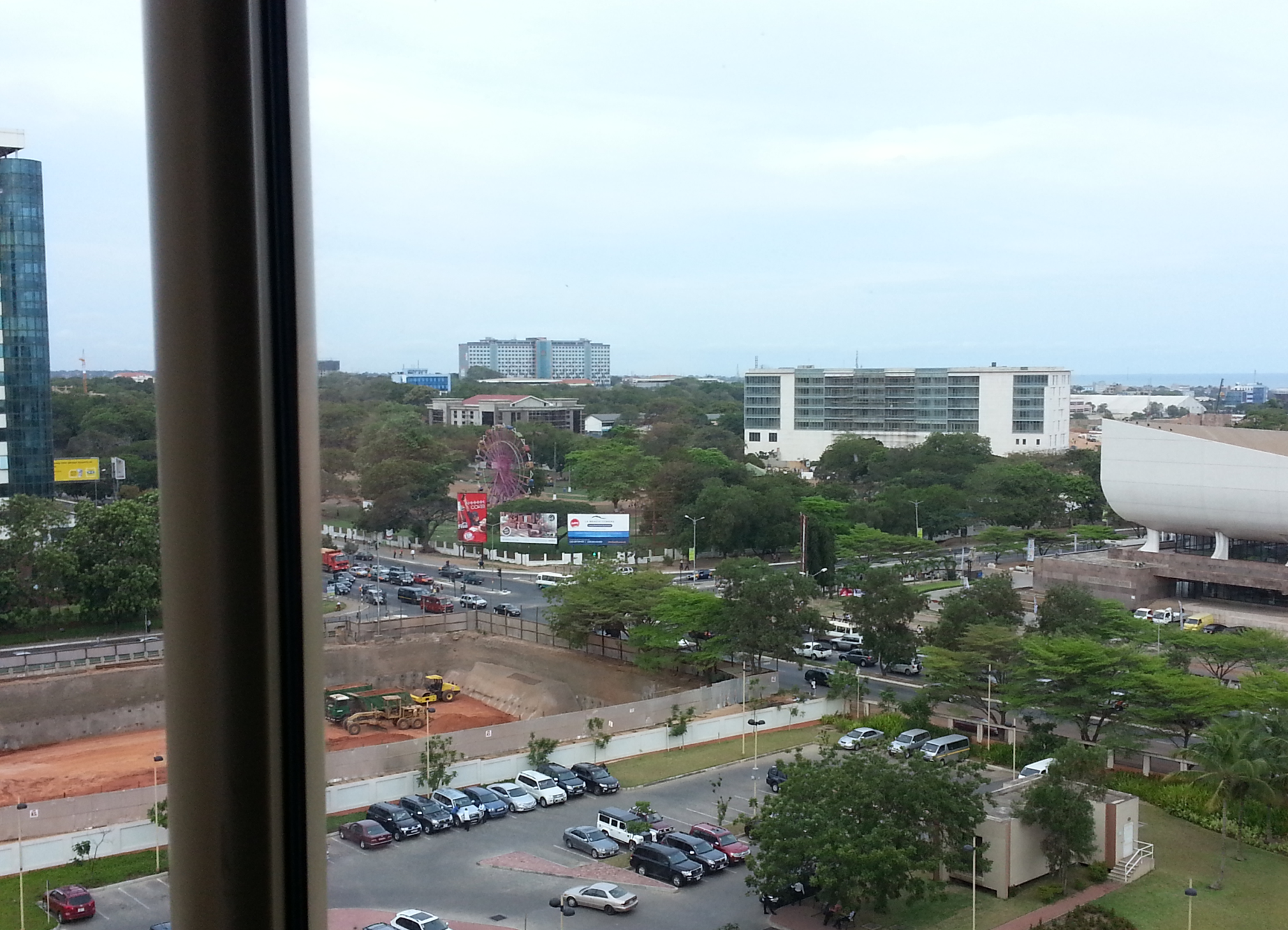
A reader writes:
The presence of the large billboards, bordering this lovely park, Tivoli Gardens, was dismaying to see, when I visited Copenhagen some years ago. They seem to have proliferated. The juxtaposition is unfortunate. The architectural feature of the building to the right is reminiscent of the ultra-modern museum which was completed less than 10 years ago. The presence of both classical and modern architecture, as can be seen in the photo, is also typical of Copenhagen. The Baltic is in the distance.
Another:
This looks like it was taken from the back of the Prince Hotel & Residence in Kuala Lumpur, Malaysia – quite possibly in one of the restaurants or conference rooms there. The big clues are (a) the red soil that is so common in SE Asia – especially Malaysia and Thailand; (b) the Japanese SUVs and (what may be) a few of their drivers hanging out around one of them and (c) the Ferris-wheel with the over the top lighting around it. I’ve stayed at the Prince before and this looks a lot like it.
Another:
With ten minutes to spare, I’m going to guess Lima, Peru. The clues I used to make my guess are: primarily Japanese cars, driving on right hand side of road, and coastal billboards appear to have Roman script. I used that to rule out most of Asia, and I thought about countries that have a strong tie to Japan but are not in Asia. I know that there is a strong cultural link between Japan and both Peru and Brazil as many Japanese emigrated to those countries in the 20th century. I don’t know if a cultural link translates into whether the citizens will buy cars, but I don’t have a lot of time.
Another is on the right track:
Definitely sub Saharan Africa. Cars are driving on the right side of the road, so we can eliminate a lot of the Southeastern countries in Africa. There’s a lot of greenery, so I’ll go with what I imagine is the greenest country in Africa. I’m guessing this is Kinshasa in the Democratic Republic of the Congo. The architecture is so distinct that I know someone is going to get the right window, but here’s hoping I’m at least somewhat close.
Another:
I thought this would be an easy one – how many fancy new buildings could there be that look so much like a bath tub? More than one unfortunately, since a very fancy new museum that looks exactly like a bathtub was just built in Amsterdam, and pictures of it filled every Google image search I could think of. Damn you, Stedelijk! The pink ferris wheel was no more help. But the trees in the lower right look like I imagine sub-saharan Africa, so I’ll say Addis Ababa because a friend hails from there, and I’d like to think it’s as nice a place as the photo seems to depict.
Another:
I flailed around a great deal with this one. I couldn’t find any building that matched the weirdly-shaped one to the right, and I’m sure someone has been there before. I was going to settle on Luanda, Angola, based on the traffic (not much) and the climate. But then I remembered Luanda has been an answer in the past, so I decided to go to the other side of Africa. I can’t find a great match for anything, so I’m just going to shoot for Maputo, specifically the Cardoso Hotel. Hopefully I’m not the dreadest “first guesser” who is always the farthest away!
Another nails the right city:
This is my first time to get one of these!
I knew it had to be Africa, with the acacia trees lining the roads, the wall around the parking lot, and, for some reason, the vertical red billboard. I was going to guess Nairobi, Kenya, because of how green it is (and I love Nairobi), but then I noticed the ocean in the background. Accra, Ghana! It’s got to be! I remember the city shocking me with how modern and western it looked compared with Cotonou, Benin and Lomé, Togo, where I had just spent a summer completing an internship in ethnomusicology.
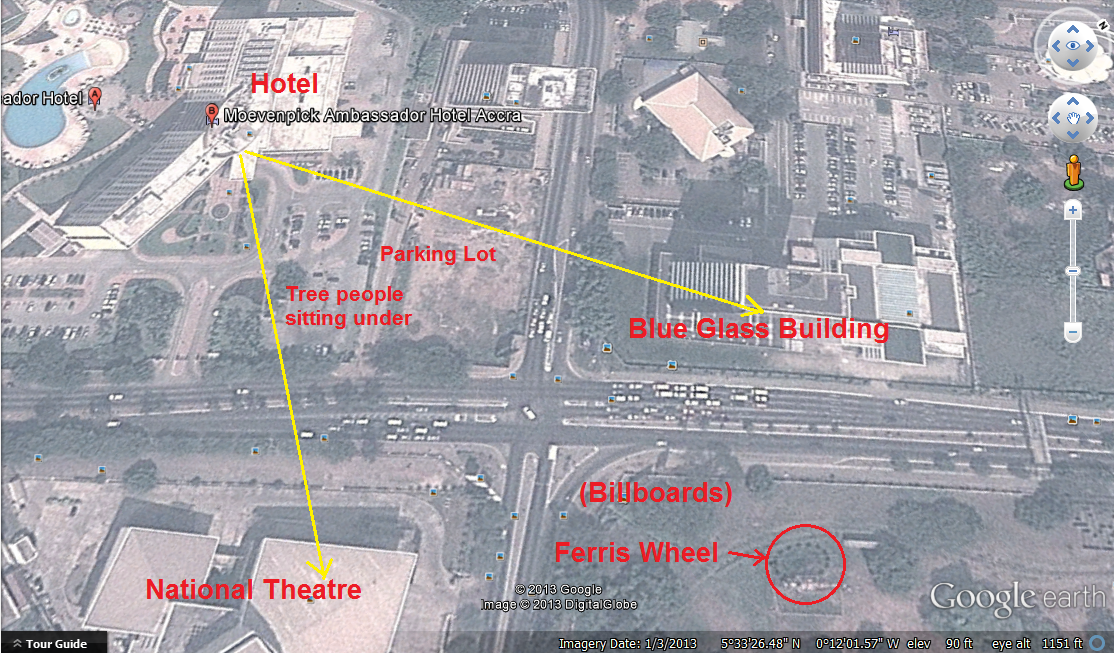
So, it was Accra – I went straight to Osu, which I remember being very built-up, then drifted west toward downtown. Behold, the National Theatre! The shape of that building stood out. The picture is taken from the Mövenpick Hotel, Victoria Borg, Accra, Ghana, looking roughly east-southeast at the intersection of Independence Avenue and Liberia Road. Maybe the 4th floor? The National Theatre is in the right midground of the picture and the Atlantic Ocean is in the background. Woo!
Another sends an aerial view:
Another:
I feel like I am cheating here. This is downtown Accra, Ghana. I recognize it because I am originally from Ghana (presently a graduate student at the University of Virginia).
Another:
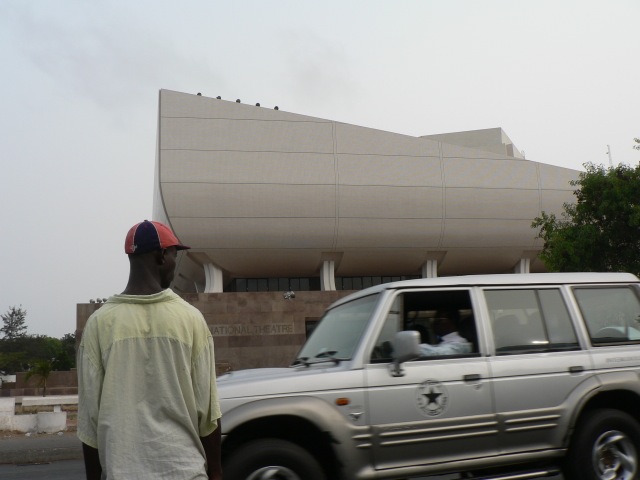
The Möevenpick Ambassador Hotel, Accra, Ghana near the corner of Liberia Rd. and Independence Ave. technically, postal address is PMB CT 343, Cantonments Ridge, Accra, Ghana. GPS: 5.554369,-0.202426. Bonus points for using the umlaut, please. Extra bonus points: my photo of the National Theater, from 7 years ago, whilst visiting my beautiful daughter on her semester abroad from NYU:
Super-bonus points: I lived in Accra as a child, many many moons ago, well before the National Theater was built, as a “gift” from China.
Another:
What a fun feeling to immediately know the view when the picture flashes on the screen! The distinctive building on the right is the National Theatre in Accra (where my wife and I enjoyed a stunning performance by Ismael Lo about 15 years ago); across the way is the new (well, used) Ferris Wheel in the Efua Sutherland Children’s Park (where our daughter had her first ride on a pony even longer ago), and the road in front is Independence Avenue is where we watched armored cars roll in Ghana’s final coup more than 30 years ago.
Thank goodness Ghana is now growing extremely rapidly and is firmly stable (stable enough to have its own controversial supreme court case about the recent presidential election – arguments are being held right now, and everyone is confident that the dispute will be resolved peacefully). The picture is taken from a reasonably high, north-facing room in the gorgeous new Moevenpick Ambassador Hotel (somebody has a nice expense account!). I won’t bother guessing the specific room; I’m sure you’ll get a few who will do the calculation.
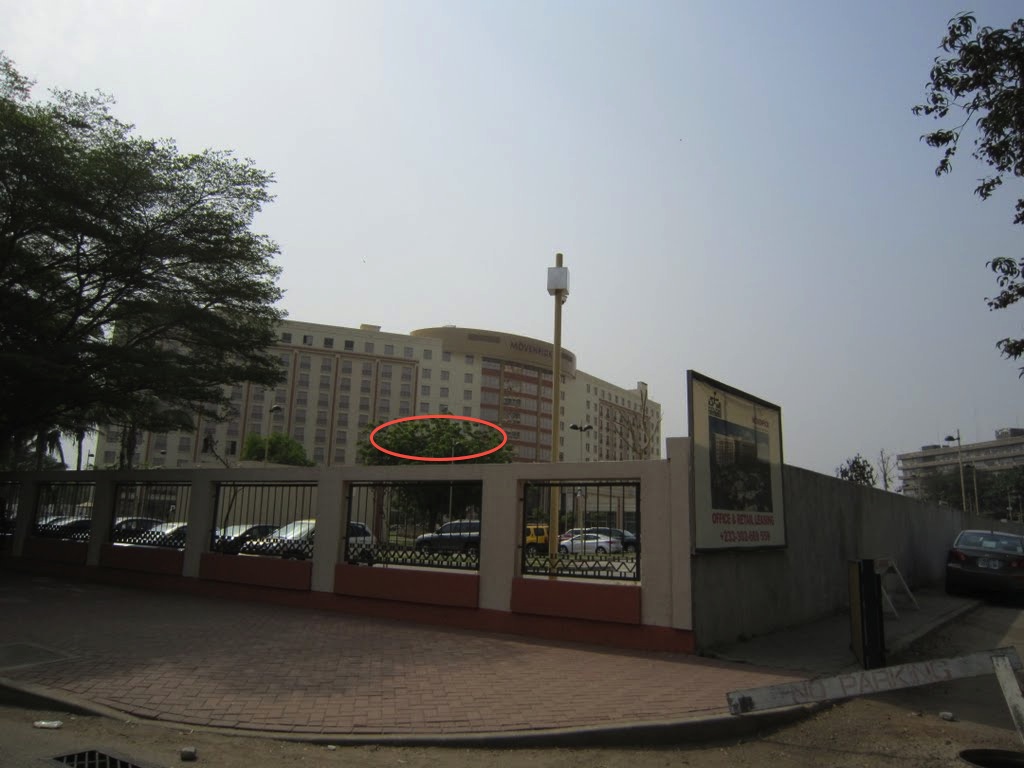
A closer look at the hotel:
 d
d
Another nails the right floor:
This week’s photo is from the either the 6th or 7th Floor of the Movenpick Ambassador Hotel in Agra, Ghana. If I had to guess it would be the 6th floor, Room 637. This photo is from an odd numbered room, likely one of the ambassador suites (since those are on the upper floors) looking out towards the intersection of Liberia Rd and Independence Avenue. The taller building on the left side of the photo is part of the World Trace Center Complex and the white building on the right side of the image is the National Theatre.
But the winner this week is the most detailed entry among the three readers who correctly guessed the 6th floor:
Bam. This photo was taken from the Movenpick Ambassador Hotel in Accra, Ghana looking south of east. Based on dead eyeball reckoning it was taken from one of the three indicated windows on the 6th floor:
Undoubtedly, others making correct guesses will have recognized the oddly shaped building on the right to be the National Theater of Ghana, stayed at that very (swanky) hotel, or somehow read one of the unreadable advertisements next to the Coke billboard (I Googled ‘comb’ before figuring it out). My clue, however, was the dark green van with a yellow stripe in the road just below that Coke billboard. It is probably a tro-tro, which are basically large taxis that serve as a bus system in Ghana. The tro-tros, especially how they were always packed and had religious slogans prominently displayed, were among the many things that fascinated me during my recent visit to Ghana:
My brother interns for Global Brigades in Ghana coordinating groups of undergrads that come in to staff medical clinics. Since he wasn’t going to make it home for either holiday for the first time in our lives, my aunt, a family friend, and I brought the family to him for Thanksgiving. It was quite an experience seeing him in his element, and also because it was my first time in a developing country. Thus, the country roads, and I mean country roads, were mortifying, but seeing an elephant take a relaxing dip (in poem form) made the trek worth it.
And to think, the other day I contemplated skipping over the VFYW contests for good. I shall travel more so that won’t happen again.
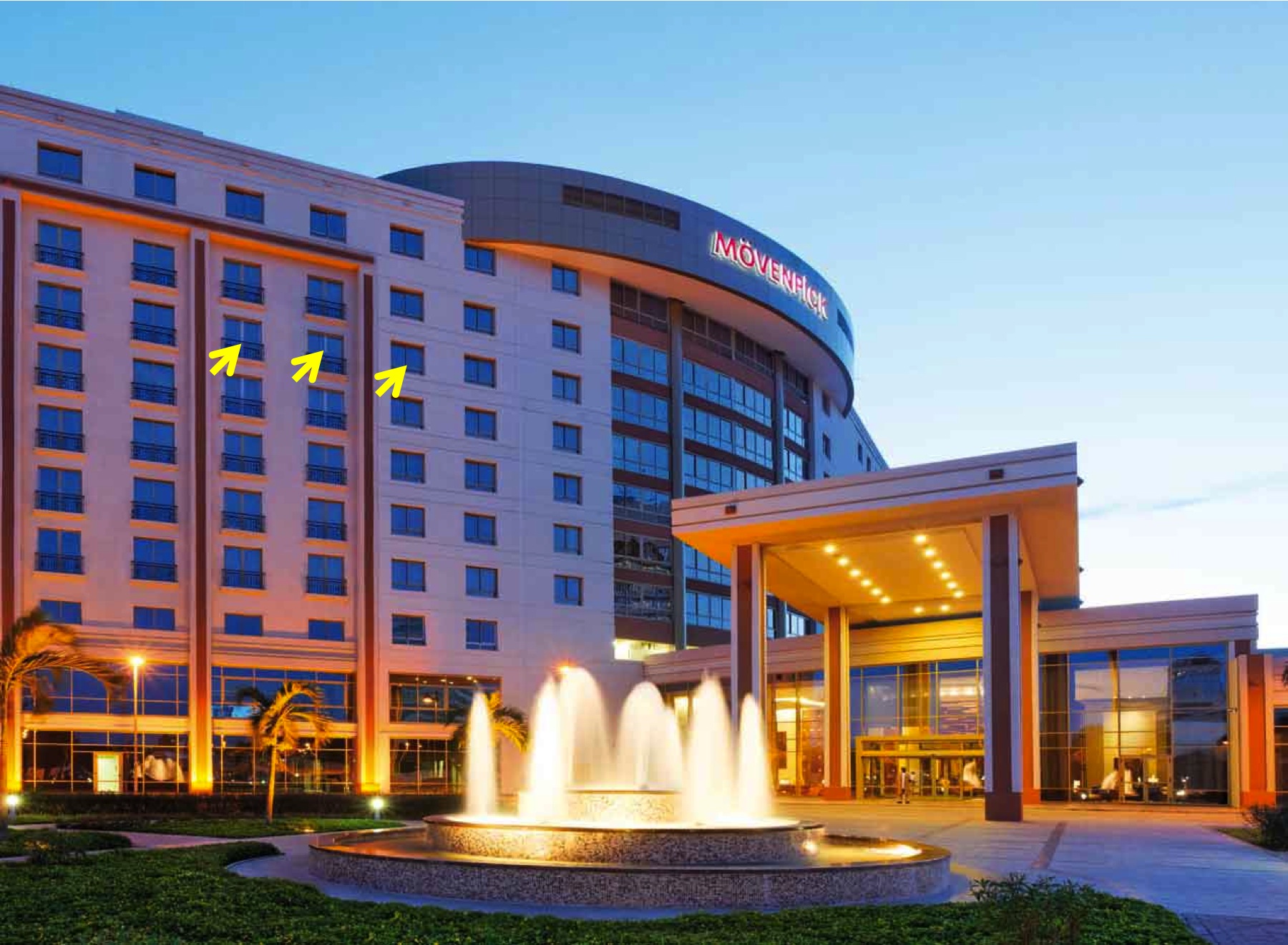

From the submitter:
As a previous winner (contest #55 – Luanda, Angola) and a weekly follower of the VFYW contest, I would like to submit this view from my hotel room in Accra, Ghana. The photo was taken from the 6th floor, room 641 of the Movenpick Ambassador Hotel facing east. This week in Ghana marks the beginning of the Supreme Court hearing in their version of the 2000 U.S. Presidential election dispute. Everywhere I went, the public was glued to their TVs as the case of the disputed Ghanaian presidential election of 2012 was being aired. Ghana is a model for other African countries in terms of respect for democracy and rule of law on one hand, and entrepreneurship and progress on the other hand.
(Archive)
Real Islamophobia
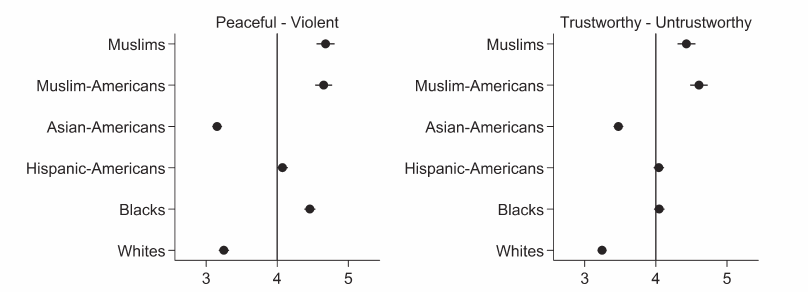
Not a criticism of the doctrines and their real-world impact, say, on the welfare of women. But broad-brush prejudice against Muslims as a whole, at home and abroad. Dan Hopkins, Danny Hayes, and John Sides examine how non-Muslim-Americans see Muslims and Muslim-American:
[O]n average these respondents rated both Muslims and Muslim-Americans as more violent than peaceful and as more untrustworthy than trustworthy. Put in percentage terms, 45 percent of respondents placed Muslim-Americans on the “violent” side of the scale, and 51 percent placed Muslims on this side of the scale. Given that Dzhokhar Tsarnaev was an American citizen, it is notable that respondents do not appear to distinguish between Muslims and Muslim-Americans. Both groups are stereotyped in much the same way.
Thoreau proposes one way to combat these stereotypes:
Maybe CAIR should get rid of the warm, fuzzy spokespeople and replace them with a cranky old Chechen uncle whose response to any terrorist incident is “Buncha goddamn losers. Screw those guys. What, you think they teach that kind of bullshit in my mosque? Oh hell no. Screw those assholes. Seriously.”
Ambers’ view:
Bias against Muslims is real and it hurts. And the easiest way to radicalize un-radicalized people is to treat them like enemies.
Overachieving Gays
Tracy Clark-Flory examines the “Best Little Boy in the World” hypothesis:
This theory holds that closeted young men in bigoted environments often respond by overachieving in certain areas, like sports or academics — the idea being that it’s an adaptive means of finding a sense of self-worth where they can. It can also serve to distract from their sexuality: As Andrew Tobias wrote in his 1976 memoir, “The Best Little Boy in the World,” a key “line of defense” was his endless list of activities. “No one could expect me to be out dating … when I had a list of 17 urgent projects to complete,” he wrote.
Despite the prevalence of this idea in gay coming-of-age narratives, it’s never been tested empirically, until now.
In a study recently published in the journal Basic and Applied Social Psychology, researchers interviewed 195 male colleges students who identified as either heterosexual or a “sexual minority.” They found that the sexual minority men based their sense of self-worth on “academics,” “appearance” and “competition” more so than the straight guys. Interestingly, the amount of time the gay men had spent hiding their sexual identity positively predicted their investment in these areas. The researchers also developed a way to objectively measure the amount of stigma each participant faced in their particular environment by evaluating their home state’s general stance toward sexual minorities. That measure of stigma also positively “predicted the degree to which young sexual minority men sought self-worth through competition.”
For what it’s worth, I fit the model pretty perfectly – and my high school helped. Each class would be graded in every subject every month and then a list would be posted ranking everyone in the class. The first time this happened, after my first month at the school, I was stunned to find out that I was in the top position. Stunned and suddenly proud. Staying there became my over-arching goal for the rest of my high school life. I buried my way into books to prove my self-worth … and to distract attention from my sexual orientation. It worked: I was labeled a nerd rather than a fag – or, in the original English, a “swot” rather than a “poof.”
And those patterns have not truly changed – I’m just more aware of them. Why am I still trying to push the envelope in new media – and risking my own money – when I could have found a more comfortable perch writing somewhere? Why do I still need to prove something every day? Part is obviously an attempt to gain self-worth after homophobia had done its silent, brutal work on my seven-year-old soul. “Does God know everything about you – everything?” I once asked my mum, according to her (I don’t recall the exchange). She said: “Yes, of course. Everything.” I replied, “Then there’s no hope for me, mum.”
But it’s also a positive desire not to allow such prejudice affect you, to break through certain barriers, to push yourself to be a living impediment to homophobic prejudice. One extremely insightful book has been written about this: The Velvet Rage. I really recommend it. It shows how many gay men, propelled by these dynamics for years, sometimes find themselves in middle age at the top of their field and yet deeply depressed or overworked. They realize that rage – even constructive, efficient, effective rage – is no substitute for love.
My fundamental hope in helping to make marriage equality a possibility is that young gay boys and girls, as I once was, can now see a future filled with love rather than rage, intimacy rather than “achievement”.
Ask Brill Anything: “$77 For A Box Of Gauze Pads”
In his first video, Steve explains why US healthcare is so expensive, including a follow-up on what he found most surprising in the course of researching his excellent Time cover-story, “Bitter Pill: Why Medical Bills Are Killing Us”:
Previous Dish on “Bitter Pill” here and here. Relatedly, Trudy Lieberman recently wondered why we don’t try to reduce costs by requiring “drug makers [to] negotiate prices with the government for the drugs used by Medicare beneficiaries” – something other countries do to keep costs down:
Brill estimated that that if drug makers were paid what other countries pay them, Medicare could save some $250 billion over 10 years and, depending on whether that amount is compared with GOP and Democratic deficit reduction proposals, “that’s a third or a half of the Medicare cuts now being talked about.” Liberal economist Dean Baker, co-director of the Center for Economic and Policy Research, crunched numbers from the Organization for Economic Cooperation and Development and came up with similar savings. He found that if seniors paid the same prices as people in Canada, the federal government would save nearly $230 billion over the next decade. States would save about $31 billion and Medicare beneficiaries $48 billion. If the federal government paid the same prices as are paid in Denmark, its savings would be more than $500 billion.
But such numbers are apparently not persuasive when they’re up against the lobbying might of the drug manufacturers. According to Open Secrets.org, drug makers spent $152 million on lobbying in 2012, an amount that has steadily increased since 2002-2003, the time when Congress was debating Medicare’s prescription drug benefit, which handed drug makers the gift of no negotiations over the prices they charge.
Thomas Bollyky highlights another growing issue in international drug prices – patents in developing countries:
Why does Gleevec, a leukemia drug that costs $70,000 per year in the United States, cost just $2,500 in India? It’s seemingly simple. Gleevec is under patent in the U.S., but not in India. Accordingly, Novartis, its Swiss-based manufacturer, may prevent competitors from making and selling lower-cost versions of the drug in the U.S., but not in India.
Last week, India’s highest court rejected an application to patent Gleevec. While the legal issue in the case is important — the patentability of modifications to existing drugs under Indian law — the impact of the decision will likely be broader than just that issue, escalating a long-simmering fight over patented cancer medications in emerging markets.
Indonesia, China and the Phillipines are taking similar measures to amend pharmaceutical patent laws:
The measures that India and other countries have taken — compulsory licensing and adopting strict standards on patentability — are consistent with its international trade commitments, but will be corrosive to the way that pharmaceutical research and development (R&D) is funded internationally. More countries are likely to follow India’s lead. Cancer is not the only NCD on the rise in developing countries, with rates of diabetes, cardiovascular, and chronic respiratory illnesses likewise increasing. U.S. patients will not indefinitely pay a 20-fold increase on the price of medicines that Indian consumers pay.
Yes, Of Course It Was Jihad, Ctd
What we know about Tamerlan Tsarnaev is that he was (a) Muslim and (b) enraged about something. Was he enraged, a la Sayyid Qutb, about the sexual libertinism of American culture? Was he enraged about perceived American support for Russia against Chechen rebels? Was he enraged about American wars in Iraq and Afghanistan? Was he acting on orders from a foreign terrorist group?
We don’t know yet. Yes, there’s plainly evidence of his growing Islamic extremism over the past three years. But if there’s anything we’ve learned over the last week, it’s that jumping to conclusions on this stuff is foolish.
This is high-minded nonsense. We know full well that Tamerlan had become a total extremist in his religion. He was thrown out of his own mosque for being a bigot; his family complained about his obsessive religiosity; he berated others for not being sufficiently devout; he had archaic notions of women’s role in society; he gave up his beloved boxing because of Islam. His YouTube account is full of Islamist extremism. And he deployed terrorist violence because of it.
That’s Jihad, Kevin. It’s religion in its most toxic form – as the AP finally acknowledged last night.
It doesn’t need a foreign terror group for it to be Jihad; it’s obviously not Chechen nationalism – because that would mean attacking Russia, not the Boston Marathon, a symbol of co-ed multi-cultural secularism. I think some liberals who have never experienced religious faith find it hard to imagine how faith alone can spur someone to mass murder. They need to get out more.
Friedersdorf writes that, if forced “to bet right now on this case, I’d put my money on the jihadist explanation too.” But he agrees with Drum:
Since 9/11, there have been numerous instances in which jumping to conclusions based on imperfect information caused damage. Think of all the people who confidently insisted on the obviousness of Dr. Steven J. Hatfill’s guilt, or Saddam Hussein’s possession of weapons of mass destruction, or the notion that all Guantanamo Bay prisoners were “the worst of the worst.” Has any harm ever been caused by a War on Terror pundit’s stubborn insistence on delaying judgement?
Yes, the information is imperfect. Yes, if all of this is some kind of set-up, I may have to recant. And I have always said that personal and psychological dynamics are obviously part of the picture, as they are with any crime. But just as silly as jumping to conclusions prematurely is the posture of aloof skepticism when the bleeding obvious is staring right at you. This was religious violence – the most terrifying any can be, because its perpetrators believe that God Almighty is protecting them.
And, to make an obvious but often overlooked point: here is a core difference between diagnosing Jihad and responding to it Cheney-style. You can do one without the other.
Our Collective 9/11 PTSD

Michael Cohen echoes me on the difference between America’s reactions to events like the marathon bombing and gun violence:
Londoners, who endured IRA terror for years, might be forgiven for thinking that America over-reacted just a tad to the goings-on in Boston. They’re right – and then some. What we saw was a collective freak-out like few that we’ve seen previously in the United States. It was yet another depressing reminder that more than 11 years after 9/11 Americans still allow themselves to be easily and willingly cowed by the “threat” of terrorism. …
If only Americans reacted the same way to the actual threats that exist in their country.
Which is to say that the terrorists succeeded in almost every way possible. The day after the IRA bombing of the hotel in which she was staying, injuring 31 and killing five, Margaret Thatcher gave a speech, on schedule, to her party conference. The IRA suspects were still at large and threatening to kill again:
Today we were unlucky, but remember we only have to be lucky once. You will have to be lucky always.
Norman Geras thinks these arguments miss the point:
The supposed ‘overreaction’ to terrorist attacks isn’t primarily about the extent of risk relative to accidental death, or about fear for one’s own safety. It’s about people taking quite proper exception when, finding it morally outrageous indeed that, individuals moved by some grievance or other and/or the tenets of a murderous ideology, freely choose to put the innocent in peril by random acts of violence.
I wrote about this for my Sunday column. I am second to none in finding these acts morally outrageous, which is why we need to exercise more control in not giving them more power over our psyches than we need to. I think, in many ways, we’re still living with 9/11 collective PTSD:
Last week shows how terrorism works. It terrorizes – and the trauma of that terror lies often buried in the psyche for years, and untreated and un-addressed, it can suddenly return, without perspective or rationality. In some ways, this is understandable. Before 9/11, Americans outside Pearl Harbor, had lived for centuries feeling relatively invulnerable to the terrorism that I grew up with in Britain in the 1970s, or that occurs routinely as a consequence of the US invasion of Iraq (on the day of the Boston marathon, 65 Iraqis were murdered by terrorist bombs). 9/11 was so traumatic, in fact, that it led the US to adopt the torture techniques of totalitarian regimes and to invade and occupy two countries. Americans lost it. And I cannot say I was immune. It changed Americans because we allowed it to traumatize us.
Before 9/11, terrorism didn’t have this kind of power. The first bombing of the World Trade Center did not “change everything”. Last week, the historian Rick Perlstein noted that in Christmastime, 1975, an explosion at a La Guardia baggage claim killed 24 civilians, with severed limbs and heads flying all over the place. No one was ever found responsible – and the city of New York was not under lockdown. It’s different now.
Which means bin Laden succeeded as well – in simply terrorizing Americans. Take this statistic: the National Consortium for the Study of Terrorism and Responses to Terrorism found that the number of terror attacks in the US in the decade before 9/11 was 41 a year. Since 9/11, it has been 19 a year. And yet our terror panic endures – and even grows. It seems we cannot yet simply live with and through occasional terror. We demand its complete absence, in the black-and-white way Americans often do:
We think in absolutes, in terms of avoiding all harms and dismissing potential benefits instead of debating the relative contributions of both. … “Never eat red meat”. “Never let kids watch TV or play video games”. “Never eat soft cheese while pregnant”. “Never fail to screen for disease”. And so on.
Is this a United States thing? Or am I just wired differently? I’m just not sure that the way we react to potential harms is the best approach. This includes, by the way, our response to terrorism.
Previous Dish on Americans’ response to terrorism here.
(Photo: At around 11:45 a.m., April 19, this was the view on Congress Street looking towards Post Office Square as a lockdown-in-place was in effect in Boston during the during the ongoing manhunt for a suspect in the terrorist bombing of the 117th Boston Marathon earlier this week. By Jim Davis/The Boston Globe via Getty Images.)
Don’t Judge A Lover By His Moves
James Wilson, lead singer for the Virginia-based rock band Sons of Bill, compiled “a list of songs for and from the mouths of bad dancers” to accompany their new single, “Bad Dancer.” He comments:
In middle school I remember hearing a friend of my dad’s tell his daughter on her way to a dance, “Remember, the best lovers are the bad dancers.” I didn’t know exactly what that meant at the time, but the line stuck with me – most likely because I was as awkward as anyone else, feeling trapped on the outskirts, but madly in love with everything like everyone else. You see this same figure recurring in so many coming-of-age stories: Holden Caulfield, Quentin Compson, every John Cusack movie, etc. I’d been listening to a lot of older pop music at the time, and I got the idea to write them an anthem – a rock and roll love song for the awkward lovers. A dance song for the bad dancers.
As I get older I start to see the ways in which some people never really get over that awkward high-school dance feeling – it opens up into broader life questions of loneliness and wonder, desiring to belong but never quite feeling at home in your own skin. I picked these songs because I think they captured that feeling.
Number one on his list? The Smith’s “Stop Me If You’ve Heard This One Before”, seen above.
The Life Spans Of Guns
Nathan Hegedus reflects on his own experience living in Croatia in the 1990s:
[H]ere is why I still worry about guns, even if they are not the root of anything, and this is almost purely grounded in my time in [Pakrac, Croatia]. Guns are not an idea or a prejudice or an emotion. They will not pass like opposition to gay marriage or dangerously moronic views on rape. They are objects, and they will endure. They get stolen, sold, found, and washed into the loneliest, least connected places, where they do the most damage. And at some point, violence has the potential to build beyond murder to something even worse—riots, wars, pogroms—and then I say that a concentration of guns does matter, too much tinder to be ignited by too small a spark.

