A Pre-Tenderized Meal

Montana recently made moves to legalize eating roadkill. Nicola Twilley consults the rest of the country’s laws:

Florida is the most permissive: according to Marketplace, “If you hit a deer, it’s legal to take it home and do whatever you want with it. You don’t need permission.” Most states with roadkill bills do require drivers to notify the authorities; for example, in New York state, residents can salvage deer, moose, or bear from the highway, but only if the collision is reported and deemed to be accidental. A handful of other states expressly forbid the collection and consumption of roadkill, including, somewhat counter-intuitively, that well-known home of guns, “freedom,” and feral hogs, Texas. In some rural counties in Alaska and Vermont, you can even add your name and number to roadkill phone trees: the state game warden will give you a call when there’s a fresh moose or deer “that’s not too smooshed.”

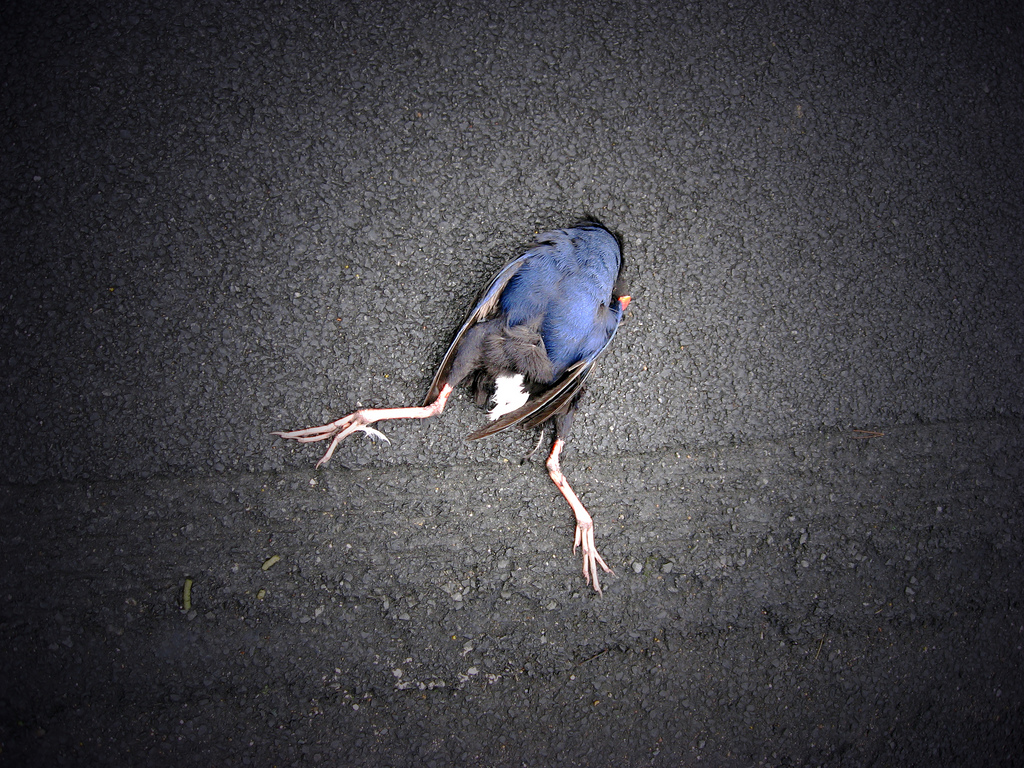
Update from a New Zealand reader, who identifies the above bird and offers advice on eating roadkill:

The bird in your post a Pukeko, a prolific New Zealand waterfowl species that gets run over often. It does not get run over in Montana though.

Roadkill is ok to eat, but it depends on where it is hit. Rabbits and hares that get run over by a wheel are too badly bruised, but those that stick their heads up and get hit by the underside of the grill are fine. Birds can be good, but preferably if they come off the windscreen obliquely, rather than getting hit by the grill. Pheasants usually hit the windscreen and are not too badly damaged.

Pukeko is not regarded as a table bird in New Zealand, as it has suffered from the adage boil it with a rock and throw the pukeko out and eat the rock. It is ok to eat but you don’t get much meat, and it is tough if it is not allowed to settle in a fridge for about two weeks to allow the proteins to break down.

(Photo by Lee Taylor)
Professorial Politics

Chris Mooney unpacks the research of sociologist Neil Gross, who found evidence that the academy indeed leans left, with 50% of professors describing themselves as “left or liberal,” and 8-9% as “far left” or “radical”:

[A]cademia is indeed more liberal than America, just as other professions, such as the clergy and the military, are dens of conservatism. But where conservatives get it wrong, Gross says, is in their simplistic assertions that academia’s leftward lean is a result of bias or discrimination. Rather, he argues, academia is liberal because… it has been attacked for being liberal. Gross’s analysis concludes that the ivory tower’s well-known political reputation has encouraged a kind of self-selection effect, where conservatives gravitate away from it, and liberals towards it.

That would mean it’s precisely backwards to claim that universities discriminate against conservatives in favor of the godless and liberal. Rather, people who are godless and liberal tend to flock to universities—and stay there.

Abandonment Issues And Poker

There appears to be a connection:

People who scored high in attachment anxiety (for example, they agreed with statements like “I worry about being abandoned” and “My desire to be very close sometimes scares people away”) tended to be better at spotting lies and made-up stories….

To see if the lie-detection skills associated with anxious attachment have any benefit in real life, Ein-Dor and Perry recruited 35 semi-professional poker players, assessed their attachment style and then observed their performance in a local poker tournament. Each participant was allocated at random to join in with a group of seven other players at the event. As they predicted, the researchers found that the participants who scored higher in anxious attachment tended to win more money in the tournament (on average, a one-point higher score in anxious attachment was associated with winning an extra 448 chips).

The Budding Of E-Commerce

The first-ever sale over the Internet? A bag of marijuana:

[According to] John Markoff ‘s 2005 book What the Dormouse Said: How the Sixties Counterculture Shaped the Personal Computer Industry … in 1971 or 1972, Stanford students using Arpanet accounts at Stanford University’s Artificial Intelligence Laboratory engaged in a commercial transaction with their counterparts at Massachussetts Institute of Technology. Before Amazon, before eBay, the seminal act of e-commerce was a drug deal. The students used the network to quietly arrange the sale of an undetermined amount of marijuana.

For the first pizza delivery ordered by a computer, see this footage from 1974.

Books As Memory Markers

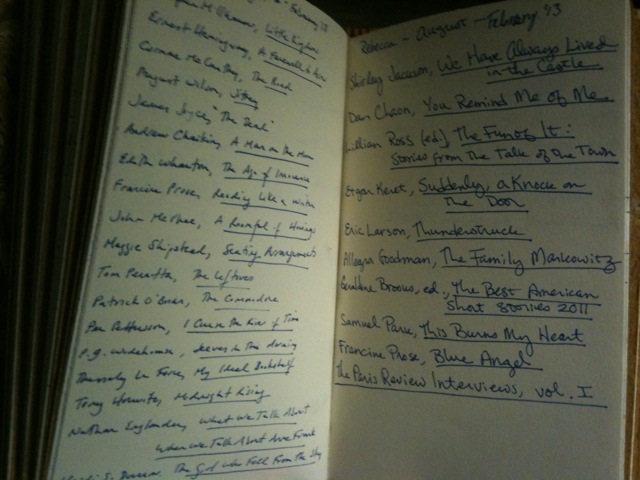
Rebecca Makkai lists the top five books she would save from a fire. One was a blank hand-bound book she received as a wedding gift:

We couldn’t see ourselves asking people to sign it. I wasn’t about to fill it with crappy story drafts or start inside-bookjournaling. So we began writing down every book we read. (Jon gets the left page and I get the right. As you can tell, he’s a much faster reader.) It’s made me more determined to finish things, in the same way my childhood library’s summer reading program once did. It’s also the best diary I could have. If I want to remember December, 2003, I just need to see that I was reading Motherless Brooklyn and it all comes back: pneumonia, hospital, striped sweater, and the last time I ever played tennis.

And it’s also afforded me the greatest insult I could give a book. When a book is so extraordinarily bad that I’d be embarrassed to record it—terrified that my grandchildren, after I’m gone, might pick this one book off the list and read it to see what kind of person I was—I’ll refuse to write it down. It’s a rare punishment, one I’ve only exercised a few times. And therein lies the essay I’ll never write, a companion to this one: The Five Books I’d Consign to the Flames.

The Underground Economy

It’s expanding:

[E]ven though the percentage of Americans officially working has dropped dramatically, and even though household income is still well below what it was in 2007, personal consumption is higher than it was before the recession, and retail sales have been growing briskly (despite a dip in March). Bernard Baumohl, an economist at the Economic Outlook Group, estimates that, based on historical patterns, current retail sales are actually what you’d expect if the unemployment rate were around five or six per cent, rather than the 7.6 per cent we’re stuck with. The difference, he argues, probably reflects workers migrating into the shadow economy. “It’s typical that during recessions people work on the side while collecting unemployment,” Baumohl told me. “But the severity of the recession and the profound weakness of this recovery may mean that a lot more people have entered the underground economy, and have had to stay there longer.”

The Dish’s Full Boston Bombings Coverage

[Re-posted from earlier today]

We’ve put up a page that contains our entire bloggery in both chronological and reverse chronological order. A reader writes:

I’d like to thank you for your coverage of what was going on in Boston so early on Friday morning – I was glued to my phone on an early-morning coach (bus) in middle-of-nowhere England, trying to contact friends and family in Cambridge (MA) and Watertown via Facebook and desperate searching for reliable news that could load onto my mobile before we left a pocket of precious O2 data coverage. At 7 AM BST (2 AM EDT), though, BBC and NYT aren’t updating, nor is Anderson Cooper tweeting away, and straight-up Google searches take too long given the quality of “reporting” too many media outlets provide. Yet there you were, middle of the night, aggregating news as it was coming in, liveblogging mobile-friendly and reasonably-accurate information to concerned readers around the world. So, to Chas, Chris, and all others who pulled Thursday’s Dish all-nighter: thank you.

You’re welcome. It’s what we do and have always done. One of many new subscribers writes:

I thought I would never pay for a website, but you won me over. I’ll admit that I had never read anything you had written until the day Margaret Thatcher died, but was familiar enough with your work that yours was the perspective that I decided was most worth tracking down. Then Friday morning, 3am, I happened to check in. Your team’s judicious choice of tweets was so good, I didn’t even think about following a live feed until about 5 in the morning. Today, I found I couldn’t hit that “Read On” button without feeling like a mooch. So count me in.

You can join her and others by subscribing [tinypass_offer text=”here”]. We’re a small team competing with huge organizations with far more resources. We have no corporate backing or advertizing – which means the only support we have is you if we hope to stay in business. If you’ve used up your ‘read-ons’, please consider taking the leap and subscribing. If all of you with maxed-out read-ons subscribed today, our readership would instantly climb 50 percent – and our future would be far more secure. [tinypass_offer text=”Subscribe!”]

The Daily Wrap

Today on the Dish, Andrew pushed back against pundits downplaying the Tsaraev brothers’ religious radicalism, connecting it with a greater refusal to acknowledge the power of fanatic faith. He weighed in on the debate over Mirandizing the surviving suspect, lauded the decision to do so when it came—contrasting this case with justice under Bush—and cautiously tracked Francis’ first few moves as Pope, with an eye to the future.

In more Boston coverage, Rafia Zakaria accounted for the preeminence of American tragedies, we reviewed how news of the bombing is going down at the Kremlin, and we continued to ask whether Boston’s city-wide lockdown was really necessary. Dzokhar Tsarnaev himself supplied the Quote for the Day and Julia Ioffe unpacked the significance of the bombers’ crisis of assimilation in the US while Charles King placed less weight on their link to the Caucasus. Later we watched a remarkable video of marine amputees comforting victims of the Marathon bombing and posted a one-stop shop for last week’s coverage of the Boston bombings.

In political news and views, Beinart dismissed MoDo’s latest critique of Obama’s grit, we gathered some analysis on the Senate’s latest flop on gun legislation, and John Ismay updated Eisenhower’s “chance for peace” speech. Soldiers shared their experiences in our thread on the plight of US veterans, Rod Dreher defended the French against American conservatives,  J. Bryan Lowder imagined the next logical step after the lifting of the Boys Scouts’ gay ban.

In miscellanea we learned that the news can be bad for your health and discovered the blowback of drug PSAs. Dean Starkman tracked the crash in WSJ’s longform writing as we read the journal of a professional killer and browsed album reviews by musicians themselves. Angela Watercutter excavated vintage Internet, we watched a grandmother experience virtual reality and Navneet Alang explained anomalous aesthetics.

Elsewhere, Andrew Johnston warned of the fragility of GPS, Kas Thomas deflated the antioxidant theory and Bill Wasik checked the phrase “viral.” Ben Marks studied the blood rust of vintage blades while we tucked our ball chairs away. Finally, we saw the bloody results of French homophobia in the Face of the Day, glanced at a view of Honolulu in the VFYW and chuckled at the less than literary output of celebrities on Twitter in the MHB.

–B.J.

The Shutting Down Of Boston, Ctd

Boston Marathon Bombing Investigation Continues Day After Second Suspect Apprehended

Thoreau notes how Tsarnaev was caught:

The authorities announced that people could again go outside, and then a sharp-eyed citizen noticed something. He escaped from the cops the night before, and was caught thanks to a sharp-eyed citizen once the authorities let people go outside and go about their business.

Marc Tracy adds:

There is no way to definitively play out the what-ifs. Authorities might not have coaxed a lockdown, people might have walked around Watertown, and somebody might have gotten hurt. Conversely, authorities might have kept the lockdown longer than they did, and Tsarnaev, who was taken to a hospital for urgent treatment, might have sat in the boat even longer, undiscovered, and bled to death. We don’t know.

The problem with the lockdown, as a matter of principle, isn’t that it could have prevented us from capturing Tsarnaev alive. Rather, the way Tsarnaev was captured alive is further suggestion that life in America is a Constitutionally codified experiment, and that the worst time to suspend experiments is when you don’t have all the answers.

Ross Anderson believes the shut-down was disproportionate:

In the London bombings, four idiots killed themselves in the first incident with a few dozen bystanders, but the second four failed and ran for it when their bombs didn’t go off. It didn’t occur to anyone to lock down London. They were eventually tracked down and arrested, together with their support team. Digital forensics played a big role; the last bomber to be caught left the country and changed his SIM, but not his IMEI. It’s next to impossible for anyone to escape nowadays if the authorities try hard.

Meanwhile, Alex Seitz-Wald examines the impact of Boston’s shutdown last Friday on workers:

“Most low wage workers can’t afford to lose a day’s pay, and there’s no doubt this lockdown will adversely impact the city’s working poor,” said Jessica Kutch, a labor activist who co-founded the organizing site coworker.org, in an email to Salon. “I’d really like to see employers state on the record that their hourly workers will be paid for the time they were scheduled to work today — but I suspect that most employers will place the burden of this shutdown squarely on the backs of people who can least afford it.”

Previous Dish on the Boston shutdown here, here and here.

(Photo: Investigators work around the boat where Dzhokhar A. Tsarnaev was found hiding after a massive manhunt, in the backyard of a Franklin Street home, in an aerial view April 20, 2013 in Watertown, Massachusetts. By Darren McCollester/Getty Images)

Are Musicians The New Critics?

Watch out, Pitchfork:

Musicians think and talk about music all day, so they have lots of practice discussing it. They hear lots of new stuff and find out about it before most people. They certainly know how the sausage is made. And guess what: a lot of them can write really well. … Writers don’t write like critics — instead, they show us how a musician hears music. It’s organic, relatively free from marketing initiatives, because the writers choose what they want to write about. And, like most music fans today, musicians have broad, often surprising tastes: you don’t have to like They Might Be Giants to be amused by Parquet Courts’ bassist Sean Yeaton’s delirious take on that band; plenty of people will be curious to hear what Laurie Anderson has to say about the latest Animal Collective album; what on earth does Andrew W.K. have to say about the new album from Robert Pollard of Guided by Voices? And Zac Pennington of the art-rock band Parenthetical Girls has an enthusiastic and trenchant take on… Taylor Swift?

Michael Azerrad helped found Talkhouse, a website where musicians write about music. From a review of Bowie’s new album by Jonathan Meiburg, singer for the band Shearwater:

Singers’ voices tend to age in interesting ways, sometimes gracefully, sometimes not.

Joni Mitchell’s, burnt (with grim purpose, one suspects) to a dry husk by cigarettes, is an extreme example, as is Robert Plant’s, whose much-abused high register has deserted him, though he seems to delight in combing through its damaged remains. Dylan, of course, went through a phase in which his voice seemed to give up on the very idea of singing (though I have an affection for the weird Jim Nabors-like “country” voice of Self Portrait and Nashville Skyline).

Closer to the present, Michael Stipe’s voice, originally grave and gritty, turned dark and husky, then brightened, cheered up, and became strangely weightless; Bill Callahan’s voice opened, dived, and doesn’t yet seem to have found the bottom; Gil Scott-Heron’s oratory ripened into a splendid growl; Lou Reed’s went kind of warbly, lost its once-unassailable authority and eerie tenderness, and hasn’t been able (or perhaps doesn’t want) to find it again.

There are exceptions, naturally — Jimmy Scott kept his high notes up to the very end, though with a slight wobble; Morrisey’s voice lost its fun but carried on otherwise, Neil Young’s voice seems to have emerged from the egg more or less in its present state, Patti Smith’s grew into the age it once affected, and Mick Jagger’s cartoony honk is a sort of museum piece, a dogged re-creation of a funny voice he stumbled into as a teenager and milked for half a century.

Which brings us, I guess by way of “Dancing in the Streets,” to Bowie, and his voice (or voices) on The Next Day. The choice of “Where Are We Now” as the first single from the record was canny, as it presents a new Bowie voice: plain, vulnerable, a little weary, and — it must be said — old, its glassy surface showing more hairline cracks than when we last heard it a decade ago. But it’s bravely, even defiantly old, and it dares you to do the one thing we’re not accustomed to doing with an artist who has so fully and publicly embraced method acting: to take him at face value.

Earlier Dish on Bowie’s new album here.