At last, something good comes out of celebrities on Twitter:
Year: 2013
Padilla vs Tsarnaev; Bush vs Obama
The first US citizen, Jose Padilla, was captured on US soil, detained without formal charges, accused of plotting a dirty bomb, and then brutally tortured until he was a human wreck. Eventually, the dirty bomb charges were dropped in the legal process. And there was a serious question about whether, after such brutal torture and isolation, he had been psychologically brutalized by his own government to the point of insanity.
Tsarnaev, in contrast, was formally charged this morning, will be tried in a civilian court, go through due process, and face a weight of evidence against him.
This is why we elected Obama. To bring America back. To defend this country without betraying its core principles.
Chart Of The Day
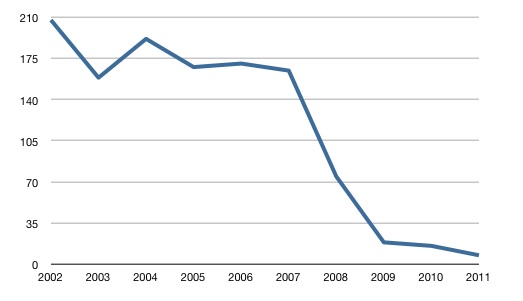
Noting the absence of the WSJ from this year’s Pulitzer finalists, Dean Starkman charts the number of WSJ pieces longer than 2,500 words:
A common trait among Pulitzer projects is that they are ambitious, require extensive reporting and careful writing, carry some significance beyond the normal gathering of news, and/or have some kind of impact on the real world, like, as I’ve written, fixing Walter Reed. Basically, this is work that takes a long time to do and requires some length in which to do it. And just because a project has all those elements obviously doesn’t mean it’s going to win anything. Public-service projects have to be a routine and done for their own sake.
[Rupert] Murdoch’s oft-stated antipathy to the concept of longform narrative public-interest journalism was the main reason some of us opposed his taking over the Journal in the first place. … It’s been well-reported what he thinks about the public-service aspect of journalism, which in some quarters is also known as, “the point.” His biographer/medium, Michael Wolff, reports, ad nauseum, on Murdoch’s view: “The entire rationale of modern, objective, arm’s-length, editor-driven journalism—the quasi-religious nature of which had blossomed in no small way as a response to him—he regarded as artifice if not an outright sham.” Wolff had 50 hours of interviews with Murdoch, by the way, so he’s not guessing here.
Your Monday Cry
Marine amputees offer love and advice to Marathon amputees:
Yes, Of Course It Was Jihad
My take here.
A Vatican Spring?

One major piece of disappointment came with Pope Francis’ endorsement of the on-going inquisition of American nuns. I’m not sure entirely what to make of it – is it an early indicator of Francis’ theological conservatism or simply acquiescing to a process already long underway? We will see by the disciplinary actions eventually taken (or not). The nuns would seem to have more in common with the Jesuit Francis, if only because he is aware of the need for outreach among religious orders – even to places and people that discomfort others. That was Jesus’ call, and Saint Francis’ and St Ignatius’. We’ll see what transpires in the end, but, obviously, I hope the Sisters can soon renew their vital work without constantly looking behind their backs.
But three other developments strike me as encouraging. The first – and least sexy – is the establishment of a global council of advisers in the governing of the church. This may seem a trivial reform. It isn’t. It restores the Second Vatican Council’s desire to place the Pope in a less dictatorial position, and to open up areas of authority within the global church as a counter-balance. And so this new governing commission – made up of highly effective cardinals in every continent – is a big shift:
More profound thinkers have read the Pope’s creation of a group of advisers as a bold new step towards fully implementing a model of ecclesial government evoked by the Second Vatican Council – one that is
less centralised, more collegial and based on the principles of subsidiarity.
“What Pope Francis has announced is the most important step in the history of the Church of the last 10 centuries and in the 50-year period of reception of Vatican II,” said the noted church historian Alberto Melloni. Writing in the Milan daily Corriere della Sera, he said the Pope had “created a synodal organ of bishops that must experiment with the exercise of the consilium”. In other words, shared governance of the Church between the Bishop of Rome and all the world’s bishops.
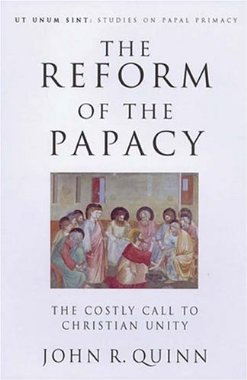
Detailed proposals for this were put forth in Archbishop Quinn’s book, [“The Reform of the Papacy“] which in 2005 appeared in Spanish. Pope Francis read that work when he was still just a cardinal in Argentina and, at around that time, he reportedly expressed his conviction that at least some of its ideas should be adopted.
More surprising is the support for civil unions for gay couples that seems to be percolating on the margins. The Pope argued for them in Argentina within the Jesuit branch he ran (it was the sole argument he lost in his years in president of the Conference), and earlier this year, some wiggle room for gay couples in civil law was mentioned by Archbishop Vincenzo Paglia, president of the Pontifical Council for the Family. This was only a defensive action against civil marriage rights for gay couples, but it was a concession to reality one cannot imagine Benedict XVI ever making. Now this:
The latest expression of support for civil recognition as an alternative to gay marriage comes from Archbishop Piero Marini, who served for 18 years as Pope John Paul II’s liturgical master of ceremonies. “There are many couples that suffer because their civil rights aren’t recognized,” Marini said.
The third indication of good news is the fact that Pope Francis has unblocked Oscar Romero’s path to beatification:
The Vatican’s Congregation for the Causes of Saints has been studying the Romero case since 1996, after the church in El Salvador formally opened the procedure in 1990. At the end of his 20-minute homily Sunday, Paglia said: “Just today, the day of the death of Don Tonino Bello, the cause of the beatification of Monsignor Romero has been unblocked.” Paglia had been received by Pope Francis on Saturday, and presumably the decision to authorize moving forward with the cause came out of that session.
Romero was shot to death while saying Mass in El Salvador on March 24, 1980. While he is seen as a hero to many because of his solidarity with the poor and his opposition to human rights abuses, his cause has also been viewed with suspicion in some quarters, partly because of Romero’s links to the controversial liberation theology movement.
Know hope.
(Photo: Crocuses in bloom. By Oli Scarff/Getty Images)
Terror And America, Ctd

Rafia Zakaria, a columnist for Pakistan’s largest English newspaper, tries to explain the disproportionate coverage of the Boston attacks – compared with, say, 65 terrorist deaths in Iraq on the same day or the West, Texas, catastrophe:
Attacks in America are far more indelible in the world’s memory than attacks in any other country. There may be fewer victims and less blood, but American tragedies somehow seem to occur in a more poignant version of reality, in a way that evokes a more sympathetic response. Within minutes American victims are lifted from the nameless to the remembered; their individual tragedies and the ugly unfairness of their ends are presented in a way that cannot but cause the watching world to cry, to consider them intimates, and to stand in their bloody shoes. Death is always unexpected in America and death by a terrorist attack more so than in any other place.
It is this greater poignancy of attacks in America that begs the question of whether the world’s allocations of sympathy are determined not by the magnitude of a tragedy—the numbers dead and injured—but by the contrast between a society’s normal and the cruel aftermath of a terrorist event. It is in America that the difference between the two is the greatest; the American normal is one of a near-perfect security that is unimaginable in many places, especially in countries at war. The very popularity of the Boston Marathon could be considered an expression of just this. America is so secure and free from suffering that people have the luxury of indulging in deliberate suffering in the form of excruciating physical exertion; this suffering in turn produces well-earned exhilaration, a singular sense of physical achievement and mental fortitude. The act of running a marathon is supposed to be simple, individual—a victory of the will over the body, celebrated by all and untouched by the complicated questions of who in the world can choose to suffer and who only bears suffering.
(Photo: Stylianos ‘Stelios’ Kyriakides, of Greece, runs up Heartbreak Hill in Newton, Mass. during the 1946 Boston Marathon. He won the race. By Charles Dixon/The Boston Globe via Getty Images.)
Why Did Gun Control Fail?
David Karol provides some answers:
[G]un control supporters have no shared social activities, no common identity and no companies that cater to them. Their jobs don’t bring them together. Unlike gun rights advocates’ they don’t find and stay in touch with each other without a conscious and sustained effort to do so. Under these conditions, it is not surprising to find far more effective mobilization of sentiment on the gun rights side. So even if there was significant intensity of feeling on the part of a sizable minority of gun control advocates, (say 10% of the 90% favoring background checks) we should expect them to have greater difficulty in channeling those feelings and building durable political organizations.
Chait explains why Senate Democrats folded:
If you’re picking your battles, background checks are as good an issue as any to lay down. For one thing, as I’ve suggested, guns loom disproportionately large in the political world of red state Democrats. Guns are the way they signal home state cultural affinity, giving themselves a chance to get their economic message heard. Their A rating from the National Rifle Association is powerful shorthand. And yes, the NRA is crazy and partisan, and was opposing a bill it used to support and that most Republicans support. But none of those facts overcomes the blunt reality of the A rating’s political value.
What’s more, this particular gun vote was an especially good time for Democrats to defect. None of them cast the deciding vote; it fell six votes shy of defeating a filibuster. The bill was already a compromise of a compromise, something that would have stopped a tiny fraction of gun crimes. Even if it passed the Senate, it faced steep odds of passing the House, where it probably would have died, been weakened further, or even turned into a law that weakened existing gun laws.
MoDo On Obama
Amazing that Dowd’s advice is that Obama *should have given more speeches.* Derp. nyti.ms/11sjNbF
— daveweigel (@daveweigel) April 22, 2013
The best response to her “Obama-Is-A-Wimp” meme (now six years’ old) is from Peter Beinart on gun control. Money quote:
Sure, Obama may have made tactical mistakes. Critics claim the White House waited too long before offering concrete proposals, and wasted time pushing an assault weapons ban that had no chance to pass. But this president, who is sometimes called reserved, aloof, and calculating, pursued gun control with a force of mind and soul that was astonishing to behold. “I never saw a president fight so hard,” remarked Sen. Barbara Boxer, “never on any issue.”
A Long Way From Kyrgyzstan
Julia Ioffe, who spent her early childhood in Russia, explores the significance of the Tsarnaev brothers’ struggle to assimilate in the US as Chechens:
If the YouTube channel that is said to be [older brother] Tamerlan’s really is his, you can see him fervently clinging to this torn identity: It is full of Islam and Russian rap, which makes sense given the Soviet policy of Russifying Chechnya. In fact, Chechnya is still part of Russia and Russian, as well as Chechen, is its official language. Dzhokhar, who was either 9 or 11 when the family moved, may have been more assimilated than Tamerlan, but if that VKontakte page is his, it too is telling: VKontakte is the homegrown Russian rip-off of Facebook. The mere fact that he had a page on an exclusively Russian social network shows that the assimilation was not a complete one. Because emigrating at 11, or even 9, is hard, too. (The most revealing image of Dzhokhar is not the one of him hugging an African-American friend at his high school graduation, but the one of him sitting at a kitchen table with his arm around a guy his age who appears to be of Central Asian descent. In front of them is a dish plov, a Central Asian dish of rice and meat, and a bottle of Ranch dressing.)

