How Olivier Roy understands Western-bred Jihadists:
The main motivation is not religious. Most of the guys, they were normal, they were not especially religious. One of them who went to Tehran became religious. It is not the process of Islamicization, through going to mosque, through studying the Koran. They go for action, they take the al Qaeda thing because if you do that in name of Al Qaeda, you will have a far hotter act than if you do that in the name of something else. They are disconnected in fact from the Muslim community. Many security officials thought the best way to spot these guys was to use the local Muslim communities to control the radical mosques, to engage mainstream imams to ask for help. And most of them comply with that, they want to help but they can’t comply because they guys are not part of these communities. They are loners.
With the Western ones, there may be some strange fusion of loner Internet Jihadism with simple fame-seeking testosterone. But the idea that religious zeal is not behind this seems to me perversely blind.
Roy’s second point, however, is a vital one. This is not about mainstream Islam. It is not about tradition or Muslim communities as we have long known them, especially in America. It is about the fusion of the most extreme and violent versions of Islam (a religion whose founder committed violence), with global Internet culture, and the lost, desperate souls of modernity.
With such an easily available, literally explosive combination, it amazes me, in many ways, that we have not seen more of this before.
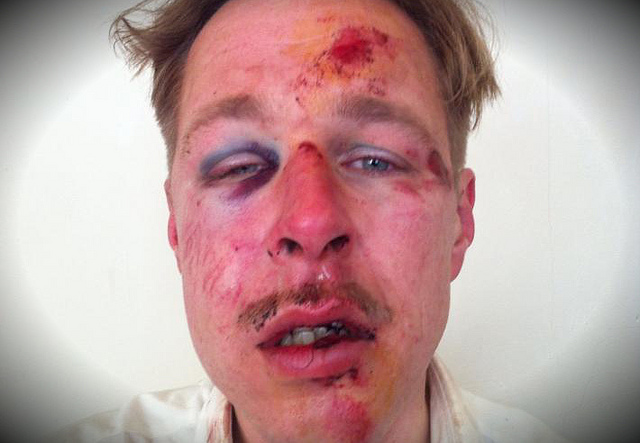
Wilfred de Bruijn, a Dutch man living in France for 10 years, after a brutal homophobic attack in Paris:
According to de Bruijn, he was attacked with his boyfriend in the 19th arrondissement of Paris on Saturday night simply because they were gay. France’s gay rights groups say the savage beating comes as homophobic incidents are on the rise.
They blame the increasingly radical and stubborn anti-gay marriage movement.
Hours after being subjected to the beating, De Bruijn put the photo on his Facebook page. It has since been shared thousands of times across social media.
“Sorry to show you this,” the victim wrote. “It’s the face of homophobia. Last night 19th arrondissement, Paris, Olivier and I were badly beaten just for walking arm in arm.
“I woke up in an ambulance covered in blood, missing tooth and broken bones around the eye.
“I’m home now. Very sad.”
Marriage equality will come to France in a matter of weeks.
Rod shares why he thinks American conservatives have such a problem with the French:
Even in March 2003, at the onset of the Iraq War, Rod was defending French culture in the pages of National Review:
I think there’s a conservative point to be made here. The French are an old country, and the love they have for their culinary traditions, and its unparalleled excellence, come from a profound respect for tradition and culture, for civilization. When they make fools of themselves beating up the neighborhood McDonald’s, I find it hard to condemn them, because we all live in a world that doesn’t ask What is beautiful? What is delicious? What is worthy; we live in a world that asks only, What is quick and easy? Many of the French resist this modern, very American impulse. They do it in bad, stupid ways sometimes, but their instinct is right. As someone who grew up in a disposable culture, the effort the French put into aesthetic excellence never fails to move me, and makes me want to learn from them. …
… I can’t hate France, and when this ugly time passes, I’ll be back. I’ve got a little boy of my own now, and rather than just tell him about the wonders of France, as Aunt Lois and Aunt Hilda did for me, I’m planning to take him there one day and show him. I want him to see the cathedral at Chartres, the experience of which first stirred me to seek Christian faith (wondering what kind of religion would inspire men to build something so magnificent to the glory of God). I want him to see the castles of the Loire Valley, the vineyards of Bordeaux, and the graveyard at Normandy, where so many of his countrymen died to make France free. I want him to see Paris, the world’s most beautiful city, and the bridge over the Seine where his father kissed his mother one warm spring evening when they were first in love, and to walk over to Berthillon on the Ile St-Louis to taste the best ice cream in the world. France is for him to love too, and not even the perfidious pomposities of Dominique de Villepin can take that from him.
Emily Bazelon worries because he hasn’t been Mirandaized:
[T]he next time you read about an abusive interrogation, or a wrongful conviction that resulted from a false confession, think about why we have Miranda in the first place. It’s to stop law enforcement authorities from committing abuses. Because when they can make their own rules, sometime, somewhere, they inevitably will.
A newsflash: Miranda does not in any way require the police to warn suspects taken into custody that they don’t have to answer questions or that they have a right to have an attorney present. All that Miranda says is that if the interrogators don’t give the warnings, then (barring an exception), the government won’t be able to introduce into evidence at trial statements the unwarned suspect makes (or the fruits of those statements). Accordingly, there is nothing remotely unusual about the Tsarnaev situation. Millions of criminal suspects are questioned every year by the police (and other law enforcement officials) without ever being advised of their rights under Miranda. Police officers I know tell me they hardly ever Mirandize individuals they arrest because cases in which the arrestee’s statements are relevant to securing a conviction (especially in a world of plea bargaining) are quite unusual.
Sandy Levinson disagrees with Mazzone’s dismissal of Bazelon and considers Tsarnaev’s individual case:
As a practical matter, as Marty Lederman has suggested elsewhere, it is quite unlikely that Dzhokhar Tsarnaev is unaware that he has a right to remain silent, either because of his knowledge of American culture or because his alleged terrorism-masters in Chechnya would surely have had the wit to say (something like) “if you’re captured, remember that those wimp Americans will accord you a right to remain silent.” Also, as Marty has suggested, it is almost certainly the fact that a smart defense lawyer would not necessarily advise taking the fifth, precisely because there is so much evidence against him and the smart thing to do would be to strike a deal for, say, life imprisonment in return for singing like a canary (and verifying what he says by tracking down his leads).
As a practical matter, I don’t object. As a symbolic matter, I fear it reeks of post-9/11 panic. I’m just relieved we do not have a Romney administration or this American citizen would be getting prepped for being tortured, just as Jose Padilla was. Orin Kerr is on the same page as Mazzone:
[T]he government is still free to question Tsarnaev outside Miranda as long as the government accepts the uncertainty of whether those statements would be admissible in a criminal case against him.
Assuming that the evidence against Tsarnaev’s many different crimes over the last week is likely to be overwhelming, agents may not need any statements from him for a criminal case. They may simply want whatever intelligence he can provide for use in broader antiterrorism efforts, and Miranda is no impediment in that case. The agents are free to question Tsarnaev outside Miranda to gather intellligence as long as they don’t cross the line into coercing statements from him.
Timothy McVeigh: killed 168 people. Injured over 800 more. Was motivated by political convictions. He was arrested, Mirandized, charged, appointed with legal counsel, and tried in a civilian court. Ted Kaczynski: killed three people. Injured 23 more. Was motivated by political convictions. He was arrested, Mirandized, charged, appointed with legal counsel, and processed through a civilian court. Eric Rudolph: killed two people. Injured at least 150 more. Was motivated by political convictions. He was arrested, Mirandized, charged, appointed with legal counsel, and processed through a civilian court.
If you recognize that the results of these legal cases were consonant with our system of jurisprudence and with justice, you cannot ask for a separate status for Dzhokhar Tsarnaev without supporting legal discrimination based on ethnicity and religion.
The local authorities that relied on coercive interrogations and didn’t follow professional procedures weren’t more likely to convict criminals, although they were more likely to convict the innocent. Miranda reflected this belief, and the intent of the rule was to inhibit coercive interrogations, because coercive interrogations were both wrong in themselves and produced unreliable information.
To refuse to inform Tsarnaev of his rights — outside of the acknowledged emergency exception to Miranda — sends the opposite message. It’s the message of the previous administration — i.e. that the rule of law and the “war on terror” are incompatible, that slapping the label “terrorist” on a suspect means that professional procedures that respect the rights of the accused can’t work.
[N]o one has produced evidence showing that non-mirandized investigations, like enhanced interrogation, are necessary to procure valuable intelligence—the administration originally argued that the ordinary criminal justice system was adequate to try even the Guantanamo detainees. “We should use the rules we currently have, because no one has made a convincingly argument that the rules don’t work,” says [Dennis] Kenney, a policing scholar and former cop. “Collectively, you’ll find that the police are pretty comfortable with the rules as they are and if you talk to police leaders, they’re nervous about these kinds of changes.”
Miranda rights aren’t conferred on a suspect at the moment an officer of the law reads them to him. They’re fundamental. And if Tsarnaev awakes in the hospital aware that he doesn’t have to say anything, and demands an attorney, the FBI ultimately can’t deny him one.
“Yeah, man, I mean, tragedies can happen anywhere in the world,” – how Dzokhar Tsarnaev reacted when discussing the marathon bombings with a classmate after the attack.
In his new book, The Faithful Executioner, Joel Harrington tells the story of Frantz Schmidt, Nuremberg’s master executioner from 1573-1618, using Schmidt’s own journal. Peter Lewis highlights what made the “pious, reflective, loyal, sober Frantz” such “a rare bird in the world of executioners”:
Schmidt was a professional torturer and punisher as well as executioner. He had to know how far he could go in securing a confession — the best place to turn the screw, how much stretch the shoulder would take in the strappado, the correct tilt of the waterboard (yes, that’s right) — and if the sentence handed down was to sever the tongue, the severer better be handy with medical tools if it was not to become an act of capital punishment. The executioner’s medical knowledge was widely sought, and Schmidt was well considered to have extensive familiarity with herbs and salves (from attending his torture victims) and of setting broken bones (so that the execution might go on). He considered healing to be his calling — for a sensitive soul, it must have been a consolation to his other profession — and he made more money as a healer than an executioner; his patients numbered in the thousands.
There are many nuances to the story of Tamerlan and Dzokhar Tsarnaev – and there is no doubt that, like all human beings their acts were, as my shrink often unhelpfully puts it, “multi-determined.” And there is a huge amount to learn from the stoner kid who got caught up in his brother’s religious fanaticism. But Glenn Greenwald veers into left-liberal self-parody this morning:
The overarching principle here should be that Dzhokhar Tsarnaev is entitled to a presumption of innocence until he is actually proven guilty. As so many cases have proven – from accused (but exonerated) anthrax attacker Stephen Hatfill to accused (but exonerated) Atlanta Olympic bomber Richard Jewell to dozens if not hundreds of Guantanamo detainees accused of being the “worst of the worst” but who were guilty of nothing – people who appear to be guilty based on government accusations and trials-by-media are often completely innocent. Media-presented evidence is no substitute for due process and an adversarial trial.
But beyond that issue, even those assuming the guilt of the Tsarnaev brothers seem to have no basis at all for claiming that this was an act of “terrorism” in a way that would meaningfully distinguish it from Aurora, Sandy Hook, Tuscon and Columbine. All we really know about them in this regard is that they identified as Muslim, and that the older brother allegedly watched extremist YouTube videos and was suspected by the Russian government of religious extremism (by contrast, virtually every person who knew the younger brother has emphatically said that he never evinced political or religious extremism).
Legally, the case for the presumption of innocence is absolutely right. But come on.
One reason the Miranda rights issue is not that salient is that the evidence that this dude bombed innocents, played a role in shooting a cop, shutting down a city, and terrorizing people for a week is overwhelming and on tape. And yes, of course, this decision to commit horrific crimes may be due in part to “some combination of mental illness, societal alienation, or other form of internal instability and rage that is apolitical in nature.” But to dismiss the overwhelming evidence that this was also religiously motivated – a trail that now includes a rant against his own imam for honoring Martin Luther King Jr. because he was not a Muslim – is to be blind to an almost text-book case of Jihadist radicalization, most likely in the US. Tamerlan may have been brimming with testosterone as he found boxing an outlet for his aggression, bragging to his peers of his coolness and machismo and piety, and all of that may have contributed. Who knows if the delay in his citizenship application because he was beating his wife was the proximate cause. But does Glenn wonder why Tamerlan thought it was ok to beat his wife, whom he demanded convert to Islam? Does Glenn see no religious extremism here:
The dramatic confrontation between Tamerlan and his imam began when the 26-year-old interrupted a solemn Friday prayer service three months ago. The imam had just offered up assassinated civil rights icon Martin Luther King Jr. as a fine example of a man to emulate – but this reportedly enraged Tamerlan.
‘You cannot mention this guy because he’s not a Muslim!’ Muhammad recalled Tamerlan shouting, shocking others in attendance according to the LA Times. Kicked out of the mosque for his outrageous behavior, Tamerlan did return to the prayer service after his outburst according to Muhammad.
‘He’s crazy to me,’ said Muhammad. ‘He had an anger inside.… I can’t explain what was in his mind.’
This is from the Daily Mail – which is almost as unreliable as the New York Post – but the sourced quotes from his own imam seem legit. So we see perhaps the core of what is in front of our noses: this was not about Islam or being Muslim as such. Look at Tamerlan’s family and his own imam. They all saw a young man drifting into something far more extremist, fundamentalist and bigoted. His uncle saw it:
‘I was shocked when I heard his words, his phrases, when every other word he starts sticking in words of God. I question what he’s doing for work, (and) he claimed he would just put everything in the will of God.”
We see the sexual puritanism of the neurotically fundamentalist. We have his YouTube page and the comments he made in the photography portfolio. To state today that we really still have no idea what motivated him and that rushing toward the word Jihadist is some form of Islamophobia seems completely bizarre to me.
When will some understand how dangerous religious fundamentalism truly is? And when will they grasp that a religion that does not entirely eschew violence (like the Gospels or Buddhism) will likely produce violence when its extremist loners seek meaning in a bewildering multicultural modern world? This was an act of Jihad. That does not mean we elevate it above crime; it means we understand the nature of the crime. It only makes sense in the context of immediate Paradise, combined with worldly fame. And those convinced of the glories of martyrdom – of going out with a bang – are the hardest of all to stop.
(Video: Introductory clip from the YouTube account of Tamerlan Tsarnaev)
Update from a reader:
In your recent post about the issue of religious extremism and the alleged acts of terror by the Tsarnaev brothers, you said: “But does Glenn wonder why Tamerlan thought it was ok to beat his wife, whom he demanded convert to Islam?” Just a quick fact-check query. The coverage I seemed to recall reading and hearing indicated that although the elder brother, Tamerlan, was charged in some kind of domestic violence incident, as I understand the facts, it was for something he did to a former girlfriend who is NOT his current wife. And separately, as I understand the reporting, he did in fact push and convince his current wife to convert to Islam when they married, but it appears that that was not concurrent with domestic violence against her.
Glad to see this subject make it on your blog. You have been fairly consistent in talking about a lot of these issues that don’t get reported on a ton in other media venues. I just want to jump in though and speak a bit about my own experiences – if nothing else, just for the catharsis of it. This country’s nonsupport of their veterans is borderline criminal. Whether it’s the stigma that gets attached to PTSD thanks to the machismo mentality of the military or the constant stereotyping of veterans with PTSD by Hollywood, or the out-and-out hostility of the VA towards the veterans who they are supposed to help.
I returned from Iraq in 2003 and left the service in 2004. For the next three years, I fought tooth and nail to get help from the VA for PTSD. Every chance they had they denied that any of the symptoms I was suffering from were related to combat; they hilariously told me that they were pre-existing conditions and that they wouldn’t cover it. I spiraled down in those years, drinking myself to sleep pretty much every night and somehow staying in school.
I finally got serious about seeking help after friends of mine sat me down, after a violent outburst followed by some cutting, and helped set me straight. Since then it’s been a constant battle with myself and many times with the VA. Pretty much every day is a struggle and yet the organization that is supposed to be on my side seems to excel at antagonizing and obstructing. For years, my only recourse was the VA because I didn’t have health insurance, and it’s only recently since I’ve gotten an actual job with insurance that I’ve been able to really start addressing these issues.
This story is replayed every single day, thousands of times across the country. Instead of seeking help, veterans will often commit suicide because there is no one there for them. Yet the VA is continuing to repeat the same mistakes. Instead of confronting the issues head-on, they are working actively to downplay the suicide numbers. It’s only recently in the last few years, with the help of veterans organizations, that the totality of the problem is coming out. (There are a lot of great organizations out there who are doing great work; Give An Hour has been a huge help to me.)
Unfortunately, nothing will happen until people start being held accountable and start losing their jobs or elections over this issue. The only way that will happen, as hard as it can be, is for those of us that are struggling with this to start a conversation with our friends, loved ones, and strangers. Only then can the totality of this issue be realized by people who have no connection to these wars and there effects. A clumsy way of saying it is that we need to come out. We need to show that yeah, we may have issues, but we’re not broken. We did our part and held up our end of the bargain – now it’s time for you to fulfill yours.
My grandfather landed on Normandy Beach and never talked about it and struggled with it his whole life. My father was in Vietnam and came back the same way. It’s time for us in this war and generation to be more open and talk about these issues and seek help. Only then can we force the country and our leaders to keep their promises to us.
Another:
I am the forty-one year old adult child of a Vietnam veteran diagnosed with PTSD. In my own experience, the effects of “secondary PTSD” can feel almost as debilitating as actual PTSD itself. As a child, my father was loving and engaged at times, but also unpredictable, swinging from violently abusive to depressed and withdrawn, as he attempted to come to grips with what he saw and did in Vietnam. He also struggled with a host of substance abuse issues – another common symptom of PTSD sufferers.
It took me a number of years to finally connect my own free-floating anxiety, guilt and depression (not to mention my own struggle with drugs and alcohol) with my father’s war experiences. I make no excuses now – trauma affects everyone differently and my father and I both remain responsible for our actions. But to think that the effects of combat (and the costs of our wars) end when our soldiers return home is naïve at best. We are still paying for Vietnam 40 years later and I suspect we will be paying for our current wars for years to come, in one of the currencies that is most valuable to us: the well-being of our families. The trauma of war is now inextricably interwoven in the fabric of my family, and I suspect even filters down into the lives of my own children.
We work hard to heal, and my father and I are both much different now after so many years have passed, but the wound is real, and sometimes still raw. There is great honor in the service and sacrifice our soldiers provide and I remain proud of what my father did in Vietnam, just as I am proud of soldiers today who risk much. But it is a real sacrifice, both for themselves and their families. When we calculate the costs of war, we would do well to remember how long those costs linger.
Most devices don’t have one, according to Andrew Johnston, curator of the new Air and Space Museum exhibit, “Time and Navigation.” He believes that will have to change considering that “GPS is shockingly easy to interfere with”:
One of the famous examples was at Newark Airport. The FAA was experimenting with a positioning system there and every so often, the GPS would stop working briefly. It kept happening over and over again. They finally figured out that what was going on was that right next to the airport was the New Jersey turnpike and the trucks were driving by with GPS jammers. And they’re inexpensive. You plug it into the cigarette lighter power adapter and GPS doesn’t work for the vehicle. The problem is that the zone that it affects is much bigger than a truck. The signal bleeds out, in this case, into the grounds of the airport.
(“The Astronaut Who Captured a Satellite” from NASA)