After last week, back to the late night conversation – and an eerily familiar discussion:
H: The idea of spreading, deliberately, terrible violence, toxic…
A: Why do you think this hasn’t happened? I mean, obviously it hasn’t happened because they can’t have gotten the serious weaponry, the WmDs, right? Otherwise it would’ve happened.
H: I don’t believe they’d have it and be hoarding it, no. Though I could be wrong about that, though: it seemed to me that upon acquisition, Saddam Hussein as a regime or al-Qaeda as a movement would use it at once, or as soon as possible, in a way that, oddly, I don’t think the Iranian regime would. I think they would have it to hoard it and use it as a threat. But, this is a very short gap of time between acquisition and use and it comes to the same thing.
A: But what we saw on 9/11 was sort of the existential fact that these people have been sanctioned, partly by their own eschatology, to believe that it is in fact a sign of the coming apocalypse. That they can act like the zealots acted in ancient Israel under the understanding that the end of the world was imminent—
H: And desirable.
A: And desirable, and that one’s actions were therefore…
H: Yup, they have that in common with all religions. They got the idea from perfectly respectable holy books that are available everywhere and are given to schoolchildren.
A: But at no point in human history have those kinds of people been able to access this kind of power, of destructive power. One isn’t even talking about the need to construct something difficult and enduring like a state or a civilization. One isn’t even talking about the ability to invent these things, it is to copy them or to steal them and deploy them in the crudest manner fashionable to kill as many—
H: To bring on the end, to prove that death is more adorable than life.
A: Yes.
H: Again a necessary religious belief.
A: The one thing I just want to come back to is how does one summon up the energy to fight this knowing it’s inevitable?
H: That’s an excellent question. Well, in the same way as one seeks, knowingly, to stave off or postpone death while accepting its inevitability. In the same way as one has, in some sense, a conscience. Because we, without these faculties, wouldn’t have progressed to the point where you and I could be talking and it could be on tape. Hah, “tape.” See how primitive I am.
A: Yes.
H: That it could be recorded and transmitted.
A: On some .mp3 file.
H: All we know is that without these qualities we wouldn’t have advanced the small distance that we have. I’m content to leave it at that. The mystery to me is that those who are impatient for it to be all over on the illusory belief that the next world, which by their own definition will be created by murder and torture — the transition to it will be accomplished by this apocalyptic, indifferent, pitiless destruction — will be better than the one we’ve got.
I have no idea what it’s like to believe this sort of thing, I think, but I think I can recognize evil when its staring me in the face. And so my resolution, to answer your question, would be not to not give an inch to it and in particular, not to make any excuses for it, not to say, “this is a protest against real human deprivation or suffering”—I won’t have it said that Osama bin Laden is a spokesman for the poor. I’m not having that.
A: We’re not going to have the slightest scintilla of disagreement about that. And I think it’s partly because I actually understand—in some ways, I think, your understanding of religion comes from a hostile point of view, mine comes from a less hostile point of view—but I do understand it. I do understand its power. I do understand why it can lead people to do these things.
H: I understand its power. But whereas I can — in a debate with, say, any kind of Republican or any kind of Leftist — I can back myself to be able, if I had to, or for money, or for a joke, or just as demonstration, to put their case for them, to make their speech, if I had to…I cannot imagine what it is like—
A: To like actually believe it.
H: No. Well, in some cases, I can, but in the case of the religious believer, I cannot. I don’t think it’s a limitation, either, on my curiosity or my mental power.
A: But in this country the biggest selling book is the Left Behind series, the biggest selling series.
H: But I’m sure the least read. It’s totally unreadable.
A: I can honestly testify to seeing people reading it on planes, in airports,
H: Do you see them turning the pages?
A: (Laughs) Yes!
H: Are they holding it the right side up?
A: You read this stuff and it’s like a terrible, terrible, sort of hackneyed, cribbed version of a Frederick Forsyth novel.
H: I’m serious, Andrew, actually, it’s torture for a literate person to read. And I don’t think that by making it written by illiterates it makes it easier for people who don’t read for pleasure to read. I say it’s technically unreadable; they maybe holding it and looking at and they may put it back reverently on the shelf when they get home—it’s not possible they’ve read all but eight words. It can’t be done. The Da Vinci Code is bad, but at least you want to find out what happens next. It’s bad beyond description…
A: Well of course—the Left Behind plot is riveting! Because, you know, you’re on an airplane then suddenly your best friend has disappeared…
H: Once. I can read that once. On a plane, particularly, or on a Greyhound bus. I presume the same is true on a bus or on a camel train.
A: (Laughs) But what I’m saying is, in this country—let’s say they haven’t read them. For the sake of argument I concede they haven’t read the whole bloody thing. They certainly bought it, that requires a certain commitment to the worldview that this thing represents, and what this thing represents is that, not only is the end of the world coming but it is a very desirable thing for it to come. I mean, you see these people rushing to a red heifer in Israel.
H: Indeed, they’re trying to grow the red heifer and in Iowa, now, they find a pseudo or corrupt geneticist who thinks he can grow one without a single white hair. But I hope it succeeds, I hope they get the heifer that doesn’t have a single white hair and it’s pure red, and I hope they do sacrifice it and scatter its ashes. It’ll be the same as every other messianic enterprise, it will end in a hideous disappointment for the morons.
A: No, you know what happens then! What happens then, is there’s a dictatorship of the proletariat and what happens then, is there has to be a vanguard of people who ensure that it occurs!
H: But Andrew, I’ve got to tell you that none of this would occur, even if all the preconditions are met, it will not happen—the temple will not come down from Heaven, the rapture will not take place, the Messiah will not come. The Messiah will not come and will not even call. This is axiomatic to me. The other form, in the secular right in the 50s, which you were recalling also – the John Birch Society was really quite strong, and it was made up of people who believed that President Eisenhower was a conscious agent of the communist conspiracy, that he was a paid enforcer of the Kremlin. Now, okay, you get up in the morning and you believe that, and then you still have to go down and get the groceries.
A: Right.
H: You still have to page through the newspaper. You still have to go and keep your doctor’s and dentist’s appointments. It doesn’t matter what you think, you can believe that if you like. That’s what Omar Khayyam says,
And do you think that unto such as you
a maggot-minded, starved, fanatic crew
God gave the Secret, and denied it me?
Well, well, what matters it! Believe that too.
It doesn’t matter what they think. Unless they’re willing to use deadly force to try and advance the process. Well, the same would be true if they were a secular movement, like fascism. I’m sorry, we’re not gonna be talked to in that tone of voice. We won’t negotiate at gunpoint, if you declare war on us you’ll be sorry, your people will be killed at a greater rate than ours. We promise it. We guarantee.
A: When you say, “your people” — let us say that Osama gets a suitcase, or some al-Qaeda group gets a suitcase.
H: We’d lose a city. We’d lose a city in a war against fascism.
A: And who do we fight? Where do we go? Who do we attack? I mean, that’s — who suffers for this? Do you take out the entire Middle East? What do you do?
H: No, that is indeed the worst aspect of the new situation. It’s—
A: Well it’s not just the worst aspect, it’s the central aspect, it’s the central conundrum.
H: Well, I said it’s the worst, I wasn’t saying it wasn’t central. For the moment, if we’re talking just about technology it’s actually very unlikely that anyone or any group could manage such a thing without at least a state machine that had at least some background to it or was willing to be a host or patron, perhaps deniably. That gives one a certain leverage. But ultimately, one has to face the thought of a small group, perhaps even born and raised in the country, could acquire at least the material, say, to poison the reservoir or release a virus.
A: I mean, you can download from the Internet the 1918 flu virus. It’s there. Presumably, if you have a smart enough biologist or somebody somewhere, you know, this is an ideology we’re talking about that is capable — I mean the 7/7 bombings, they were organized by people from Yorkshire…
H: No, this is and will be, as long as long as I live—however long that is, and I don’t want it shortened by these riff-raff, but it’s possible they can do that—a continuing source of anxiety. Because it proceeds from an anti-human ideology that, in the name of God, can be replicated like a plague anywhere in the world.
A: Now, we could talk about this the way we are, but let’s say you’re president in the United States—
H: Things will never be that perilous.
A: (Laughs) This astonishing, amorphous, constant, changing, invisible, largely, potential threat is never ending. You can, presumably, construct surveillance systems, there are all sorts of things maybe one can permanently set up. And let’s face it, the structure of self-defense, the war we’re talking about is permanent, it seems, at least to my mind as far as I can see, endless. There is no point at which these people—maybe there will come a point at which this thing will…
H: This is not a new thought to me though, Andrew, because the struggle against religion is a perpetual one, and against the toxins that it spreads. So it’s—
A: Nevertheless, you would equate the kind of struggle we’re dealing with here with the struggle against something like Soviet communism as ideology, right? It’s the same mindset, right?
H: No, I would not. The struggle against communism as an ideology is a quite separate thing in my mind, and still is, from the struggle against the Soviet Union as an imperial superpower, which wasn’t in fact able to use its agents and supporters in other countries to any such effect. And, actually it has to be said, it didn’t wish to do so in such a way as to spread random terror and disease. No, this is entirely different. This is the way in which fanaticism knows no law; it’s the way in which no one knew for several decades what to do about the so-called assassin movement because it appeared to be impermeable to deterrence or retribution. That it was terrifyingly irrational and for that reason very strong.
A: Right, we’re talking about the late nineteenth and early twentieth centuries?
H: No, no I’m talking a period much earlier than that, about which nobody knows very much because the story is somewhat legendary but the assassin—the hashishin as they’re sometimes called, because it was believed they were influenced by narcotics—who were able to kill monarchs and political rulers at will in the area roughly we would now call Turkey, Persia, Armenia, and so on. Controlled by a fanatical leader, in the end put down actually by a Muslim authority. But the terrifying thing about them was that they knew no fear, they believed they would go to heaven if they died, they were impervious to deterrence, impermeable to retribution and spread fear and trembling then for the same reason these people do now. There was nothing to bargain with, in rather the same way as the terror of Hitler and national socialism—somewhat different, I think, than that from the threat of Stalin and Stalinism—was that it was, in the literal sense, unappeasable. It was self-destructive; it secretly desired its own death and the death of others.
A: Except we now have the technological factor. Which multiplies, exponentially, the damage that can be done. We’re not just talking about the occasional assassination, we’re talking about the destruction of great cities, we’re talking about what would be the collapse, or at least an astonishing decline in the world economy, we’re talking about the end of trade as we know it, to some extent.
H: Well, yes, of civilized, trusting life. Everyday life. That’s why I’ve written a book saying faith is our enemy.
A: But you’re also saying that faith is eternal so, I mean, you can rail against this, but it won’t disappear off the face of the Earth. I mean, Jefferson believed that within a hundred years or so, the kind of religious faith that he talked about, the founders believed it would become a kind of Episcopalianism, they predicted that.
H: No, no, Jefferson went further than that; he said, “there is not a boy living now,” I think he said, “in America who will not die a Unitarian.” Amazing. Though, if you actually asked, absent a few centers of extreme biblical literalism in the country, what most people’s belief really is, whatever church they attend or whatever faith they profess, something not unlike a vague spiritual, humanitarian Unitarianism wouldn’t be far from it. Most secular Jews adopt a view not unlike that. Extreme tolerance, no insistence on monotheism…
A: We know that the form, by far the strongest element of American religion at this point in time is a much more severe form of inerrant biblical scriptural fundamentalism. By far.
H: I think you say that in error.
A: How?
H: And, well, I think you register them more because they have you in their…
A: In their sights?
H: Yes. It’s impossible to govern the United States, or even a state in the United States with this group, they’ll never win even a state government, and if they try it they’ll lose.
A: They already run every single state south of the Mason-Dixon line. They run the Republican Party!
H: No, they don’t. No, this, you see, this is just your gay paranoia. Your bum-banging paranoia.
A: No it’s not.
H: There’s no possibility these people can run a state let alone the Republican Party.
A: The president is one of them!
H: The president is not one, any more than any of his advisors or ministers are. This is the way the Democrats scare people into sending them money.
A: No, it’s what Fred Barnes is telling me. It’s not what the Democrats are telling me.
H: I’m sorry, I’ve been hearing it for 25 years, since I heard that they ran the Ronald Reagan administration, which is more near, by the way, to being true because Reagan was a bit nearer to being one of them. No, this is a threat inflation of diminishing returns.
What there is in this country, though, is a very large centrist swamp of people who essentially believe that religion is good for you, some faith is better than none, that religion should be charitable, should raise money for the poor, should look with kindness on the less fortunate and so forth. Jefferson wasn’t, in that sense, that wrong. But when the country is confronted with people who really are free of all doubt and all pity, such as those who attacked our civil society in September five years ago, it’s Jerry Falwell and Pat Robertson who come out at once to say, “yes, they are God’s verdict on us,” as you know they did. Indeed, they attributed this to sodomy and divorce, this attack. Well, that should surely have allowed American society to rally toward secularism and say, “we’re not having any of that talk.”
A: But they didn’t.
H: They did not. It’s a great opportunity missed. I’ve been spending the last five years of my life trying to repair that breach.
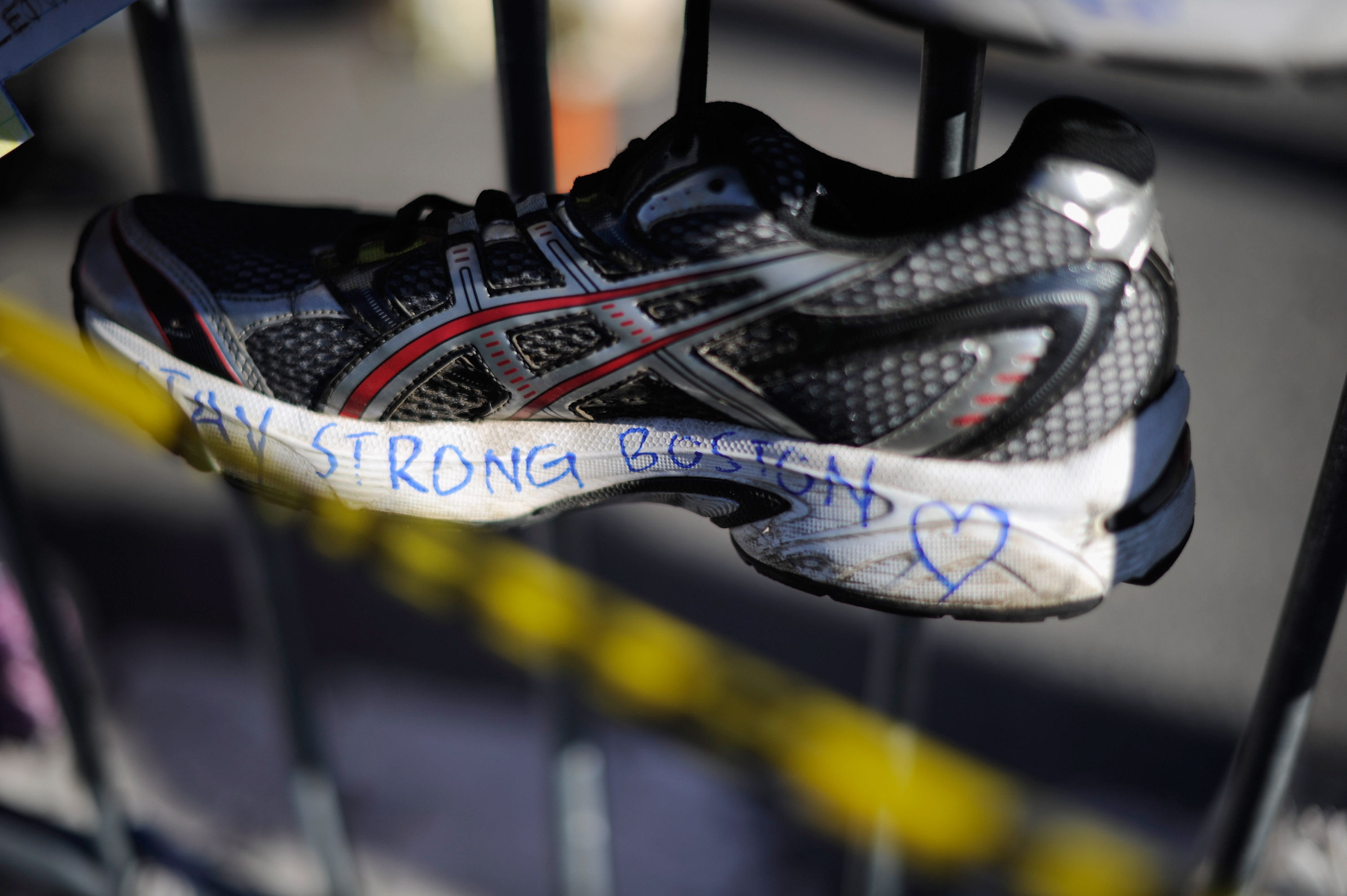
(Photo: Running shoes are placed at a makeshift memorial for victims near the finish line of the Boston Marathon bombings at the intersection of Newbury Street and Darthmouth Street two days after the second suspect was captured on April 21, 2013 in Boston, Massachusetts. By Kevork Djansezian/Getty Images.)