A good time to run a rendition of the national anthem – this one by a blind disabled girl who will bring you close to tears:
Dish compilation of Star-Spangled Banner renditions here.
A good time to run a rendition of the national anthem – this one by a blind disabled girl who will bring you close to tears:
Dish compilation of Star-Spangled Banner renditions here.
Joyner asks:
[W]hile these attacks are thankfully rare, I can’t for the life of me figure out why. The Boston Marathon and the Super Bowl are comparatively easy to secure, because they’re one-offs, generate sufficient revenue to make a security investment reasonable, and obvious targets. It’s simply impossible to protect all of our schools, shopping malls, movie theaters, airports, and other places where hundreds and even thousands of people gather on a daily basis.
McArdle responds:
So why don’t they happen more? The most convincing answer I’ve gotten to that question is that fostering terror is only one of the aims of a terrorist attack. These attacks also function as recruiting, and as fundraising promotions for your terrorist organization. There are what you might call business considerations, in other words, and those business considerations dictate the kinds of attacks that terrorists want to carry out.
Peter Bergen provides another answer:
After 9/11 there was a rapid increase in the number of Joint Terrorism Task Forces around the country, which are made up of multiple law enforcement agencies working together to ferret out suspected terrorist activity. And following the 9/11 attacks, far more businesses started reporting to law enforcement suspicious purchases of any kind of material that could be used for bomb-making. As a result, since 9/11 bomb plots that have simply fizzled out have overwhelmingly been the rule.
Evidently the linden tree also has that seminal smell:
A reader expands on yesterday’s popular post:
I used to do chemical analyses of the fragrances of plants, especially orchids. Flowers that smell like semen are not uncommon. Basic amines such as putrescine, spermine, spermidine and cadaverine are probably components of such floral fragrances. Chestnut flowers (Castanea sativa) are notoriously semen-like, and I once saw a pressed museum specimen of a Trillium that stated the flower smelled “like freshly-collected bull semen”. Several species of the Asian orchid genus Coelogyne are powerfully fragrant of fresh semen.
Years ago, a gay friend in Atlanta with a diverse orchid collection was giving a greenhouse tour to an elderly woman in her early nineties. Moving unsteadily through the greenhouse, she paused in front of a large basket of blooming Coelogyne trinervis that filled the whole house with its odor. She closed her eyes and inhaled deeply, and exclaimed “Oh, my, my…. I know I’ve smelled that fragrance somewhere before…. I just can’t put my finger on it…. Somethin’ about it reminds me of my first husband…”. Unlike the fragrance of Proust’s madeleines, the orchid fragrance was not successful in triggering her old memories, even though she returned to the topic throughout the afternoon.
Jack Shakely reviews a new book, With Charity for All, written by former NPR president Ken Stern about the dark side of nonprofits:
His blood-boiling chapter on nonprofit fraud will make you wonder if the IRS ever checks on these miscreants, especially those with the word “veteran” in the title. Well actually, Stern says, it doesn’t. It is the very rare and very unlucky nonprofit thief who gets caught. Less than one percent of all nonprofit tax returns are even reviewed. And nonprofit theft is pervasive, we learn:
The average charitable theft is estimated to be $100,000, meaning that money is walking out in large chunks. Given that the average bank robber in the United States gets away with only about $4,000 and runs a far higher risk of apprehension, one might expect that in a sensible theft marketplace, more people would be attracted to the soft targets of charities.
Previous Dish on Stern’s book here.
Ross Pomeroy reviews research on the subject:
In 1987, psychologist and risk perception expert Paul Slovic skillfully summarized in the journal Science how we calculate risk. In general, humans tend to be wary and apprehensive of risks that are uncontrollable, potentially fatal, possibly catastrophic, and relatively unknown.
The danger of terrorism put in perspective:
In the last decade, you’d be hard-pressed to go one day without hearing about [terrorism]. However, as Reason‘s Ronald Bailey wrote in 2011, an American’s chances of being killed by a terrorist are approximately one in 20 million. Heck, even if all of the thwarted terrorist attacks over the last 10 years were carried out, that still would translate to a risk of one in 1.7 million. Compare that to an infinitely more dangerous activity you may undertake every morning: climbing into a car. The annual risk of dying in a motor vehicle crash is one in 19,000.
Matthew O’Brien warns that businesses are discriminating against long-term unemployed:
As long as you’ve been out of work for less than six months, you can get called back even if you don’t have experience. But after you’ve been out of work for six months, it doesn’t matter what experience you have. Quite literally. There’s only a 2.12 percentage point difference in callback rates for the long-term unemployed with or without industry experience. That’s compared to a 7.13 and 8.95 percentage point difference for the short-and-medium-term unemployed. This is what screening out the long-term unemployed looks like. In other words, the first thing employers look at is how long you’ve been out of work, and that’s the only thing they look at if it’s been six months or longer.
Drum doubts that this is a new development, writing that hiring managers “have always been suspicious of applicants who have been out of work for a long period.” Yglesias wonders what long-term unemployment really indicates:
It’d be interesting to know whether this kind of discrimination is grounded purely in irrational bias, or if it reflects a sound satisficing strategy in which long-term unemployment really is a statistically reliable indicator of some unobserved quality.
Previous Dish on long-term unemployment here and its lasting effects here.
A reader adds another horrific and heartbreaking medical condition to this collection:
As someone who last year chose to terminate two pregnancies for massive hydrocephalus (all brain structures blown away by the pressure of the fluid), I find it very frustrating that the
discussion of North Dakota’s law banning abortions for genetic defects largely centers on children with mild cases of Down’s Syndrome. Because the conversation focus is on a trisomy, a case of improperly separated chromosomes that might happen to any couple, but almost certainly only once, it misses the truly spectacular cruelty of this law.
We don’t have a diagnosis, but my husband and I must have a recessive gene that combines to cause hydrocephalus. For every pregnancy, we have a 1 in 4 chance of this happening.
There are lots of diseases like that. Tay-Sachs is another fatal example. Because of this, I spend a lot of time chatting on an Internet forum with other women in my situation. They approach their pregnancies in few ways. Some absolutely know that they will carry to term, with the hope of spending a few moments with their baby while it lives. Some are so terrified that they use every kind of expensive fertility technology to avoid carrying a baby that carries a fatal flaw. Those cost tens of thousands of dollars, with no guarantee that the pregnancy will take. Some women choose to terminate their pregnancies if the genetic test come back wrong or it shows on the anatomy scan. But they want living children. They pin their hopes on a 3 in 4 chance of a healthy baby.
One of the women waiting on the genetic test results has a three year old at home on hospice care. She is terrified of losing another and will terminate if the tests come back wrong. She can’t watch another die at age three. One woman had a baby boy who lived to be nearly one before he died. Her second baby boy died at eight months. Then she got a diagnosis and was able to test during her third pregnancy – another boy. It had the disease. She chose to terminate.
The thing I cannot believe is the unbelievable, astounding cruelty of anyone who would dictate her choice in this. Force her to birth and care for another dying baby? She knows what that means! She chose not to! How can anyone be so cruel that he would tell her she must go through pregnancy, birth, months-long death of her baby before she can try again to have a living child?
Trisomies are one thing, and they are most often fatal. They do not usually lead to living children that can interact socially. Mostly healthy Down Syndrome children are the exception – not a good example for policy-making. But for almost all couples who come up against that tragedy, a trisomy is a one-off. The people who face the dilemma of a recessive gene that kills their children, at different paces and with different amounts of pain – those are the people who know what it means to choose to go through with or terminate a pregnancy for genetic reasons. How dare anyone else tell them which they should do? Who would give them additional burdens if they get the awful diagnosis? Who would do that?

The Economist‘s religion blog remembers the faith of Margaret Thatcher:
In religion, as in so much else, Mrs (later Lady) Thatcher was a bundle of paradoxes. She was the last British prime minister openly and emphatically to acknowledge the influence of Christianity on her thinking, in particular terms not fuzzy ones. Her fellow Tories, John Major and David Cameron, have presented themselves as loyal but lukewarm Anglicans. “I don’t pretend to understand all the complex parts of Christian theology,” Mr (later Sir John) Major once said, reassuringly. As for Labour’s leaders, Gordon Brown inherited the ethos but not the zeal of his father, a Presbyterian minister. Tony Blair is passionately religious but was famously discouraged by his advisers from “doing God” in public because of the fear that he might sound nutty.
(Photo: The coffin of former British prime minister Margaret Thatcher rests in the Crypt Chapel of St Mary Undercroft beneath the Houses of Parliament on the eve of her funeral on April 16, 2013 in London, England. Dignitaries from around the world will join Queen Elizabeth II and Prince Philip, Duke of Edinburgh as the United Kingdom pays tribute to former Prime Minister Thatcher Baroness Thatcher during a Ceremonial funeral with military honours at St Pauls Cathedral. Lady Thatcher, who died last week, was the first British female Prime Minister and served from 1979 to 1990. By Leon Neal – WPA Pool/Getty Images)

A reader writes:
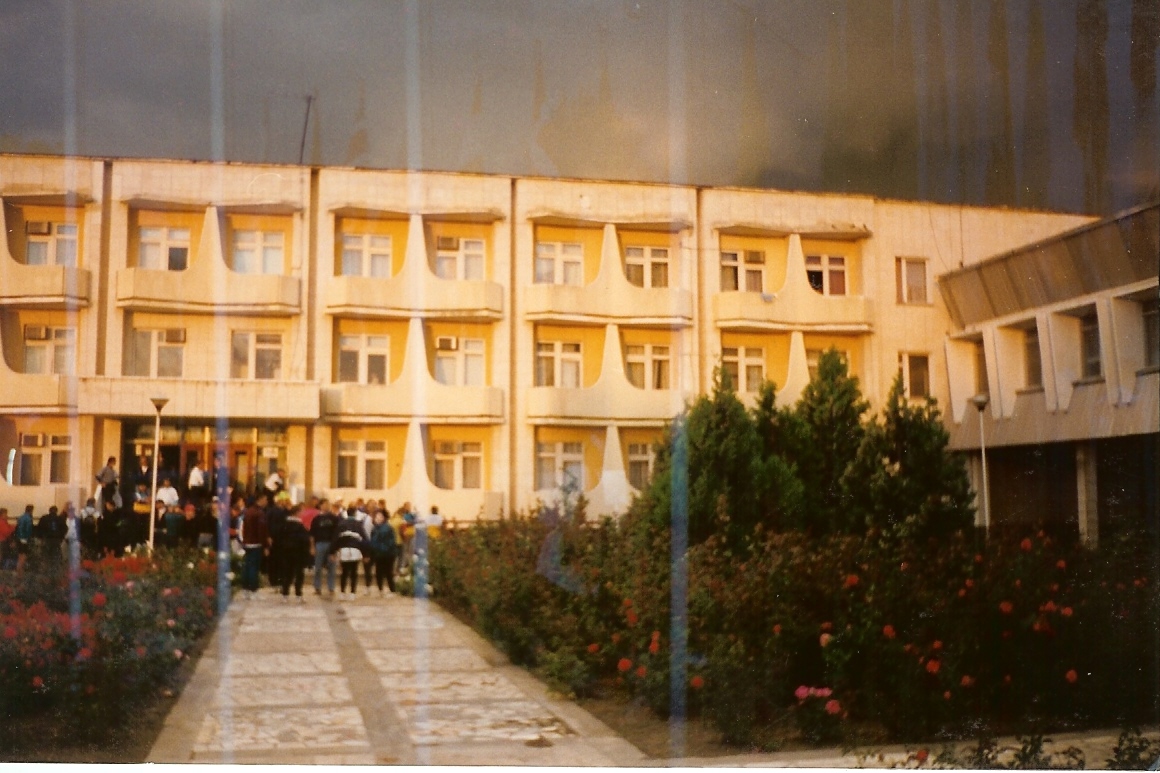
The city in the picture has a very East-African vibe to it. My first thought was Khartoum but the greenery is generally lacking in Khartoum’s city center. I also noticed the traffic was left-sided. My gut tells me this is Kampala, Uganda.
Another:
The buildings and the advertising look very familiar (we like to backpack often, usually in Asia) and so I have decided to go with my gut and say Malaysia. A look online for stadiums suggests a likely candidate is Stadium Merdeka, right in Kuala Lumpur. While I cannot suggest what window this shot is taken from, my guess is somewhere like the Swiss Inn, on Jalan Sultan.
Another:
Not too much to go on this week. It’s warm, wherever we are, and there’s a language that uses the Roman alphabet, from what I can tell by squinting, and cars are on the “British” side of the road. I’m guessing Indonesia, not Malaysia, because the abundance of flat land reminds me of the east coast of Sumatra, and the haziness in the air reminds me of the smoke that used to blow across the Melaka Straits to Singapore when I lived there. Both Indonesia and Malaysia have a ton of those ads for skin-lightening creams, which is what the sign looks like (a terrible industry that too many Western cosmetic companies get away with participating in). So here’s a vote for Medan, Indonesia. I’m going to throw a dart and say the Tiara Medan Hotel. Someone with more time and better Google-mapping skills will probably beat me, but here’s hoping I’m on the right side of the world.
Another:
My guess this week, with no fancy computer analysis: Cairo, Egypt.
Another:
My initial reaction was that this was somewhere is Asia, but upon further inspection, I think it is southern Europe somewhere. People will undoubtedly try to decipher the ad on the building, but the best clues are beyond the buildings. One of my colleagues noticed that one of the buildings in the background looks like a castle, and off to the left it seems that there are stadium lights and stadium seating. There is also one palm tree that is visible. The air quality looks somewhat like it does here in southern California, and I think it is a fairly large city. But since we discovered these background buildings only a few minutes ago and time is running out, I am going to have to take a wild guess rather than an educated one: Seville, Spain.
Another:
I suspect there is zero chance I’ll get this right, but it looks very much like a town in Russia I visited once on the Black Sea called “Anapa”:
However, most Eastern Bloc architecture looks like this.
Another:
Finally!!! A place I recognize. This has to be India – that is an advert for Dettol soap. The image of a woman, with much lighter skin than the rest of the populace – where else but India!
Another:
Oh now you are just torturing me. Just like that bank branch near the Albania window gave me hope, I was psyched to figure out after a few false starts that the big ad on the side of the building is for Dettol Re-energize soap (“skin so healthy it glows!”). Turns out Dettol soap is sold all over the world, but the particular brand seems to be an Indian thing. So there we have it: India. How hard can that be? Not much help beyond that. There seems to be a stadium in the distance between the buildings with large light stanchions. I can’t spend too much of my like searching for Indian stadiums, and hotels nearby (that building in the foreground sure looks like a hotel). After a desultory look at New Delhi, Mumbai, and just for fun Karachi, I say forget it. I’m sure a Dishhead from India knows it on sight, but let’s just say New Delhi, near Delhi Gate. I look forward to finding out how far off I am.
Another gets the right country:
You must be flooded with Pakistan guesses. Mine is the equivalent of a dart thrown from across the room. The Ashoka trees (those pointed leafy trees that grow so easily in the tropics) and the architecture all suggested South Asia. And the ad for Dettol soap on the building on the left looks like this one. Lahore is a wild guess. Road, building, etc: no freaking clue, really.
Another gets the right city:
Hmm, looks tropical, Middle-Eastern architecture, perhaps. Yellow plates with black lettering is a good clue … I’d guess this is Karachi, Pakistan.
Another goes into great detail:
At first glance, this week’s view looked promising – a large city, distinguishable buildings, tree lined
boulevard, and a stadium in the background. The landscape alone was not enough to determine the region. It looks like places I’ve been in Africa, Southeast Asia, or the Indian subcontinent. The one signage that was clear (but may not be familiar to your American viewers) is the Dettol soap advertisement on the side of the office building. Searching Google for Dettol soap ads, I was able to determine the exact country where this advertisement runs.
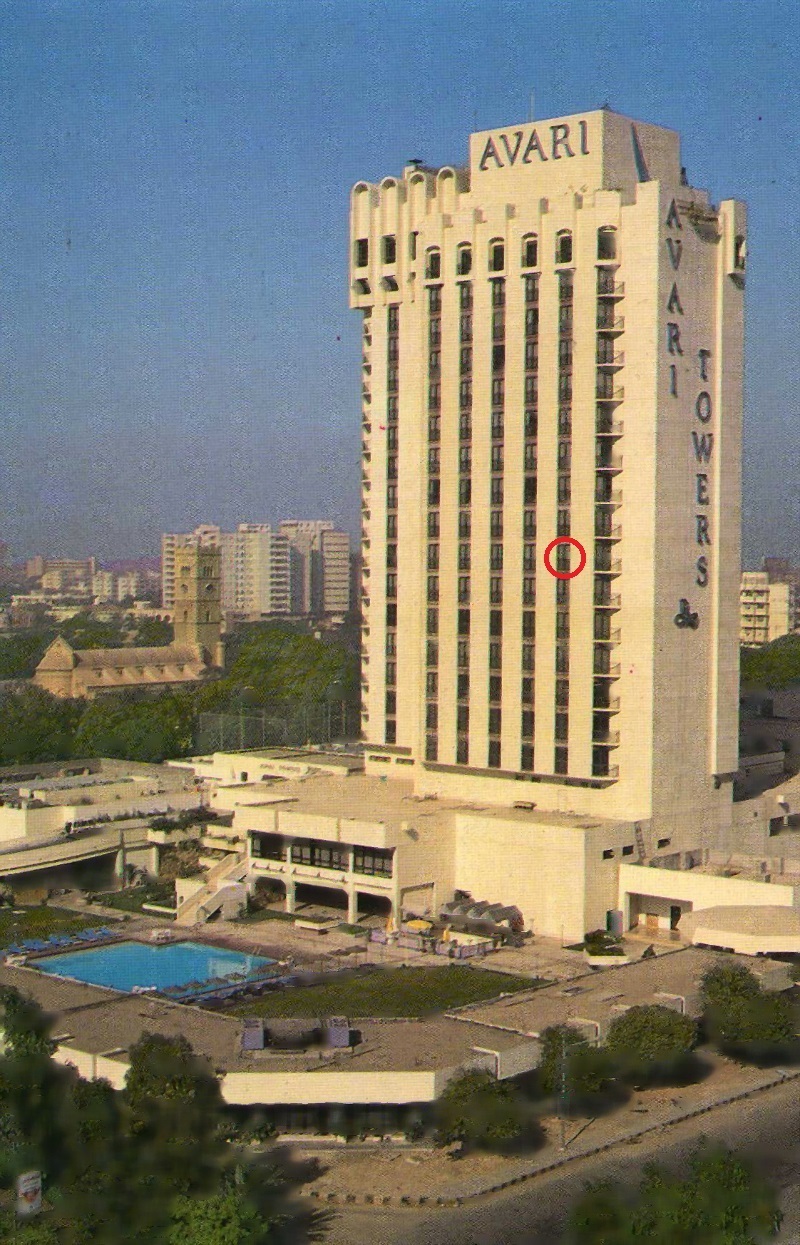
Using the stadium as a landmark, the view was found to be from the Avari Towers Hotel in Karachi, Pakistan. The building on the right side of the view is the Hotel Mehran and the taller commercial building on its left is the Kashif Center. The landmark stadium in the background belongs to the Hockey Complex of Pakistan. My guess is that the view is from the 7th floor, as seen in the photo. Hope I’m right! (or closest).
Another adds:
A Google search of “Skin So Healthy It Glows” leads me to this Tweet by a Pakistani advertising agency identifying the lady in the billboard as actress Sonya Jehan. A Google image search of “Sonya Jehan billboard” fortuitously – because Google mislabeled the image – leads me to this photo of the Kashif Center in Karachi, the building on which the billboard appears. Google Satellite view tells me that the VFYW photo was likely taken from the Avari Towers building, 242 Fatima Jinnah Rd, Karachi, Pakistan. I’ll take a wild guess and say the photo was taken from the 14th floor.
A previous winner writes:
Some contests, like last week’s, are difficult because they provide you with few distinct clues. Contests
like this one, however, are challenging because the abundance of small clues means that a few will be red herrings. Whether you won or lost this week therefore turned on whether you chose the right clues to focus on. Some readers, for example, will have found the region’s architecture via Google and located the city almost immediately. But for those lured in by, say the row of cypress trees, it might have been a long weekend wandering through that tree’s native habitat in the eastern Mediterranean.
In any case, this week’s view comes from the heart of Karachi, Pakistan. The picture was taken just after dawn by a reader staying on roughly the 9th floor of the Avari Towers located at 242 Fatima Jinnah Road. The photo looks east, southeast towards the balconies of the Hotel Mehran at center frame. Just behind that building and to its left are the light towers of the Karachi Hockey Club’s stadium, whose grandstands are also partially visible. As for that giant billboard with the woman holding her hands to her neck, it’s an ad for an Indian hand soap called Dettol.
Another:
Woohoo! After years of being amazed at the folks who research the Internet to determine the location of your windows, I finally got one using that most wonderful sense – gut instinct!
Saw the picture and immediately got the vibe of Karachi, where I lived in the late ’80s and early ’90s. The Suzuki Carry in the image cinched it for me. Showed the picture to my dad who confirmed the building on the right was the Mehran hotel. Google told me the rest! The picture has been taken from the Avari Towers hotel, I’m guessing 10th floor, eastern-most room. I’m attaching a Google map picture:
Karachi is a vibrant city that sadly is being torn apart by violence against religious minorities.
I’ve not submitted an entry in the past, so I probably won’t win, but I’ve been meaning to write in for so long this just seemed like a sign too blatant to avoid! My excuse for not writing earlier is that if I wait a day someone almost always says what I want to say before I say it. Anyway, good luck with the subscription model; you had my money on Day 1.
From the submitter:
Delighted again to be part of the contest. Sorry to be late; just back late last night from another trip, this time to exotic Columbus, Ohio.
The room number was 816, obviously facing southeast. Looking at the Bing maps view, if you think of the swimming pool as being south of the tower, the 816 window is the easternmost of five vertical bands of windows, approximately aligned with the east edge of the pool.
Normally I’d make a joke about my two recent submissions – Iran and Pakistan – something about Petraeus having been unavailable … but events today and yesterday lead to other associations: The major earthquake this morning in an area that Pakistan maps as a low seismic risk, felt about 800 miles away in Karachi. And the Boston bombing yesterday – just the sort of nonsense Karachiites have been living with for years.
Btw, I’m just finishing Steve Inskeep’s very good book, Instant City, about the impact of Islamism and ethnic factionalism in general on the development of Karachi as a megacity.
The following entry was the closest to room 816:
Wow, that was almost too easy. I’m a bit giddy at how things just fell into place. The name on the hotel is visible, but not sharp enough to properly read (HOTEL _ _ _RA…?). After a few wild guesses,
I decided to just do an image search for “Pakistan hotel” and just scan the results. I knew it was a silly stab in the dark, but unbelievably, it took no more than two minutes to come across this image of the hotel in question, Hotel Mehran. Then identifying the submitter’s location as Avari Towers was a simple matter of checking the area on Google Maps and a quick image search to confirm the building on the left is indeed Kashif Center. No doubt this will will come down to the floor and perhaps even room number, so let’s say 8th floor and … room 807?
This is my first VFYW contest submission, as I usually don’t have much patience, but I might just be hooked now. I’m a Dish subscriber who splits his time between Hong Kong and Taipei. Keep up the great work!
Congrats to our reader on the tough win. See everyone else on Saturday for the next contest.
(Archive)
EJ Graff, a Bostonian, tries to process yesterday’s events:
To cripple the city all you’d have to do is take a gasoline tanker and crash it in one of the tunnels built by the Big Dig—you could take down a couple of major arteries and shut down the city for months. On the other hand, if you wanted to strike at our symbolic heart, at what it means to belong to this ludicrously snobby little city built on a harbor that was filled in, if you wanted to grab international headlines on a day when ordinary and extraordinary people from around the world were cramping their legs and exercising their hearts with ordinary and extraordinary joy, if you wanted to make a statement about what it means to be an American, then attacking the Marathon—which belongs to us all—on Patriots’ Day might be just right.
Kornacki, who grew up outside of the city, adds his thoughts:
Between texts and calls to friends and family, I lived on Twitter Monday afternoon, clicking on every link with new information and retweeting anything that seemed useful. It was Twitter at its best. It was also Twitter at its worst, a combination of tasteless tweets from the usual suspects and self-satisfied policing, as if what really mattered was who was saying what on social media. I had no patience for it, or for the speculation about who might have done it and why, or for anyone trying to wring some kind of deeper political or philosophical meaning from any of it. In every picture, I saw home. In every face, I saw an old friend or classmate or teacher colleague or neighbor. We’ll find out who did this, hopefully soon, and part of me is trying to imagine a punishment harsh enough to fit this crime. The rest of me just wants to cry.
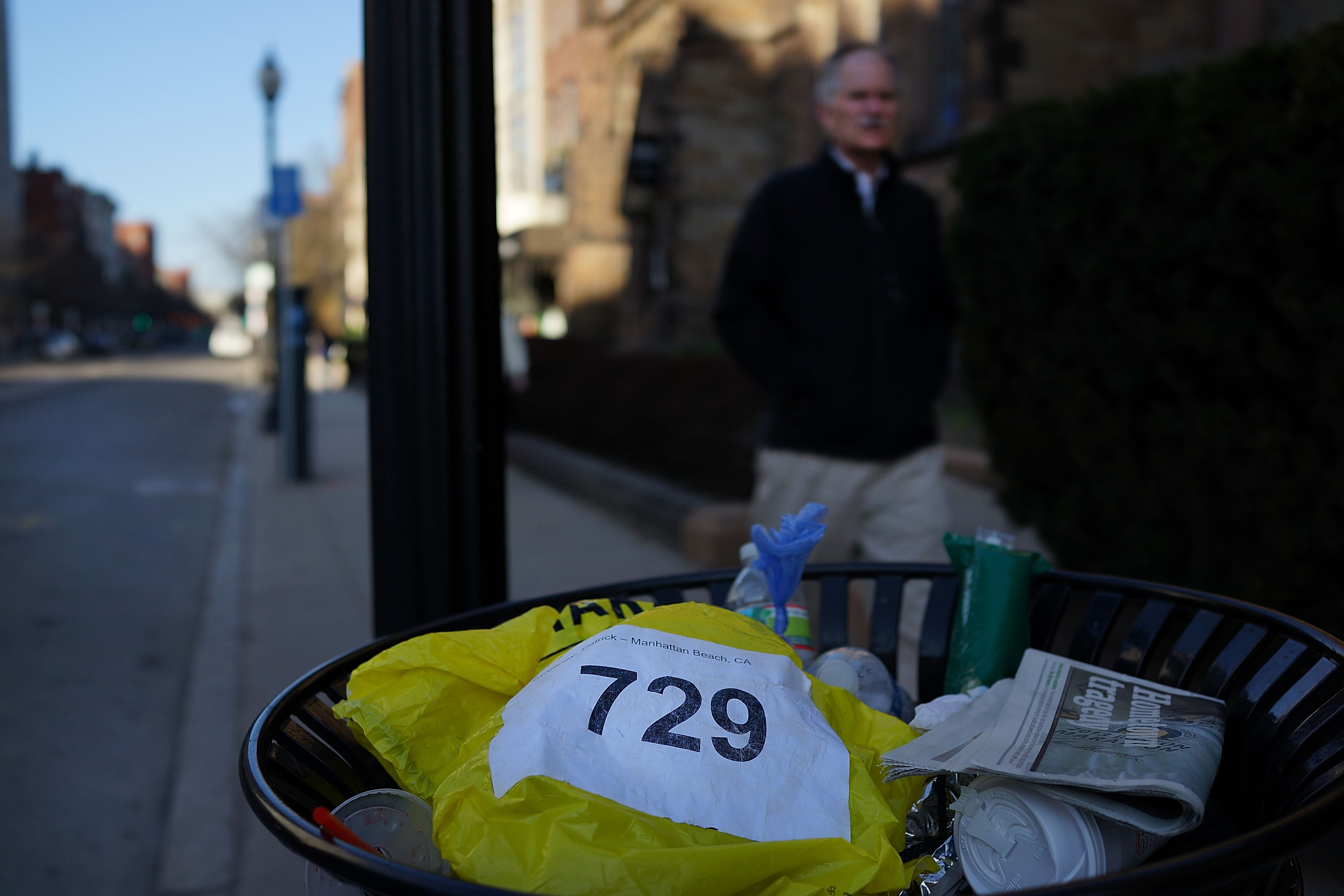
(Photo: A discarded runners bib is viewed near the scene of a twin bombing at the Boston Marathon on April 16, 2013 in Boston, Massachusetts. By Spencer Platt/Getty Images)