Words That Need To Die

In an interview celebrating the New York Review of Books‘s fiftieth anniversary, the publication’s longtime editor, Robert Silvers, divulges the muddled phrases that drive him crazy:

Framework could rightly refer to the supporting structure of a house, or a wooden construction for holding roses or hollyhocks in a garden, but now the word is used to refer to any system of thought, or any arrangement of ideas. And it really means nothing.

The most heretical thing we do is try to avoid context. Context has an original, useful meaning, now generally lost: the actual language surrounding a particular text—con, meaning “with,” and text—and now it’s used for every set of surrounding circumstances or state of things, and it gets worse with contextualize, sometimes used to mean some sort of justification.

Even more insidious and common is in terms of, a fine phrase if you are talking about mathematical equations or economic functions in which specific “terms” are defined, but it is just loose and woolly when you say things like “in terms of culture,” for which there are simply no clear terms.

Then there is the constant movement of every kind of issue—war, treaty, or political feud—on or off “the table.” The question of an independent Palestinian state is on the table! Or is it off the table? It’s become a way of avoiding a more precise account of just what’s happening.

Into The Great Quiet

Another beautiful meditation on religion and silence from Karen Armstrong:

In the tenth century BC, the priests of India devised the Brahmodya competition, which would become a model of authentic theological discourse. The object was to find a verbal formula to define the Brahman, the ultimate and inexpressible reality beyond human understanding. The idea was to push language as far as it would go, until participants became aware of the ineffable. The challenger, drawing on his immense erudition, began the process by asking an enigmatic question and his opponents had to reply in a way that was apt but equally inscrutable. The winner was the contestant who reduced the others to silence. In that moment of silence, the Brahman was present – not in the ingenious verbal declarations but in the stunning realisation of the impotence of speech. Nearly all religious traditions have devised their own versions of this exercise. It was not a frustrating experience; the finale can, perhaps, be compared to the moment at the end of the symphony, when there is a full and pregnant beat of silence in the concert hall before the applause begins. The aim of good theology is to help the audience to live for a while in that silence.

“A Mystery To Be Lived”

Barry Lenser praises Rod Dreher’s just-released book about his sister’s struggle with cancer, their complicated relationship, and the small-town her illness and death brought him back to:

The Little Way of Ruthie Leming is a book of real pain and real tragedy. Unlike a conventional Hollywood screenplay, the story doesn’t proceed inevitably to a tidy, feel-good conclusion. Here, the stakes are high, and you can’t escape the overwhelming sense of regret and sadness. Imagine having a tortured relationship with someone you love, and then that person dies thinking you were a “fraud” of some kind.

To the benefit of this book, Dreher doesn’t obsess over the question “why”, pursuing a resolution where one can’t be found. Rather, he submits, after some consideration, to the unknown. He describes his and Ruthie’s fallen relationship as “a mystery to be lived”. As with the question of theodicy, which briefly comes up, he doubts that having an explanation would actually ease his mind.

In an age that demands answers and seeks mastery over life’s details, Dreher instead humbled himself before the wonder and uncertainty of the human experience. He didn’t find full peace by acknowledging his powerless position, but it did help him to achieve a measure of clarity. There’s a lesson here to ponder. To embrace what we can’t know isn’t a display of weakness. It’s a recognition of our limited purview.

Yuval Levin’s glowing review, which we noted Friday, deserves a second look:

If, like me, you live very far away from the place you were born, you will at times find this book almost unbearably difficult to read. But only almost, because you will also find in it a moving affirmation of the sense that most of us can only discern rarely and vaguely in the bustle of our daily lives—the sense that beyond our petty vanities and momentary worries, beyond arguments and ambitions, beyond even principles and ideals, there is a kind of gentle, caring warmth that is really what makes life worth living. It is expressed through the words and acts of people who rise above themselves, but it seems to come from somewhere deeper. Maybe it’s divine, maybe it isn’t, but it’s real, and it effortlessly makes a mockery of a lot of what goes by the name of moral and political philosophy, and especially of the radical individualism that is so much a part of both the right and the left today. And it’s responsible for almost everything that is very good in our very good world. If I had to define what conservatism ultimately means for me, it would be the preservation and reinforcement of the preconditions for the emergence of that goodness in a society of highly imperfect human beings.

The book made Justin Green cry – “not watery-eyed man-tears, but unashamed weeping.” It also reminded him of his own Nebraskan upbringing and his love-hate relationship to the small town he left behind:

All of it was for us: the stifling nature, the insistence that everyone should know everything about everyone, that we should all be hyperinvolved in a slew of activities that had little to do with us, the small talk, and the identification of people by family instead of individual personality. That’s all by design, it’s all because of love, and it’s something I’m glad I got to experience. It’s community, and most kids my age will never know what that really means. I don’t like my hometown. But I do love it, because it – in its own infuriating way – taught me the most important lesson in life: you haven’t grown up until you care about someone else more than yourself.

Airplane Evangelism

Reflecting on the difficulties of sharing her faith, Rachel Held Evans shares a cringe-inducing anecdote about a chapel speaker she heard while a student at a Christian college:

Mark suggested we begin a conversation with our seatmate by asking if they knew where they would go spend eternity should there be a catastrophic failure in the plane’s hydraulic system and we all went down in flames. If that doesn’t work, he said, we should drill the person on how many of the Ten Commandments they might have broken, revealing their need for a savior—Ever committed adultery? Ever lied? Ever disobeyed your parents? Ever coveted your neighbor’s things? You know, make a little small talk about idolatry and death and then tell them about Jesus.

She closes the piece by noting a different conversation she recently had on a plane, where she merely listened to and encouraged a woman whose husband was suffering from dementia:

The woman on the plane planted a good seed in my heart, and I hope I planted a good seed in hers. We might not get to watch as the God of rain and soil and sun makes those seeds grow, but we can trust that God is faithful, that God can take even our clumsiest attempts at witnessing and turn them into something good.

Face Of The Day

eyes_as_big_as_plates_agnes_ii_hjorth_ikonen

Details on the portrait above, which is part of a series:

The project, called Eyes as Big as Plates, started off as a play on characters and protagonists from Norwegian folklore, but for Norwegian photographers Karoline Hjorth and Riitta Ikonen the series has become something more about, as they put it, exploring the mental landscape of their neighborly and pragmatic Finns.”

The models in the photographs are captivating, not only for the strange organic headwear or clothing they wear in the photographs, but equally for the character they project through the images. Who are these quirky and fascinating people who trek across the cold wilderness, willing to dawn strange clothes and convey so much through their expressive eyes? What stories do they tell when not behind the lens? In a sense, the mystery behind the people in the images transforms them back into the folkloric images they were originally intended to be.

More images here. If you’re in New York, check out the exhibit’s closing reception at Recess Redhook, Pioneer Works on April 24th.

(Eyes as Big as Plates # Agnes II, © Karoline Hjorth & Riitta Ikonen.)

How To Love

Vivian Gornick reviews a recent book by Lawrence Friedman on famed psychiatrist Erich Fromm. The way Fromm thought about love:

In the Art of Loving Fromm argued that the phrase “falling in love” was a dangerous misnomer. We did not fall into anything; what we did, once attraction had allowed a relationship to form, was recognize ourselves in the other and then—through affection, respect, and responsibility—work hard to teach ourselves how to honor that recognition. “Once one had discovered how to listen to, appreciate, and indeed love oneself,” Friedman paraphrases The Art of Loving, “it would be possible to love somebody else . . . to fathom the loved one’s inner core as one listened to one’s own core.” In short, the dynamic would induce an emotional generosity that allowed each of us to be ourselves in honor of the other. Once one had achieved this admittedly ideal state, Fromm declared, as he did in every single book he wrote, one could extend that love to all mankind.

The Holiness Of The Ordinary

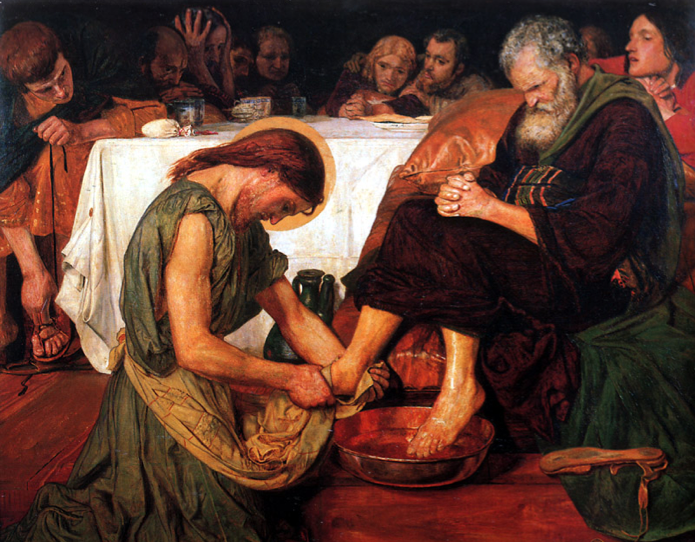
jesuspeter

Eve Tushnet went to see the new exhibit of pre-Raphaelite paintings at the National Gallery of Art and came away fascinated by the movement’s controversial emphasis on “the human qualities of Jesus and the saints at the expense of transcendence”:

Ford Madox Brown’s huge Jesus Washing Peter’s Feet originally showed a Christ naked to the waist, but public outcry prompted him to paint in a loosely draped shirt. John Millais’s Christ in the House of His Parents drew controversy (Charles Dickens loathed it) because it seemed to portray the Holy Family as just another carpenter and his clan: ordinary people doing ordinary things.

And Rossetti’s Ecce Ancilla Domini!—his Annunciation—is still shocking today: Mary, a scrawny girl cornered against the wall in a thin nightgown, stares blankly at the angel, who lifts a hand to bless or maybe just to calm her. This is no royal queen of Heaven. The look on her face is the look of a teenager watching the second line darken on her pregnancy test: What does this mean? What on earth do I do now? She’s sallow and almost vampirized, and clearly shaken. This is the moment before she says yes.

Earlier Dish on the exhibit here.

(Image: Ford Madox Brown’s Jesus Washing Peter’s Feet, 1876, via WikiPaintings)