Your summer blockbuster preview:
Year: 2013
The Crimefighting Power Of Brown
Ray Fisman dives into research on the effects of Brown v. Board of Education:
A growing body of social science research is now reaching the conclusion that school desegregation should get some direct credit for the drop in black crime. Indeed, as courts have begun overturning these rulings over the past decade, we’ve seen an alarming uptick in crimes by young black men. It turns out that integrating schools wasn’t just a matter of turning them into melting pots or providing equal access to education. It was also an effective way of fighting inner-city crime. …
Berkeley economist Rucker Johnson’s looked at the longer-run effects of desegregation on children of the civil rights era, using a range of methodologies, each of which generates the same set of findings: Desegregation led to higher earnings, better health, and a better chance of staying out of prison for black males. Johnson’s findings on crime echo the results of earlier research, which found that desegregation reduced violent crimes by young (15-24) black men by as much as one-third.
The Bitcoin Bust
Yesterday, the value of the newfangled currency plummeted 61 percent:

Timothy B. Lee points out that Bitcoin has crashed and recovered several times before. Yglesias expects this cycle to continue:
The problem is that if the price of a bitcoin is on a steady upward trajectory, then nobody’s actually going to want to spend a Bitcoin on anything. And if everyone’s hoarding their Bitcoins, then the network is actually useless. Then, since it turns out to be useless, you get a crash. The funny thing is that once the upward spiral comes to an end, then the technological virtues of the Bitcoin platform come to the fore again. If nobody wants to hoard Bitcoins, then Bitcoin-as-platform looks like an attractive alternative to elements of the payment system. But when Bitcoin starts looking attractive again, you should get a renewed hoarding cycle.
Jerry Brito argued recently that Bitcoin’s valuation doesn’t necessarily matter:
Bitcoin will work as a seamless payment system so long as you can get in and out of it quick enough to mitigate volatility. That is largely a technical consideration, but it could also depend on the market’s liquidity, which conceivably could be hurt by speculative hoarding. I haven’t given this much thought yet, but given that bitcoin can be denominated down to eight decimal places, I’m not sure it will be a big problem anytime soon.
Felix Salmon thinks Bitcoin is too volatile to work well for payments:
Currently, it can take an hour for a bitcoin transaction to clear, which means that the value of the transaction when it clears can be radically different from its value at inception. Bitcoin only works for payments if you can be reasonably sure that its value will remain reasonably steady for at least the next hour or so.
McArdle bets that governments will restrict Bitcoin’s growth:
I think that governments can make it so difficult to translate your bitcoins into the real economy that most people simply won’t bother. And the more successful that bitcoins are–the better they become established as an alternate currency–the more likely it is that rich-world governments will swoop in and make it prohibitively difficult to use bitcoins to procure real-world goods in developed countries. At that point you’ve essentially got a novelty currency like greenstamps, which can be exchanged for only a limited supply of goods, and maybe some developing-world travel.
Eric Posner calls the currency a “Ponzi scheme”:
A regular Ponzi scheme collapses when people realize that earlier investors are being paid out of the investments of later investors rather than from the returns on an underlying asset. Bitcoin will collapse when people realize that it can’t survive as a currency because of its built-in deflationary features, or because of the emergence of bytecoins, or both. A real Ponzi scheme takes fraud; bitcoin, by contrast, seems more like a collective delusion.
Rand’s Racial Outreach
Bouie questions the point of Rand Paul’s speech this week at Howard University, a historically black college:
I’m not sure Paul deserves any praise for his performance. It would be one thing if Paul had gone to Howard eager to listen as well as speak. Instead, he condescended with a dishonest and revisionist history of the GOP. “He didn’t say anything I didn’t expect,” said one student, a senior majoring in sociology and economics. I couldn’t agree more.
I have to say the sheer lack of any grace among some liberal commenters on what was an obvious outreach to African-Americans depresses me. Josh Marshall piles on:
Yesterday morning Sen. Rand Paul went over to Howard University. And it didn’t go terribly well. One might say that’s only to be expected in a case like this – perhaps even the whole point – since the aim is to break the ice between communities either antagonistic to each other or thoroughly out of communication. But it’s more an example of what happens when a staunch conservative steps out of the GOP’s tightly-drawn racial nonsense bubble and hits an audience not dying to be convinced that the GOP’s problems with non-whites are the results of boffo misunderstandings about a Republican party that is actually the best thing that ever happened to black people.
That’s too harsh, in my view. But maybe it’s because I’m a libertarian and see some key grounds for coalition politics with the specific victims of the drug war: disproportionately young black men. Weigel gets it right:
No one applauded until Paul got to some actual policy. “I am working with Democratic senators to make sure that kids who make bad decisions such as nonviolent possession of drugs are not imprisoned for lengthy sentences,” said Paul. “I am working to make sure that first time offenders are put into counseling and not imprisoned with hardened criminals.” Barack Obama and George Bush did drugs, after all, and they turned out okay because they got “lucky.” … When he left the campus, past the students still holding the “White Supremacy” banner and conducting interviews, Paul remained the Republican most likely to reform mandatory minimums. He remained the most prominent Republican supporter of drug law reform.
Freddie takes Chris Hayes to task for mocking Paul’s speech and overlooking Paul’s comments on the drug war:
The drug war, of course, is one of the most damaging weapons that is employed in this country’s ongoing war on black people. It’s also one of the few places where I ever feel genuine optimism about our coming to legislative progress on race and class injustice. I can actually imagine a Republican coalition working with progressive legislators to help gradually decelerate our ruinous, racist, cruel drug policy. I can’t see that happening, though, if prominent liberal voices like that of Hayes are so busy chuckling and snarking on national television that they give up every opportunity to find common cause.
Right on.
Face Of The Day

Via Memebase.com.
Today, They’d Call Thatcher An Anti-Semite
There is simply no question that Margaret Thatcher was a great admirer of the Jewish people and promoted and was influenced by Jewish Brits in a way never seen before:
“As half of one percent of the British population, Jews in the Margaret Thatcher era held 5 of 20 cabinet positions. Her high office Jewish contingent included Nigel Lawson (Chancellor, who resigned over the “Westland Affair”), Leon Brittan (Trade and Industry Secretary), David Young (Minister without portfolio, Malcolm Rifkind (Foreign Secretary), and Keith Joseph… “I was born to a Lithuanian father and am of Jewish descent,” noted Minister David Young. “My only brother, Stewart, is chairman of the BBC. My father used to say, ‘One son deputy chairman of the government, another chairman of the BBC — that’s not bad for immigrants.”
The former Tory prime minister, Harold MacMillan, quipped that there were more “old Estonians in her cabinet than old Etonians” – an almost classic trope of an upper-class Tory condescension toward Jews. She shattered that kind of attitude – and was absolutely right to. Which is why the neocons fall all over her. Kirchick’s piece is insightful when it comes to the cultural and religious affinities Thatcher’s Methodism had with what she saw as Jewish virtues (he could have no better source than John O’Sullivan).
But Jamie simply ignores the factual record of her dealings with the Jewish state. If Thatcher were to do to Israel today what she did in her time in office, I have no doubt that Kirchick would be calling her an anti-Semite. Why? She was often infuriated by Israel’s foreign policy and firmly and consistently opposed the project of Greater Israel, which is now the unspoken goal of the Israel Lobby in America. Ali Gharib examines the official records of her actual history with the state of Israel:
Documents released by the British archives reveal Thatcher as a hard-nosed opponent of Israel’s West Bank settlement project. Just weeks after taking the premiership in May 1979, she hosted Begin, the Israeli leader who’d formed the country’s first right-wing government in 1977, at No. 10 Downing Street. The meeting was reportedly tense: Thatcher’s foreign minister railed against the settlements. Thatcher, as many world leaders then did and today do, believed that settlements imperiled a potential deal that could end the Mideast conflict.
Gharib also relays Thatcher’s reaction to Israel’s ’82 invasion of southern Lebanon to root out the PLO:
Late last year, when previously undisclosed papers on the British reaction became public under the U.K.’s thirty-year rule, Jenni Frazer rounded up the Thatcher government’s sentiments: it was “more concerned with maintaining ostensible balance in the Middle East than in recognising Israel’s determination to stamp out terrorism from its northern border.” Frazer goes on:
Overwhelmed with managing the Falklands War, Mrs. Thatcher—though MP for Finchley and Golders Green—drew a comparison with invaded Lebanon in Argentina’s invasion of the Falkland Islands. Francis Pym, Foreign Secretary, made it clear publicly that Britain wholeheartedly condemned Israel’s invasion. In private, the papers confirm, Britain was furious with Israel. A Foreign Office memo states: “It would be odd if we were now to conduct bilateral business with the Israelis as though nothing had happened.” An invitation to Israel to attend the British Army Equipment Exhibition was withdrawn and licences for arms sales were stopped… .
Today, the notion that the U.S. would stop buying weapons for Israel, let alone block their sales, is unthinkable.
Thatcher, unlike the neocons, believed in international law (she opposed the invasions of Grenada, the Falklands and Lebanon alike), as Scott McConnell notes. And she was not afraid to pressure and punish the Jewish state if she viewed its actions as violations of such law and a threat to long-term peace in the Middle East and British interests. That precise position today is regarded as proof of anti-Semitism by the Greater Israel lobby. I believe in suspending all aid to Israel until it stops the settlements. That’s enough to make me a Jew-baiter in today’s America.
Just one request: call Thatcher an anti-Semite too. Show a little fucking consistency.
End Of Gay Culture Watch
The Best Sports Bar in the nation’s capital, as voted for in Washington DC’s City Paper, is this year a gay bar. And it’s called Nellie’s.
In some ways, though, that isn’t a sign of the end of gay culture (perhaps that phase has already passed). Nellie’s –  its slogan is “Are You Nellie Enough?” – is a product of the maturation of the gay community as more and more types of gay men – especially those who could and did “pass” for straight in decades past – are able to be who they are. My boyfriend before Aaron, for example, was a sports nut, a Cubs fan, and a stats wonk. All he really wanted to do on a weekend was head to a sports bar and drink beers and watch the game. For a long time, gay culture didn’t give him that option. But the free market is a wonderful thing.
The twist, of course, is in the ironic name. We can’t integrate without some kind of wink. Even when we are fully part of society, I suspect there will always be a tinge of Wildean irony to our identity. This is often not true of the more humorless activists, or smugger, tight-assed liberals. But among regular homos? Yep, they’re nellie enough.
(Photo: Nats Night out, 2009, with the Gay Men’s Chorus of Washington singing the national anthem, Team Nellie from the Aids Walk being honored and more. By Chadwick Cipiti.)
Obama, Deficit Hawk
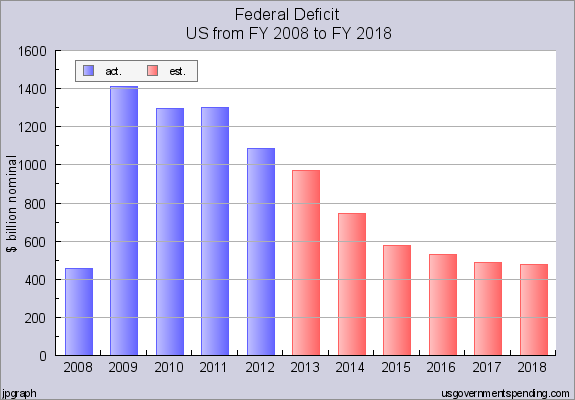
Daniel Gross does the math:
While the national debt mounts, I’ve noted that the primary deficit—the annual mismatch between revenues and expenditures—is melting away. … Through the first six months of this fiscal year, revenues are $1.196 trillion, up 12.5 percent from $1.063 trillion in the first six months of fiscal 2012. Meanwhile, the government has spent $1.797 trillion in the first six months of fiscal 2013, down 2.4 percent compared with the first six months of fiscal 2012. The deficit for the first half of the fiscal year is $600.5 billion, down 22.5 percent from $775 billion in the first half of fiscal 2012.
If the Obama budget were implemented, and if current trends continue, the deficit will have come down by 47 percent in four years. In relation to GDP, it will have declined from “10.1 percent of GDP in 2009 to a projected 6 percent in fiscal 2013 (it’ll probably be less), and 4.4 percent of GDP in fiscal 2014.”
And Obama has managed this while not crippling economic growth, as in Europe, and without a Grand Bargain. If the GOP responds to his new budget by taking yes for an answer, he could do better.
Correction Of The Day
“An earlier version of this column misspelled the surname of a former Speaker of the House. It is Newt Gingrich, not Gingrinch,” – the NYT.
The Sequester Hasn’t Gone Away
The big cuts start to bite this month. What that may mean:
Unemployment checks for people who’ve been without a job for more than 26 weeks are about to get cut by 11 percent. Military contracts are about to get canceled. Medicare patients are being turned away from cancer clinics. Schools will lay off teachers. Infrastructure projects will stop. There will be much more demand for a compromise than there is now. There will be much more political anger than there is now.
This budget sets up that debate. Republicans are, at this point, out of excuses. They can’t say the president isn’t reaching out to them. They can’t say he’s not willing to make painful concessions — or, to rephrase, they can say that, but given all the on-the-record quotes of Republican leaders demanding the White House accept means-testing Medicare and chained-CPI, no one will take them seriously. The White House is calling their bluff. The question is whether, as the pressure mounts, they double down against compromise, or they begin to fold.
Meanwhile, cuts could prompt more government workers to become spies:
Lawmakers and officials who oversee security clearances say the abrupt cut to roughly 20 percent of federal workers’ pay is pushing tens of thousands into the category of financially strapped government workers for whom foreign agents look in recruiting moles and spies. It may sound far-fetched, but those with experience in espionage cases said the threat is genuine.

