The Other One Percent: Our Vets

Screen Shot 2013-04-09 at 10.01.28 PM

Mikey Piro, a two-time veteran of Iraq diagnosed with PTSD in 2006, has an excellent little blog called PTSD Survivor Daily through which he processes his post-war struggles. I met him at West Point and chatted late into the night. We hope to be launching a podcast soon, and Mikey will be one of my first guests. A soldier is supposed to be as courageous as this West Point grad from Long Island. But not as gob-smackingly candid about the reality of what we as a nation did to the tiny percentage of us who fought unwinnable wars, while we merely fought about them. Never in the history of human warfare has a nation demanded so much for so long from so few. From a recent post:

In combat we were always provided something to release our emotions or frustrations. Missions and free time let us discharge not only our weapons, but our pent up frustrations. Yelling, shooting, driving, crying, walking and many other releases were all at our disposal.  They were standard issue. In the staccato of combat, a rhythm existed where we could gauge and guess when we needed to pull the release valve.

However, as a civilian, life is so unpredictable by comparison that we as Veterans have a hard time adapting to a continual set of challenges at irregular and less predictable intervals. We miss the neat bookends our tours provided us to bracket the ups and downs combat threw at us. At home the issues build up and we don’t have the markers set to know when to release.

He points to an earlier post about “the pressure that builds from within our core”:

Last week, I met a woman standing in line at a Starbucks.  As I stood waiting for my coffee, I showed her one of my tweets about “#caffeination.”  We got to talking about twitter (@mikeypiro in case you didn’t know) and the conversation led to sitting and talking about our respective professions.  We pulled up a set of chairs in a quiet corner of an outdoor café.  The conversation led down many paths but we talked about the Iraq deployment, job hunting as a new civilian, and my PTSD recovery path.

As I explored the loss of my Soldiers I broke down in the court yard in front of this total stranger.  She was extremely polite and shared a story of her own as I gained my composure.  The conversation for me was very exciting in that this total stranger out of the kindness of her heart was willing to listen.  I felt I could open up to her on a number of topics, so I did not let the previous anxiety of crying get in the way.  Talk about an In Vivo exposure!  Normally, medicine helps me keep those tears in check.  Alas, I was on the tail end of my cycle and I have found that holding tears back is more exhausting than just letting them go.

You can follow his writing here, with posts including “The Myths of #PTSD recovery: A survivors’ perspective” and “Superheroes have issues too: The #Avengers and #PTSD symptoms“.  In this post, he recalls one of many traumatic moments in Iraq:

The first KIA [killed in action] was a little ways up the road.  He had bullet holes from head to toe and was in a large pool of thick red blood.

(Did I mention we didn’t have body bags?  Oh yeah, that.  We ran out a few months back and were forced to use tarps…)

The few ground troops got with the HQ guy, wrapped up the first KIA, and put him on the back of the truck.

The second KIA was a little farther up the road.  He was a big man.  Had to be two hundred and fifty pounds.  He was hunched over and also lying in his own pool of blood.

[Quick Aside]

Under the laws of the Geneva convention (I am paraphrasing here) , once you engage an enemy and they are wounded and you take their weapon, they are now an enemy combatant and subject to medical treatment and POW status.  You own them.

Back to business

We roll the giant man over to get him ready to put on the tarp only instead of being dead, he starts screaming, moaning and gurgling.

Like many times in combat, the initial report was wrong.

He was not going to live.  One third of his head was missing.  The horror is of this realism of war is still with me to this day.

I wanted nothing more than to finish him.  It would be easy, just cap him.

So there I was, new XO, with everyone looking at me.

What did I do?

I turned to the medic and said, “I don’t care if you have to scoop his brains back in his head.  Put a bandage on him; we are taking him the to the aid station.”

It was the beginning of a very long day.

In a very long war.

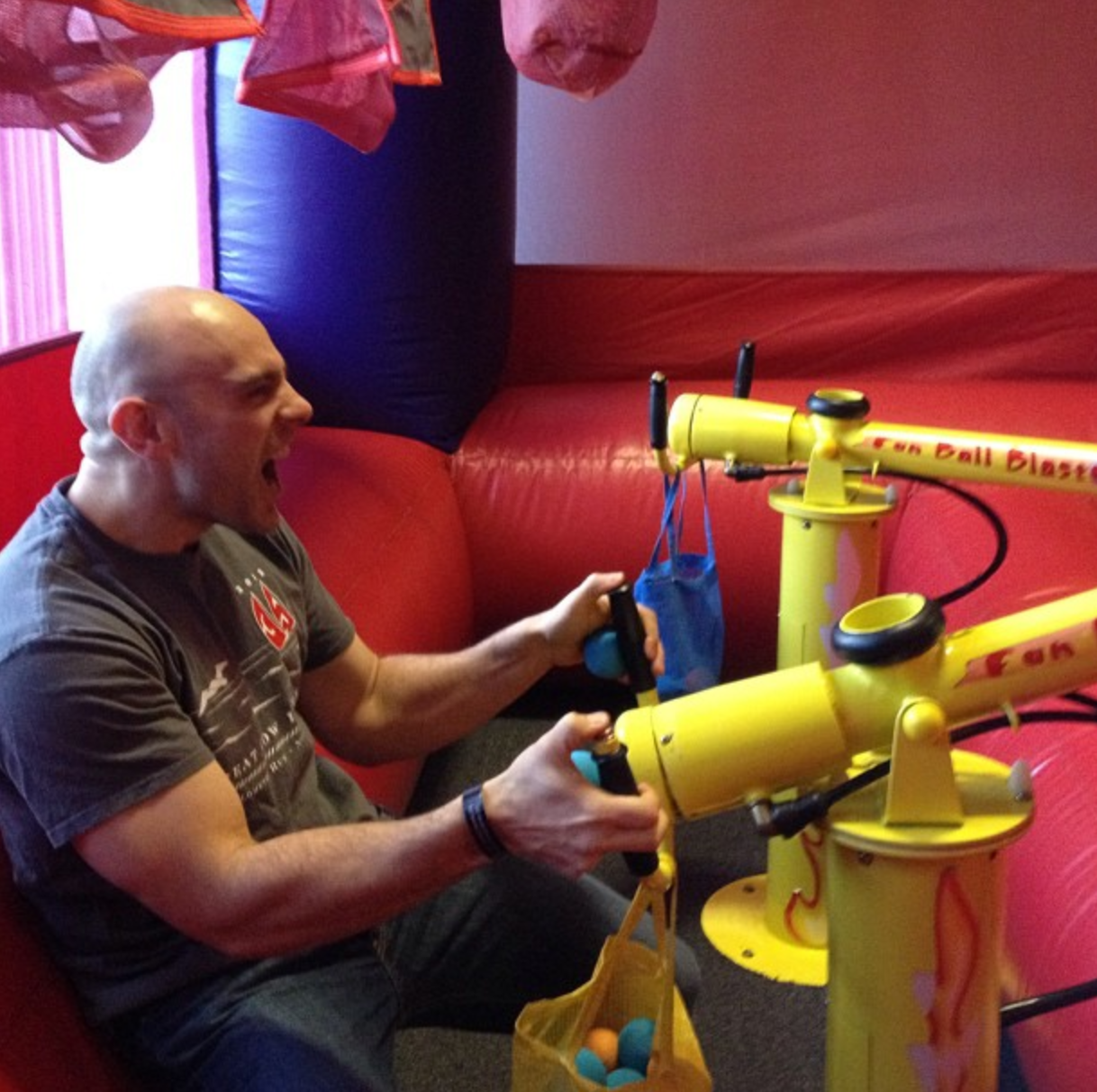
(Photo from Piro’s Instagram account)
Yglesias Award Nominee

“Margaret Thatcher’s last years were spent coping with dementia, a terrible illness. If, like us, you were disgusted by how she treated the least well off in Britain and around the world, the old line about not wishing something on your worst enemies still applies. We can’t help but think it’s pretty lousy to celebrate or gloat over anyone’s suffering and death and we don’t want anyone else to do it either.

We just want to place front and centre people who had no place in the Thatcherite worldview. And we want to do that in a way that can actually do some good. You can help us by donating to the excellent charities we have chosen to represent a fraction of them – the homeless, miners’ families, gay teenagers, Hillsborough survivors and South African victims of the Apartheid regime,” – a quote from a British liberal group called “Don’t Hate, Donate.”

They’re afraid some of the truly horrible bile directed at Margaret Thatcher since her death may be backfiring. I sure hope so. I have every respect for those who disdain the Thatcher legacy and are now saying so forthrightly. There should be no phony squelching of debate or universal deference when someone of Thatcher’s stature dies. But there are some limits in decency. Death-parties? Misogynist placards? They remind me one reason why I was a Thatcherite in the first place. The ugly extremism of her opposition.

Obama, The GOP And Fiscal Seriousness

Screen shot 2013-04-11 at 12.38.48 PM

A simple question given divided government and the scale of the future fiscal imbalance: which party is prepared to compromise more? The GOP is arguing that their acquiescence to a relatively minor part of the fiscally ruinous Bush tax cuts – four years after they were supposed to be sunsetted – gives them the prize. But Obama’s new budget is in a different universe. He has already kept in place a large swathe of the Bush tax regime, but now has offered some serious, tangible cuts to entitlements, including the chained CPI. On top of his previous squeeze of Medicare and the cost-control provisions in the ACA, he’s open to means-testing more for wealthier Medicare recipients.

The rough balance of his new budget is 2 – 1 spending cuts to revenue increases. The howls from the left – has the Democratic party reverted to pre-Clinton brain-deadness so swiftly – confirm the constructive moderation. One reaction from the right, it seems to me, was so cynical, toxic and foul in its hypocrisy and bad faith … well it had to have happened in Washington. Even the Club for Growth was taken aback:

“Greg Walden doesn’t seriously oppose even the most modest of reforms to social security, right?” said Club for Growth President Chris Chocola in a statement. “With nearly $100 trillion in unfunded liabilities, the last thing Republicans should attack the Democrats for is for making the most minor reforms to our entitlement programs. If anything, President Obama nibbles around the edges of entitlement reform and doesn’t do anything to put entitlements on a permanently sustainable path.”

I have been arguing for Obama to bring forward this kind of budget for a while. Maybe his caution was justified – especially given how he has been lacerated for negotiating with himself in the past and because the GOP is so riddled with purism and partisanship (even after its electoral shellacking), the compromise always seems to be in one direction.

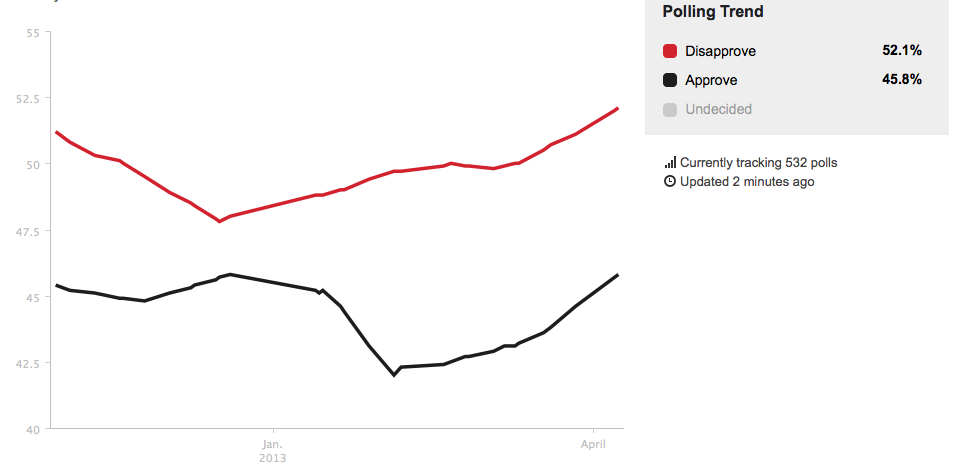
But I think the president has realized his sagging poll numbers on the economy (see above) are directly related to his seeming inability to get even the slightest fiscal compromise in the face of unsustainable long-term debt. He’s the president, after all. In the end, he was elected to get some kind of bargain done, before the debt compounds even further. He’s now taken a clear enough step that even Bill O’Reilly may have to concede that he is serious about entitlement reform – if only to make discretionary spending in any way feasible in the near future.

What Obama needs to do soon is go everywhere and explain his compromise and demand some give in return. Perhaps if gun regulation and immigration reform really do gain traction, some kind of momentum for a deal could emerge. It is entirely to Obama’s advantage if that happens. The Democrats? They’re too smug right now. Obama’s concessionary move is in actuality a shrewd one. Inertia isn’t – if the Dems want to appeal to the center of the country on the economy and its future.

The Other Other White Meat, Ctd

53776601_723864b67c_b

A reader writes:

Your reader’s story about Peru reminded me of my ex-girlfriend.  She was a doctor and spent quite a bit of time volunteering for a poor village in the Andes.  She said that nearly everyone raised guinea pigs at home and they were considered a good dish to serve a special guest.  As a visiting doctor from America providing free medical care, everyone considered her a special guest. Nearly every night some family would invite her over for dinner and they’d all insist on serving her guinea pig.  By the end of her stay, she would spend the better part of each evening begging her host for the night to please serve anything other than guinea pig.  She was a well-traveled woman, not a picky eater in the slightest, but apparently that was one taste she was never able to acquire.  Granted, I was never able to discern if this was due to the taste itself or the notion of eating a common childhood pet.

Another quotes Michael Todd:

[G]uinea pig is good for you, with more protein and less fat than flesh from pigs, cows, sheep, or chickens. Guinea pig is also good for Mother Earth—you don’t need a Ponderosa-sized spread to raise them, and they convert their feed into edible protein twice as efficiently as a cow.

That could be in large part because any animal that is raised for food is raised today in a way that makes it bad for you, and guinea pigs aren’t currently raised for food. If they were raised for food, they would be raised in vast numbers in horrid factory farms.

They would be bred to gain tons of weight and get very fat very fast. They would be virtually immobilized in intense confinement for their entire lives and fed a diet that is not natural for them (all corn and/or soy, including pesticides). They would live in their own waste and every breath would be filled with the ammonia that the waste emits, burning their lungs and eyes as it enters their bodies.

Their food would contain antibiotics. They would likely be given growth hormones. Their flesh would cease even to resemble the flesh of their non-factory-farmed ancestors – just like meat today has very little in common with the meat that used to exist in the wild, and is far less healthful to consume than the meat that used to exist in the wild. Oh, and just like the eggs, meat, and dairy from factory farms today, it would have deceptive “humane myth” labeling such as “Cage-Free”; “Free-Range”; “All Natural”; “Humane Certified” and other such non-defined marketing terms.

Guinea pig flesh would no longer have “more protein and less fat than flesh from pigs, cows, sheep, or chickens.” It would have a far higher fat content than it does today. Further, “twice as efficiently as a cow” is still horribly inefficient compared to plant-based foods. And to the extent their flesh replaced the flesh of larger animals, there would be more suffering in the world because it would take more individuals to produce the same quantity of flesh as larger animals. Everything that industrial agriculture touches gets destroyed.

Another reader:

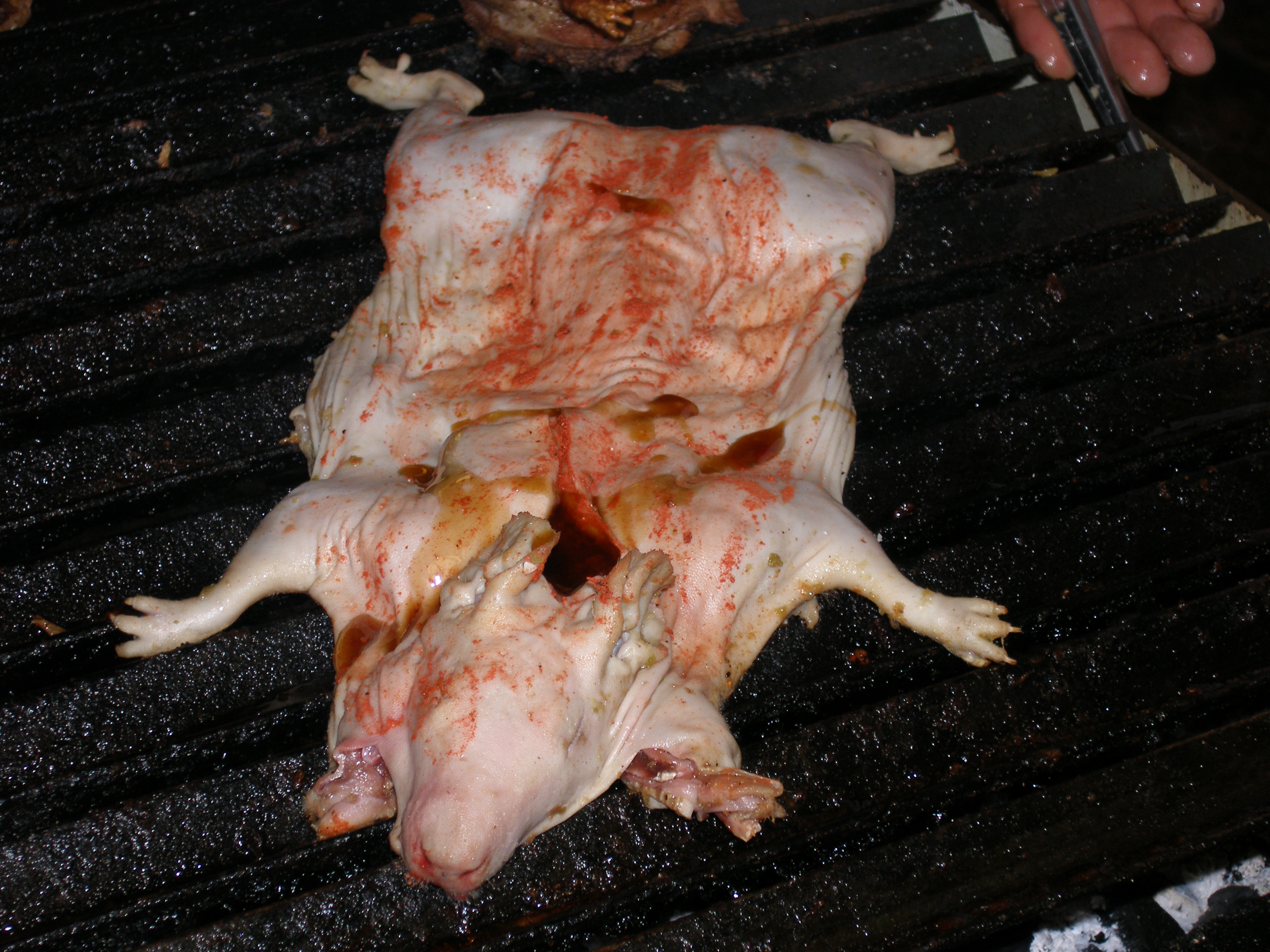
OLYMPUS DIGITAL CAMERAI couldn’t resist sending in the attached photo of a guinea pig roasting on the grill, taken in Otavalo, Ecuador back in 2006.  I tasted some of the finished product, and it wasn’t terrible, more or less like somewhat greasy quail.  We subsequently visited the home of an indigenous family, who had dozens of them running around the dirt floor of the house.  The grandmother would toss them some grain to keep them fed, and I guess would just grab one or more of them up when it was time to make dinner.  As far as I could tell, guinea pigs are very much a rural/Indian thing in Ecuador, as I did not see any on the menu when I was in the capital, Quito.

Aside from the cuteness issue, I can’t really see guinea pig taking off as a food item in lieu of poultry or other meats.  There’s not very much meat on those bones.

Another:

Anecdotal evidence from friends who have visited Peru: if you order guinea pig in a restaurant, be sure to ask that it be served with the head attached, so you can be sure you’re getting guinea pig and not rat.

Another:

I had an odd feeling that I had read about eating guinea pig on your blog previously, and thanks to your highly functional and awesome new search bar, I confirmed my suspicion: “Eating The Family Pet“. Okay, I’m not sure how likely it really is that I remembered this small item from five years ago. I probably read about it somewhere else and this is a coincidence. Still, the new search is awesome!

One more:

At the Cathedral in Cuzco, Peru, there is a wonderful Last Supper with guinea pig as the main course:

181DCFD6-1E02-4FE1-BA2A-3E5C46DEFAE8

(Top photo of “home grown” guinea pigs in Peru by Sam Judson)

Low-Caliber Gun Control

Waldman is unimpressed by the Senate’s gun control bill:

Toomey and Manchin’s proposal would close the “gun-show loophole,” meaning if you buy a gun at a show you’ll have to submit to a background check. It also covers sales over the Internet. What it doesn’t cover is private sales between one person and another. You’ve probably heard the figure that 40 percent of gun sales happen outside licensed dealers, and while the evidence for this figure is thin, nobody really knows if it’s too high or too low. Furthermore, nobody knows what proportion of that 40 percent occurs at shows, and what proportion happens when a guy sells a gun to his neighbor’s cousin or to some dude he met at a party or to one of the attendees at his garage sale.

Jacob Sullum asks how background checks relate to Sandy Hook:

Since Manchin describes that requirement as a response to the Sandy Hook massacre, you might reasonably surmise that Lanza bought the rifle he used in the attack from a private seller at a gun show or after seeing it advertised online. But you would be wrong, since the rifle belonged to Lanza’s mother, who purchased it legally from a federally licensed gun dealer after passing a background check. And if Lanza had tried to buy a gun on his own, it looks like he also would have passed a background check, since it seems he did not have a disqualifying criminal or psychiatric record, which is typically the case for mass shooters.

Judis would prefer that Congress focus on the economy:

It would be ridiculous to say that reducing inequality in the United States, and providing much greater opportunity in cities would eliminate homicide as a problem. But it would be equally ridiculous to say that an improvement in the country’s economic fortunes, and the reduction in the wild disparities in income, would have no effect on diminishing the homicide rate. Why, for instance, did the homicide rate in the United States start to decline in the mid-1990s? Some of it had to do with declining access to crack cocaine; but it also had to do with the economic expansion that took place. Gun control is part of the solution to homicide; but so, too, is economic improvement.

Will Readers Finally Pay For Content? Ctd

My thoughts on the feasibility of pay-meters for most bloggers:

On a related note, the Dutch continue to experiment with pay models:

De Nieuwe Pers recently launched in the Netherlands as an online platform for freelance journalists. Users pay €4.49 a month for access to all content on its app or website. But what stands out is the possibility to subscribe to individual reporters, for €1.79 a month. Think True/Slant, but with paywalls. “News has become more personal,” Alain van der Horst, editor in chief of De Nieuwe Pers, told me. “People are interested in the opinions, the beliefs, the revelations of a certain journalist they know and trust, much more than an anonymous person who writes for a large publication.”

Karskens concurs, stressing that a personal brand is key in this business model. “People read my stuff because I have a clear, crystalized opinion based on over 32 years of war correspondence,” he said. “This really works well for journalists with a distinctive character. It’s not for the average desk slave.”

Van der Horst also thinks paying per journalist is fairer to the readers than subscribing to a publication as a whole. “When you subscribe to a newspaper, you’ll get the full package. Even if you always throw out the sports section, you’ll still get it. With this model you decide: ‘This is what I want to read, so I’ll pay for it — what I don’t read, I don’t pay for.’”

We recently spotlighted another Dutch experiment, De Correspondent. Nieman Lab’s profile of the newspaper reveals several parallels with the Dish model:

De Correspondent’s record-breaking [$1.3 million crowdfunded] campaign is remarkable, not least because even those paying up aren’t clear on what the platform will look like when it launches in September. “That’s for a very good reason,” Wijnberg said — “we don’t really know yet.”

“When you try to sell an idea, it’s very easy to refer to what people know — ‘the platform looks like this, and you can compare the writing style with that’,” he said. “We didn’t want to do that, because we really wanted to be able to create something new — start with a clean slate.”

Here’s what we do know about De Correspondent: It promises to break away from the daily news cycle by focusing on context, not just what happened in the past 24 hours — new content that isn’t driven by “the news.” Individual correspondents, many of them famous or semi-famous in the Netherlands, will lead as “guides” — deciding the news agenda, and making their choices explicit. …

For an idea of what the new publication might look like, check out its 10-item manifesto (translated into English): Daily, but beyond the issues of the day. From news to new. No political ideology, but journalistic ideals. Themes and interconnections. Journalism over revenues. From readers to participants. No advertisers, but partners. No target groups, but kindred spirits. Ambitious in ideals, modest about wisdom. Fully digital.

A-fucking-men. And may sponsored content die on its corrupting vine. One reader who finally decided to pay for content writes:

I just wanted to pass along a thought on subscribing today. I’ve been mulling over subscribing since this all started, but hadn’t yet made the plunge, partly because I am unsure about the long-term feasibility of the direct pay-for-content model on the larger scale for the media. But this week I realized what it is about your site that’s different and worth stepping out and supporting this model: you don’t just offer a point of view on the blog, but a perspective. Except for the wire services, there’s little out there that doesn’t support a point of view, but you go beyond that in speaking personally, something I realized as I’ve read your pieces on David Kuo (as an evangelical living in DC with tangential connections to David) and Margaret Thatcher (as a struggling conservative) this week. I am grateful that you can admit to your readers that areas are only important when they are lived.
So, thank you for being authentic. It’s what makes the Dish rise above everything else out there today.