
What’s Wrong With “Good Looking”? Ctd

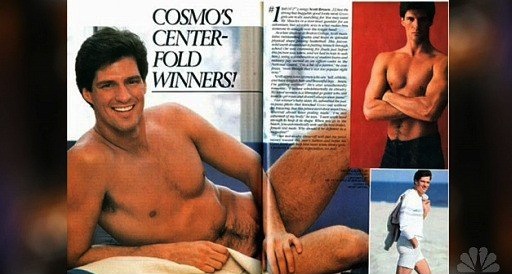
scott-brown-cosmopolitian-leno-bp

A reader writes:

The notion that we don’t judge male politicians by their appeance is absurd.  People comment endlessly about Chris Christie’s weight. Sarah Palin joked that if she had won the election, Joe Biden would be promoting his book, Going Rogaine. Reagan once pulled back his ears to demonstrate to a reporter that he didn’t have face-lift scars, and invited the reporter to run his fingers through Reagan’s hair to show that it didn’t feel like it had been dyed. Even when we don’t talk about male politicians’ appearance, we judge them by it.  It’s been 112 years since there has been a U.S president who was shorter than 5’9” – the average height for an adult American male today.

Another is on the same page:

Ask Aaron Shock or Paul Ryan about covering men in this fashion.  The fact is, most politicians just aren’t remarkably good or bad looking and especially aren’t young and “hot” enough to objectify. I’d contend that is more the reason why it’s rare to see these comments about politicians of either gender. That said, I doubt the breathless cooing and shirtless pics of Shock and Ryan measurably hurt their image. There’s the real difference. Attractive women are unserious or dumb, unattractive women have something to prove, and men are just a little more glamorous when they’re pretty and it’s irrelevant when they’re not particularly easy on the eyes.  Maybe someday we’ll get to the point where we see Shock and Ryan as the bimbos they really are.

What’s A Silencer For? Ctd

Readers counter Goldblog over the question:

I’m no gun nut. I don’t even own a gun (although I do sometimes go shooting). I’m a San Francisco liberal. I believe first and foremost that this is mainly about silencer sales. That being said, I think Jeffrey Goldberg is on the losing side of this argument. Guns are really loud. Goldberg acknowledges that and says that it’s true that “hunters who don’t wear ear protection may eventually damage their hearing.” That’s an understatement. Most guns are around 150-160 db. Just one shot can be enough to damage your hearing. “Silencers” (aka suppressors) can’t actually silence a gun or even get anywhere near that. It’s absolutely nothing like the pfft pfft you’d hear in a Bond film. It’s still about 130-145 db. This brings it down to the level of a military jet taking off. A car horn going off a meter from your ear is still quieter than a gun with a silencer. Even with a silencer, you should still be wearing hearing protection.

In other words, neighbors are still going to hear your shots if you fire a gun with a suppressor. On the other hand, it may be just enough quieter to save the hearing of many gun enthusiasts.

Another reader:

A hunter can wear ear protection.  The guy getting up in the middle of the night to an intruder doesn’t have that luxury, and a suppressed weapon will allow him to fire more than one shot without it being as though a bomb has gone off and potentially deafen him and his family for the rest of their lives (since being indoors magnifies the sound from a fired gun many times over).

A gun owner writes:

What’s a silencer for? Hearing protection. Goldblog’s glib dismissal of the utility of silencers is a prime example of why gun people get so fed up with non-shooters and the idiocy about guns that Hollywood propagates.

Here is a pretty high-tech and very well established suppressor company, AAC. Here is a listing of all their large caliber suppressors. The “best” one in terms of dampening reduces noise levels by 39 decibels (dB); the typical suppression value is about 30 dB. Whats 30 dB? In an echo chamber, that’s the sound of someone whispering in a library six feet away from you. Typical rifle calibers have sound levels in excess of 150 dB. A jet engine at full throttle 100 feet away is only 140 dB (and please keep in mind, the scale is logarithmic). So attaching a silencer to a hunting rifle might reduce the loudness from 150 to, at most, 110 dB. Well, what else is around 110 dB? Running a circular saw 3 feet away (108), or a motorcycle (100), or an amplifier 4′ away from your head (120).

Should suppressors be available to everyone? No, probably not. But they should definitely be more available then they currently are, where you need to pay a $200 tax stamp to the federal government, subject yourself to a six-month FBI background check, and then get personal approval from your local police chief or sheriff, who hey, might want to “ask” you for political donations (just ask anyone at calguns.net for their CCW approval process).

Another passes along a video demonstrating how oil filters can be used as effective suppressers:

Perhaps Mr. Goldberg can explain how while a suppressor is as readily available as an oil filter (if you’re willing to break Federal Law), they’re not frequently used in violent crimes?

Western Criminology Review “Criminal Use of Firearm Silencers” (pdf) puts the number of suppressors related to crime (including cases where the unlawful possession of a suppressor was part of the charges) at around 30-40 federal cases/year between 1995-2005, and only 12 federal cases (not per year – just 12 total) where the suppressor was used in the commission of the crime. Partially-reported case data for California shows similarly rare incidence of use.

Bruce Schneier coined the term “movie-plot threat” when talking about security and risk analysis in terms of terrorism, but it certainly applies to the use of “silencers” here.

Northern Overexposure

Erin Sheehy documents the latest extraction-based industry to hit Alaska:

Over the past few years, the number of reality television shows set in Alaska has skyrocketed. In 2012, more than a dozen aired on major cable networks. Most of the programming is of the “man versus nature” variety: shows like Deadliest CatchGold Rush Alaska, and even Ice Road Truckers tend to focus on the strange and dangerous professions of the Last Frontier. But forays into human drama have been made. This past fall the Military Wives series held a casting call in Anchorage, and in 2011, TLC aired the short-lived Big Hair Alaska, a show about Wasilla’s Beehive Beauty Shop, where Sarah Palin used to get her hair done. The film and television industry in Alaska has grown so rapidly that in 2010 the Anchorage Daily News started a blog called “Hollywood Alaska,” which reports on the latest industry news and routinely asks whether the state is getting enough return on this media gold rush.

The Lower 48’s obsession with the Last Frontier isn’t the only cause of the boom. In 2009, the Alaskan government began offering subsidies that allowed producers to recoup up to 44 percent of their spending in the state. The subsidy program—one of the most generous in the country—has been controversial.

Before 2009, shooting an entire feature film or TV series in Alaska tended to be prohibitively expensive. (Northern Exposure, the famous 1990s show about a Jewish doctor from New York who moves to a small town in Alaska, was shot entirely in Washington State.) More filming means more out-of-state film crews spending money on food and lodging, and could potentially be a boon for tourism, but the latest reports from the Alaska Film Office show that only around 15 percent of the total wages paid by these tax-subsidized productions have gone to Alaskans over the past three years. On the 2010 season of Deadliest Catch, Alaskan workers earned less than $20,000, while out-of-state workers took home more than $1.3 million. And although an Alaskan setting is central to the plotline of most of the films and shows that are shot here, some production companies have come under fire for abusing the subsidy. Baby Geniuses 3, a movie about crime-fighting babies and toddlers, paid less than 6 percent of all wages to in-state employees, and its plot brought little attention to “Alaskan issues.”

The NRA’s Unlikely Role Model, Ctd

Several readers beg to differ with this one:

“The right to bear arms was an essential right in 1787 because of the risk of Indian incursion, not as a bulwark against tyranny or a defense against foreign invasion.” Your reader is missing a bit of history of the Revolution. The fact is that the British authorities were doing exactly what the correspondent suggests they were not – seizing arms (gunpowder and weapons) – in a bid to squelch resistance in New England. The inaugural event of the Revolution, the April 19 raid on Lexington and Concord, was in fact triggered by Army regulars (Redcoats) marching to seize these arms. Nor was this the first instance of this behavior, there were many raids on New England’s powder houses in the preceding year. What Paul Revere and his fellow riders achieved was to get word of the impending seizure out in enough time for the well-regulated militias of the towns to the West and North of Boston formed up and able to resist.

In short, a tyrannical government seizing arms in a bid to prevent citizens from protecting their liberty was a very real experience for the Constitution’s framers and to suggest otherwise “shows a complete lack of understanding of both the document and the history of its writing.”

Another:

If your reader is interested in knowing what the Founders actually considered a “well regulated militia” to be, I refer him or her to the Militia Acts of 1792 passed by the second Congress, in which a good number of those Founders were sitting and knew perfectly well what they meant by “well regulated”. And what they meant bears absolutely no resemblance whatsoever to what your reader just wrote.

Those acts conscripted every able bodied white male between 18 and 45 years of age in the country (with some exceptions based on occupation) into the militias. It mandated they be organized into divisions, brigades, regiments, battalions and companies organized by the state legislatures. It required all members in those militias to provide specific items of equipment (musket, ammo, knapsack, bayonet, gunpowder, etc.). To regularly report for muster and training. Militia members were subject to court martial for disobeying orders. And they were at the call of the president to either defend the nation against invasion or to enforce the laws of the nation if he felt it necessary to employ them to that end. One example is the Whiskey Rebellion, when President Washington personally marched 13,000 militia out to Pennsylvania to inform a bunch of farmers threatening tax collectors that, oh yes, they WOULD pay their taxes.

THAT is what the Founders idea of a well-regulated militia was. We know because they created them. The idea that it was any yahoo with a rifle who wanted to call himself a member of “the militia” is a modern invention created by people like the NRA.

Another:

I have to take issue with your reader’s relatively condescending comment that the earlier reader comment showed a “complete lack of understanding of the [the Bill of Rights] and the history of its writing.”  I think the evidence is strong that Madison modeled the Second Amendment after the English Declaration of Rights of 1689, and that the amendment’s inclusion was due to the fear in the Southern States that the centralization of military authority in Congress could subject them to the risk of slave rebellions if Congress were neglectful of the safety of the Southern slave owners.  (I recommend Volume 31 of the University of California at Davis Law Review (1998) on page 309 for the article “The Hidden History of the Second Amendment”, for an analysis of this point.)

What is clear is that the idea that the Second Amendment’s inclusion in the Bill of Rights was driven by some wish to arm insurrectionists so as to renew the Tree of Liberty in a Jeffersonian sense, is simply not supported by the records of the discussions leading up to it.  The 1994 article by Joyce Malcolm on insurrectionists rights theory,goes to great lengths to explain away English history for inclusion of arms provision in the 1689 Declaration, in order to come up with this right.  This fore-bearer to our Second Amendment provided “[t]hat the subjects which are Protestants may have arms for their defence suitable to their condition and as allowed by law.” It is more likely that the “as allowed by law” language was to define the right’s applicability to parliament as opposed to the King, and was not a call to create in individual right.

I think it is clear that there were multiple reasons for the Second Amendment, but insurrectionists’ rights were not high among them.  At one level, the amendment supported conscription for the militia by having a source of guns among the population, and at another, the right to have the militias addressed the fears in the south that inadequate financing or deployment of the militia could be used by the Northern states to end slavery.

One more:

Your reader’s criticism of another reader who had earlier referred to the NRA’s having found a Court willing to ignore the words “militia” and “well-regulated” in the Second Amendment is itself flawed, at least with regard to its reliance on the amicus brief filed in the McDonald case by Jack Balkin and other constitutional law professors.  That amicus brief addresses only the issue whether

the Privileges or Immunities Clause of the Fourteenth Amendment was intended to protect substantive, fundamental rights, including the individual right to keep and bear arms at issue in this case.

That’s from the first page of the amicus brief. Remember that the Court had found the individual right to keep and bear arms under the Second Amendment earlier in Heller.  But the amendment only limits the power of the federal government. The question in McDonald was whether the ruling in Heller applied to the States and their political subdivisions via the Fourteenth Amendment.  This was the narrow legal issue the amici law professors argued was settled among legal scholars of the left, right and center.  The brief specifically disclaimed taking any position on the question whether the Court’s reading of the Second Amendment was right, and certainly cannot be read as supporting that interpretation.  Immediately after the passage quoted above, the amicus brief states:

Amici do not, in this brief, take a position on whether the particular regulation challenged in this case is constitutional in light of the individual privilege to bear arms, which, as the Court noted in District of Columbia v. Heller, 128 S. Ct. 2783, 2816 (2008), may be regulated to a certain extent.

Permission To Be Me

Another testimony to the remarkable life of David Kuo. Money quote:

I don’t know a lot but I’ve come to believe the following:

The world is broken. Our bodies break eventually. Our minds and hearts can break as well. We lose things in this life. We lose relationships. We lose people. And so a lot of folks live with a lot of pain. Much is mystery but God asks us to love, not just when it’s easy and not just when a certain Scripture fits. What does it look like to love someone when you’ve never been where they are? When there are no words? Or what about allowing someone to love you when you feel completely alone, like no one can relate?

Beyond that, maybe it’s better not to fake it, not to offer something cheap. For the rest of us still here, with air in our lungs and tears in our eyes, perhaps we are meant to simply meet each other in the questions.

Is It Time To Retire Romeo And Juliet? Ctd

Noah Berlatsky sticks up for Shakespeare after Alyssa’s takedown, noting that the play is not just about young love, but about the divide between the young and old:

Rosenberg claims that Romeo and Juliet is dated because of the uncomfortable way its childishness, and its child protagonists, sit in our contemporary culture. I’d argue, though, that that uncomfortableness is not a contemporary addition, but is instead one of the things Shakespeare was writing about to begin with. At that first flirtatious meeting, for example, Romeo is masked with friends at a Capulet party. Old Capulet, seeing the maskers, reminisces about when he used to do the same. …

Capulet slips back through time… and when he stops slipping, it is Romeo who speaks and goes to woo Juliet. Capulet was Romeo, Romeo is Capulet—and so, by substitution, the lover of the daughter is the father. The mask is a device not so much to enable young love, as to enable the old to imagine young love.

In Romeo and Juliet play-acting with the categories of adult and child can lead to exhilarating delight, pleasurably moralistic revulsion and, sometimes, to tragedy. If, in our own day, we have pushed the onset of adulthood past the tweens, past the teens, and even to some degree up into the 20s—that makes the play’s insights and its sometimes exasperating perversities more relevant, not less.

The World Of Kuo

A cherry blossom tree is pictured in the

[Re-posted from earlier today]

So there we were this morning, on a summery day, surrounding a coffin, offering prayers. David’s evangelical Christianity was omnipresent – and a cultural novelty for me, as a Catholic. First off, the coffin was never laid into the earth. It stayed there and remained there as we left. Were his very young kids the reason? I didn’t ask. But in this letting go, dirt was not shoveled or thrown over the casket, which was closed. We left it hanging. Rather, at the very end of the day’s festivities – and they were festive, not funereal – we all let go of balloons into the sky. They drifted upward, looking like little sperms, with wiggling trails of ribbon beneath them, looking for a heavenly egg.

I saw John DiIulio and his wife, Joe and Victoria Klein, along with Ralph Reed, who visited David in his final agonies, along with many of David’s uniquely eclectic posse. The service was in David’s evangelical mega-church, and infused with the surety of physical resurrection. The idea of our getting new bodies in Heaven – perfect bodies without tumors or HIV or wrinkles – has always seemed a little strange to me. If it’s true, then it must be a very different kind of existence. I remember after my friend Pat died of AIDS that I had one searing dream about him, in which he seemed extremely real, completely recognizable, yet utterly different in appearance: transfigured, but still Patrick. Perhaps that also accounts for the bewildering variety of the accounts of the risen Jesus in the New Testament. But it may also be our refusal to see the person in his or her final form: sometimes, as with AIDS, awfully deformed, or with a brutal brain tumor like David’s, wracked with pain, his face aged not just by time but by disease. We want these things not to continue. We want our dead friends and family to be remembered in the best of their prime, as if they were photo-shopped by Vogue.

I have never been to a mega-church service – which is something to be ashamed of, since I have written so often about evangelicalism’s political wing. And it was revealing. The theater was called a sanctuary – but it felt like a conference stage. There were no pews, no altar (of course), just movie-theater seats, a big complicated stage with a set, and four huge screens. It looked like a toned-down version of American Idol. I was most impressed by the lighting, its subtlety and professionalism (I’ve often wondered why the Catholic church cannot add lighting effects to choreograph the Mass). The lyrics of the religious pop songs – “hymns” doesn’t capture their Disney channel infectiousness – were displayed on the screens as well, allowing you to sing without looking down at a hymnal. Great idea. And the choir was a Christian pop band, young, hip-looking, bearded, unpretentious and excellent. Before long, I was singing and swaying and smiling with the best of them. The only thing I couldn’t do was raise my hands up in the air.

This was not, in other words, a Catholic experience. But it was clearly, unambiguously, a Christian one.

There was little sadness – and no purgative drunken wake. We were told not to wear suits and dark clothes, so the crowd was in greens and blues and whites (Joe bought a special pink plaid number just for the occasion). And the reason for this was quite obvious: almost everyone there, including myself, were completely sure that a) David was still there and b) his death was something to be celebrated if you loved him. He was certainly looking forward to it. His extraordinary wife, Kim, was effervescent and stunning in a white dress. She has been through hell and back several times in the last decade. And yet she wore that toll lightly today. The tears were for another time. The sobs for another one too.

What I guess I’m trying to say is that so many of us have come to view evangelical Christianity as threatening, and in its political incarnation, it is at times. But freed from politics, evangelical Christianity has a passion and joy and Scriptural mastery we could all learn from. The pastors were clearly of a higher caliber than most of the priests I have known – in terms of intellect and command. The work they do for the poor, the starving, and the marginalized in their own communities and across the world remains a testimony to the enduring power of Christ’s resurrection.

In some way, this was David’s last gift to me. His own unvarnished, embarrassingly frank belief helped me get over my prejudices against evangelicalism as a lived faith. His faith strengthened mine immeasurably, especially when we were among the first two to bail on the Bush administration in its first term. It was not a shock that his last day above the ground opened up more windows and doors in my mind. He doubtless hoped it would.

I feel no grief. I remain, as someone once said, surprised by joy.

(Photo: Carl Court/AFP/Getty.)
The Daily Wrap

Matamata-New Zealand-12pm

Today on the Dish, Andrew shared his experience of attending the David Kuo’s funeral and expressed his feelings on a reasonable, Christian understanding of life and death. He took on more criticism from readers for his take Thatcher’s legacy, posted the results of our reader survey on Dish policy of featuring graphic war imagery, and paid respects to Goldblog.

In political coverage, we debated MSNBC’s TV spot calling for collective responsibility of your kids, provided an introduction for those bamboozled by the bitcoin and wondered how long it will take for the rest of us to join Jay and Bey in Cuba. Bobby Jindal’s stock crashed as News Corps put Fox News on notice. Millman reassured us that our trade deficit is a red herring, China and Brazil clocked in richer but tubbier, and we questioned whether we owe the Arab Spring to the Iraq War. Also, the navy drew up designs for a doomsday laser.

Ambider sensed incoming relief in Congress’s partisan stalemate, McWhorter unpacked the terminology of immigration, and Drum supplied some data to back up the backlash against Obama’s remark on Kamala Harris’s attractiveness. Finally, Goldblog pointed out the NRA’s unhelpful stance on silencers and readers fleshed out more contrasting views of the second amendment.

In assorted coverage, Ashley Fetters expected a cameo from Ralph Nader in Man Men, Brad Leithauser relayed stories of his grandfather’s casual catchphrases, and we learned that e-books can be bound study-ready. Balko pointed out that cops don’t have it as bad as they used to, Ben Smith vouched for the success of Sheryl Sandberg’s Lean In, and we charted the ongoing plummet of newspaper ad revenue.

Waldman queried our fascination with listicles, we asked whether life is about creating life and sampled a taste of guinea pork. We played out a quick day with the band the Real Ones in the MHB, checked in with the Syrian rebels for the Face of the Day and peeked out at Matamata, New Zealand in the VFYW.

–B.J.

Left To Wonder

To The Wonder was the last film Roger Ebert reviewed:

A more conventional film would have assigned a plot to these characters and made their motivations more clear. Malick, who is surely one of the most romantic and spiritual of filmmakers, appears almost naked here before his audience, a man not able to conceal the depth of his vision.

“Well,” I asked myself, “why not?” Why must a film explain everything? Why must every motivation be spelled out? Aren’t many films fundamentally the same film, with only the specifics changed? Aren’t many of them telling the same story? Seeking perfection, we see what our dreams and hopes might look like. We realize they come as a gift through no power of our own, and if we lose them, isn’t that almost worse than never having had them in the first place?

There will be many who find “To the Wonder” elusive and too effervescent. They’ll be dissatisfied by a film that would rather evoke than supply. I understand that, and I think Terrence Malick does, too. But here he has attempted to reach more deeply than that: to reach beneath the surface, and find the soul in need.

Previous Dish on the film here and here.

Accidental Aphorisms

Brad Leithauser praises the passing down of casual but poetic sayings:

Of all the helpful lessons [my grandfather] imparted to me, I recall nothing in any detail. No, after all these years, I can retrieve verbatim only one thing he ever said, and this didn’t originate in his dutiful tutoring. It was a spontaneous remark. One December day, he and I were sitting in the family room. I was probably seven or eight. I glanced out the window and beheld a miracle: the first snowflakes of the year. I uttered an ecstatic cry: “Look! Look! It’s snowing!” And my grandfather replied, “Never be glad to see the snow.”

I loved my grandfather dearly and felt the loss sharply when he died. That I fail to recall anything else he said sometimes seems like a moral failure. But mostly I see it as an example—again—of the fateful caprices by which certain word clusters survive the decades. For this particular advice reverberates within me still: “Never be glad to see the snow.” It’s an apt follow-up to “You think you’re happy now,” or “This may look like a good thing.” And it’s a line that would fit neatly into any iambic tetrameter verse. It would make a perfect refrain in an old-fashioned poem about the disillusionments of youth: “The road is longer than you know. / Never be glad to see the snow.” Or “We hear his echo as we go: / Never be glad to see the snow.”

Similar catchphrases, in which casual comments are promoted into a sort of immortality, doubtless exist in nearly every family, every close friendship. I find this notion deeply heartening—that people are everywhere being quoted for lines they themselves have long forgotten. And of course each of us is left to wonder whether, right at this moment, we’re being quoted in some remote and unreckonable context.