The Daily Wrap

Today on the Dish, Andrew responded onscreen to critics of Thatcher, and revealed how foreign the Baroness would have been to the Republican program, from climate change to AIDS. Andrew also implored us not to wait for politicians to spearhead social change, pointed out one such case (of gay rights in Uganda), and considered the Obama administration’s role in the change sweeping America. Elsewhere, Andrew continued to express hope for Pope Francis, gave an interview with Vanity Fair, and daydreamed of a future career as a canna-critic.

In political coverage, we tried to measure what racial animus cost Obama in both elections, located the GOP in the 12-step plan, and explored some new ideas of class in Britain. We discovered most scandals don’t torpedo careers and reassessed animal rights’ victory on horse slaughter as Francesca Mari peeked between the grand moments and figures in history. Reading up on WWII, TNC pushed back on lofty assurances against barbarism, as we granted certain elements of the nanny state a second look.

In miscellanea, Laura Bennet and Willa Paskin panned Vice’s new HBO show, Tom Shone triangulated the elements of good cinema, and we counted music sharing as just one new struggle over intellectual property. We uncovered the history of the suicidal dogs of war and considered whether loneliness is a killer while the world markets craved red hot chili peppers. We came across a Fargo-style self-kidnapping service, looked beyond calories for healthy eating, and studied elite chic.

Later we read David Foster Wallace on Fyodor Dostoevsky, spotted the difference between hardcovers and their paperbacks, and wondered if the art gallery is becoming history. Things got beardy in the MHB, we met the gaze of an anti-Maggie Briton celebrating Thatcher’s death for the Face of the Day, spotted a shadowy VFYW in the East Village, and tracked down Rohrmoos-Untertal, Austria in the results of the latest VFYW contest.

–B.J.
Obama’s Cultural Transformation Of America

Marijuana Crime

[Re-posted from earlier today]

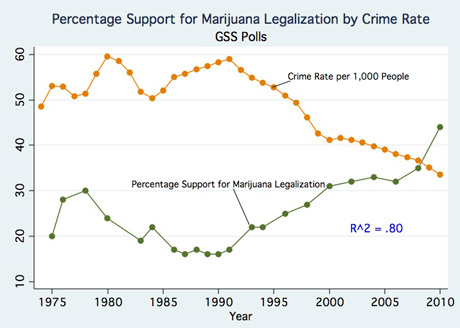
Support for marijuana legalization increases as crime goes down:

Eighty percent of the differences in support for marijuana legalization nationwide since 1975 is explained by the change in the overall crime rate through 2010 (the last year in which we have the crime rate and GSS data). Crime rates are currently at very low levels nationwide, which could explain why we saw the demonstrated upswing of marijuana legalization in all polling during the first decade of this century. If we were to see an increase in the crime rate in the future, there’s a pretty decent chance we’d see a decrease in support for marijuana.

Maybe so. But I’m still impressed by that sharp sudden uptick in the last few years. It looks a lot like the marriage equality graphs:

Screen shot 2013-04-09 at 1.21.32 PM

More and more, as the Obama re-election moves into the rear-view mirror, I think we are wrong to see the current fiscal stalemate or economic situation as the most dispositive aspects of Obama’s presidency.

I think what he may well be remembered for will not be his careful stewardship of a very sick economy back from intensive care. Given the nature of the economic collapse, he was never going to get a Reagan recovery anyway. All he needed was a recovery strong enough to get re-elected, and a winning coalition that remade America as a cultural entity. And that’s what we are now seeing. The 2012 election was a watershed for cultural change – and I suspect the sudden jump in support for marriage equality and marijuana legalization reflects a bandwagon effect in the wake of Obama’s overwhelming cultural victory.

Obama has presided over the moment when white America came to accept that it no longer has the demographic clout to ignore non-white America – a huge symbolic step in national self-understanding, literally epitomized by a multi-racial, multi-cultural president. It looks likely that his presidency will be the most significant one for gay rights in American history. He has established the principle of universal healthcare in America – another huge shift in the cultural identity of the country. He has harnessed the political power of American women to decimate the GOP’s coalition. If he presides over immigration reform, we will be a different country culturally than we were only a decade ago. And he will have ended – perhaps permanently – the entire idea of militarily occupying foreign countries to advance our geo-political goals, and, if the sequester continues, will have cut defense in ways even Clinton couldn’t dare to.

This is a cultural revolution. He did not create it. He organized it. And epitomized it. We are now looking very closely at various political, tactical moments – the budget, entitlement reform, taxes – exacerbated by the new instant and universal media. What we are missing is the strategic cultural revolution that has been occurring all the time, and that he has very carefully guided.

And he is quite happy for us to miss it. Because that stirs up less resistance. But the change goes on …

Quote For The Day

“I think of myself as being particularly baffled on the one hand, by the whole question of God and the relation of This picture taken 21 March 2007 shows ahumans to God, but also, possibly because of lots of empty spaces in my life, open to exploring what that might mean. I have open spaces where I put that question and just see what happens.

Going to church is one such space, though I don’t go with any expectation of fulfillment or illumination. I just go because I have gone, and my mother went and her mother went and there’s something there that happens to all of us. A kind of thinking takes place there that doesn’t take place anywhere else. No matter how unattractive the service—and nowadays the mass is rather unattractive in its modern translation—no matter how brainless the sermon, there is a space in which nothing else is happening so that thinking about God or about the question of God can happen. So I go there and let it happen.

Nothing changes, I don’t become wise about this, I don’t become ethically better or more interesting. I’m just the same person, I’m that person with this space open and I do think that for me, in this life, that’s as far as I’m going to get with spirituality,” – Anne Carson.

(Photo: This picture taken 21 March 2007 shows a a grey-beam coming through a stained-glass window, on every spring and autumn equinoxes, at the Strasbourg cathedral, eastern France. By Frederic Florin/AFP/Getty Images.)

The History Of The Everyday

Francesca Mari zooms in on it:

Microhistory arose largely in Europe and the United States in the 1970s and 1980s in reaction not only to the top-down historical narratives common to political history but also to the increasingly quantitative ones of social history. Microhistorians argued that the generalizations of capital “H” Great Man History distorted the truth of how most individuals actually lower-case lived and therefore advocated telling the stories of what one practitioner called “the normal exception”: the interesting small player who could stand in for the average person and, as a result, offer a unique angle overlooked by elite texts and master narratives. Although at first a European phenomenon—perhaps best exemplified by Carlo Ginzburg’s 1976 The Cheese and the Worms: The Cosmos of a Sixteenth-Century Miller—microhistory also found its advocates on this side of the Atlantic: Robert Darnton’s The Great Cat Massacre and Other Episodes in French Cultural History, for example, and Laurel Ulrich’s Pulitzer Prize–winning A Midwife’s Tale: The Life of Martha Ballard, Based on Her Diary, 1785–1812.

Mari focuses on the work of Jill Lepore:

Although one of her essays shows how a biography won Andrew Jackson the presidency and set a presidential precedent, another shows how Thomas Paine, who motivated the American Revolution with his pamphlet Common Sense, died alone in Greenwich Village shortly after being turned away from the poll booth, his nails curled over his toes like claws. Perhaps such instructives are why Lepore doesn’t primarily write for writing’s sake in the form of finely-crafted fiction. She writes to redeem a set of truths about the past for consumption by the normal exception, an audience of ordinary lives, readers who want history that sounds like them: “Who tells the story,” Lepore says in her preface to The Story of America, “like who writes the laws and who wages the wars, is always part of that struggle”—a struggle over who’s included and who’s excluded, which is to say, over who is empowered.

Kidnappers For Hire

Of a different sort:

[Adam] Thick founded Extreme Kidnapping in 2002 after being inspired by the old David Fincher movie The Game. (SPOILER: It was all a game!) For $500, Adam and his crew will abduct you at gunpoint and hold you hostage for four hours. A thousand bucks gets you ten hours, along with a bit of customized sadism. GQ was curious to see what $1,500 would buy me.

If it strikes you as obscene that people would pay to be kidnapped at a time when it happens routinely to other people for real, the fact is that we live in an age when a normal life simply isn’t enough for many Americans. If you watch enough movies and TV (as I do), you end up yearning for a life that is more cinematic than blissful. Experiences are the newest, hottest luxury items. I looked at it like I was paying for a memory implant, Total Recall-style.

War Porn

Laura Bennett is unimpressed by Vice magazine’s new HBO show of the same name:

“Vice” mostly peddles an aggressive nihilism, an undifferentiated stream of brutal images and events. By the second episode, all the gunshots and explosions have begun to sound as phony and rote as special effects. The thinness of context makes the trauma feel mostly atmospheric, all this highly specific misery and atrocity blending into a single panorama of carnage. War becomes a series of assaultive clips and soundbites, the sum reduced to its parts. So the world is screwed, the government is corrupt, war is a desolate waste. Child soldiers, enslaved sex workers, a cross-dressing basketball star befriending a heinous dictator: It is all sad and mystifying and strange.

Willa Paskin’s view:

Despite showing some very gruesome imagery— a real decapitated head, for example— and having a swaggy, “we’re so hip we send our reporters into dangerous places looking like they just rolled out of bed” self-aggrandizement, “Vice”  is fundamentally earnest: war is terrible, these situations are totally effed up, American foreign policy positions are generally right. The series, according to the voice-over that plays at the beginning, is out to expose the “absurdity of the modern condition,” but it doesn’t really fixate on the “absurdity,” or not much more than any news outlet sending dispatches from dangerous places.

Marah Eakin adds:

Serious journalists had been in Pakistan, Angola, and North Korea for years, so what made Vice think that because it sent some tattooed kids wearing jeans to a war torn area that it was reporting serious news and not just promoting “what the fuck” tourism. With [“Vice”], that question looms large and is never really answered.

Class In The UK

Toby Young reflects on a social class quiz that Manchester University created for the BBC (one of many spoofs is seen above):

One advantage of moving beyond the socio-economic definition of class is that you end up with a less inflammatory portrait of modern Britain. Yes, the social elite are quite numerous, but it’s better to belong to a four million-strong group than be bracketed with the dreaded ‘1 per cent’. … Seven different classes also feels more accurate than the usual three, even allowing for such sub-categories as lower-upper-middle (the class George Orwell said he belonged to). The more there are, the easier it is to move between them and the harder it is to keep track of who is a member of which one. That chimes with the general sense that class has become less important in the past 25 years.

Jenny Diski details how class tests were applied in the past:

You looked, you listened, you sniffed the air. And there it was, at 60 paces. Along, of course, with the telltale signs of arrivisme or decline, everyone with an exquisitely precise social degree of their own as obvious as the nose on their face, the first syllable uttered, the cut of their jacket.

It was as easy to know as it was intricate, the British class system. Provided you were born to it. But those of us who didn’t exactly fit because our parents or grandparents still spoke with foreign accents learned pretty quickly how to spot the finest distinctions. Even an Australian classmate knew, at my boarding school, when I tried to join the drama club, that with the wrong accent, I ‘would only be any good at playing maids’.

Nigeness contemplates “the lost richness of the English class system”:

Once among the glories of our national life, this endlessly complex and subtle system (or rather organism) gave us all our best comedies and most of our best fiction, while also proving a remarkably effective engine – and index – of social mobility, both upward and downward. (‘Was he born,’ inquires Lady Bracknell of Jack Worthing’s father, ‘into what the radical papers call the purple of commerce, or did he rise through the ranks of the aristocracy?’). It also gave us something other than the weather to talk – and even think – about.

Music Piracy Is Nothing New

Noah Berlatsky reviews Alex Sayf Cummings’ Democracy of Sound, a “history of music piracy from the wax cylinders of the 1870s to the present day”:

Music has been compact and easy to reproduce since the days of sheet music. It is, moreover, intensely social: People want to share it with each other, whether by sending a YouTube URL in the 21st century, trading Grateful Dead tapes in the 20th, or copying sheet music for other singers in the church choir in the 19th.

Perhaps even more importantly, music is, and has long been, hard to pin down. A book or a painting is a physical object—but where is a song? Is it notes on paper that tell you how to sing it? Is it a live performance? Is it the recorded notes? Is a singer singing someone else’s song copying that song, or is she making a new artistic work? Turning music into property is, in other words, conceptually complicated—which is why, Cummings, suggests, struggles over intellectual property have often started, or been worked out first, in struggles over ownership of music.

Hollywood’s Holy Trinity

Tom Shone theorizes that “great films arise when there is a triangulation between director, actor and protagonist — when all three share a spiritual umbilicus”:

[T]he Godfather is Coppola’s shadow-King as much as he is Brando’s; “One Flew over The Cuckoo’s Nest” is Milos Forman’s kiss goodbye to soviet Czechoslovakia as much as it is Jack Nicholson’s middle-finger salute to Hollywood. This also explains the airlessness that hangs over “Citizen Kane”, whose star, director and main character are already united in the singular frame of Orson Welles. What was never sundered cannot coalesce.

When Animal Rights Goes Wrong, Ctd

Like Marc Champion,  Steve Chapman argues that the ban on horse slaughterhouses has done more harm than good:

When 17 state veterinarians were polled on horse welfare, all said it’s gotten worse since the slaughter ban. According to the National Association of Counties, the number of abandoned horses has risen — just as opponents warned it would. If an owner can’t sell the horse for a decent sum and lacks the money to have it euthanized, he may leave it somewhere to meet death by starvation, disease or predators. … Rescue operations would be a more congenial answer, but they can’t do enough. They currently care for only about 6,000 horses nationwide, and most are at capacity. They couldn’t possibly accommodate the 166,000 shipped for slaughter each year. Those unwanted animals have to go somewhere.

Update from a reader who discusses a factor brought up during the Dish thread on why Americans don’t eat horse meat:

I am a small animal veterinarian who has been watching the horse slaughter debate since the US facilities were closed. One issue that people never seem to address is that fact that horses in the US are not subject to the same medication restrictions as animals raised for meat.

There are strict limitations on drugs that can be used in cattle, poultry, or small ruminants (i.e. goats) due to the fact that the drug residues in the meat end up being consumed by people. Horses exist in this strange in-between world where they are treated as companion animals while they are being used for riding, racing, etc, but then treated as meat animals when they go for slaughter. If horse slaughter advocates want to pursue re-opening US slaughter facilities, they ought to also advocate strict limitations on what medications horses can be given to protect the humans or zoo animals who eventually eat those horses- which in turn may have huge quality of life impacts on those horses treated as companions. Thanks for bringing attention to the issue!