That’s a slang term for gay or queer in Uganda and the title of a film project about the plight of gays in Uganda, fomented in part by Tim McCarthy, a pathological videographer and fearless gay activist. If you saw “How To Survive A Plague”, you will have seen much of his unforgettable raw footage of the AIDS crisis. He now wants to go to Uganda to join Pepe Onziema and chronicle the grim reality unfolding there. I guess you could call the film, ‘How To Survive A Culture War.” Here’s the project on Kickstarter if you want to help.
Year: 2013
Mental Health Break
A catchy and cartoonishly morbid music video from The Beards:
Marty Beckerman interviewed the band recently:
What percentage of your fans are beardless? (Male and female.)
It’s kind of hard to say. I never pay any attention to anyone without a beard, so I couldn’t really tell you how many beardless fans we have. When it comes to women, we like to encourage a practice called “bearding.” It involves tying your hair around the front of your face to replicate a beard. It looks great and it’s really starting to catch on.
High-Brow Racism
After reading Antony Beevor’s The Second World War, TNC grapples with the Holocaust:
It is often said that racism is the result of a lack of education, that it must be defeated by civilization and progress. Nothing points to the silliness of that idea like the Holocaust. “Civilization” is irrelevant to racism. I don’t even know what “civilization” means. When all your great theory, and awesome literature, and philosophy amounts to state bent on genocide, what is it worth? There were groups of hunter-gatherers wandering the Kalahari who were more civilized than Germany in 1943.
The End Of The Gallery Show?
Jerry Saltz recently sounded a death knell:
These days, the art world is large and spread out, happening everywhere at once. A shrinkingfraction of galleries’ business is done when collectors come to a show. Selling happens
year-round,at art fairs, auctions, biennials, and big exhibitions, as well as online via JPEG files and even via collector apps. Gallery shows are now just another cog in the global wheel. Many dealers admit that some of their collectors never set foot in their actual physical spaces.
The beloved linchpin of my viewing life is playing a diminished role in the life of art. And I fear that my knowledge of art—and along with it the self-knowledge that comes from looking at art—is shrinking.
Artists and dealers are as passionate as ever about creating good shows, but fewer and fewer people are actually seeing them. Chelsea galleries used to hum with activity; now they’re often eerily empty. Sometimes I’m nearly alone. Even on some weekends, galleries are quiet, and that’s never been true in my 30 years here. (There are exceptions, such as Gagosian’s current blockbuster Basquiat survey.) Fewer ideas are being exchanged, fewer aesthetic arguments initiated. I can’t turn to the woman next to me and ask what she thinks, because there’s nobody there.
Sarah Nardi nods:
Warhol said that an artist is someone who produces things that people don’t need to have. That’s hard to argue with. I need water. I need to exhale after I inhale. But I don’t need to have a painting on my wall. No one does. But a sense of connection, I believe, is something we all need.
And art serves as a way to form those connections—to ourselves, to each other, and to the world. We need galleries for that. We need thoughtfully curated shows, the juxtaposition of wildly different points of view, and—most importantly—access to living, breathing, working artists. We need to see them standing next to their work, enjoying a well-deserved glass of wine.
So let the champagne crowd toss back their bubbly and move on. And let the faceless collectors appraise pixelated shadows projected on the virtual wall. Galleries serve a larger purpose than sales. Beyond their role as a place where work is sold, they are physical spaces that help foster a culture of real, meaningful connection. They are, as Saltz writes, “social spaces, collective seances, and campfires where anyone can gather.”
(Photo by Celine Nadeau)
A Second Look At The Nanny State
In an excerpt from his new book, Cass Sunstein defends certain forms of paternalism:
Here’s a simple but striking example of the possibility that paternalism can actually increase people’s welfare. We would ordinarily expect people to be worse off if government makes it more expensive for them to purchase goods that they want. If government tells you that you have to spend more to buy a computer, a lamp, or a pair of shoes, your life will hardly be better. But empirical work suggests that there are exceptions. More specifically, cigarettes taxes appear [pdf] to make smokers happier. To the extent that this is so, it is because smokers tend to be less happy because they smoke. When they are taxed, they smoke less and might even quit, and they are better off as a result.
For various reasons, including its addictive nature, smoking is a highly unusual activity. In light of the risks of error and abuse, we have to be careful in generalizing from it. But the broader point is that in some cases, there can be real space between anticipated welfare and actual experience, leaving room for a paternalism that respects people’s ends.
Some Like It Really Really Hot
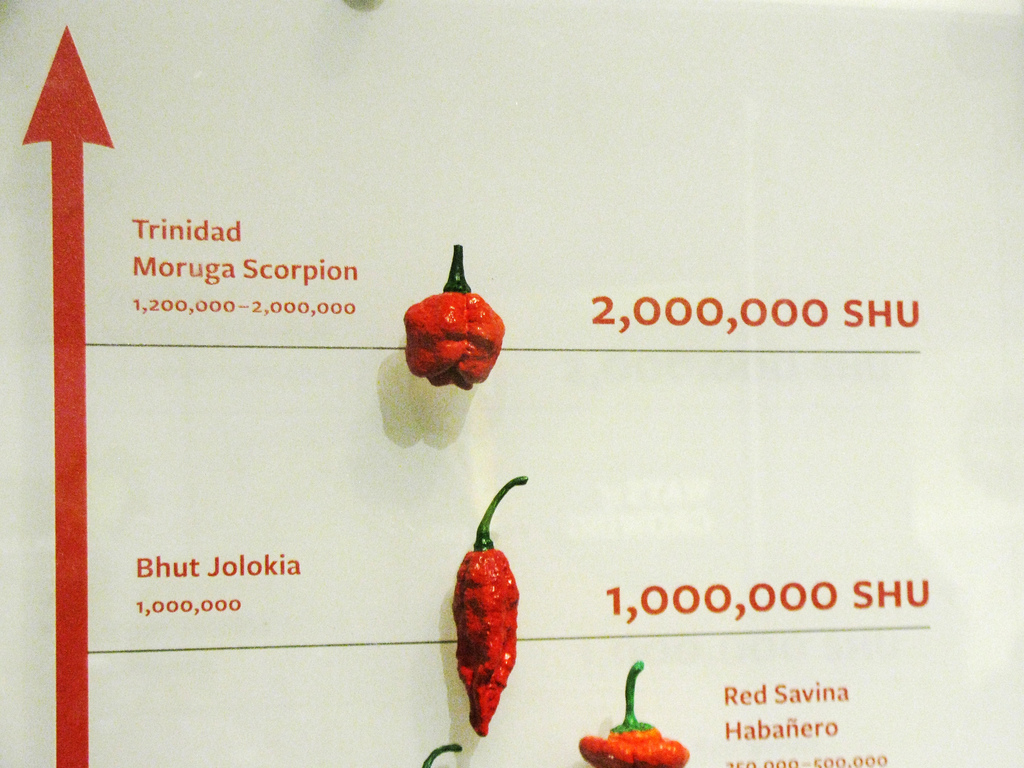
There’s an arms race afoot to grow the hottest pepper in the world. Lessley Anderson tasted a top contender, the Moruga Scorpion:
[U]pon popping the Scorpion into my mouth, the tip of my tongue feels like it’s being jabbed by a hundred needles and there’s a heavy burn rolling toward my tonsils. My salivary glands are in overdrive, drool gushes into my mouth and my nose is running. This all from eating a piece the size of a sesame seed.
The Moruga Scorpion, in fact, is at the same Scoville heat unit (SHU) level as police-grade pepper spray. Yet the market is hungry for the superhots, “with hot sauce just behind social gaming and solar panel manufacturing as one of our fastest growing industries”:
There’s a serious commercial advantage to being the official grower of the official hottest pepper in the world. Superhot seeds aren’t commercially available from large seed companies, so heat freaks wishing to grow their own have to buy them online from small suppliers like Duffy and Currie. Being able to market yourself as the record holder is great advertising. Hot sauce makers, who generally contract with one main grower, sell more sauce with a world-famous chile on the label.
“The Superhot peppers are an extremely valuable commodity,” says Dave DeWitt, an author and chile expert who runs the industry’s biggest event, The National Fiery Foods and Barbecue Show in Albuquerque, New Mexico. A typical Scorpion pepper pod at a farmers’ market will go for one dollar, notes DeWitt. “Think if you had an acre of these things; think how much money you could generate. Behind marijuana, they have the potential to become the second- or third-highest yielding crop per acre monetarily.”
For all of the superhot lovers out there, DeWitt has 1,001 Best Hot and Spicy Recipes. (And speaking of marijuana, he also put out Growing Medical Marijuana: Securely and Legally.)
(Photo by edenpictures)
Thatcher On AIDS: No Reagan
On a topic I touched upon here, Harold Pollack, not a big fan of the Tory prime minister, concedes that “Thatcher-era British policies provided a damning contrast to the Reagan and George H. W. Bush administrations”:
The Thatcher government responded rather effectively and humanely to the HIV/AIDS crisis. Embracing harm reduction measures such as syringe exchange and methadone maintenance, it saved thousands of lives. Indeed the words “harm reduction,” anathema to American drug control policy until the Obama administration, were official watchwords of British drug policy. As Alex Wodak and Leah McLeod summarize this history:
By 1986 the Scottish Home and Health Department concluded that ‘the gravity of the problem is such that on balance the containment of the spread of the virus is a higher priority in management than the prevention of drug misuse.’ and recommended accordingly that ‘on balance, the prevention of spread should take priority over any perceived risk of increased drug use.’ This approach was strengthened by the influential UK Advisory Committee on the Misuse of Drugs asserting in 1988 that ‘the spread of HIV is a greater danger to individual and public health than drug misuse…accordingly, services that aim to minimize HIV risk behaviour by all available means should take precedence in development plans.’
The Beginnings Of Upscale Bud

Whitney Mallett looks into the origins and usage of marijuana brand-names:
The demand for all these different strains is relatively recent. Once upon a time, pot was pot and you bought what your dealer down the street was selling. But a new breed of cannabis connoisseur has emerged alongside increasingly nuanced legal restrictions. In the Netherlands in the 1970s, coffee shops dispensing marijuana tolerated by the government started cropping up. For the first time, there were dozens of different strains on the menu. Today medical marijuana dispensaries in North America offer a similar range of choices.
But crops of the same strain can vary:
Marijuana Man [aka Greg Williams] agrees that increased legalization will lead to a more regular product. But he also points out that Mother Nature is still bound to create unpredictability. “Each crop is going to be a little bit different,” he explains. “In Amsterdam, I would go in and buy Haze and then go in again and ask for the same thing, and the guy would say, ‘It’s not as nice this time.’” Just as wine from the same type of grape and the same vineyard varies dramatically year to year, marijuana of the same strain and same growing conditions varies too.
If I live that long, I fancy a retirement to Colorado or Washington or perhaps even Ptown where I can blog as a legal canna-critic. We have wine critics. And food critics. Why not a critic of the thing that makes food and wine even more blessed? By then, the subtleties, the mixes of CBD and THC, the nuances of sativa and indica strains will all be turned by the genius of the free market into something quite marvelous. We will finally have made of this weed what was long made of the simple grape.
And we will all be happier. Which is the point of America, right?
(Photo: Dave Warden, a bud tender at Private Organic Therapy (P.O.T.), a non-profit co-operative medical marijuana dispensary, displays various types of marijuana available to patients on October 19, 2009 in Los Angeles, California. By David McNew/Getty.)
The View From Your Window

East Village, New York, 12 pm
The Exhausted Blogger Eats Lunch
My interview with Vanity Fair‘s John Heilpern is up:
“What have you done for pleasure lately?” I asked.
“You mean apart from the occasional sodomy?” he replied.
We also talked blogging models:
He conducts an ongoing conversation with more than a million people a month about such topics and hobbyhorses as the intransigence of Republicans versus Obama (which he nicknames Wile E. Coyote and the Road Runner); the moral shamefulness of government-sanctioned torture; pedophilia and the lost credibility of the Catholic Church; and Montaigne’s essay on why we bless someone who sneezes.
“Montaigne was an early blogger,” he pointed out, for he wrote about everything under the sun. And doubtless Pascal too—for what else are prototype blogs but spontaneous pensées? Sullivan himself was a born blogger before blogs existed. Among the brightest and best of his Oxford and Harvard generations, he was weaned on the old print media of Fleet Street when he left Oxford to join The Daily Telegraph in 1984—an unapologetic Thatcherite and novice editorial writer among the gilded newspaper palaces along the Street of Shame.
“People forget that we churned out an editorial a day at newspapers. When I went to the Telegraph, the editorial conference took place at 4:30, and there was tea afterward, and gin. They’d already demolished two bottles at lunchtime. Copy was due at seven P.M., and you had to write it on deadline, very concisely, very solid.” He began to laugh. “That’s how I learned how to blog—in the most traditional setting ever.”

