Change The Country, The Party Will Follow

Bill McKibben claims “the hardest part of the Keystone pipeline fight has been figuring out what in the world to do about the Democrats.” He acknowledges that, “taken as a whole, they’re better than the Republicans”:

[A]s I turn this problem over and over in my head, I keep coming to the same conclusion: We probably need to think, most of the time, about how to change the country, not the Democrats. If we build a movement strong enough to transform the national mood, then perhaps the trembling leaders of the Democrats will eventually follow. I mean, “evolve.” At which point we’ll get an end to things like the Keystone pipeline, and maybe even a price on carbon. That seems to be the lesson of Stonewall and of Selma. The movement is what matters; the Democrats are, at best, the eventual vehicle for closing the deal.

The greatest error of almost all important social movements is to look for and follow the politicians for success. The politicians are often the last people to get it. That was the underlying principle behind the marriage equality movement – we would change hearts and minds on the ground first. Then after 25 years of that, we have a sudden Senate majority for equality. In a couple of months. That pattern can tell you a lot.

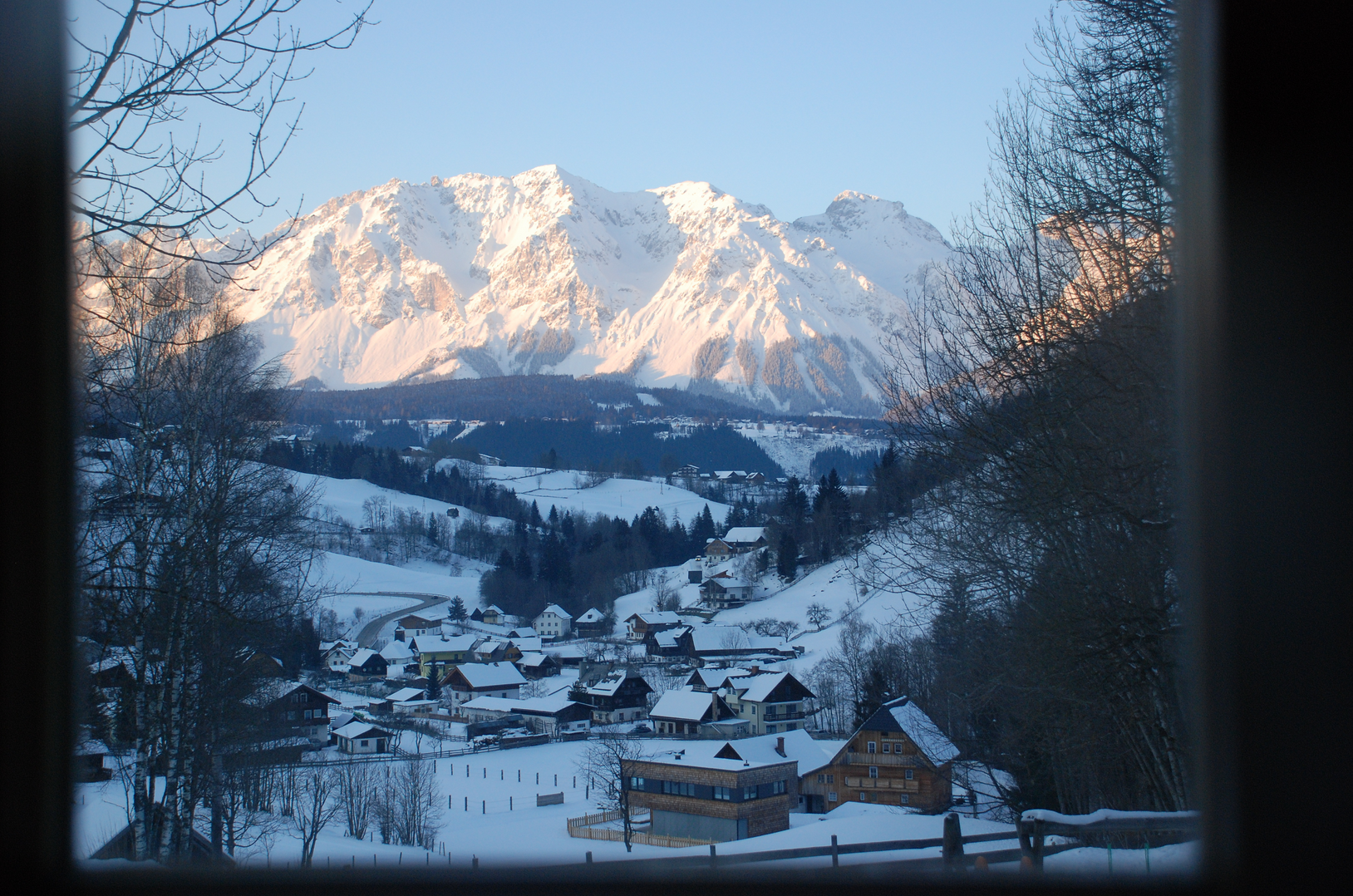
The View From Your Window Contest: Winner #148

Screen Shot 2013-04-06 at 1.12.11 AM

A reader writes:

Now that’s an awesome view! It certainly looks like it could be in the Alps somewhere, but I am going with the U.S. because I think we have more of a fondness for fences than Europeans, though I could be wrong about that. The mountains look more like the Rockies than the Sierra Nevada, and a couple of my students mentioned Telluride but then said no to that because the town is more self-contained than what we’re seeing. However, I did notice that on the outskirts of Telluride there is an area called Mountain Village, which is more residential and would have this view overlooking Telluride, which would be just off to the northeast. Sunset in beautiful Mountain Village, CO?

Another looks west:

I’m sure someone will be able to pinpoint the exact hotel, room, and, based on the angle, the probable height, weight, and dietary preferences of the photographer, but it looks a lot like Jackson Hole, Wyoming to me. I’ll go ahead and guess the Grand View Lodge.

Another jumps to Europe:

This looks to me very much like the Alps based on the landscape and chalet style houses; the modern square building in front makes Italy and France less likely, leaving Switzerland, Austria and Liechtenstein. I imagine some readers will spend hours figuring this out – I’ll just guess the western outskirts of Vaduz, Liechtenstein since the mountain range across the valley looks like the one you see from Vaduz.

Another:

Swiss Alps! French Alps! German Alps! Austrian Alps! I have no idea which Alps this view belongs to, but lovely it is.  An hour browsing through pictures of the Alps is not an unpleasant hour at all. But I’m reduced to a wild guess: Engelberg, Switzerland. And just for fun, here’s one of the many beautiful Alpine views I came across in my searching. Okay, one more.

Another:

Verbier, Switzerland? I am sure that is not correct. I am not a geolocation wonk but enjoy VFYW for the memories and other connections evoked by the photographs. I spent my 20th birthday in Verbier, over 30 years ago. The view from my window that morning was as peaceful and full of promise as this week’s shot.

Another adds his own view:

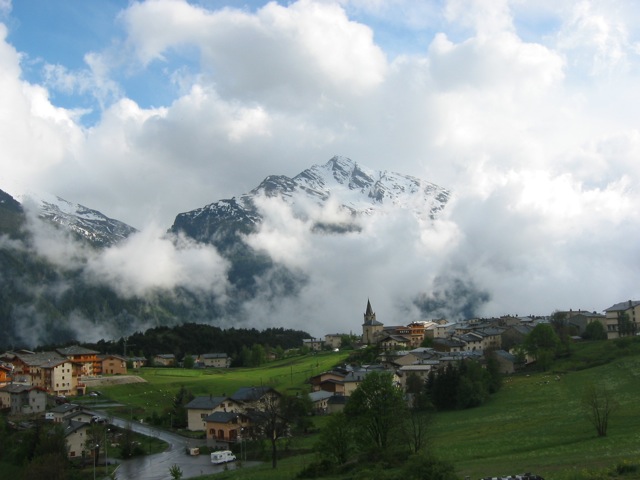
Wow, this week’s contest brought back a strong memory of a conference I went to five years ago in the French Alps. Here’s a picture I took at the time, from the Centre Paul Langevin looking into the village of Aussois:

IMG_1088

What a gorgeous location. Pretty similar, huh?

But not quite the same. In the contest photo, there’s no church, and the mountain looks different and more distant. So you’re not going to get the level of detail from me that usually wins these contests, as in “the photo was taken at 7:23 pm from the east-facing window of suite 327 in the Smith building, and assuming the photo was taken by someone standing with the camera at eye level, the photographer was 6 ft. 2 in. tall, with a slight limp and probably dark brown hair and moderate acne.”  Heck, I may not even be in the right country. But thanks for the excuse to reminisce and go thru some old pix of mine!

Another gets the right country:

Clearly in the alps, and likely Austria, eastern Switzerland, or perhaps even Lichtenstein if I remember my rooflines right.  No time for a search – have to go shovel an half-foot of snow off the driveway for the second time today – so I’m going with a town I visited on a high school ski trip and had some fine fondue chinoise: Lech, Austria.

A previous contest winner nails the exact location:

A few months ago you had a great contest, #139, which featured a German schloss that no one actually found. As time ran out, my failed search for it ended just 40 miles to the south in the vineyards of the Rheingau. When I realized this week’s view was nearby, in the Alps, I saw a chance for redemption. But with weak clues, such as the sun’s angle or the ski tips at lower right, and having never skied in Europe, my only option was to start “trekking” through the mountains. And trek I did. Hour after hour, through every snow peaked massif and ski resort the Alps have to offer. Finally, late on Sunday night, pay-dirt:

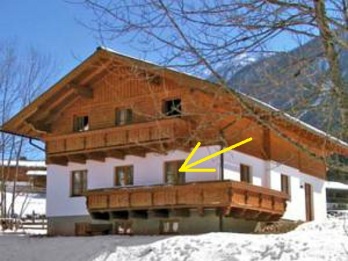
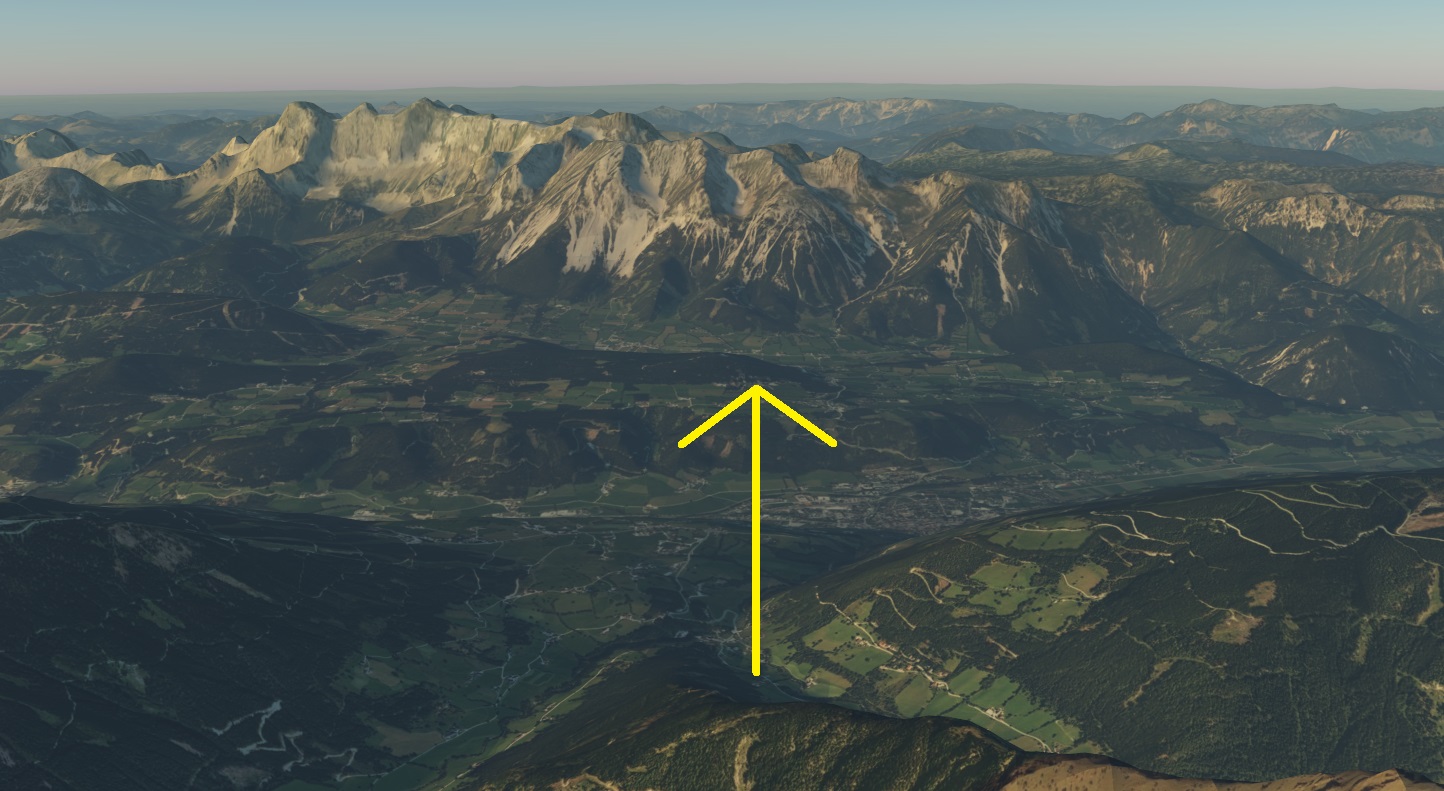
VFYW Rohrmoos-Untertal Actual Window Marked - CopyThis week’s view comes from the village of Rohrmoos-Untertal, Austria, in the Schladming ski region. The photo was taken by a Dish fan who rented an apartment in a private ski-haus named for its owner, Christine Milalkovits. The house is located at 104 Untertal Strasse, altitude 2,961 feet above sea level, latitude 47.22.04.91 N, longitude 13.40.44.91 E. The view was taken from the first floor and looks nearly due north along a heading of 353.33 degrees towards the Dachstein massif.

Ironically, I thought the orange plastic tips in the lower right of the photo were skis, so I emphasized ski resorts while searching. Turns out, they’re actually the handrails for a child’s slide/swing. So it goes.

Attached is a bird’s eye view which simulates the lighting on February 28, 2013 at 5:07 PM local time (my best of four estimates for time and date):

VFYW Rohrmoos-Untertal Bird's Eye Marked - Copy

Lastly, in recent weeks readers have been sending in some pretty nice visuals, so I created something new to try and keep up. Assuming it can be transcoded and uploaded, it’s a video which might as well be titled “The View From (an F-16 doing 400 mph above) Your Window”:

The only other reader to answer the correct village writes:

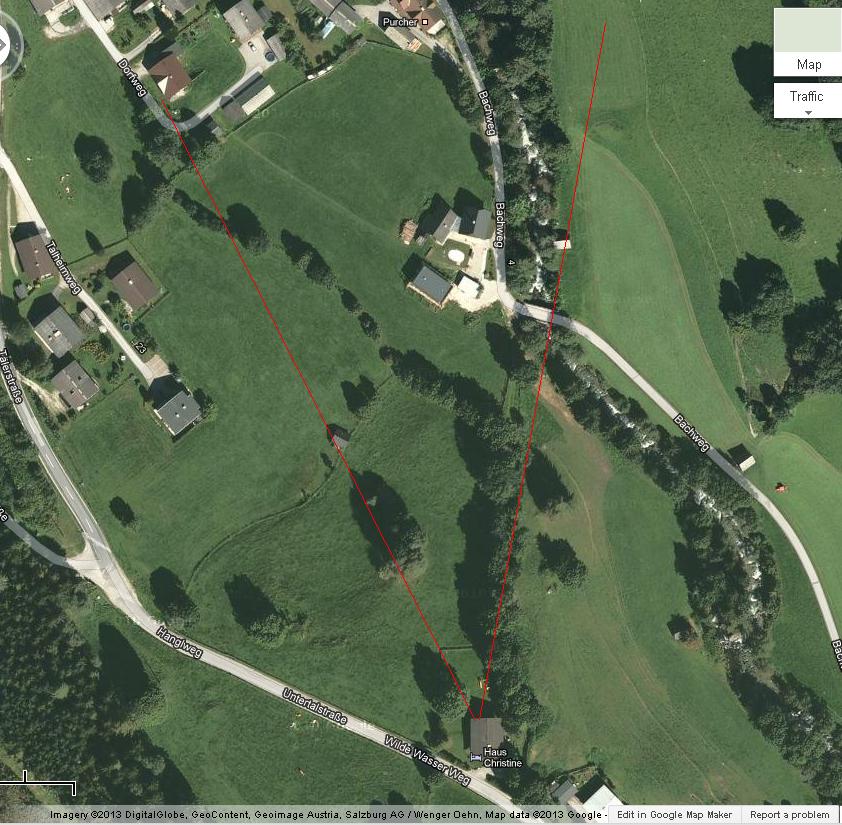
This view reminded me of Flachau, Austria, where spent some vacations as a child. So I started looking in the right general area right away. Google maps Austria doesn’t have street view, but I think I found the flat-roofed building in the aerial photograph:

VFYW_HausChristine

My guess is that the view is from Haus Christine, Untertalstraße 104, 8971 Rohrmoos-Untertal, Austria, looking north over the village of Rohrmoss-Untertal towards the Dachstein mountains from a room in the north-west corner of the house.

Congrats to our reader on the tough win. Details from the submitter:

This picture is taken from one of the first floor bedrooms of the Apartment Christine II in Schladming-Rohrmoos, Austria. The mountains to the north are the Dachstein mountains, a spectacular range covering the Austrian regions of Upper Austria, Styria and Salzburg. There is actually a ski resort at the top (nearly 3000 meters high), accessible only via a Gondola. On our side of the valley you have the ski resorts Fageralm, Reiteralm, Hochwurzen, Planai, and Hauser Kaibling; Rohrmoos is in the valley between Hochwurzen and Planai.

We were here for a week to ski and watch the second half of the FIS World Cup Alpine Championships, held at Planai (Schladming), where the USA did remarkably well despite the early injury of Linsey Vonn. Austrians are bat-shit crazy about skiing; while they were gracious hosts to all racers, they would certainly cheer the 6th place Austrian well above the first place foreigner. We are certainly skiers but not really ski spectators, but it was easy to get caught up in the emotions when you are surrounded by thousands (upwards to 40,000 near the end ofthe week we are told) of fanatical fans.

DSC_0738By the way, you have posted in the past our VFYW shot in Lake Tahoe. At the time I commented that none of the Views ever have children compositions obstructing the otherwise interesting perspectives. In our case it was these same kids (9 and 5-year-old twins, all girls) who brought us to Europe (Salzburg) for a year: my wife is German and our kids were not making as much progress in their command of the German mother tongue as we had hoped, so we have taken the immersion (otherwise known as throwing your kids to the wolves) route. It was in Salzburg that we were introduced to Krampus‘, which I emailed you all about early in December [see photo to the right]. Weird shit.

As with the thousands of others I too am a Dish subscriber and wish you all continued success. I am not gay; not conservative; not Catholic (or religious); and clean shaved, which is why I enjoy the perspectives and am willing to pay them, unreserved.

(Archive)

Francis The Pragmatist?

John L. Allen Jr. visited Argentina to report on Pope Francis. He writes that “people who know the lay of the land here insist there’s little meaningful sense in which Bergoglio could be described as a ‘conservative’, at least as measured by the standards of the church.” Some reasons why:

• Bergoglio is one of the least ideological people you’ll ever meet, more interested in concrete situations than in grand political theories.

• The most serious opposition to Bergoglio from within the Catholic fold in Argentina consistently came from the right, not the left.

• Despite a checkered personal history with the [center-left Argentine President Cristina] Kirchner family, Bergoglio had good relations with other members of Argentina’s current government, and is open to dialogue with all political forces.

The fact that he is the first Pope to come from a country that already has marriage equality – and that he was on the liberal wing of the conservative side on that issue within the church – seems salient to me. An ideologue could never have supported civil unions as an alternative, as Bergoglio did. A pragmatist – who could see the actual damage the church was doing to itself with its harsh rhetoric against gay couples – might. But the one thing Allen picked up on that I’ve also heard among Jesuit friends is Francis’ executive skills:

He’s a man comfortable exercising authority. Lozano said that during the twice-monthly meetings Bergoglio held with his six auxiliary bishops in Buenos Aires, he would always go around the table and solicit advice, and he took it to heart. When it came time to decide, however, things weren’t put up for a vote — Bergoglio made the call, and never seemed anxious or overwrought about it.

Third, Bergoglio may be a peace-loving man of the people, but he’s no naïf about the use of power to make his vision stick. Wals, for instance, noted that the new pope’s very first episcopal appointment was the choice of 65-year-old Mario Aurelio Poli of Santa Rosa as his successor in Buenos Aires. That move came on March 28, just 15 days after Francis was elected — among other things, a sign that the wheels may grind more quickly under this pope…

In the same way, Bergoglio also didn’t shrink from holding people accountable. Villarreal, for instance, said he’s familiar with at least one instance in which a priest wasn’t toeing the line, and after giving him a chance to straighten out, Bergoglio didn’t blink about sending him packing.

Dissents Of The Day

Readers push back against my praise for Margaret Thatcher (and I largely respond to their dissents in the above video):

I’m sure you’ll just dismiss me as a lefty toady, but, good god man, not a peep about Thatcher’s willingness to demonize gay men?  Exploiting prejudice is, if nothing else, brilliant politics.  Doesn’t she get a pat on the back for that, too?

Tom Dolan points out that her record is more of a “mixed bag”:

As a member of Parliament (MP) in the 1960s, she was one of only a handful of Conservatives to vote for the decriminalization of homosexuality, a truly forward-thinking and brave gesture that she deserves a great deal of credit for. Sadly, as Prime Minister, she would squander much of that credit (ironically enough, for a politician who put such stock in thrift) by lending her support to one of the nastiest anti-gay measures of modern times: the infamous Section 28 of the Local Government Act 1988, which forbade schools from teaching “the acceptability of homosexuality as a pretended family relationship”.

Dan Savage remembers the Section 28 fight:

I was living in London—waiting tables, seeing plays, stealing silver, pining after British boys—when Section 28 was being debated. The law prompted Ian McKellen to come out of the closet and it prompted some righteous lesbian parents to tag Thatcher billboard with “Lesbians Mums Aren’t Pretending.” Coming at the height of the AIDS epidemic, Section 28 instilled panic. It felt like this law might the first of many anti-gay laws to come. Instead Section 28 was the beginning of the end for political homophobia in the UK. Because McKellen wasn’t the only gay person to come out in protest. And you know what happens when gay people come out.

So thanks for that, Maggie.

Section 28 was and is indefensible – and I should correct my statement above that it was from 1981 – when it was 1987. But it was also part of an epic struggle between Thatcher and the far left that emerged after her first election, and caused the creation of the breakaway pre-Blairite Social Democratic Party (now the Liberal Democrats in a coalition government with the Tories). Local governments – especially in London where “Red Ken” Livingstone was ensconced – were constructing curricula of conscious radicalism. She was wrong to take the bait. But, unlike Reagan, she also launched a very comprehensive nation-wide safe sex campaign when HIV and AIDS emerged. I wrote the editorial in the Tory Telegraph at the time in favor of investment in research and public information campaigns on HIV and AIDS. She was a scientist. She was not a homophobe.

Another reader points to a speech in which Thatcher laments, “Children who need to be taught to respect traditional moral values are being taught that they have an inalienable right to be gay.” Again, I think that was more about her war with the left than the issue as such. The context makes that clear:

In the inner cities—where youngsters must have a decent education if they are to have a better future—that opportunity is all too often snatched from them by hard left education authorities and extremist teachers. And children who need to be able to count and multiply are learning anti-racist mathematics—whatever that may be. Children who need to be able to express themselves in clear English are being taught political slogans. Children who need to be taught to respect traditional moral values are being taught that they have an inalienable right to be gay.

But its only real defense is that this was 1987. Another reader:

Even if you agree with her economic policies, how do you justify her human rights record? Her coddling of dictators and butchers? In Chile, Indonesia, South Africa, etc, she was so clearly in the wrong and she remained steadfast and unapologetic about it.

Finally, as a Catholic of Irish heritage, how do you justify supporting her Ulster policies? Dick Cheney is a war criminal and Thatcher isn’t? John Yoo is morally reprehensible and Thatcher is an inspiring leader? Is torture of IRA members (and worse, suspected IRA members) okay? If you can do nothing else, explain to your baffled readers how you can beat the war criminal drum daily against the Bush-Cheney-neocon cadre and still respect Thatcher.

I’m not going to defend her love of Pinochet. But the torture of IRA prisoners predated her premiership. Unlike Yoo, she was a fanatical devotee of the rule of law. And, as I have already argued, she opposed pre-emptive war as a violation of international law. Another reader:

Not to burst your balloon, but the hagiography of Margaret Thatcher has really got to stop. Two really concrete examples of the backwardness and stupidity of Thatcher’s politics can underscore what I mean:

First, when the Berlin Wall fell in 1989, Thatcher immediately declared her opposition to the reunification of Germany, because such a unification would pose a danger to the security of Europe. Try for a moment to grasp the deep hypocrisy required to believe that. For decades the US and the UK used the Wall (justly) as a symbol of Soviet oppression. Thatcher stood shoulder-to-shoulder with Reagan when he demanded Gorbachev “tear down this wall.” And as soon as the Wall was torn down and the liberation of East Germany from dictatorship became a possibility, she lost all interest in the liberation of others.

Second, Thatcher continued the Labor government’s failed policies with regard to the violence in Northern Ireland, and then played right into the IRA’s hands by ratcheting up the police state there. Rather than sitting down with republicans and loyalists and hammering out an agreement, Thatcher seemed to actually believe that enough troops and police and arrests were the solution. How many people died because Irish Catholics felt (rightly or wrongly) that the IRA’s shootings and bombings were the only response to a British government that would not negotiate a settlement in Northern Ireland under any circumstances? I would submit that a British government amenable to sitting down with the SDLP and Sinn Fein and the unionist parties would have been able to reach the very same terms as the Good Friday Agreement a decade earlier if not for Mrs. Thatcher’s refusal to even attempt a peaceful solution.

Thatcher was a groundbreaking person, a very overrated prime minister, and a fantastic orator. And given her opposition to things like peace in Northern Ireland and the reunification of Germany, it seems fitting that she will be most remembered for speeches where she proudly proclaimed her stubbornness in the face of contrary evidence (“The lady’s not for turning!”) and her politics of being against virtually everything (“No, no, no!”).

Maybe you had to be there. I was born in the eighties, so I really wasn’t. But I happen to value things like peace, freedom, and self-determination. Thatcher was in favor of those things for good old England, but only paid lip-service in the case of the rest of the world.

I copped to the Germany derangement earlier. Another reader:

I’m not denying Thatcher’s impact and historical significance, but I’ve always thought that you over did it with your praise for her.  It seems to me that she looms larger for YOU personally than historically since her rise to power coincided with your political and philosophical maturation.  Understandable, but I still think she is ultimately over-rated and candy-coated by you.  Of course, I’m not a Brit, so maybe I just don’t know of what I speak, but I am roughly the same age (born 1960) and have lived through the same times as you, Reagan and all.

I get how you feel she changed British politics, and there’s no question in my mind that she was a damned interesting, complex, and charismatic person, but it’s the gauzy “warm and fuzzies” you feel for her that I question.  You just wrote a bunch of posts about how pop music went after her all because of her policies, and then laud how she cut the budget etc.  But did it ever occur to you that her policies really did cause hardship for many, that there was a reason besides the left’s “collectivist, envy-ridden” feelings?  Two wrongs don’t make a right: the hard left and trade unions needed a kick in the pants, but that didn’t mean their original intentions weren’t good.

Part of my “Gotcha!” is I now regularly read you laud Obama’s “conservative approach” to healthcare, your adjustment to understanding that social spending is often necessary for the poor and powerless, and that the 1 percent sometimes need something – government – to stop them from totally subverting the system.  So, how do you square this reality with your enthusiastic memories of Thatcher?  Is it just that things were SO out of whack in the UK by the 1970s that “the left” deserved to be eviscerated at all costs just to level the playing field?  That the “collateral damage” caused by her be damned, it was all about the process? That the UK is/was so different from the US, that the time needed her?  Or, have simply you mythologized the time and made it grander than it really was?  But Reagan and Bush 43 were “strong leaders” too and you aren’t afraid to even re-evaluate “St. Reagan” after all of these years.

The answer is yes – things really were that out of whack. The entire British economy was a propped up, inflated, inefficient state-subsidized mess. There was no way out of that without a major restructuring – and it began under her Labour predecessor who acceded to spending cuts under the direction of the IMF. The unemployment of 1981 – 1987 was appalling in its human costs. But it led the way to far lower unemployment in Britain than the continent in subsequent years.
The Iron Lady vs Today’s GOP

James West recalls Thatcher’s speech at the 1990 Second World Climate Conference:

[H]er speech laid out a simple conservative argument for taking environmental action: “It may be cheaper or more cost-effective to take action now,” she said, “than to wait and find we have to pay much more later.” Global warming was, she argued, “real enough for us to make changes and sacrifices, so that we do not live at the expense of future generations.”

The Iron Lady’s speech makes for fascinating reading in the context of 2013′s climate acrimony, drenched as it is in party politics. In the speech, she questioned the very meaning of human progress: Booming industrial advances since the Age of Enlightenment could no longer be sustained in the context of environmental damage. We must, she argued, redress the imbalance with nature wrought by development.

“Remember our duty to nature before it is too late,” she warned. “That duty is constant. It is never completed. It lives on as we breathe.”

David Frum reprints some of the speech as well. Thatcher cited the IPCC and her skepticism was not to be confused with the denialism now at large in America’s know-nothing rump:

The IPCC report is very honest about the margins of error. Climate change may be less than predicted. But equally it may occur more quickly than the present computer models suggest. Should this happen it would be doubly disastrous were we to shirk the challenge now. I see the adoption of these policies as a sort of premium on insurance against fire, flood or other disaster. It may be cheaper or more cost-effective to take action now than to wait and find we have to pay much more later.

While I’m at it, some other discomforting facts for today’s American right. Thatcher was a firm believer in international law – and opposed the US invasion of Grenada and Argentina’s invasion of the Falklands as a violation of that order. She was a strong supporter of nuclear deterrence and containment – as opposed to pre-emptive war. She wanted UN support for any intervention in Iraq, and inisted it be limited to restoration of the old borders. She cut taxes but, unlike the GOP under Reagan and the second Bush, she also cut spending seriously. She didn’t have any time for the loopy idea that cutting taxes would increase net revenues.

She inherited and handed over a fully socialized medical system, and, while tearing apart the government’s control of the economy, did not undo the welfare state in any profound way. “The National Health Service Is Safe With Us” was her constant refrain. Her policies on healthcare make Obama’s modest private sector-based reform look positively right-wing. She loathed Europe but signed the Maastricht Treaty, and deepened British ties to the Continent. She was the first Cold Warrior to respond to Gorbachev. In all this, she remains pragmatically alien to the current Southern-based GOP. And her undemonstrative Methodism was never worn on her sleeve.

Like Reagan, in other words, she could never be a contender in today’s GOP. She was far too conservative, in the proper sense of that word. She preferred order to revolution – and her own revolution was about the restoration of civic order, not its dissolution.

Solitude Is Deadly?

Maybe:

A new study published in the Proceedings of the National Academy of Sciences finds that after adjusting for demographic factors and underlying health, self-reported feelings of lonesomeness have no significant connection to mortality among the elderly, but actual social isolation increases the likelihood of death by a stunning 26 percent.

Sartorialists Among The Stars

NBC News special correspondent Tom Broka

Colin Marshall reviews Nicholas Antongiavanni’s The Suit: A Machiavellian Approach to Men’s Style:

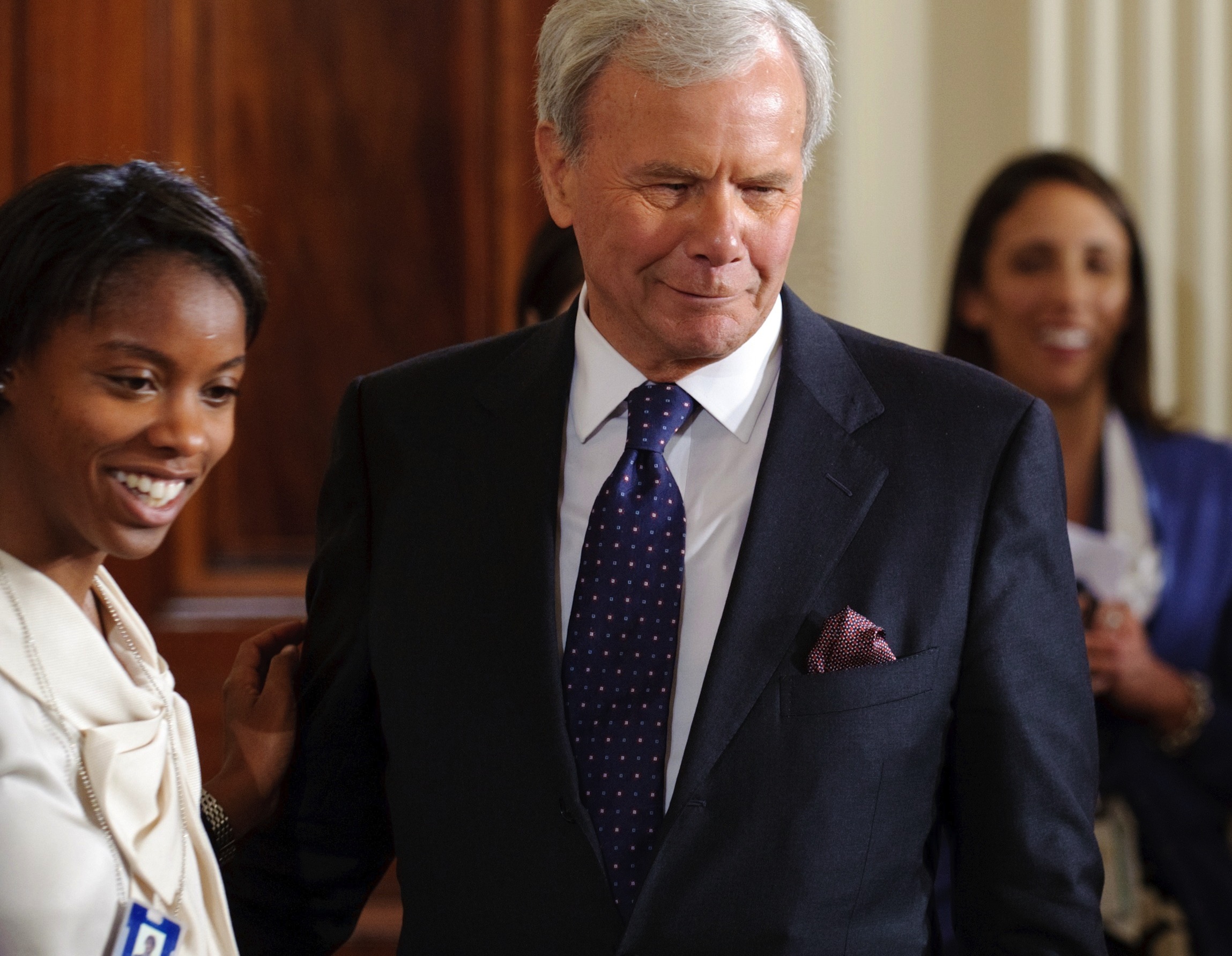
Alas, we live in a time of few princes, and nearly as few dandies. Prince Charles counts as both, and Antongiavanni makes a case study out of him more than once. He also draws lessons from the dress of American newscasters and presidents. “Brokaw is the most elegant,” he observes of the former group. “Rather’s clothes fit well, but he is so slavish in aping his hero Edward R. Murrow — even patronizing the same Savile Row tailor — that he cannot be said to have any style of his own.” President Johnson, envious of Kennedy, “sought out a London tailor whom he told to make him ‘look like a British diplomat.’” Of Carter, Antongiavanni writes only that “it is one thing to wear Hawaiian shirts in Key West or jeans and cowboy boots when splitting wood, and another to address the people from the Oval Office in a sweater.” …

Newscasters’ jobs demand deliberate dress, and our political leaders, whether elected or royal, act as media figures in essentially the same mode. David Letterman favors a versatile form of double-breasted jacket, but one that is “difficult to tailor, and thus no longer favored by the industry.” Alex Trebek also wears double-breasted jackets, yet “acquires his clothes through a promotional deal with a third-rate manufacturer.”

Other “eminent men, such as Kelsey Grammer, David Hyde Pierce, Jon Stewart and Matt Lauer, have shown that it is possible to dress fashionably without getting carried away.” Coming to Conan O’Brien’s lack of not just double-breasted jackets, but pocket squares, patterns, or even stripes, Antongiavanni remarks that “people expect those with more money, more fame, and more delightful jobs than themselves to be more stylish; and when they are not, they do not respect them, for they consider that so much opportunity to cut loose has been squandered.”

(Photo: NBC News special correspondent Tom Brokaw arrives for an event launching a ‘national initiative to support and honor America’s service members and their families’ April 12, 2011 in the East Room of the White House. By Mandel Ngan/AFP/Getty Images.)

Did Obama’s Race Hurt Him?

Seth Stephens-Davidowitz estimates (pdf) that “racial animus in the United States appears to have cost Obama roughly four percentage points of the national popular vote in both 2008 and 2012.” Bouie wonders what this might mean for 2016:

If this is correct, and Obama underperformed by roughly four points in 2008 and 2012, then there’s a chance that the Democratic brand is stronger than we think. We’ll see in 2016, but a “threepeat” for the Democratic Party might be more likely than we think, given the potentially wider support for a white Democratic nominee for president.