As part of a larger look at the business strategy behind paperbacks, Nichole Bernier explains the logic behind new covers:
A look at a paperback’s redesign tells you a thing or two about the publisher’s mindset: namely, whether or not the house believes the book has reached its intended audience, and whether there’s another audience yet to reach. Beyond that, it’s anyone’s Rorschach. Hardcovers with muted illustrations morph into pop art, and vice versa. Geometric-patterned book covers are redesigned with nature imagery; nature imagery in hardcover becomes photography of women and children in the paperback. Meg Wolitzer, on a panel about the positioning of women authors at the recent AWP conference, drew knowing laughter for a reference to the ubiquitous covers with girls in a field or women in water. Whether or not publishers want to scream book club, they at least want to whisper it.
About the example seen above:
When Jenna Blum’s first novel, Those Who Save Us, came out in hardcover in 2004, Houghton Mifflin put train tracks and barbed wire on the cover. Gorgeous, haunting, and appropriate for a WWII novel, but not exactly “reader-friendly,” Blum recalls being told by one bookseller. The following year, the paperback cover — a girl in a bright red coat in front of a European bakery — telegraphed the novel’s Holocaust-era content without frightening readers away.
“The paperback cover helped save the book from the remainder bins, I suspect,” Blum says. Armed with her paperback, Jenna went everywhere she was invited, which ended up tallying more than 800 book clubs. Three years later, her book hit the New York Times bestseller list.
“Often the hardcover is the friends-and-family edition, because that’s who buys it, in addition to collectors,” she says. “It’s imperative that a paperback give the novel a second lease on life if the hardcover didn’t reach all its intended audience, and unless you are Gillian Flynn, it probably won’t.”
As the saying goes, the first step toward recovery is to acknowledge the problem.
The problem in 2012 — as in 2008, as in the near-death experience of 2004, as in the popular vote loss of 2000, as in the loss of 1996, as in the loss of 1992 — was the GOP’s failure to offer an economic program relevant to the problems of middle-class Americans. The party’s present three front-runners would not only repeat that failure, but double down on that failure.
The Republican Party desperately needs renewal, its early presidential front-runners are characterized by their rejection of change.
Relatedly, Jonathan Bernstein argues that the GOP is broken. One reason why:
Winning parties have a tendency to overlearn the lessons of their campaigns; winning candidates become role models for the party in the future. And the Republican Party, which has produced many impressive and honorable politicians over the years, has been unlucky in its winners — especially Richard Nixon and Newt Gingrich, but also in many ways Ronald Reagan. The lessons they learned from those politicians and from the 1968, 1980 and 1994 victories have reinforced the worst instincts of party actors (even though the victories actually mainly had to do with economic and other fundamentals that had nothing to do with the lessons “learned”).
Paul Collins surveys the history of animals for hire. One of the more disturbing examples:
During the Second World War, the Soviet Union resorted to training dogs to wear explosives that would detonate when they ran up to German tanks. It is unclear whether the “anti-tank dog” program succeeded, except perhaps at being horrifying. But that disgust is instructive: animals are killed all the time in war, yet we cringe at sending one to obliterate itself, oblivious to any understanding or possibility of consent. We cannot help but view it as creatures who do understand the motive and causation of a suicide vest.
According to Wikipedia, the Soviet suicide-dog program was extremely ineffective:
In the field, the dogs refused to dive under moving tanks. Some persistent dogs ran near the tanks, waiting for them to stop but were shot in the process. Gunfire from the tanks scared away many of the dogs. They would run back to the trenches and often detonated the charge upon jumping in, killing Soviet soldiers. To prevent that, the returning dogs had to be shot, often by their controllers and this made the trainers unwilling to work with new dogs. …
Out of the first group of 30 dogs, only four managed to detonate their bombs near the German tanks, inflicting an unknown amount of damage. Six exploded upon returning to the Soviet trenches, killing and injuring soldiers. Three dogs were shot by German troops and taken away, despite furious attempts by the Soviets to prevent this, which provided examples of the detonation mechanism to the Germans. A captured German officer later reported that they learned of the anti-tank dog design from the killed animals, and considered the program desperate and inefficient. A German propaganda campaign sought to discredit the Soviet Army, saying that Soviet soldiers refuse to fight and send dogs instead.
One a related note, last fall This American Life featured US military dogs on the front-lines of WWII.
(Video: What appears to be a Soviet propaganda film about the anti-tank dogs)
Cynthia Haven dug up a 1996 David Foster Wallace review of the first four volumes of Joseph Frank’s behemoth biography of the Russian author. An excerpt:
[Dostoevsky’s] concern was always what it is to be a human being – i.e., how a person, in the particular social and philosophical circumstances of 19th-century Russia, could be a real human being, a person whose life was informed by love and values and principles, instead of being just a very shrewd species of self-preserving animal. …
So, for me anyway, what makes Dostoevsky invaluable is that he possessed a passion, conviction, and engagement with deep moral issues that we, here, today, cannot or do not allow ourselves. And on finishing Frank’s books, I think any serious American reader/writer will find himself driven to think hard about what exactly it is that makes so many of the novelists of our own time look so thematically shallow and lightweight, so impoverished in comparison to Gogol, Dostoevsky, even lesser lights like Lermontov and Turgenev. To inquire of ourselves why we – under our own nihilistic spell – seem to require of our writers an ironic distance from deep convictions or desperate questions, so that contemporary writers have to either make jokes of profound issues or else try somehow to work them in under cover of some formal trick like intertextual quotation or juxtaposition, sticking them inside asterisks as part of some surreal, defamiliarization-of-the-reading-experience flourish.
Update from a reader:
Just wanted to let you know that Cynthia Haven didn’t “dig up” DFW’s review of Joseph Frank’s biography of Dostoevsky. It’s in his book of essays, Consider the Lobster.
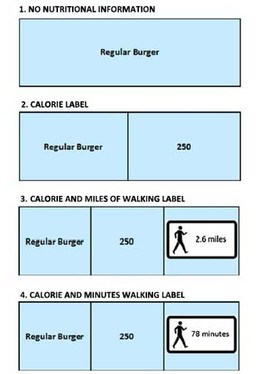
Increasingly, researchers are showing there’s a better way than just calorie postings to encourage eaters to make healthier decisions: by informing consumers how much exercise it would take to burn a meal off.
A study by researchers at UNC’s medical school, published in the journal Appetite, showed the kind of choices people make when randomly presented with different types of menus with differing levels of nutritional information: one with no nutritional info, one with calorie info, one with calories plus the minutes of walking required to burn the calories, and a fourth with calories plus the distance required to burn off the calories.
“People who viewed the menu without nutritional information ordered a meal totaling 1,020 calories, on average, significantly more than the average 826 calories ordered by those who viewed menus that included information about walking-distance,” writesScientific American.
All considered –after resignation, retirement, primary losses and general election losses – Basinger’s data show that 60 percent of scandal-tainted incumbents ultimately find themselves back in Congress.
Not all scandals are created equal, of course. They vary in scope and importance, as well as the amount of attention they receive. A widely publicized scandal about clear financial or criminal wrongdoing likely will be more difficult for an incumbent to overcome than an obscure technical violation involving Federal Election Commission paperwork.
But the overall patterns suggest that American voters are a fairly forgiving, or at least forgetful, people.
I remember reading an article in the Washington Monthly back in the late 1980s by one of the smugger liberal British columnists, Polly Toynbee. It captured part of the true derangement that Margaret Thatcher brought out in her political foes. It was called simply: “Is Margaret Thatcher A Woman?” It’s still online. It was a vicious attack on her having any feminist credentials. It included this magnificent lie:
She has experienced nothing but advantage from her gender.
Toynbee’s case is worth hearing out, but it’s an instant classic of the worst British trait: resentment of others’ success. No culture I know of is more brutally unkind to its public figures, hateful toward anyone with a degree of success or money, or more willing to ascribe an individual’s achievements to something other than their own ability. The Britain I grew up with was, in this specific sense, profoundly leftist in the worst sense. It was cheap and greedy and yet hostile to anyone with initiative, self-esteem, and the ability to make money.
The clip below captures the left-liberal sentiment of the time perfectly. Yes: the British left would prefer to keep everyone poorer if it meant preventing a few getting richer. And the massively powerful trade union movement worked every day to ensure that mediocrity was protected, individual achievement erased, and that all decisions were made collectively, i.e. with their veto. And so – to take the archetypal example – Britain’s coal-workers fought to make sure they could work unprofitable mines for years of literally lung-destroying existence and to pass it on to their sons for yet another generation of black lung. This “right to work” was actually paid for by anyone able to make a living in a country where socialism had effectively choked off all viable avenues for prosperity. And if you suggested that the coal industry needed to be shut down in large part or reshaped into something commercial, you were called, of course, a class warrior, a snob, a Tory fascist, etc. So hard-working Brits trying to make a middle class living were taxed dry to keep the life-spans of powerful mine-workers short.
To put it bluntly: The Britain I grew up in was insane. The government owned almost all major manufacturing, from coal to steel to automobiles. Owned. It employed almost every doctor and owned almost every hospital. Almost every university and elementary and high school was government-run. And in the 1970s, you could not help but realize as a young Brit, that you were living in a decaying museum – some horrifying mixture of Eastern European grimness surrounded by the sculptured bric-a-brac of statues and buildings and edifices that spoke of an empire on which the sun had once never set. Now, in contrast, we lived on the dark side of the moon and it was made up of damp, slowly degrading concrete.
I owe my entire political obsession to the one person in British politics who refused to accept this state of affairs. You can read elsewhere the weighing of her legacy – but she definitively ended a truly poisonous, envious, inert period in Britain’s history. She divided the country deeply – and still does. She divided her opponents even more deeply, which was how she kept winning elections. She made some serious mistakes – the poll tax, opposition to German unification, insisting that Nelson Mandela was a terrorist – but few doubt she altered her country permanently, re-establishing the core basics of a free society and a free economy that Britain had intellectually bequeathed to the world and yet somehow lost in its own class-ridden, envy-choked socialist detour to immiseration.
I was a teenage Thatcherite, an uber-politics nerd who loved her for her utter lack of apology for who she was. I sensed in her, as others did, a final rebuke to the collectivist, egalitarian oppression of the individual produced by socialism and the stultifying privileges and caste identities of the class system. And part of that identity – the part no one ever truly gave her credit for – was her gender. She came from a small grocer’s shop in a northern town and went on to educate herself in chemistry at Oxford, and then law. To put it mildly, those were not traditional decisions for a young woman with few means in the 1950s. She married a smart businessman, reared two children and forged a political career from scratch in the most male-dominated institution imaginable: the Tory party.
She relished this individualist feminism and wielded it – coining a new and very transitive verb, handbagging, to describe her evisceration of ill-prepared ministers or clueless interviewers. Perhaps in Toynbee’s defense, Thatcher was not a feminist in the left-liberal sense: she never truly reflected on her pioneering role as a female leader; she never appointed a single other woman to her cabinet over eleven years; she was contemptuous toward identity politics; and the only tears she ever deployed (unlike Hillary Clinton) were as she departed from office, ousted by an internal coup, undefeated in any election she had ever run in as party leader.
Indira Gandhi and Golda Meir preceded her; but Thatcher’s three election victories, the longest prime ministership since the 1820s, her alliance with the US in defeating the Soviet Union, and her liberation of the British economy place her above their achievements. What inspires me still is the thought of a young woman in a chemistry lab at Oxford daring to believe that she could one day be prime minister – and not just any prime minister, but the defining public figure in British post-war political history.
That took vision and self-confidence of a quite extraordinary degree. It was infectious. And it made Thatcher and Thatcherism a much more complicated thing than many analyses contain.
Thatcher’s economic liberalization came to culturally transform Britain. Women were empowered by new opportunities; immigrants, especially from South Asia, became engineers of growth; millions owned homes for the first time; the media broke free from union chains and fractured and multiplied in subversive and dynamic ways. Her very draconian posture provoked a punk radicalism in the popular culture that changed a generation. The seeds of today’s multicultural, global London – epitomized by that Olympic ceremony – were sown by Thatcher’s will-power.
And that was why she ultimately failed, as every politician always ultimately does. She wanted to return Britain to the tradition of her thrifty, traditional father; instead she turned it into a country for the likes of her son, a wayward, money-making opportunist. The ripple effect of new money, a new middle class, a new individualism meant that Blair’s re-branded Britain – cool Britannia, with its rave subculture, its fashionistas, its new cuisine, its gay explosion, its street-art, its pop music – was in fact something Blair inherited from Thatcher.
She was, in that sense, a liberator. She didn’t constantly (or even ever) argue for women’s equality; she just lived it. She didn’t just usher in greater economic freedom; she unwittingly brought with it cultural transformation – because there is nothing more culturally disruptive than individualism and capitalism. Her 1940s values never re-took: the Brits engaged in spending and borrowing binges long after she had left the scene, and what last vestiges of prudery were left in the dust.
Perhaps in future years, her legacy might be better seen as a last, sane defense of the nation-state as the least worst political unit in human civilization. Her deep suspicion of the European project was rooted in memories of the Blitz, but it was also prescient and wise. Without her, it is doubtful the British would have kept their currency and their independence. They would have German financiers going over the budget in Whitehall by now, as they are in Greece and Portugal and Cyprus. She did not therefore only resuscitate economic freedom in Britain, she kept Britain itself free as an independent nation. Neither achievement was inevitable; in fact, each was a function of a single woman’s will-power. To have achieved both makes her easily the greatest 20th century prime minister after Churchill.
He saved Britain from darkness; she finally saw the lights come back on. And like Churchill, it’s hard to imagine any other figure quite having the character, the will-power and the grit to have pulled it off.
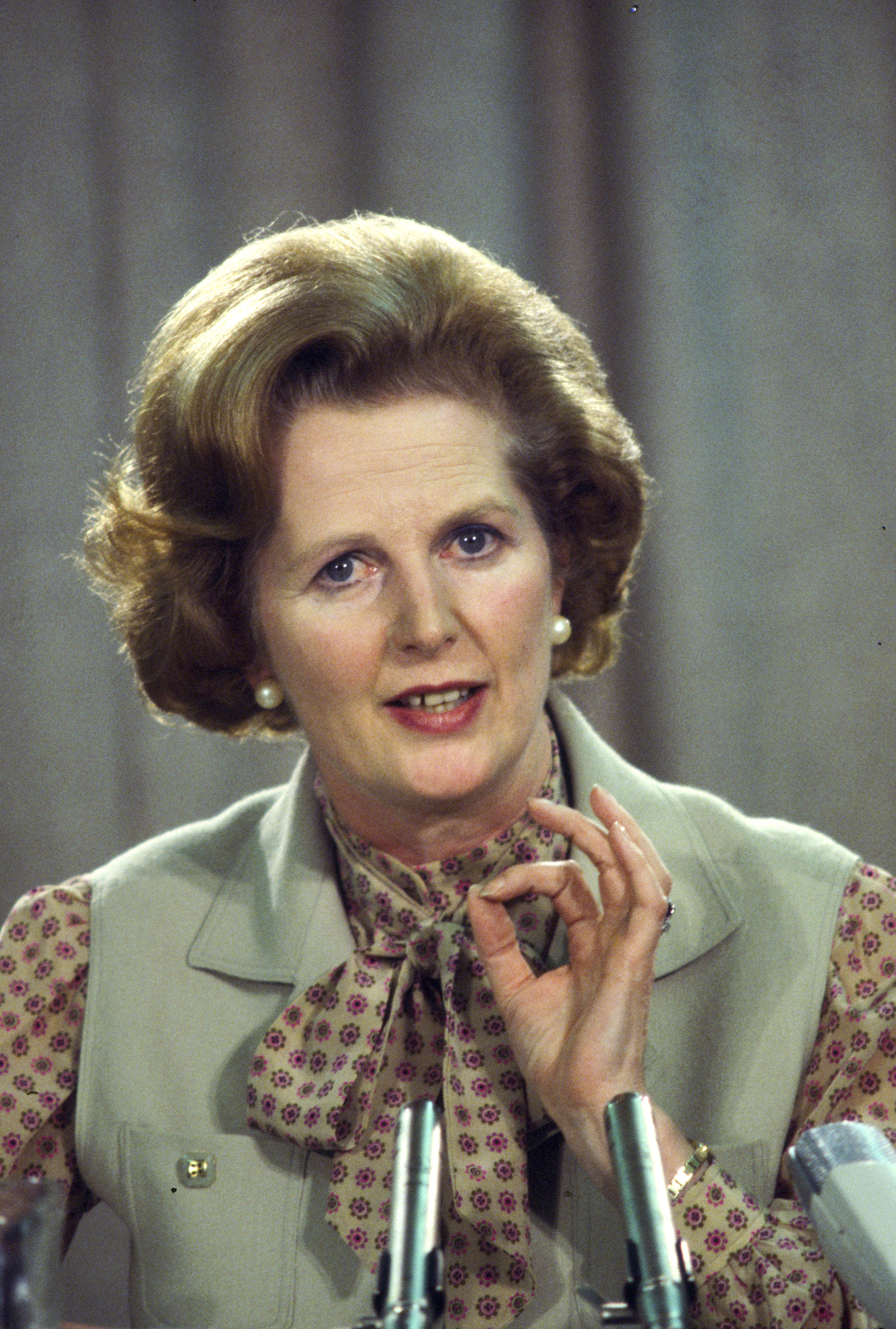
(Photo: Prime Minister Margaret Thatcher speaks at a political conference during the early 1980s in London, England. By Tim Graham/Getty Images)
Today on the Dish, Andrew returned from vacation to reflect at length on the death of his hero and idol Margaret Thatcher. He measured the scorn of her enemies, contemplated the fruits of her legacy, and praised the strength and savvy that made her the first woman to become Prime Minister. Also, readers asked Andrew if he regrets his attacks on leftists over Iraq. On an even more personal note, he eulogized as his dear friend David Kuo who died last week.
Meanwhile, we rounded up reax to the death of Lady Thatcher, as well as a batch of her one-liners. On the home front we gathered analysis on Obama’s new budget proposal while the administration’s FDA scored a win in the contraception battles, and Josh Marshall suspected that money talks in the struggle for marriage equality. And on the foreign beat, Osnos parsed China’s stance on North Korea as Pat Buchanan gritted his teeth at America’s presence over the border.
In miscellanea, we let more readers ask Rod Dreher anything, considered whether the advantages of a college degree are shrinking and tallied up the lives saved by nuclear plants. Readers caught up with the debate over randier sex and learned that sometimes in space, no one can see you cry. Owen King pondered book titles that might have been, Nathan Bransford expected books to end up over our eyelids and we browsed the prints left on Americans over the years. Brian Jay Stanley took on a new dimension of life in fatherhood as we imagined what it would mean to lose a twin and surveyed the punishment of deserters throughout history.
We explored the history of verminous myth, got real about CPR, came across a spoiler firewall, and considered whether stupid is as stupid says. We peered out at Tokyo, Japan for the VFYW, spent a moment with a few fans at Fenway in the Face of the Day, and slow-jammed alongside snails in the MHB.
After the recent birth of his daughter, Brian Jay Stanley distills a touching truth about vulnerability:
How can I be dependent on a being who, six months ago, did not exist? I did not need her when I did not have her. But she has entered my life as a nail enters a block of wood, simultaneously creating a hole and filling it. Remove the nail, and the hole remains. Love completes unhappy people, but uncompletes happy people, because love means we can no longer be happy alone.
Big Air Package is the largest ever inflated envelope without aid of a skeleton (Gasometer Oberhausen bills it as “the largest indoor sculpture in history”) and reaches 90 meters high, with a diameter of 50 meters and a volume of 177,000 cubic meters. The work was conceived in 2010 and is Christo’s first major work after the passing of his wife and artistic partner Jeanne-Claude in 2009. … Christo says that “when experienced from the inside, that space is almost like a 90-meter-high cathedral,” which is easy to see just looking at these incredible images.
Arno Frank spoke to the 77-year-old artist about wrapping up the final projects he started with his wife:
“Everything that exists must disappear. Now, our art is something that basically cannot be owned, cannot be purchased, cannot be kept. It is ephemeral, and therefore it is free — and it is beautiful.” Is that all it is, just beauty? Christo furrows his brow, as if not understanding the question. No, nothing more. What should it be? Then he smiles indulgently and says with a shrug: “Now it is there. Soon it will be gone.” And that’s all.