The Novelist Exits Stage Left

by Zoe Pollock

Even the greatest writers can fail at applying their talents to the stage, as Rodney Welch learned while reading The Tragedy of Mister Morn, “the latest piece of Nabokov miscellany to find its way into print”:

This convoluted five-act verse 1923 play about the overthrow of an imaginary kingdom is the work of an impassioned young writer who bit off more than he could chew, did not know how to make a complex story look easy, or how to develop cardboard stereotypes into three-dimensional characters. The dialogue is guaranteed to reap little more than confused stares or snorts of derision from the audience. Sometimes, it’s ridiculously expository: “The rain quivers as though in senile drowsiness” or “the moulded whimsy of a frieze on a portico keeps us from recognizing, sometimes, the symmetry of the whole.” Or just ridiculous: “…my face drifts up out of the semi-darkness to meet me, like a murky jellyfish, and the mirror is like black water…” …

On the surface, it seems like he might have succeeded in this career, as his fiction has always had a certain theatricality to it. So many of his characters are lost in plays of their own making, bent on staging their own version of reality. But telling a story in dialogue cramped his style; even in his books, it wasn’t his best means of expression. Like Proust, he was more in his element writing from a deeply interior level, usually through a single tortured consciousness, a single fractured perspective. That’s when his incredibly colorful and comic style took flight, and why he ruled the novel and short story in ways he never could the stage.

For more, check out Christopher Michel’s comprehensive review of Andrea Pitzer’s The Secret History of Vladimir Nabokov.

Notes Of Dankness And Blueberry

by Zoe Pollock

William Breathes, who writes under a pseudonym, reviews dispensaries and their various strains of pot for the alt-weekly Denver Westword and runs its cannabis news blog, Toke Of The Town. The best part of the job? Normalizing the drug:

[Readers] can go to westword.com to get news about the state legislature, or about education, about the prison system—and about marijuana. It’s not the old-school media approach to marijuana, where it’s like, “Let’s see how many pot puns we can cram into the lede and how many jokes we can make at the expense of marijuana smokers.” We definitely make jokes at the expense of marijuana smokers, but we also take news very seriously.

We’ve seen other news outlets come around on that.

The Denver Post—and I’m not trying to pick on another news media outlet—but for the longest time, their pot coverage was shit. It just was. Every time it was just them making fun of the pot smokers. But in the last year, they’ve realized that it’s important, and it’s not just 20-something stoners tuning in to figure out what’s going on. People wanna know because it’s a viable, million-dollar industry. In the sense of the media, that’s been an important role for my job.

But I think the obvious one is that I like to think I’m helping patients find really good places to buy medicine. Whether it’s for price or quality—for some people, as long as it’s clean, that’s fine to them, they just don’t want to go somewhere scuzzy. That’s why I still focus on what the interior of these places look like. I always think about it like this: if my mom was to read this and she had a medical marijuana card, what would she get out of this? ’Cause it’s not just people like me, it’s not just 20-somethings. It’s also baby boomers [and older people, too]. Our average-age patient is 41.

The Grey Lady Goes Zen

by Zoe Pollock

Justin Ellis applauds a new project from the NYT’s James Harris:

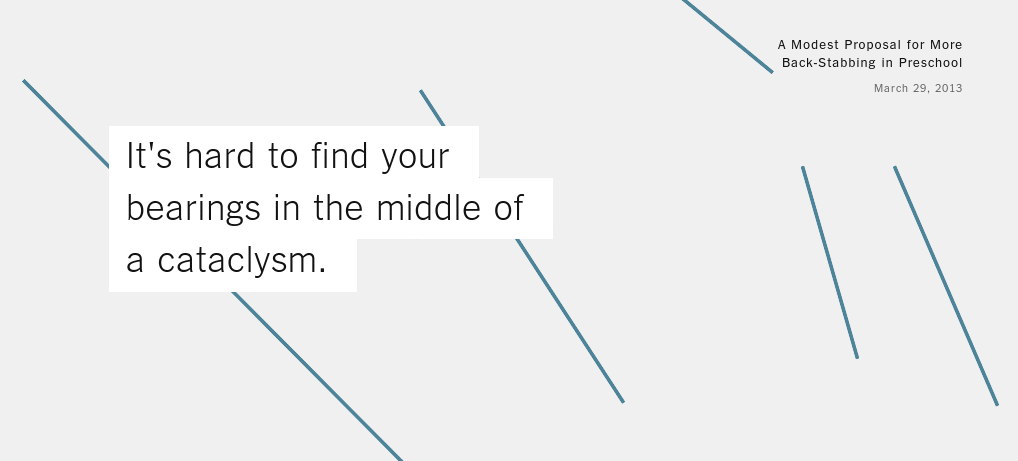
Times Haiku is a collection of what they are calling “serendipitous poetry,” derived from stories that have made the homepage of NYTimes.com. The haiku live on a Tumblr hosted by the Times. Harris built a script that mines stories for haiku-friendly words and then reassembles them into poetry. (For those of you that may have zoned out in class, haiku are comprised of three lines with, in order, five, seven, and five syllables.) The code checks words against an open source pronunciation dictionary, which handily also contains syllable counts.

“Sometimes it can be an ordinary sentence in context, but pulled out of context it has a strange comedy or beauty to it,” Harris said. … The result, much like @nytimes_ebooks, is bizarre, quirky, and kind of zen.

As Harris explains on the About page, it’s not a strict interpretation of the form:

Most of us first encountered haikus in a grade school, when we were taught that they are three-line poems with five syllables on the first line, seven on the second and five on the third. According to the Haiku Society of America, that is not an ironclad rule. A proper haiku should also contain a word that indicates the season, or “kigo,” as well as a juxtaposition of verbal imagery, known as “kireji.” That’s a lot harder to teach an algorithm, though, so we just count syllables like most amateur haiku aficionados do.

But it’s got a solid foundation:

Articles covering sensitive subjects are not scanned for potential haikus, and the bot knows to skip anything with awkward sentence construction. … “Over time we’ve added syllable counts for words like ‘Rihanna‘ or ‘terroir,’” the haiku Tumblr reports. Yesterday, Harris posted on Twitter that he was adding syllable counts for “gewürztraminer, vindaloo, sabermetrics, esoterica, mortarboard, defenestrate, koan, nametag, ceramicist…”

One more cool fact via Ellis: the blue lines behind the haiku are computer generated, based on the meter of the first line of text.

(Image: Times Preschool Haiku)

Faces Of The Day

by Zoe Pollock

Kottke compares beauty across the ages:

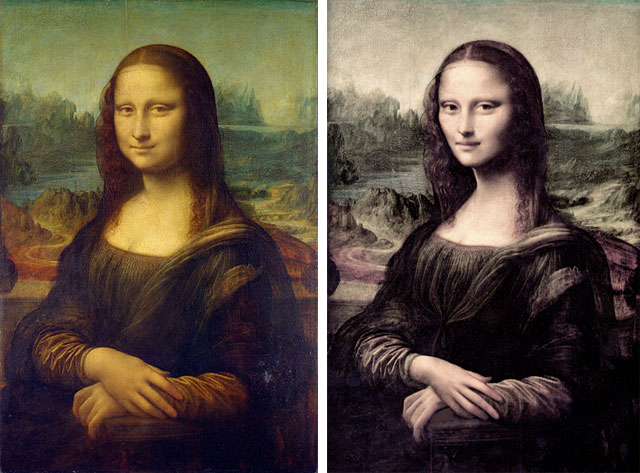
For his Alpha Beauties project, artist Nazareno Crea retouches paintings and sculpture from throughout history, a process which normalizes each period’s ideal of female beauty to that of the present day. That is, much skinnier, with smaller noses, higher cheekbones, and larger breasts.

For a similar eye-opener, check out these webcam workers posing like famous works of art.

Listening To A Picture

by Brendan James

Patrick Feaster found a way to recover the audio of records that have perished using photographs of the discs:

To “hear” the vanished record, Feaster scanned the page into a computer, unwound the lines from their spiral, cleaned up any breaks, and ran the resulting image through software that converted the lines into audio files. (Feaster details the process in more technical terms, with accompanying screenshots, in this blog post.)

The Great American Novelist

by Matthew Sitman

Pivoting off the recent PBS documentary, Philip Roth: Unmasked, Michael Kimmage finds the novelist to be the last of a dying breed:

Writing in American, he stands in a long line of national writers, each of them a living presence in Roth’s own novels: Hermann Melville, William Faulkner (Roth’s Newark resembles Faulkner’s South), Saul Bellow. These writers depended on American novel readers, even if, in Melville’s case, it took a few generations for them to find their way to Moby-Dick. They also depended on the cherished idea of a national literary culture. American novel readers are dwindling, and the ideal of a national literary culture is fading away. It has been passed over by writers, critics, editors, publishers, and academics convinced that, to be good, literature must be global. Accordingly, most contemporary literature vacillates between the island of the self and an ocean of global detail. The national writer, a product of the nineteenth century, is a relic of the past. Yet it was Roth’s calling to be exactly this, to join nation and imagination and to serve his citizen-readers as a writer-citizen, the worthy object of as many monuments as the nation is willing to sponsor.

The View From Your Window Contest

Screen Shot 2013-04-06 at 1.12.11 AM

You have until noon on Tuesday to guess it. City and/or state first, then country. Please put the location in the subject heading, along with any description within the email. If no one guesses the exact location, proximity counts.  Be sure to email entries to contest@andrewsullivan.com. Winner gets a free The View From Your Window book. Have at it.

Where Are The YouTube Politicians?

by Zoe Pollock

Seth Masket wonders:

A century ago, if you wanted to run for office, you needed the backing of a party boss or some major money figure; no one could do it on their own. You needed expertise, infrastructure, and lots of money—more than any one person could amass. Yet today, the thinking goes, it’s possible to put together a campaign by yourself. A charismatic speaker with a bit of money can just hire some people and use some clever marketing tactics (Facebook ads! Viral videos!) and get himself elected. You can probably do it all with an iPhone. Except… it doesn’t actually work that way. No, the party bosses don’t quite work the way they used to, but they’re still there, in one form or another. And people who think they can make it in politics on their own fail far more often than they succeed.

In research for my book, I studied the backgrounds of people involved in local politics in California. It turns out that lawyers and businesspeople, the people we tend to think of as strong potential candidates, have no real advantage in elections—they do about as well as anyone else. The people who do have electoral advantages are those who have worked for officeholders, are related to officeholders, or have ties to political organizations like unions or interest groups.

When CGI Came Of Age

by Brendan James

This embed is invalid


Alexander Huls considers the profound impact of the special effects developed for Spielberg’s Jurassic Park:

[M]oviegoers had yet to accept CGI as anything more than a novelty. As journalist David Morgan observed in 1993, “audiences were always aware that what they were watching was carefully crafted special effects.” Which is why for all of Terminator 2: Judgment Day’s success and technological innovation, its effects didn’t so much sweep audiences away as it did elicit “How did they do that?” reactions. For effects to truly break, their creators had to advance the technology to the point where the seam between illusion and reality completely disappeared.

Jurassic Park did that. Spielberg told Tom Shone (for Blockbuster: How Hollywood Learned to Stop Worrying and Love The Summer) that when he saw Industrial Light and Magic’s first test shots of the dinosaurs, he felt as though he was “watching our future unfolding on the TV screen.” George Lucas, who was also there, recalled “it was like one of those moments in history, like the invention of the light bulb or the first telephone call… A major gap had been crossed and things were never going to be the same.” He was right. In the words of Shone: “Jurassic Park heralded a revolution in movies as profound as the coming of sound in 1927.”