A Poem For Sunday

Caravaggio_-_The_Incredulity_of_Saint_Thomas

“Pied Beauty” by Gerard Manley Hopkins (1844-1889):

GLORY be to God for dappled things—
For skies of couple-colour as a brinded cow;
For rose-moles all in stipple upon trout that swim;
Fresh-firecoal chestnut-falls; finches’ wings;
Landscape plotted and pieced—fold, fallow, and plough;
And áll trádes, their gear and tackle and trim.

All things counter, original, spare, strange;
Whatever is fickle, freckled (who knows how?)
With swift, slow; sweet, sour; adazzle, dim;
He fathers-forth whose beauty is past change:
Praise him.

(“The Incredulity of Saint Thomas” by Caravaggio, via Wikimedia Commons)

A Different Conclusion To The Same Book

Danny Nowell recalls the first time he read Walker Percy’s The Moviegoer, describing its last thirty pages as “one of those really out of body reading experiences”:

At the time, I felt as if Walker Percy were reading my diary to me. I was eighteen and prone to seeing the world as tailored to me personally, but even still the novel was a perfect fit. The muted raciness and frustrated lust of it (it is as much about sex as any novel whose most graphic phrase is the supremely unsexy “flesh poor flesh failed us” can be) feels like a beacon to readers at the age where sex still feels like a secret. I recall feeling as if the book were the most perfect and grandest social commentary I’d ever read. I tested the word “prescient” out on my father after I’d finished it.

Five years later he turned to the book again – only to be confounded:

Family, obligation, love and its overlap with lust now populate the pages where once I read something like a neatly trimmed indictment of late capitalism. In the five years since I last read it—the time elapsed between repetitions—five years’ worth of life has accumulated. Reading my chosen terms of “family” and “obligation” as thematic signposts is as obvious a reflection of my present life as “asses” was for my eighteen-year-old self.

A Quote For Easter Sunday

Resurrection

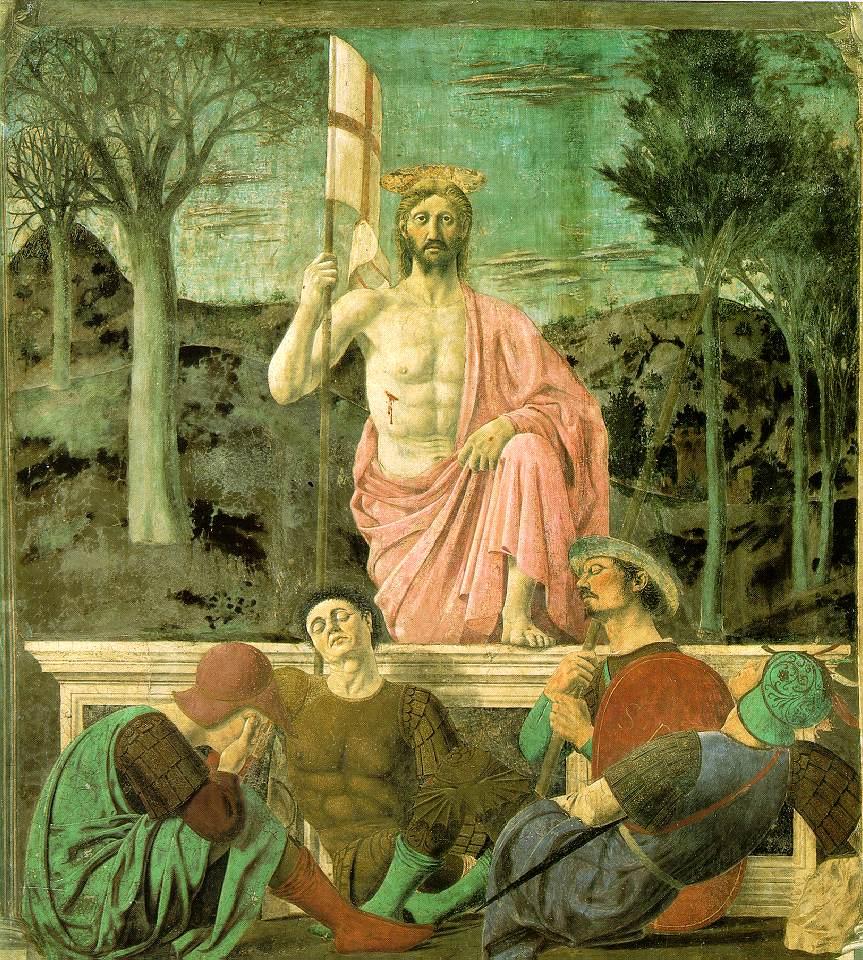
“It seems to me that the intent of the gospel writers is not to make the resurrection seem somehow plausible or credible – this could hardly be done without diminishing its impressiveness as miracle – but instead to heighten its singularity, when, as event, it would seem by no means unexampled. I believe it is usual to say that that the resurrection established who Jesus was and what his presence meant. Perhaps it is truer to say that opposite, that who Jesus was established what his resurrection meant, that he seized upon a narrative familiar or even pervasive and wholly transformed it.

When, in the Gospel of John, weeping Mary Magdalene stoops to look into the tomb and sees angels, they ask her, ‘Woman, why weepest thou?’ The text creates the dreamy impression that the two angels speak together. Then she turns and sees a man standing behind her, Jesus, whom she mistakes for a gardener. He speaks the same words as the angels did, ‘Woman, why weepest thou?’ and he asks, ‘Whom seekest thou?’ Does he see and hear angels, too? Or does he know her thoughts? Or was it his voice she heard in the first place? Mary herself would not have known. Jesus seems to be teasing her toward delight and recognition, ready to enjoy her surprise, in something like the ordinary manner of a friend. The narrative asserts that he is a figure of unutterable holiness, only pausing to speak to Mary before he ascends into heaven, yet it is his very ordinariness that disguises him from her. Splendor is very well for youths and angels, but when Jesus takes up again for a little while the life he had wept to leave, it is the life of a plain man,” – Marilynne Robinson, “Psalm Eight,” from The Death of Adam: Essays on Modern Thought.

(“The Resurrection of Christ,” 1463, by Piero della Francesca, via Wikimedia Commons)

A Grown-Up God

The New Statesman queried thinkers about what atheists can learn from believers. Karen Armstrong’s take is worth your time:

Most of us are introduced to God at about the same time as we hear about Santa Claus, but over the years our views of Santa mature and change, while our notion of God often gets stuck at an infantile level.

As a result, “God” becomes incredible. Despite our scientific and technological brilliance, our religious thinking in the west is often remarkably undeveloped, even primitive, and would make Maimonides and Aquinas turn in their graves. They both insisted that God was not another being and that you could not even say that He (ridiculous pronoun!) existed, because our experience of existence is too limited. God, said Aquinas, is Being itself (esse se ipsum).

The biblical God is a “starter kit”; if we have the inclination and ability, we are meant to move on. Throughout history, however, many people have been content with a personalized deity, yet not because they “believed” in it but because they learned to behave – ritually and ethically – in a way that made it a reality. Religion is a form of practical knowledge, like driving or dancing. You cannot learn to drive by reading the car manual or the Highway Code; you have to get into the vehicle and learn to manipulate the brakes. The rules of a board game sound obscure and dull until you start to play, and then everything falls into place. There are some things that can be learned only by constant, dedicated practice.

Face Of The Day

fotd_3-31

David Rosenberg admires the work of Gillian Laub. From a series documenting her own family:

Although she’s covered hard-hitting stories of life in the Middle East and segregated high-school proms in the South, Laub’s images are often reminiscent of family portraits, with their intimate and deeply personal style. …

“I am very interested in tradition and ritual, so naturally every family holiday and ritual I will be photographing,” Laub wrote. Recently Laub became a mother for the first time and said the experience feels as if everything has come full circle. “I have spent so many years photographing other people’s children, so to now photograph my daughter with my mother and grandmother is pretty amazing.”

(Grandma Feels My Belly, Mamaroneck, N.Y., 2012 by Gillian Laub, courtesy of Bonni Benrubi Gallery)

Reading Like A Child

Alice Bolin fondly remembers the summer she stumbled upon Rudolf Flesch’s The Book of Unusual Quotations and its eclectic passages about religion:

I read attempts to expand the bounds in which God can be encountered: “We can never see Christianity from the catechism,” Ralph Waldo Emerson says, “from the pastures, from a boat in the pond, from amidst the songs of the wood-birds we possibly may.” And attempts to understand how spirituality might work in the absence of God: according to Søren Kierkegaard, “Prayer does not change God, but changes him who prays.” There were also cryptic sayings that mostly served to misdirect, like H. L. Mencken’s cheery epigram, “Every man is his own hell.” At this point in my life, I had never heard of any of these people.

How she now thinks about this random approach to reading:

It is, of course, a childish approach to meaning. As I grew older, I started to understand the importance of insights accumulated and laid over one another, rather than isolated. But I think the teen-age quote fetish is ultimately a good thing. It is evidence of the way a mind is built: randomly, piece by piece, working slowly through the dark with the few truths one finds or has been given. Children are experts on negative capability—in their comfort with what they don’t know, with not seeing the full picture, with moving without knowing what they are moving toward.

Proust’s Young Love

Marcel_Proust_et_Lucien_Daudet

The just released translation of Marcel Proust’s collected poetry includes his first known attempt at verse, “Pederasty,” written when he was 17. Harold Augenbraum, the volume’s editor, notes that it reveals him to be “struggling with his homosexual urges”:

Proust’s sexuality was a matter of public discussion even during his lifetime, but this poem and letters between Proust and Jacques Bizet (the son of Georges Bizet, the composer of Carmen) and Daniel Halévy written at the same time certainly make his interest in homosexuality abundantly clear. In a letter to Bizet, probably written in the spring of 1888, he responds to Bizet’s letter (now lost) that seems to say that Bizet had refused Proust’s advances, Proust saying that he is “not fatuous enough to believe that my body is so precious a treasure that to renounce it required great strength of character… Still, I always find it sad not to pluck the delicious flower that we shall soon be unable to pluck. For then it would be fruit… and forbidden.”

Recent Dish on Proust here.

(Proust, seated, with two companions in 1894, via Wikimedia Commons. The photo is said to have scandalized Proust’s mother.)

Liturgical Liberals

Thomas Holgrave considers the rise of younger Christians who are drawn toward more traditional forms of worship:

Older liberal Christians have assumed that a younger generation of evangelical Christians, who are clearly more liberal politically than their generally Republican parents, will join them on the theologically liberal, desacralizing side of the church. What is actually happening, though, may be more complicated than this. Younger evangelicals who keep the faith are often dissatisfied with elements of their parents’ churches, but they seem to be shifting in a more ’catholic’ direction, toward a more liturgical, roots-oriented Christianity. While their politics may not be those of the Christian Coalition, their religion may actually be more ‘conservative.’

The Decline And Evolution Of Sex Scenes

A very NSFW scene from Game of Thrones, discussed below:

Kate Hakala mourns the decline of steaminess on the big screen:

The zeitgeist favors both family-oriented films and flicks full of special effects and gun violence, which are cheap to produce, over realistic, provocative depictions of human sexuality. Sex scenes require rehearsing, clearing of no-nudity clauses, the development of chemistry, and the hiking of R ratings, whereas CGI takes a computer and some imagination. The latter will time and time again have a wider audience. In 2012, out of the top 20 grossing films of the year, only four included any sex scenes, and only one of those, Ted, was R-rated.

And the resounding trend I see on the internet’s “Best Movie Sex Scenes” lists* is that they all feature movies that are mainly over ten years old. In fact, the last movie to top the box office that included a truly hot and heavy love scene was Titanic (who could forget that smudged hand print on the car window?), but that was a depressingly long sixteen years ago. … We may have now become a culture that feels safer watching a city be bombed to death with their mom than they feel safe watching somebody feeling pleasure next to their mom.

Alison Natasi rounds up actors’ and directors’ opinions on the awkwardness of shooting a sex scene. Jason Kehe tracks the migration of such scenes to television and sees an artistic evolution of the form:

When the adaptation of George R. R. Martin’s fantasy novels first aired in spring 2011, it swelled with sex—par for the course in HBO’s True Blood era. But there was a difference this time: Characters spoke in these scenes. And not just pillow talk, either, but epic discussions of dynasties, subterfuge, and redemption. We learned about the Lannister siblings while a character was downing wine and being serviced by a topless prostitute. Dragon lore got discussed during one extremely NSFW bath. Then the coup de grâce: a major character delivering a five-minute monolog while two women get it on in the background. Even the competition couldn’t hide its admiration. “Nobody gets to talk for two pages about power!” says Julie Plec, executive producer of The Vampire Diaries, CW’s sex-lite answer to True Blood.

So forget sex. It’s “sexposition” now—a way for cable writers to keep your attention while educating you on plot, background, and character.

A Poem For Saturday

horse2night

“Bluegrass” by Carl Phillips:

And he told me nowhere was a lake that,
any day now, he’d surely drown in. What’s the right
answer to a thing like that?

*

So we just stood there,
the two of us—shaking a bit in the cold,
but pretty still, mostly. Horses in a field of moonlight.

(Forthcoming in Silverchest: Poems by Carl Phillips, to be published April 2nd by Farrar, Straus and Giroux, LLC. Copyright © 2013 by Carl Phillips. All rights reserved. Photo by Flickr user zenera)