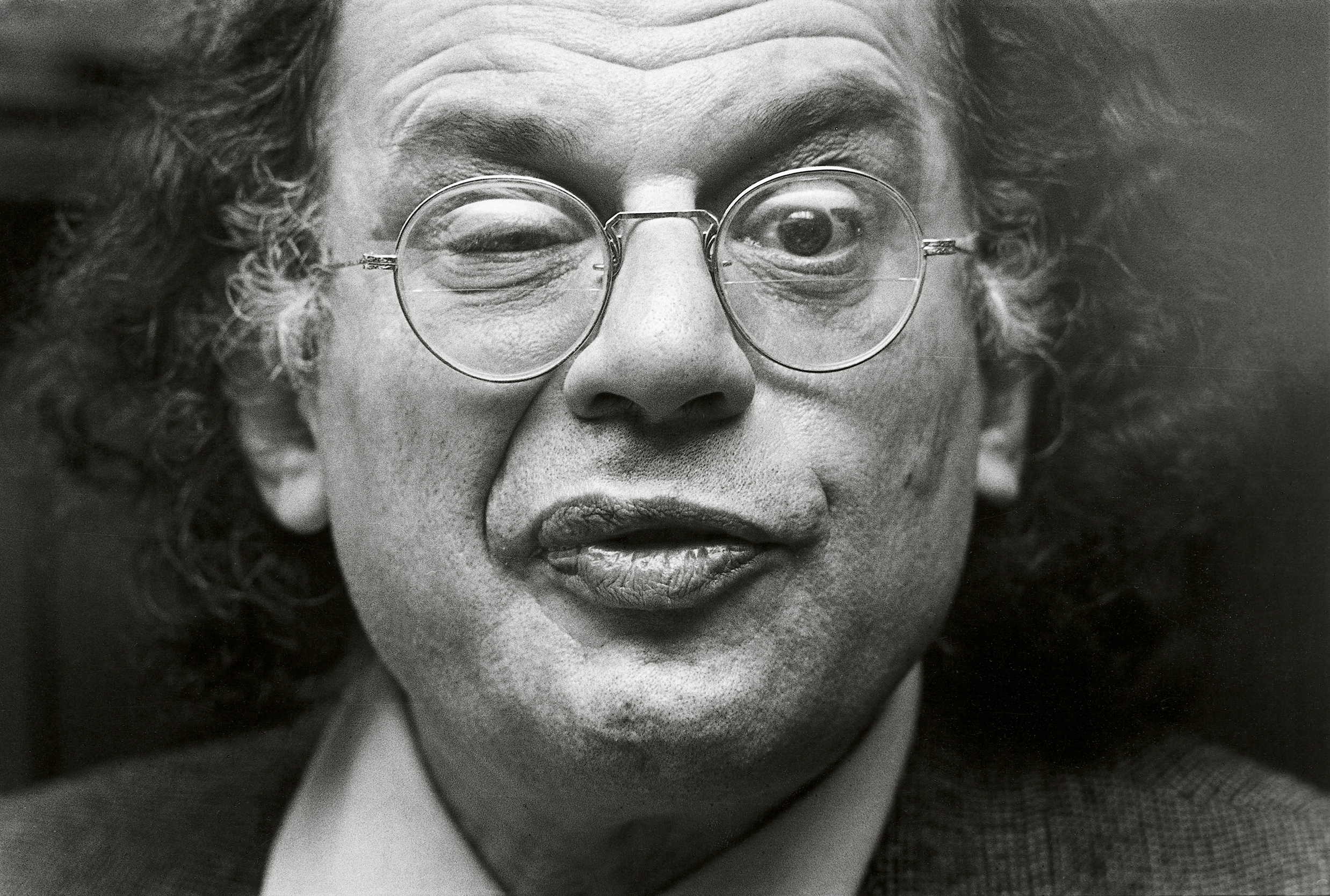
The Howl That Got Heard

Allen Ginsberg - 1979

After a week in which the Supreme Court heard two cases about same-sex marriage, David Biespiel ponders the ways we still live in the wake of Allen Ginsberg’s poem, Howl:

As a lament, “Howl” dissents against the destruction of youth, refutes the violence of industrialism, and grieves over the compromised life of Carl Solomon, whom Ginsberg met in a psychiatric hospital in the late 1940s. And it is an anthem for for homosexual freedom, rights, and visibility.

Ginsberg’s argument is that American industrial violence and cultural intolerance are a cancer at the root of American life and they cause the corrosion of the beatitude of the imagination. Therefore Howl deplores an American Cold War culture that pushes individuals — pacifists, free spirits, anti-capitalists, women, and yes, gays and lesbians — to its dark fringes. Then that same culture accuses those most vulnerable of being derelicts and outcasts who are undisciplined trash that live beyond the mainstream norms.

But Howl helped to create the world we now live in, a world that is opposed to an intolerant America.

Listen to Ginsberg recite Howl here.

(Allen Ginsberg in 1979, photographed by Michiel Hendryckx, via Wikimedia Commons)

Defying An Author’s Dying Wish

A collection of Willa Cather’s letters are about to be published, despite her expressed instructions to the contrary:

As Jennifer Schuessler explains in the New York Times, “Cather was believed to have destroyed most of her letters and sternly ordered that her surviving correspondence never be published or quoted from, a wish her executors adhered to unbendingly, even as it fueled sometimes rancorous debate about her sexuality.” She goes on to point out that Cather wanted to be known for her work rather than her private life, as evidenced by her refusal to allow excerpts for anthologies or film adaptations, the latter following her disappointment with the 1934 adaptation of A Lost Lady.

The editors of the new collection, Andrew Jewell and Janis Stout, acknowledge in the introduction that this publication flies in the face of Cather’s instructions, as set forth by a will that partially expired in 2011. Still, they believe that publication of her letters will prove invaluable for her legacy, arguing that “these lively, illuminating letters will do nothing to damage her reputation.”

Doug Barry emphasizes that “Cather really wanted her work to be widely perused, and making her letters widely available can only help burnish her reputation” – and that they confirm Cather’s lesbianism:

The letters should be a boon to Cather scholars, who, in the 1980s and ‘90s, were engaged in a fierce debate over Cather’s sexuality, and the role it played in her fiction. Feminist and queer theory scholars began to read a lot of pyschosexual turmoil into Cather’s work, prompting a harsh rebuke from Joan Acocella in a 1995 issue of the New Yorker.

All that controversy can be put to rest now — we’ll all soon get to have a long peek into the personal correspondence that Willa Cather would probably rather us not have read.

Nabokov’s Dirty Lit

Edward Jay Epstein recalls, in the fall of 1954, taking Lit 311: European Literature of the Nineteenth Century – unofficially called “Dirty Lit” for its emphasis on adultery – which was taught by Vladimir Nabokov:

I did not get around to reading any of Anna Karenina before Nabokov sprang a pop quiz. It consisted of an essay question: “Describe the train station in which Anna first met Vronsky.” Initially, I was stymied by this question because, having not yet read the book, I did not know how Tolstoy had portrayed the station. But I did recall the station shown in the 1948 movie starring Vivien Leigh. … Only after the exam did I learn that many of the details I described from the movie were not in the book. Evidently, the director Julien Duvivier had had ideas of his own. Consequently, when Nabokov asked “seat 121” to report to his office after class, I fully expected to be failed, or even thrown out of Dirty Lit.

What I had not taken into account was Nabokov’s theory that great novelists create pictures in the minds of their readers that go far beyond what they describe in the words in their books. In any case, since I was presumably the only one taking the exam to confirm his theory by describing what was not in the book, and since he apparently had no idea of Duvivier’s film, he not only gave me the numerical equivalent of an A, but offered me a one-day-a-week job as an “auxiliary course assistant.”

God From The Machine

Julia Kaganskiy profiles three programmers who are exploring the similarities between scripture and code:

In the gallery, I approached a laptop on a pedestal, flanked by tall white candles and two iPads displaying the project description and samples of the God.js code, both written in Medieval-looking type and flowery language. I was instructed to select my “religion” from a set of three belief systems available in the God.js Chrome plug-in. Each one placed a unique set of constraints on my browsing behavior, doling out punishments for transgressions, such as visiting a page with too many obscenities.

I selected the religion developed by the second developer, Will Brand, and randomly pointed my browser to Gawker. Festering boils filled the page as clipart frogs rained down. Apparently the god behind this religion was not a Nick Denton fan.

Writing The Other Sex

In an interview, the novelist Ben Schrank describes why he’s drawn to female characters:

 I don’t pretend or claim to know or understand women. But writing about men doesn’t interest me as much… The darkness and cruelty in men’s souls is not something I want to dig into. I watch guys on the subway all the time and I’m just not that curious about what they’re up to. I have a general sense and that’s plenty. That stuff doesn’t need to be fleshed out. We still live too much with the damage men do. But the darkness and cruelty in women’s souls? Women are not so easy to read. They wear masked expressions on the subway that are endlessly inscrutable. For me, women are far more provocative.

The Religious Case Against Drones

The Rev. Dr. Paul F.M. Zahl makes it:

Our use of drones are out of “proportion” because it uses the most advanced technology in the world to assassinate people who can basically only throw the equivalent of sticks and stones back at you. Moreover, it gives these people no chance to surrender. It is like capital punishment without an arrest, a charge, a trial, or a right of appeal.

Our use of drones is not humane, because it totally objectifies the enemy by making them into a picture on a screen. There is not the faintest possibility, in the conduct of drone warfare by means of remote control, that you can regard the enemy as a fellow human citizen of the planet.

Addicted To Footnotes

Helen Rittlemeyer explores the similarities between David Foster Wallace and Samuel Coleridge, which range from youthful fame to struggles with addiction. One revealing parallel? Their fascination with footnotes:

Contemporaries were skeptical of Coleridge’s protestations, just as many people today are skeptical Wallace’s, but anyone who criticizes them should first think why it makes sense that a man who overuses footnotes would also become dependent on drugs and alcohol. Coleridge and Wallace were both acknowledged as having immense native brainpower—a friend of DFW’s described him as receiving more frames-per-second than most people—and both of them were great readers with great memories. Coleridge was nearly a child prodigy, reputed to be able to recite long passages from books he’d read only once.

These men could not have a thought without twelve sidebars, citations, and quibbles popping up from their mental recesses. The result: footnotes and digressions. The other result: an overwhelming desire, when the stimulation became too strong, to power down the machine for a while. “He once said to me that he wanted to write to shut up the voices in his head,” Wallace’s best friend told a reporter. “He said when you’re writing well, you establish a voice in your head, and it shuts up the other voices.” And alcohol shuts up all the voices.