Energy Codependence

by Doug Allen

Concerns about shale gas resources hindering renewable-energy development are likely overblown:

[R]ather than replacing renewables, the [Citigroup] analysts suggest that the shale gas industry will actually be dependent on the broader deployment of wind and solar for its future. … Far from competing with each other, [Citigroup] suggests renewables and shale gas will be co-dependent as the world’s energy systems are weaned away from the baseload model that has dominated the industry for the last century. That is until forms of dispatchable renewable energy, such as solar thermal with storage, and technologies such as smart grids, push gas out of the market.

Map Of The Day

by Doug Allen

mainborders

Theoretical physicist Dirk Brockmann used data entered on the dollar-bill tracking site wheresgeorge.com to explore boundaries in the US:

Brockmann took data for how the dollar bills traveled, and used network theory to draw lines where dollar bills are less likely to cross. In places they follow state borders, but not always; Missouri is divided into East and West, as is Pennsylvania. The “Chicago catchment area” includes a big chunk of both Indiana and Wisconsin.

The resulting map shows how “effective communities” don’t necessarily follow state lines. “I don’t know so much about the culture of the U.S.,” says Brockmann, who grew up in Germany. “But when I give talks on this, normally someone in the audience says, ‘Oh, this makes perfect sense.”

Update from a reader:

I’d like to point out that the “effective communities” that Mr. Brockmann references in his map may not be as organic as he implies. The boundaries roughly correspond to the districts serviced by the Federal Reserve Banks, which exchange old bills collected by banks for new bills.

(Image from Dirk Brockmann)

Why Can’t The IRS Do Your Taxes?

by Zoe Pollock

For most Americans, it could:

Imagine filing your income taxes in five minutes — and for free. You’d open up a pre-filled return, see what the government thinks you owe, make any needed changes and be done. The miserable annual IRS shuffle, gone. It’s already a reality in Denmark, Sweden and Spain. The government-prepared return would estimate your taxes using information your employer and bank already sent it. Advocates say tens of millions of taxpayers could use such a system each year, saving them a collective $2 billion and 225 million hours in prep costs and time, according to one estimate.

But the TurboTax lobby is strong: 

[Maker of the tax software] Intuit has spent about $11.5 million on federal lobbying in the past five years — more than Apple or Amazon. Although the lobbying spans a range of issues, Intuit’s disclosures pointedly note that the company “opposes IRS government tax preparation.” … Roughly 25 million Americans used TurboTax last year, and a recent GAO analysis said the software accounted for more than half of individual returns filed electronically. TurboTax products and services made up 35 percent of Intuit’s $4.2 billion in total revenues last year.

Paul Waldman adds:

For many people, this wouldn’t work. Let’s say you have a lot of investment income, which varies from year to year. Or you’re a freelancer, and your income comes from multiple sources and your expenses also vary. But many people just have one source of income (their job) and a stable set of deductions, and this kind of thing would work perfectly well, saving them the $40 or so it would cost for Turbo Tax, or the even greater expense of going to a tax preparer.

The Weekend Wrap

by Matt Sitman

Caravaggio_-_The_Incredulity_of_Saint_Thomas

This Easter weekend on the Dish, Andrew praised the radical Christianity of Pope Francis, told us about his inspiring trip to West Point to speak to the military academy’s gay-straight alliance, and announced he was taking a breather.

We also provided our usual eclectic mix of religious, books, and culture coverage. Fittingly, we emphasized matters of faith, doubt, and philosophy, with Marilynne Robinson musing on the Resurrection, Paul F.M. Zahl making the religious case against drones, Karen Armstrong urging us to believe in a grown-up God, and Thomas Holgrave considered the complex traditionalism of young Christians. Julia Kaganskiy profiled programmers exploring the similarities between scripture and code, Alice Bolin recalled the benefits of reading like a child, Helen Rittlemeyer plumbed the parallel lives of DFW and Coleridge, and Francis Gino explained how what we wear impacts the likelihood of our cheating.

In literary and arts coverage, David Biespiel pondered the ways we live in the wake of Allen Ginsberg’s Howl, the publication of Willa Cather’s letters defied her dying wish, and Edward Jay Epstein remembered Nabokov’s Dirty Lit. Ben Schrank described why he’s drawn to writing female characters, Danny Nowell re-read Walker Percy, and Harold Augenbraum profiled Proust’s young love. Avi Steinberg detailed why teaching creative writing in prison is so important, Barry Hannah proffered the reasons for writing, Maria Bustillos penned a love letter to editors, and Julia Fierro contemplated the challenge of novelists writing about sex. Stephen Marche was disappointed by the Kindle’s lack of development, Kate Hakala mourned the decline of steaminess on the big screen, James Parker put The Real Housewives franchise under the microscope, and Patrick Radden Kaffe was fascinated by the brainstorming sessions for Raiders of the Lost Ark. Read Saturdays poem here and Sunday’s here.

In assorted news and views, coughing in a quiet music hall meant more than you think, Roy Peter Clark downplayed claims of a plagiarism pandemic, Tomasky grew tired of waiting for his restaurant checks, and wine declined in France. Dinosaur sex proved to be complicated, Barry Schwartz continued the conversation about marriage and love, and Alison Gash chronicled how same-sex adoption victories were won. Cool Ad watch here, MHBs here and here, FOTDs here and here, VFYWs here and here, and the latest window contest here.

(“The Incredulity of Saint Thomas” by Caravaggio, via Wikimedia Commons)

Straight Adoption And Gay Marriage, Ctd

by Chris Bodenner

A reader points out:

Chief Justice Roberts and his wife are the parents of two adopted children. It will be interesting to see if any of his fellow Supremes use this procreation nonsense in their opinion.  If they do, “blind justice” won’t begin to describe it.

That message to Roberts is being championed by Daniel Leffew, the adopted son of two dads seen in the above video. Follow-up video with the rest of Daniel’s family here.

Is Adderall The New Caffeine?

by Brendan James

Will Oremus takes a sober look at the unprescribed use of Adderall and questions whether it might become recognized as a casual performance enhancer like coffee:

In fact, there is scant evidence that Adderall is physically addictive or dangerous if used responsibly by adults. Its side effects—which can include dizziness, weight loss, and increased heart rate—are real and worth watching out for. People with cardiovascular conditions in particular could have an adverse response, which is one good reason why people should think twice before taking the drug without consulting their doctor. And as with pretty much any medication, crushing and snorting Adderall to get high, or taking more than the recommended dose, is patently foolish. But the drug appears to be far safer on the whole than legal substances like alcohol and nicotine. Even that terrifying Times article [about the Adderall-linked suicide of Richard Fee], if you read it to the bitter end, acknowledges that “almost every one of more than 40 ADHD experts interviewed for this article said that worst-case scenarios like [Fee’s] can occur with any medication.”

Why Take His Name? Ctd

by Chris Bodenner

Screen Shot 2013-04-01 at 1.31.16 AM

The above screenshot (click to enlarge) from our Urtak survey shows how 58% of female readers are planning to keep their name after marriage compared to 83% of male readers. Also, 6% of married readers hyphenated their last name in marriage and 7% of unmarried readers are planning to do the same. Explore all of the results here. Below is another big follow-up to one of our most popular threads this year:

I don’t think that anyone has mentioned yet the professional concerns around changing your last name to your spouse’s upon marriage, in an age where your “brand” is very much linked to your online identity and it’s a given that potential employers are going to be googling job applicants. While you can always change your last name easily on social media sites like Facebook, Linkedin, Twitter, etc., it’s basically impossible to go back and change it on the masthead of your law journal, the articles you wrote for your college paper, the announcement for the scholarship you won, or the acknowledgements page of your professor’s book that you helped research. Put simply, an increasing number of women today will have racked up a list of accomplishments under their birth names prior to marriage, so I’d rather be searched as “Jane [Maiden Name]” than “Jane X” upon marrying Mr. X. I’d think that a good number of us are reluctant to give up the online “brand”/professional identity that we’ve been building for years.

Of course, the fact that you can find absurd amounts of information about virtually everyone through a quick online browse works in the other direction as well. Hence, a name change might be beneficial for those who have past indiscretions tied to their maiden names and would like to “start over.”

Another factor that hasn’t been raised thus far is divorce. Many divorced Americans who had taken their spouse’s name revert to their original name, even before they consider another marriage and yet another name change. Perhaps millennials are more likely to keep their name in marriage due to all the name-changing they saw from their remarried and re-remarried boomer parents, the most divorce-prone generation. Another reader:

For my first 23 years, I had no middle name.  My mother tried to spare us the dilemma of having to choose whether to use our middle name or our maiden name when we did get married (she chose the latter).  So for the government, my middle initial was ‘N’ for none.  If I had to have a middle name (again, for government documents) it was ‘NMN’ for no middlename.  So I was very glad to finally get a middle name when I married.

Another has advice for parents:

Here is a solution that my grandparents came up with. You hyphenate last names when you get married. When your children grow up and get married, they keep half the hyphenated name from the parent of the same gender as them (or they can just pick one in the case of same-sex couples) and take half of their spouse’s last name. This allows for the continuation of lineage through surnames, while still eliminating the gender imbalance in the process.

Another:

I swear this is not apocryphal; I know these people; they were at my wedding. His name is Bent. Her maiden name is Dover. They decided NOT to hyphenate.

Another:

My wife and I are late-20s Philadelphians who both felt attached to the family history behind our last names. We decided over a beer one night to flip a coin and avoid the hyphenated circus.

We flipped a coin outside the bar and she won so, I took her last name. You should have seen the social security office when I went in. The woman behind the desk didn’t know how to enter a man making a marriage-based name change, and whispered the scenario to her coworker like I was doing something I should be embarrassed about. I’ve gotten similar vibes from her small town extended family as well. Meh. I only know one other person in all my urban Northeast network where the man took a woman’s name and it’s my cousin in Brooklyn (who also doesn’t know anyone). I recommend the coin toss.

Another:

The best ever solution to the last name question was a rock-paper-scissors match between the best man and the man of honor (the bride’s best friend was a guy), played during the wedding ceremony.  A win by the best man meant the couple would take the groom’s name, ditto for the bride’s name if her attendant won.  What to do in the event of multiple ties had not been considered.  This became more important when both attendants threw a tie six times in a row.  While hybridnames were considered, the couple elected to soldier on until the tie was broken by the best man, and the couple have happily shared the groom’s name ever since.

Another:

I didn’t take my husband’s name, and probably for the worst of all possible reasons: spite. Back when we were still dating in college, we went out one night with another couple. The other guy mentioned to my now-husband that his girlfriend had told him she planned to keep her name if they married. My husband (who possibly wasn’t aware I was within earshot), laughed at him and said, “No wife of mine is gonna keep her last name!” To which I immediately replied, “Oh, really?”

Prior to that, I would’ve taken his name without a second thought. But I’m contrary by nature, and the moment he implied I had to take his name was the moment I knew I wouldn’t. I hate it when someone tells me I have to do something.

For the record, we celebrated our 19th wedding anniversary last month. And I generously allowed our son to have his dad’s last name.

An Easter Breather

photo(1)

I’m taking the next week off – my first, I think, since last summer. The Dish team will be subbing as usual – as, of course, they do all the time anyway, with my oversight and authoritah. But next week, they can say anything they like, under their own by-lines, as is tradition, (as the Canadians say). I want to thank them in advance – from Patrick and Chris to Matt, Zoe, Alice, Chas, Doug and Brendan.

partnersIt is simply a fact that without Chris and Patrick (see right) and Chas, the new Dish would never have happened. Period. And it’s another fact that without you, this new experiment in online publishing would have sputtered from the get-go.

So before I sleep for a few days, a message of gratitude for you, dear Dish readers, for your support and faith and persistent engagement. Thanks for subscribing in numbers large enough to make this one of the single most successful pay-meter debuts ever. And to those of you who are still holding out, [tinypass_offer text=”$1.99 a month”] is now an option.

At West Point

IMG_5550

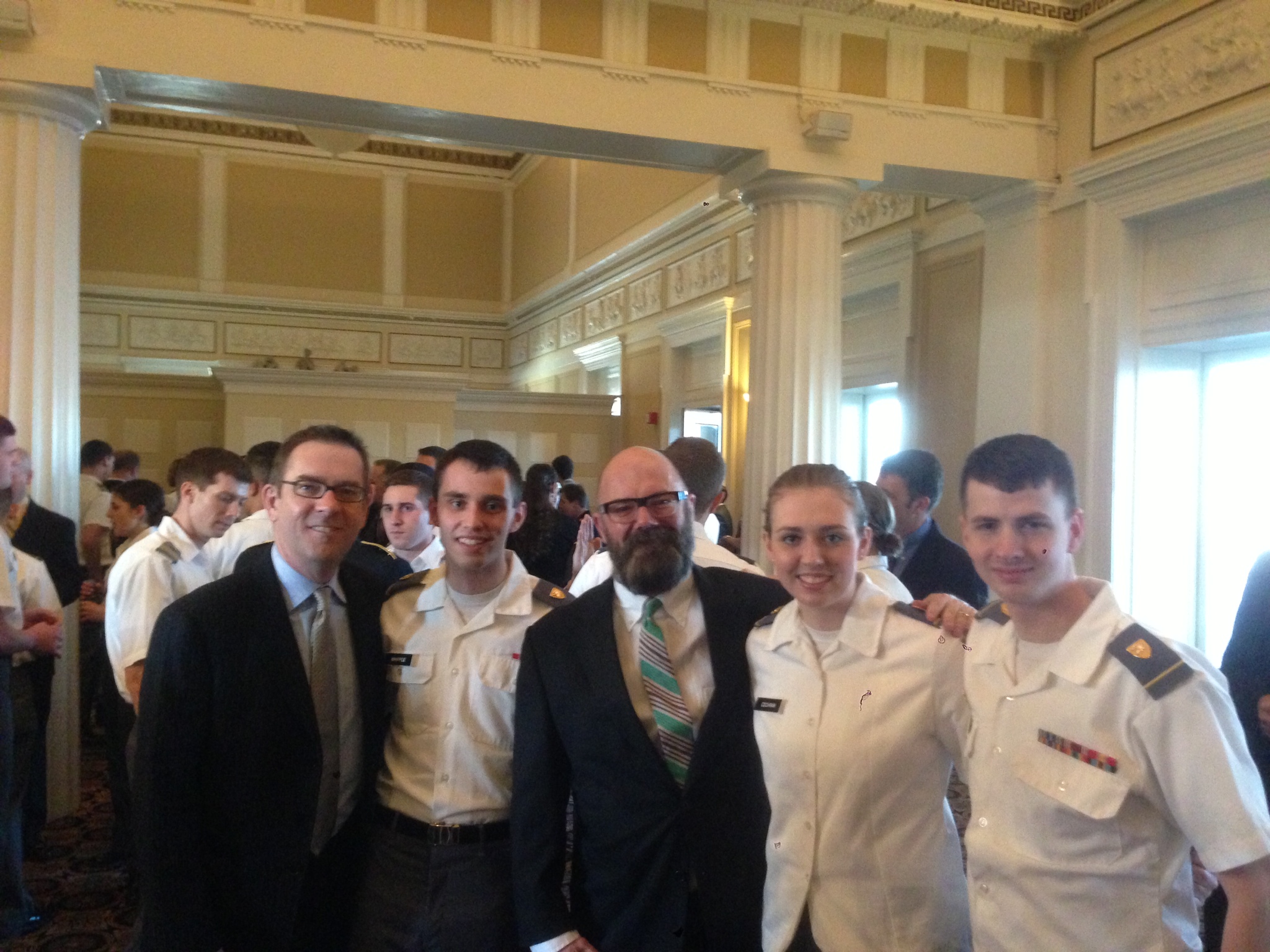
A week ago last Saturday, I was invited to West Point by a group called “Knights Out”. That’s the name for the gay-straight alliance among cadets at the oldest continuous military installation in America. This was their second annual dinner – which, like all things done twice at West Point, is now therefore a tradition. (Yes, that’s TV foodie, Ted Allen, on the far left. He was also a guest.) I thought I was just attending a dinner and making a few remarks, but they insisted on giving me an award for my work on ending the military ban on openly gay service-members. This happened the week before those critical court cases on marriage equality.

It’s taken me this long to write up the event because my bewilderment has been so disorienting – and because it was difficult to absorb the power of this moment while putting on my analyst’s hat for the court cases. But here’s part of what I managed in my paywalled Sunday column in the Times of London:

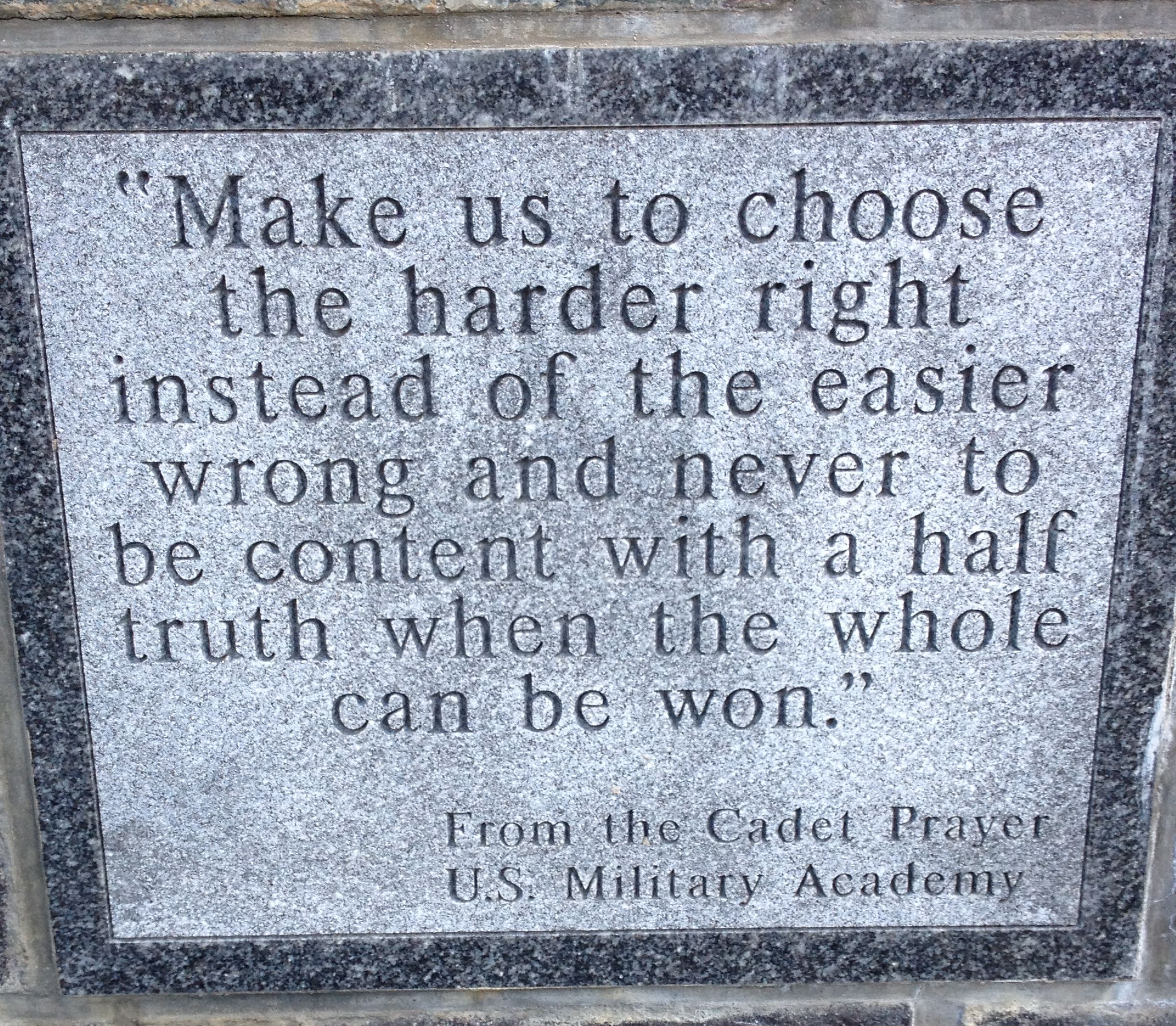
There were around 30 gay cadets present, and then plenty of old boys (and girls), and military faculty. An older general was there – with his husband. It was a formal event held in a central building. And as I tried cadetprayerto absorb the moment, it occurred to me that a little over two years ago, all of those cadets would have been expelled for merely being there. Since the beginning of the institution, gay cadets were either subject to immediate discharge or, after 1993, under the policy of “Don’t Ask, Don’t Tell”, ordered to keep their sexual orientation secret or face dismissal. They were, in other words, forced to break the core ethic of the place – “a cadet will not lie …” – in order to remain in good standing with it. And it was that ancient alleged contradiction – between military honor and homosexuality – that was being dissolved that night.

A tough Brigadier General, Tammy Smith, gave an address: “You’re military first, gay second,” she insisted, her wife sitting nearby. And these young gay men and lesbians gave her a standing ovation. They were in the military not because they were gay, but because they wanted to serve their country. One young cadet I met was following family tradition that had sent the next generation to West Point and the Army for decades. The only difference this time is that she was a woman and a lesbian. Another young cadet from the South argued with me at dinner, protesting Obamacare. He was a Republican and gay and in uniform – and saw nothing contradictory or odd about any of it.

The organization as a whole has taken as its own motto a section of the Academy’s prayer: “Never to be content with the half-truth when the whole can be won.” They did not want to rebel against this institution, or to occupy some special niche. They merely wanted to be wholly, honorably part of it. And finally, they were.

In a column today, Ross Douthat urges those who have championed and almost won the argument for homosexual civil equality to adopt Churchill’s advice: “In Victory: Magnanimity,” while he opts for Churchill’s other dictum, “In Defeat: Defiance.” There was certainly no hubris or triumphalism at West Point. There was merely relief – relief that forcing gay cadets to break West Point’s honor code against lying is now mercifully left in the trashcan of history.

From the next generation, I heard nothing but the desire to serve their country without lying. This was not about the relevance of their sexual orientation but rather its irrelevance compared with this honorable vocation. There was a time when conservatives rejoiced when a balkanized minority wanted to integrate itself into the whole of society by affirming traditional goals, like serving one’s country in uniform or marrying the one you love. There was a time when identity politics was the foe of conservatism. Now, the integrators and opponents of identity politics are suddenly those at fault. And the right has resorted to the identity politics of victimology to describe its current predicament.

And what struck me about these gay soldiers – as with the many gay service-members I have been proud to know and meet in my life – was their commitment to honor. They truly found the lies they were commanded to tell about their lives to be dishonorable. And what struck me about West Point was its constant, persistent American military insistence on choosing the “harder right instead of the easier wrong.” Honor is everything there. It is a standing rebuke to the following sentence:

“You don’t want your honor to be questioned? Why would those things matter when compared to protecting America?”

Yes, the antidote to Cheney is West Point. And the cadets who found the courage to put honor first. And changed the world because of it.

The Radical Christianity Of Francis

Pope Francis Attends Easter Mass and Urbi Et Orbi Blessing in St. Peter's Square

What has struck me the most about the new Pope is his reticence. Benedict XVI was as bewilderingly bejeweled in his prose as he was in his elaborate, fastidious outfits. Francis seems to be following his name-sake, who rarely preached as such, but whose actions spoke far louder than any Latin. “Spread the Gospel everywhere – if necessary with words” was the saint’s alleged remark. It was certainly his way of life, although I doubt Pope Francis will suddenly break out into a spiritual dance or song, as Saint Francis was wont to do.

And so Francis was of few and plain words, as he emerged at first: “Bueno Sera” before urging people to go to bed soon. He has simply let the ornate and elaborate vestments of his predecessor fall from his body, as Saint Francis did in renouncing his worldly inheritance from his father. He has spoken of the need to protect Creation from the forces of pure exploitation and greed; he has reiterated Jesus’ message to visit the sick in hospital and the incarcerated in prison. He has washed the feet of a Muslim female juvie. He has refused the Papal throne and its palatial residence. And he has done all this almost instantly. No words could have said as much.

The reaction from the arch-traditionalists, especially in Liturgical matters, has been just a notch short of outright hysteria. One of the new, young priests, who came of age under the counter-revolution of Wojtila and Ratzinger, registers his bafflement at the washing of women’s feet:

I am a young, recently ordained priest. Tonight, I planned on preaching about the Eucharist and the institution of the priesthood. How can I speak about such things – the self-offering of Christ, the 12 viri selecti – when our Holy Father is witnessing to something different?

I feel like going up to the congregation and saying, “I don’t have any idea what the symbolism of the washing of the feet is. Why don’t we just all do what we want.” How hard this is for young priests.

How hard for a young priest to have to grapple with the idea that in Christ, there is “neither male nor female.” Or that some Pharisaical rules, designed to protect the powerful, are what Jesus came to disarm with the power of love, outreach, and embrace of the other. No: what matters to this priest is that those who are selecti are viri, i.e. men, that the washing of the feet is about the supremacy of the male priesthood, not the humility of a God who places the last first and the first last. There is some awkward resistance from the Ratzinger faction as a whole:

“The pope does not need anybody’s permission to make exceptions to how ecclesiastical law relates to him,” noted conservative columnist Jimmy Akin in the National Catholic Register. But Akin echoed concerns raised by canon lawyer Edward Peters, an adviser to the Vatican’s high court, that Francis was setting a “questionable example” by simply ignoring the church’s own rules.

“People naturally imitate their leader. That’s the whole point behind Jesus washing the disciples’ feet. He was explicitly and intentionally setting an example for them,” he said. “Pope Francis knows that he is setting an example.”

The inclusion of women in the rite is problematic for some because it could be seen as an opening of sorts to women’s ordination.

There is no sign that Francis will move to end that ban – although what a day for the church that would be! There are signs rather that Francis wants to break out of the zero-sum dynamic of those issues for a while and reaffirm the central truths of the faith: that the force behind all of creation is love, that Jesus revealed this in his words and in his actions, that those who believe they have everything have nothing, and that those who are marginalized, poor, alone, afraid and vulnerable are by those very facts more capable of seeing God in the world. We have to become more like them to find Jesus, and less like ourselves.

This is a Pope who follows Jesus’ example by simply showing, not telling. Francis of Assisi is the obvious precedent. But this man is a Jesuit as well, an order founded by Saint Ignatius:

St. Ignatius had been a Basque soldier, as well as something of a ladies’ man, until his conversion while convalescing after a cannonball shattered his leg. In his writings, most notably in his “Spiritual Exercises,” St. Ignatius espoused a theology based on loving deeds rather than loving thoughts or words. St. Ignatius calls us not merely to worship Christ but to imitate him.

My italics. Deeds over words; love over law. In the end, the way a human being acts is what his or her religion is. And a spiritual leader can say so much more without words, because he is describing something beyond human understanding. In the washing of a young woman’s feet – from another universe of doctrine – you are witnessing the surrender of law to love. You are witnessing Jesus’ constant resurrection in our world – every day, somewhere, in someone, opening up to the sun, like flowers in springtime.

(Photo: Daffodils in front of St. Peter’s Basilica as final preparations are made before Pope Francis delivers his first ‘Urbi et Orbi’ blessing from the balcony of the Basilica during Easter Mass on March 31, 2013 in Vatican City, Vatican. By Christopher Furlong/Getty Images)