My God, My God, Why Have You Forsaken Me?

As we mark Good Friday, a meditation on prayer in the depth of pain:

I pray today for my friend, David Kuo, whose long battle against a brain tumor is in its final days. And for all those enduring war or plague or illness or despair. Especially despair. In one Gospel, Jesus himself seems to feel the loneliness of that despair on the cross. He had to go there to show how deeply he is still with us – perhaps especially in the valleys of our life when the sky itself recedes from view.

The Hung Ones

Premiere Of AMC's "Mad Men" Season 6 - Arrivals

Jon Hamm is tired of commentary about the size of his dick. Alyssa sympathizes:

The questions that Hamm faces, from whether he should just invest in some Calvins to whether he should be flattered by the attention, are ones actresses have fielded forever. It’s a framing that acts as if the problem were the kind of underwear starlets and their stylists were picking out, rather than the photographers who zoom telephoto lenses in on their crotches. It says that if people get a glimpse of your body once, they’re entitled to speculate it about it forever, and you’re a prude for reminding people that you’re more than the sum of your junk.

What makes Hamm different from, say, Anne Hathaway, who had to weather discussion about the appearance of her nipples in her Academy Awards dress, is that Hamm isn’t used to being objectified. He has outrage left to burn, rather than being exhausted by endless appearance-based prying and insane body standards.

This is surely connected to a shift in the public’s understanding of male sexiness. This began in the 1990s, as Calvin Klein recruited Marky Mark’s abs, as Herb Ritts and Bruce Weber changed the presentation of the male body in photography (influenced by Robert Mapplethorpe), and as women became more empowered and gay men became more public. I wrote a cover-story on this for TNR in, er, 1988. This is male objectification turned back on the male. Alyssa is kind to empathize. But after all that women have had to endure over the centuries, a little payback isn’t so terrible a thing. And Jon Hamm simply cannot look bad. But I miss the beard.

(Photo: Actor Jon Hamm arrives at the Premiere of AMC’s ‘Mad Men’ Season 6 at DGA Theater on March 20, 2013 in Los Angeles, California. By Jason Merritt/Getty Images)

Straight Adoption And Gay Marriage

Orphans Become Naturalized U.S. Citizens

A question has often occurred to me as opponents of marriage equality cite gay people’s biological inability to procreate as a reason to bar us from marriage. What are they implicitly saying about infertile couples who adopt children? Tom Junod takes it personally, as well he should:

I have been married for 28 years. I met my wife in my freshman year of college. We started dating in my second semester, and have been so exclusive that we celebrate the anniversary of our first kiss rather than our wedding day… We have never thought of our marriage as anything but pleasing to anyone who cared to judge it, and have never imagined that the sanctity of our marriage might threaten the sanctity of other marriages, not to mention the institution of marriage itself.

Until now.

What has changed our understanding of the way some people see our marriage is, of course, the general debate unleashed by the last two days of argument before the Supreme Court on the subject of same-sex marriage. No, my wife and I are not of the same sex; I am a man and she is a woman. But we are infertile. We did not procreate. For the past nine years, we have been the adoptive parents of our daughter; we are legally her mother and father, but not biologically, and since Tuesday have been surprised and saddened to be reminded that for a sizable minority of the American public our lack of biological capacity makes all the difference — and dooms our marriage and our family to second-class status.

Read the whole thing, especially the arguments of NOM that uphold biological parenting as the only truly moral option. The logical contortions opponents of marriage equality have gotten themselves into just to justify excluding gays from their own families has led to this. I doubt whether any anti-equality campaigner wants to stigmatize adoption. But their arguments inevitably do – and are becoming a growing liability across American society.

(Photo: Jamie Lieberman (L) of New York City, cries as she holds her adopted son Theo, 2, an orphan originally from Ethiopia, after he received American citizenship November 18, 2010 at the US Citizenship and Immigration Services offices in New York City. Eighteen children, originally from Haiti, Ethiopia, China, and others countries, were sworn in as citizens with their American adopted parents standing by in a ceremony at the New York headquarters from USCIS. By Chris Hondros/Getty Images)

“I’d Fuck Elvis”

A reader writes:

Tatum saying “I’d have sex with [Clooney]” has been a sort of macho way for younger straight men to indicate they’re comfortably and confidently hetero for over a decade now. I, at least, remember starting to hear it in college at the end of the ’90s. It might date to this classic scene from the Tarantino-penned movie True Romance. It’s sort of a hyperbolic way of re-affirming straightness: “I can express my admiration for that man’s good looks and charm without compromising my own straight, masculine self-image only by doing it in this over-the-top way.” We “self-confident” straight men no longer feel the need to add Clarence’s qualifier from the movie: “I ain’t no fag, but…”. We obviously aren’t that insecure.

Update from two readers:

There is a movie scene that predates True Romance’s by 14 years, in the 1979 musical Hair.

One of the characters is asked by an Army recruiter if he is attracted to men and answeres, “Well, I wouldn’t kick Mick Jagger out of bed, but I’m not a homosexual, no”, which then leads to the hit song “Hair” being performed. Here’s the scene on YouTube.

So give credit where it is due; it started with the ’60s freedoms, where men chose to grow their hair long while still being masculine, at a time when much of the general population could mistake you for being a female if you wore your hair long.

I actually used that Mick Jagger line myself for a few years afterwards, when I was living in a smaller Midwest college town. It was more to throw a curve into other’s persons assumptions that most everyone was straight. It allowed me to be part trickster, playing with their minds a bit, and suggesting and planting the seed in their mind for a few seconds that I might actually be gay – or that others might be gay. The effectiveness of this declined as more and more people actually came out as being gay.

Another:

While Hair is a good earlier example of the phenomenon, it goes deeper. To me the classic expression of male-on-male adulation comes from 1942’s Casablanca. Claude Raines’s Inspector Renault explains to Ingrid Berman’s Ilasa Lund that “He (Bogart’s Rick) is the kind of man that – well, if I were a woman and I were not around, I should be in love with Rick”. Maybe it just serves as characterization of Vichy French turpitude, but the character of Renault is portrayed as an inveterate skirt chaser whose real kinship rests with Rick Blaine.

“An Invitation To Evil”

Screen shot 2013-03-29 at 11.25.24 AMHere’s a reminder of why “sponsored content” should be anathema to a free and independent press: E.B. White’s letter to Xerox after the company sponsored content in a 1976 issue of Esquire:

A funded article is a tempting morsel for any publication—particularly for one that is having a hard time making ends meet. A funded assignment is a tempting dish for a writer, who may pocket a much larger fee than he is accustomed to getting. And sponsorship is attractive to the sponsor himself, who, for one reason or another, feels an urge to penetrate the editorial columns after being so long pent up in the advertising pages. These temptations are real, and if the barriers were to be let down I believe corruption and abuse would soon follow.

Not all corporations would approach subsidy in the immaculate way Xerox did or in the same spirit of benefaction. There are a thousand reasons for someone’s wishing to buy his way into print, many of them unpalatable, all of them to some degree self-serving. Buying and selling space in news columns could become a serious disease of the press. If it reached epidemic proportions, it could destroy the press. I don’t want IBM or the National Rifle Association providing me with a funded spectacular when I open my paper. I want to read what the editor and the publisher have managed to dig up on their own—and paid for out of the till. …

The funded article is not in itself evil, but it is the beginning of evil, and it is an invitation to evil. I hope the invitation will not again be extended, and, if extended, I hope it will be declined.

At the time, the NYT covered the uproar over the Xerox-sponsored content:

The article by Mr. [Harrison E.] Salisbury, former associate editor of The New York Times, provoked editorials around the country and protests from writers who feared that it would set a precedent for encroachment by advertisers into the traditionally independent editorial side of journalism. Under the arrangement, Xerox paid Esquire to commission Mr. Salisbury to write “Travels Through America,” a 23-page article that took six months to complete. Mr. Salisbury was paid $40,000 plus $15,000 in expenses. Esquire in turn received a contract for a $115,000 advertising package from Xerox for one year.

The agreement stipulated that Xerox would not interfere with or have any influence over the article, but would run full-page ads at the beginning and the end of the article. If the corporation did not like the essay, Esquire would be free to publish it, without returning Xerox’s money, but without identifying it with Xerox in any way. “It was an experimental idea and since the big corporations sponsor television specials and other cultural enterprises, I saw nothing wrong with it,” said Mr. Salisbury yesterday to Mr. White’s criticism. He added that “magazines are suffering from lack of funds to pay their writers. “I’ve had no bad feedback from the article and if it is done just like our arrangement, that’s fine,” he said. “It worked like a charm.”

The NYT is prepping a report on this phenomenon, which is now spreading like wildfire in online media and in danger of becoming the norm. It’s a rare moment when the press has covered this issue – perhaps because the NYT is one of the few media brands self-confident enough to take it on, without worrying it will need to go there in the near-future.

(Hat tip: Ernie Smith)

Dissents Of The Day

A reader quotes me:

“I find the opportunism of the Clintons – who did more substantive harm to gay people in eight years than any other administration – more disgusting than the fundamentalist hostility.” OK, I can go along with “more disgusting than fundamentalist hostility,” but I would describe Bill Clinton’s behavior in 1996 as cowardice more than opportunism.  It was an eternity ago in terms of public opinion, and DOMA passed the House 342 to 67 and the Senate 85 to 14.  To buck that would have required great courage. (Hillary’s more recent statements when a senator are far worse.)

But worst of all was 2004, where Rove, the GOP, and the right-wing propaganda machine aggressively targeted gay people to get out the vote in state after state.  What makes their behavior so much worse was that cowardice was NOT a factor; on this issue, the GOP was not threatened with a challenge from the left. They maliciously ginned up fear and hatred solely to get a few more voters to the polls.

Another:

You keep repeating this assertion about Clinton, and I have to say it doesn’t ring true. I’d argue Reagan, in his disregard for AIDS, was clearly more responsible for not just “harm” but a quantifiable number of deaths. DADT happened because Clinton overreached, in his first months in office, on trying to fully lift the restrictions on gays in the military. DOMA was considered to be a sop to homophobes in an area (gay marriage) that was inconceivably distant.

Did his Justice Department have to ringingly announce it had no constitutional objections to DOMA during the actual hearings? Did his 1996 campaign have to run ads in the South bragging of defending marriage? And it was not inconceivably distant: Hawaii was pushing the envelope. And even if it were inconsistently distant, why wouldn’t that be an argument for his vetoing it – or just letting it pass into law without his signature? Another adds that “in 1996, not only were about 80% of Americans opposed to marriage equality, but roughly half supported outlawing gay sex.” Another:

The whole idea of Lent is repentance and the search for forgiveness, isn’t it? And isn’t Easter about renewal? Which is why your comments on the Clintons, I feel, are wholly out-of-whack with what you’ve said about folks like Rob Portman.

You are falling victim to the vitriol you felt about Clinton’s presidency back in the ’90s and his own blatant opportunism, neither of which I fault you for. I do, however, fault you for castigating the Clintons’ “change of heart.” You recently told a reader:

Even if they are pure opportunists, as a civil rights cause, it shouldn’t matter. What matters is support for marriage equality. Period. Late-comers should be as welcome as the pioneers.

Now granted, you said this about Rob Portman, who suddenly did an about-face on gay marriage strictly because opposition to it harmed his son (he didn’t give a shit when it was other people’s sons and daughters, apparently), but how does this not apply to the Clintons as well?

Let’s say for the sake of argument that the Clintons are nothing but glaring opportunists who did everything they could to keep gays out of normalizing institutions that would allow them to feel like full human beings. I’m willing to buy that argument, because I think DOMA and “Don’t Ask, Don’t Tell” showed President Clinton to be at best callous and at worst a political eunuch. But just look at Rob Portman’s voting record. He voted YES on an amendment to the United States Constitution banning gay marriage, something the Clintons never did. He voted YES on banning gays from adopting in Washington, D.C. – which the Clintons vehemently opposed.

Here are two recent posts on the Clintons:

I welcome president Clinton’s change of heart, just as I welcomed Barack Obama’s and Bob Barr’s. But I am not going to white-wash his or Richard Socarides’ records.

And again:

It’s churlish to cavil. If we can forgive Ken Mehlman, we can surely forgive Bill Clinton. And welcome him to the civil rights cause of our time.

But here’s the legacy that Clinton wielded as a Democratic Party president – cited now by countless Foxbots. Clinton didn’t just sign DOMA, he signed the law banning HIV-positive tourists and immigrants, legitimizing the rank bigotry and anti-scientific posture of Jesse Helms. He had plenty of time to prep for the military ban, but his first few months were among the most disorganized and chaotic of any president in recent times. He didn’t just enact DADT, his own Pentagon subsequently doubled the rate of gay discharges from the military.

I’ve praised Hillary Clinton for her breakthrough for gay human rights at State. I’m happy about Bill Clinton’s recent op-ed. But I cannot accept an apology Bill Clinton still refuses to offer. I’m not whitewashing the GOP either (is that the impression you’ve got from the blog on gays and the GOP over the years?). They bear by far the largest share of the blame – especially Rove and Bush and Mehlman who knew better and used our lives and loves as tools for the maintenance of their own power. The Clintons were just cold opportunists – the Frank and Clare Underwood of their time. I’m just not going to pretend they were allies of the gay community, when they weren’t. They like to think they are; but they weren’t. The record is patently clear. I lived through it. And had a front row seat in Washington.

Cameras At Court

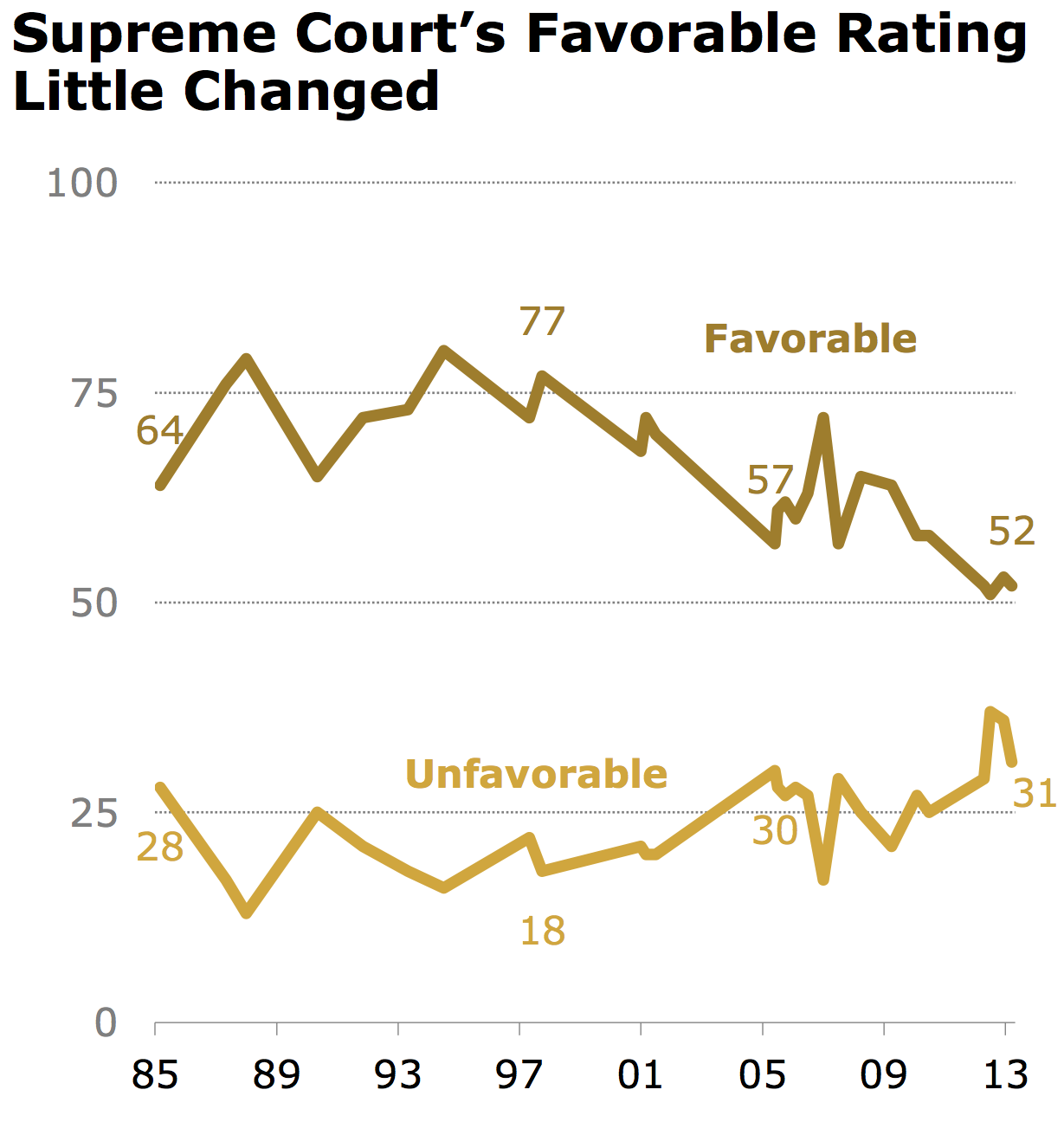
SCOTUS Favorables

Al Tompkins can’t understand why Americans don’t demand televised access to Supreme Court arguments:

Last year, the court decided the future of the nation’s health care system. In 2000, it effectively decided who would be president. The public can’t witness these decisions being made because, as Justices Stephen Breyer and Anthony Kennedy have suggested, people might not understand the complex work of the court, cameras could hurt the dynamics of the court, and someone might mug for the camera. … It reminds me of the Wicked Witch of the West saying to Dorothy: “These things must be done delicately or you hurt the spell.” I think justices — presumably some of the most honorable citizens among us — can control their behavior on the bench and resist the “insidious dynamic” that a camera might produce.

It might help SCOTUS’s public image as well:

Just this week, a new Pew survey shows the Supreme Court’s favorability rating is near a historic low. The court should not concern itself with popularity polls, but it should concern itself with public trust. Nothing builds trust like openness. Nothing builds openness more than access. It is time to reverse a 41-year ban on cameras in courtrooms.

The Public Defender Deficit, Ctd

A reader writes:

Comparing the budgets of a public defenders’ office to a prosecutors’ office is a false equivalence. I work as a state-level prosecutor in a small county. Public defenders only get involved in a case after someone gets charged with a crime. Prosecutors spend a good part of their day involved in investigations that never lead to charges (things like reviewing search warrants, interviewing witnesses, and discussing cases with officers where we decline to prosecute). The State has substantial discovery obligations in each case, which means the production of hundreds of pages of documents and a support staff to handle those requirements. In only a fraction of cases does the defense disclose anything through the discovery process. Keep in mind that the State has both the burden of proof and production in criminal cases while the defense has none. It’s not uncommon for the State to arrange for and call dozens of witnesses in a case and for the defense to call none. It’s a lot more expensive to build a house than tear one down.

Another agrees that the comparison is “grossly misleading”:

As that final sentence in that post shows, there are private defense attorneys where there is no private prosecutorial function. By definition all criminal prosecution is handled by the government. So even if you have some form of functional parity, you would naturally have more headcount and funding for public prosecutors than for public defenders, because a great deal of total criminal defense work is handled by private attorneys.

I’m not disagreeing that there are serious concerns with staffing and resourcing in criminal justice. In fact, as the husband of a prosecutor, I strongly support increased funding on both sides, and of the court system itself, in the interest of speedy trials and fair justice. Far from favoring prosecution (and here is where my bias may interject), budget and staffing cuts means that prosecutors are constantly walking away from cases they don’t feel as confident about or don’t have the time anymore to pursue. That’s an automatic win for the defense. So to think that lousy budgets only helps prosecution is wrong. Budget cuts means a lot of criminals just don’t go to trial.

That’s just my humble dissent on an issue that hits close to home. I sometimes rankle when people get anti-prosecutor because of the ridiculous implication that they spend all day locking up minorities out of malice or careerism. These are attorneys who are making far less money than their private sector peers to engage in public service. I wish people knew the number of domestic battery, rape, poaching, child porn, child abuse, human trafficking etc. work that these bright attorneys take on. Seeing this evidence is not easy on the prosecutors or the families who support them. But someone has to stand and represent the People, and fight for justice and for the victims. When prosecutors are underfunded, the defense is underfunded, and the courts are underfunded, that doesn’t always happen.