
Waiting For An Arab Sexual Revolution

TO GO WITH Lifestyle-Gulf-Bahrain-social

Reviewing Sex and the Citadel: Intimate Life in a Changing Arab World by Shereen El Feki, The Economist compares the region’s early attitudes toward sex to today’s repressive atmosphere:

Once upon a time things were different. The Prophet Muhammad urged his followers to satisfy their partners in the bedroom. Prudish medieval Christians despised his detailed advice on the ins and outs of sex as “a cunning ploy to win converts”, which undermine their own faith’s fixation on virginity, chastity and monogamy. When Gustave Flaubert travelled to Egypt in the 19th century, he spent hazy days watching bawdy skits on the streets of Cairo about “whores and buggering donkeys”, and fleshy nights enjoying the local prostitutes.

Today East and West have shifted positions. The West, in the eyes of Islamic conservatives at least, is a “cesspit of sexual chaos and moral decay”. Sex in the Arab world is, theoretically at least, confined to “state-registered, family-approved, religiously sanctioned matrimony”.

But in practice, young men and women are hardly as prude as their culture dictates:

In the Arab world, explains an Egyptian gynaecologist, sex is the opposite of sport: “everyone talks about football, but hardly anyone plays it. But sex—everyone is doing it, but nobody wants to talk about it.” As a result young Arabs are painfully ignorant about it. Rania, a doctor, sits in a basement in Cairo operating a helpline for confused teenagers, patiently answering questions about anything from masturbation to whether washing boys’ and girls’ underwear together can lead to pregnancy.

(Photo: Bahraini sex shop owner Khadija Ahmed shows a lingerie item being sold at her shop in Isa, north of the capital Manama, on May 19, 2010. ‘Darkhadija’ appears to be just another lingerie shop from outside, but it actually is the first sex shop in the kingdom of Bahrain. By Adam Jan/AFP/Getty Images)

Did The War Cause The Recession?

Maybe:

I argue that the choice to finance the War on Terror by borrowing rather than by raising taxes worsened the US external imbalance and the resulting “capital flow bonanza” triggered the US credit boom. The credit boom generated the asset bubble the deflation of which generated the great global crisis from which we are still recovering. Obviously, it takes a lot of heavy lifting to get from the war-related budget deficit to the global financial and economic crisis.

(Hat tip: Farrell)

Quote For The Day

“What future commentators write about me (if they write about me at all which I doubt) when I am dead won’t matter much. I will by then be in the hands of a Judge both just and (thankfully) merciful, a world where truth counts. I’m not triumphal about that fact, I suspect we will all be surprised to discover first-hand how dark the sins we justified in this world really are — when our self-imposed veils of ignorance are removed. We’ll see how much we all require mercy. In the meantime let’s love each other as best we can, but always, always in truth,” – Maggie Gallagher, my friend.

The Brits And The Jews

Jenny Diski, a British Jew, examines the UK’s lingering bigotry:

Gilbert-ShylockAt a middle-class dinner table (my own, actually) I have listened to an hilarious recounting, by people with long English heritages, of attending a Jewish wedding, and the awful clothes, the bling, the raucous voices and excessive bad taste they had to put up with. The sister and brother-in-law of my best friend came directly from Sunday lunch at a restaurant and regaled us with a description of ‘the Jews’ at the next table who wore so much gold jewellery that they clanked as they scoffed food too fast and shrieked at each other about how much money they’d made that week. Surprisingly often, on social occasions, I have had apparently regular, intelligent people explain to me that ‘the Jews’ run the media and prevent various kinds of truth being told; and once I was told by a painter that good reviews of art by non-Jewish painters were excluded from publication by Jewish editors and newspaper owners. All these things are said with the assumption that they were only confirming what the rest of the company already know.

The definitive history of British anti-Semitism is Anthony Julius’s masterpiece, “Trials of the Diaspora: A History of Anti-Semitism in England.” George Orwell’s discussion of the topic is here. Money quote:

The Jew who grew up in Whitechapel took it for granted that he would be assaulted, or at least hooted at, if he ventured into one of the Christian slums nearby, and the “Jew joke” of the 516px-Fagin_from_Oliver_Twistmusic halls and the comic papers was almost consistently ill-natured. There was also literary Jew-baiting, which in the hands of Belloc, Chesterton and their followers reached an almost continental level of scurrility. Non-Catholic writers were sometimes guilty of the same thing in a milder form. There has been a perceptible antisemitic strain in English literature from Chaucer onwards, and without even getting up from this table to consult a book I can think of passages which if written now would be stigmatised as antisemitism, in the works of Shakespeare, Smollett, Thackeray, Bernard Shaw, H. G. Wells, T. S. Eliot, Aldous Huxley and various others. Offhand, the only English writers I can think of who, before the days of Hitler, made a definite effort to stick up for Jews are Dickens and Charles Reade. And however little the average intellectual may have agreed with the opinions of Belloc and Chesterton, he did not acutely disapprove of them. Chesterton’s endless tirades against Jews, which he thrust into stories and essays upon the flimsiest pretexts, never got him into trouble — indeed Chesterton was one of the most generally respected figures in English literary life. Anyone who wrote in that strain now would bring down a storm of abuse upon himself, or more probably would find it impossible to get his writings published.

Chesterton is a huge figure on the theocon right. I’ve never read a theocon exploration of his anti-Semitism, but I may have missed it.

(Illustrations: Shylock After The Trial, by John Gilbert. Fagin waits to be hanged, from Oliver Twist, by Charles Dickens.)

Faces Of The Day

lesbian-couple-jet-magazine

From the Queer Museum, the story behind this photo from 1970:

Edna Knowles, on the left, and Peaches Stevens were wed in Liz’s Mark III Lounge, a gay bar on the South Side of Chicago, “before a host of friends and well wishers.” The article ended by noting, “although the duo has a type of ‘marriage license’ in their possession, the state’s official marriage license bureau reported it had no record of their license.” This ending serves to remind Jet readers that Knowles and Stevens’ union was not legitimate in the eyes of the state, as does the use of quotes around the word “married” in the headline.

However, decades prior to this bold public display of queer affection, African American female couples in New York strategized alternative ways to obtain marriage licenses in the 1920s and 30s:

“Marriage ceremonies were held with large wedding parties which included several bridesmaids, attendants, and other wedding party members. Actual marriage licenses were obtained by either masculinizing the first name, or having a gay male surrogate obtain the license for the marrying couple. These marriage licenses were placed on file with the New York City Marriage Bureau.” – Luvenia Pinson, “The Black Lesbian: Times Past-Time Present,” Womanews, May 1980  p. 8.

This is very new from the point of view of legal and heterosexual America. But marriage between two people of the same gender is as old as gay and therefore human history.

How Common Is Gay Rape?

How one reader responded to the convictions in Steubenville:

I hope you take this as a serious question and I hope it doesn’t offend you. As a father of two girls something like this happening to one on my daughters always lurked in my mind. Getting drunk, losing control and then God knows what happens. As a father of a son I always prayed that I had raised my son with the proper values and respect for women that didn’t fly out the window in a rush of drunken, drug-induced rush of teenage hormones.

So here is my question: Does something like this happen at gay gatherings or parties? Is there gay rape that goes unreported due to embarrassment and maybe the fact that the victim’s family may not know he or she is gay? Do these horrible incidents have the same frequency of occurrence in the gay culture as straight? Maybe this is something you might devote a thread to. I have never heard the subject discussed.

A 2003 Guardian report provides some perspective on the underreported crime:

Hundreds of men have been attacked after their drinks were spiked with ‘date-rape’ drugs by gangs targeting victims in pubs and clubs across Britain. At least three men are thought to have fallen victim to a gang last month after being approached by an apparently friendly stranger. It is believed their drinks were spiked with the ‘date-rape’ drug GHB before the victims were taken elsewhere and attacked. At least one of the victims was drinking in a mainstream pub when he was targeted, but the others were approached in gay venues.

Graham Rhodes, chief executive of the Roofie Foundation, a charity for victims of drug-rape, said: ‘Men are the victim in 10 to 15 per cent of cases reported to us. That is 730 cases. Nearly always the perpetrator is male and in these cases there is a much higher proportion of gang rape.’ … Rape is often portrayed as a crime against women only and cases are rarely reported by gay men. Keith Cowen, community safety spokesperson for the gay rights charity Outright Scotland, said: ‘This is a huge problem for every one. We spoke to people at sexual health clinics and they are telling us it happens all the time – among heterosexuals and among gay people.

The Dish: Now Just $1.99 A Month! Ctd

199reax

As we promised from the beginning of the new venture, feedback from readers at every stage:

Something clicked for me with the rollout of your monthly payment option. I’ve been reading the Dish for a thousand years and it’s only now that I can treat it the way I treat NPR – something I depend on every day, but pay for every month. There’s something seriously satisfying about doling it out this way, and it turns out it’s not the free tote bag. I don’t know how many others will have this sort of reaction, but it was a sudden and beautiful solution to a problem I didn’t even know I had. And best of all, I can still feel that smug elitism that comes from knowing I’m one of those people paying for what all those freeloaders are getting for free.

The tote bag would help, though. You know. Just saying. If you have one around. Doesn’t have to be nice, I’m just going to use it for groceries. Just putting that out there.

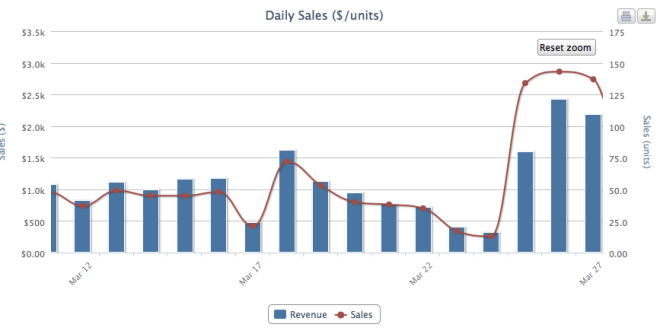
On the full disclosure front, here’s the impact of adding the $1.99 option a month in the last week:
Screen shot 2013-03-28 at 12.53.43 PM

That suggests to me that we made the right call. We’ve shifted the daily revenue from the $1K range to $2K, and new subscribers from around 50 a day to around 100. That will surely go down in time, and may be distorted by a big news week – but it’s encouraging for now. Another reader:

I’d like to see an economist or finance analyst look at your monthly pricing, but my instinct is that you underpriced it by a dollar.

At $1.99, the person is paying just about the suggested subscription price.  Why bother to subscribe – you can graze forever and skip some months etc.  I understand you want to nudge people to start paying, but you need a little more pain.  At $2.99, the person is spending 50% more than a straight subscription, but the price is low enough to get someone to decide he or she might as well pay for the subscription. Those of us who bought subscriptions are also buying into the idea that you need to pay for web content that is high quality, edited, thoughtful etc.  Your pricing should reward the committed, not the grazers (but allow for grazing at a surcharge).

We like the simplicity of $19.99 a year or $1.99 a month (or more if you want to set your own price). Another:

Just read your $1.99 subscription post and it made me wonder if you have an option for us to give monthly/annual gift subscriptions? (I subscribed in February, so I don’t recall if that was an option.) In this day and age when so many of us have way too much stuff and we don’t need one more thing, I have found magazine/newspaper subscriptions to be terrific gifts.

Gifting is definitely in the works. Another:

I think if the Dish really wants to start doing long-form journalism and if you guys really want to be more ambitious you cannot rely on just reader support alone. At this point I would be honestly surprised if you managed to reach 900k by the end of the year. My question is, why don’t you just follow the model of Pandora.com or spotify? Have advertisements for the people who have not subscribed to the blog and none for those who have not subscribed. You’ll generate some revenue and it’s more then fair. The fact is the limit is easy to get around and how many newspapers or magazines have ever been fully supported just by readers? A reader support base is just too unstable to rely upon in the long term.

We have been thinking over that option as well. Another:

Wintery economic conditions, even at the $1.99 level (which I realize with a certain sober fright), have prevented me from joining the “New Model.” As an every day reader and supporter of e journalism with all it’s warts, I fully intend to hand over my money and will do so proudly once my financial outlook seems less dire.

But please STOP saying “this may not work.” As much as I appreciate your candor and humility, I think you often stay the hand with such statements. I wonder if I’m going to be the last dope who pays before the site winds up back on the Beast. Perhaps a little conviction? Burn that bridge. Take off those training wheels.

Or maybe you’d be better off not taking advice from someone who can’t find $1.99 a month to rub together.

Another:

I really don’t mean to show a lack of empathy for anyone out there, but I’m pretty shocked that any significant number of your readers – who in general are well-educated professionals on the average – can’t pony up $20 in cash for your site and need $1.99/month. If that is really the reason many aren’t subscribing, may I just say … budget? Check out www.youneedabudget.com for a great program. There’s no reason people shouldn’t be able to come up with $20 for something they want. We aren’t talking about a huge sum here: we’re talking about the price of 2 movie tickets.

(Full disclosure: I have not subscribed. But not because I can’t find the money, I’m still not convinced it’s worth my money right now. I’m sure there are readers who can’t spare $20, and I feel for them; but I also suspect many can’t find the $20 because they’re bad at managing their cash. Budget, people. Budget.)

(Dish readers’ Gmail profiles pics used with permission)

Greater Israel Watch

Here’s a statistic worth pondering:

Over the past 33 years the Civil Administration has allocated less than one percent of state land in the West Bank to Palestinians, compared to 38 percent to settlers, according to the agency’s own documents submitted to the High Court of Justice.

It took a while to get this information from the Jewish state. As usual, Israelis – not American Jews – forced the issue. Meanwhile, AIPAC’s successful strangling of Obama’s attempt at peace-making has borne fruit:

The number of approvals for home construction plans in the settlements leaped in 2012 compared with the two previous years, says the Israeli non-governmental organization Peace Now. Building plans for 6,676 residential units were approved in 2012, the vast majority in settlements east of the fence. This represents a huge increase from 1,607 housing units approved for construction in 2011 and the several hundred housing units approved in 2010.

When you look at the details, all you can do is marvel at how the Greater Israel Lobby can still maintain a straight face and say it wants peace via a two-state solution. They’re world-class bullshitters:

The Civil Administration subsequently provided the court with the following details: 671,000 dunams of state land is still held by the state. Another 400,000 dunams were allocated to the World Zionist Organization. Most of the Jewish settlements, both residences and agricultural land, are on this land.

Another 103,000 dunams of state land were allocated to mobile communications companies and to local governments, mainly for the construction of public buildings.

Utilities such as the Mekorot water company, the Bezek communications company and the Israel Electric Corporation received 160,000 dunams, 12 percent of the total state land in the West Bank.

Palestinians have received a total of 8,600 dunams ‏(2,150 acres‏), or 0.7 percent of state land in the West Bank.