The Long Journey From Execution To Marriage

If SCOTUS punts, Linda Hirshman won’t be discouraged:

[I]n Poe v. Ullman, Justice Harlan’s dissent from the Court’s standing decision was a rough draft for his opinion four years later in Griswold, and, indeed, is one of the most-cited and influential opinions in the modern era. If the Court votes to duck on Perry, it may very well happen that Justice Ginsburg will write a similarly persuasive dissent. This feminist luminary cannot be pleased to see her egalitarian writings about the abortion case used to urge the Court, as several legal commentators have done, to withhold equal protection from another disadvantaged group like gay and lesbian people. Although she says she is staying on, time passes, and she is unlikely to see another case of this magnitude directly in the area of her legacy.
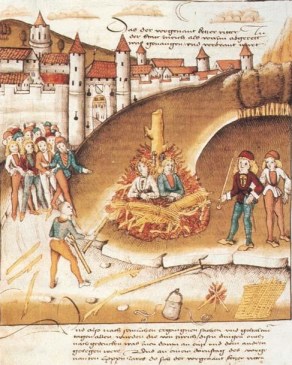
burning_of_sodomites

While we are still on the topic, I recommend David von Drehle’s time-line of the movement from its very beginnings. (Also a must-read: a profile of Mary Bonauto, truly our Thurgood Marshall.) I’m particularlygrateful for the mention of Jeb Boswell, the astonishingly brilliant Yale historian whose book, Christianity, Homosexuality and Social Tolerance, lit the same fire in me as it did Even Wolfson, when we were both coming of age. It’s a world-shifting book, and all I can say is that I wish he’d had time to perfect his subsequent book on early same-sex unions in Christianity. He died of AIDS, like much of his generation. But the texts he found for Christian rites of union for two people of same gender were never in dispute as artifacts – just in dispute as to cultural meaning. Aaron and I used a prayer from an 8th century male-male union rite in our own wedding.

But when I say “very beginnings”, I mean simply the legal and cultural shift in the US from the early 1990s onwards. There’s a dangerous tendency to believe that somehow, this was the first time in human history that gay people had sought marriage, or deemed themselves worthy of it. That’s not true – and my anthology finds examples from 14th century China to Native American culture to African matriarchies. Here is Montaigne, writing in the late 16th Century, of an incident he had heard of:

On my return from Saint Peter’s I met a man who informed me humorously of two things: that the Portuguese made their obeisance in Passion week; and then, that on this same day the station was at San Giovanna Porta Latina, in which church a few years before certain Portuguese had entered into a strange brotherhood.

They married one another, male to male, at Mass, with the same ceremonies with which we perform our marriages, read the same marriage Gospel service, and then went to bed and lived together. The Roman wits said that because in the other conjunction, of male and female, this circumstance of marriage alone makes it legitimate, it had seemed to these sharp folk that this other action would become equally legitimate if they authorized it with ceremonies and mysteries of the Church.

Eight or nine Portuguese of this fine sect were burned.

“This fine sect”… “these sharp folk”. Montaigne was one of the first supporters of marriage equality. But he had to tell us in code. As we congratulate ourselves, let us recall the profound pain this stigmatization caused for so many throughout history, and the brutal repression they had to endure – even being burned alive for seizing their own destiny and declaring the church their own.

(Illustration: Burning of two sodomites at the stake outside Zürich, 1482, by Spiezer Schilling)

How The Democrats Have Evolved

In the below video, various Democrats rail against marriage equality. Given her recent change of heart, Hillary Clinton’s 2004 speech is particularly jarring – but not surprising – to watch:

This embed is invalid


Weigel comments:

The new Democratic advocates for SSM fall into two camps. The first consists of people who always liked the idea of this but worried about losing national elections. In his memoir, Democratic consultant Bob Shrum remembers John Kerry fretting that the Massachusetts Supreme Court had forced Democrats to talk about gay marriage before they were ready to. “Why couldn’t they just wait a year?” he asked Shrum, mournfully. The second camp consists of people who really do oppose the idea of gay people getting married. Republicans argued that this second camp was tiny, and that liberals were hiding behind it. They were right!

I’m not so sure. But Kerry’s position was that of most of the Democratic pols and they were backed up through the 1990s by the Human Rights Campaign, who wanted nothing more than to kill this issue they deemed premature (while their number one goal back then, the Employment Non-Discrimination Act, remains unaccomplished). In some ways, I find the opportunism of the Clintons – who did more substantive harm to gay people in eight years than any other administration – more disgusting than the fundamentalist hostility. At least the Christianists were sincere. The Clintons have always been phonies and opportunists and for Bill Clinton to proclaim the sanctity of marriage and sign DOMA while cigar-fucking his intern tells you a lot about him. On no issue were they as shameless as on this one – portraying themselves as civil rights advocates while kicking those of us fighting for equality squarely in the groin.

The former president still refuses to apologize for what he did to us. He cannot own it. But history will.

American Royalists

Mark Dery, author of England My England: Anglophilia Explained, ponders America’s supermarket-tabloid monarchism:

The American infatuation with the inbred members of a small, stunted Anglo-Teutonic family, sustained as a kind of a curiosity by the good-natured charity of the British people, is as complex as it is perverse. It has something to do with the comparative brevity of our history, as opposed to the storied traditions of the mother country, and something to do with a yearning, weirdly, for the feudal hierarchies swept away by capitalism and industrialism (as Marx famously noted), which result in a sociocultural disorientation — a class vertigo, so to speak — that makes some Americans yearn for a world where everyone knows his place, even if that sense of community and identity is purchased at the price of a boot on your neck.

Or a dowager on your television.

A Bigger Fig-Leaf For The Atlantic

The Atlantic, to their credit, appear to be beefing up the difference between their corporate propaganda masquerading as editorial product and their actual editorial product. Here’s the first iteration of their whored-out-to-corporations model:

Screen shot 2013-03-27 at 11.52.35 AM

And here’s the new version:

Screen shot 2013-03-27 at 11.53.47 AM

Notice the new yellow Atlantic banner; how the Sponsor Content label has been increased in size and punch. Better still, we have this disclaimer after the by-line:

Screen shot 2013-03-27 at 11.59.02 AM

That’s all good news. I hope others follow if they have to pursue this revenue model.

An Expensive Leather Fetish

In the past few years, Buzz Bissinger spent $638,412.97 on high-end clothing, primarily leather products:

I bought at least a dozen items that cost over $5,000 each but did not fit, the hazard of online purchasing, since sizing by high-end retailers is often like Pin the Tail on the Donkey. I bought items I wore once, or never wore at all, the tags still hanging from the collar. Yet I returned very little: The more the closets in the house filled, the more discerning I became, the more expensive the items, the more I got off on what I had amassed.

Fallows calls Bissinger’s article “one of the most subtly skillful and elaborate April Fool’s Day hoaxes anyone has ever pulled off … or one of the most unintentionally embarrassing, you-have-to-turn-away-because-it’s-cruel-to-keep-watching acts of unaware self-humiliation anyone has ever committed.” Dodai Stewart notes how the piece upends gender roles:

“Shop til you drop” is assumed to be the battle cry of giggling gals; for every sneakerhead dude hellbent on acquiring Airforce Ones, there’s a Mariah or Kimora or Imelda Marcos with a truly obsessive collection. But of course men shop. And of course men shop to excess. But drop the phrases “shopaholic” or “shopping addict” in a conversation and the average person will assume said shopper is female.

Alyssa adds:

Bissinger is not wrong to argue that there’s powerful, unexplored territory out there when it comes to men, fashion, and the presentation of their sexuality. He’s just missing the fact that it’s not just his personal style, but powerful business interests, that are going to push that discussion forward—and in ways that he and other men might find as difficult and uncomfortable as women have for years.


Is Farmland Peaking?

Peak Farmland

Ronald Bailey passes along research (pdf) on “peak farmland,” the point at which the amount of land we need to feed the world population begins to decline. This farmland decrease is possible because the amount of crop produced per hectare is increasing at a faster rate than the global population:

Cranking various population, economic growth, and [crop] yield trends through the ImPACT equation, the authors conservatively conclude that in 2060 “some 146 million hectares could be restored to Nature, an area equal to one and half times the size of Egypt, two and half times France, or ten times Iowa.” Under a slightly more optimistic scenario—one where population growth slows a bit more, people choose to eat somewhat less meat, agricultural productivity is modestly higher, and there’s less demand for biofuels—would spare an additional 256 million hectares from the plow. That would mean nearly 400 million hectares restored to nature but 2060, an area nearly double the size of the United States east of the Mississippi River.

Federalism’s Double-Edged Sword

Tom Goldstein explains how using states’ rights to strike down DOMA could box in SCOTUS on Prop 8:

[I]f DOMA is going to be decided as a federalism case, Hollingsworth [v. Perry] becomes a much harder case for the plaintiffs. That ruling in Windsor implies that California should have a parallel right to decide the definition of marriage for itself – i.e., that Proposition 8 should be upheld.

In fact, there is a realistic chance that the Court’s most conservative Justices understood that dynamic from the beginning and for that reason voted to grant certiorari in Hollinsgworth. In effect, they would put the Court in the box fully grappling with the implications of a ruling invalidating DOMA. To then also invalidate Proposition 8, the Court would have to go quite far in applying heightened scrutiny and invalidating the traditional definition of marriage, notwithstanding its professed concerns for states’ rights.

The Marijuana Movement Keeps Growing

California Legalization

Abby Rapoport examines the efforts of marijuana reformers:

The next big question for activists will be whether to start more initiative campaigns for 2014 or whether to wait until the next presidential election. [Mason] Tvert [co-director of the initiative campaign in Colorado] advocates focusing on the legislative level for now, and says the initiative process shouldn’t be tried again until the next presidential election—when turnout is higher across the political spectrum. Midterm elections tend to rev up groups out of power—currently the conservative base. Not everyone is willing to wait, though. In Florida, two big Democratic fundraisers have announced their intention to help get a medical-marijuana initiative on the ballot in 2014. According to [Allen] St. Pierre [executive director of NORML], legalization efforts—like the ones that passed in Washington and Colorado—are in full swing in California, Massachusetts, Maine, and Oregon, where a similar measure failed in 2012. “We already have lots of grassroots on the ground and all of those states ready to rock,” he says.

(Screenshot from (pdf) a recent California field poll.)

Are Prenups Pernicious? Ctd

A reader writes:

You will probably get a flood of emails on this issue.  I speak from experience on this.  In my first marriage I had no prenup.  It was a brief marriage of a couple of years between two naive fools with almost no money.  Both my wife and I had a combined income at the time (early ’90s) of about $25k.  But in the divorce judgment (in a “no-fault” divorce state) I got creamed, forced to cough up $500/month in alimony to a working woman with more education that I had, for no discernible reason other than the fact that I was a man.  I could barely pay my rent and eat for a period of time, until she married another guy.

In my current marriage I insisted on a prenup.  People were perplexed because my current wife earns far more money than I do.  Why would I need protection when she has more than I?  They also presumed that prenup’s are for the very wealthy – millionaires who don’t want to lose half the fortunes they earned before getting married.  But I always make a couple of points to the naysayers:

1) Never presume a divorce judge is going to be fair or rational – as was made clearly evident in my divorce.  2) When you enter divorce proceeding without a prenup, you risk all of your future earnings.  That means a percentage (or fixed amount) of your future income could be claimed by someone else for the rest of your life.  This is where the assumption that prenups are for “rich people” falls apart.  If a movie star earning millions per year has to give up half of that to an ex-spouse, he still has millions left over with which to live his life and save for retirement.  But if someone in poverty level income brackets gets shafted and forced to pay out a large percentage of his income to an ex-spouse, it could be the tipping point to starvation or homelessness.

Prenups should not only be encouraged for younger and low-income betrothed; they should be required by law.

A Potemkin Marriage?

Emily Nussbaum is intrigued by the conceit of FX’s The Americans, in which KGB agents Philip and Elizabeth Jennings attempt to pass as a typical American family:

As with [“Homeland”], many scenes in “The Americans” are meditations on espionage, which requires its disciples to sublimate human decency to larger moral imperatives. Yet despite the sleek surface and fun retro aspects (Jordache jeans, VCRs, landlines), setting the show in the Reagan era is more than a gimmick. With historical distance, “The Americans” has the freedom to sympathetically portray characters who, on a different show, would be hissing terrorists.

Jesse Damiani recently called it the most compelling romance on television:

What separates The Americans [from other anti-hero dramas] is its foregrounding of the simplest device in the history of narrative: love. In effect, The Americans is an extended remarriage plot. Sure, it’s replete with the trappings of espionage, but all the mad chases, brutality, and political intrigue function in service of its romantic core. What leaves viewers clinging to their armrests in these moments of pulpy thrill is the underlying terror that, at any moment, the fledgling relationship between protagonists Philip and Elizabeth Jennings (played by Matthew Rhys and Keri Russell), will suffer a blow—whether physically, emotionally, or both—that it cannot survive.
