Ethical Shopping 101

Though sweatshops remain a fact of the global garment industry, Jake Blumgart notes that there is one market where the anti-sweatshop movement has been making progress – college apparel:

Universities contract with garment companies to produce their branded apparel and students have points of leverage that are unavailable to most consumers, allowing them to more easily hold companies accountable for abuses that take place within their supply chains. Student groups like the United Students Against Sweatshops (USAS) have been able to pressure universities and colleges to force their suppliers to accept independent inspections from organizations like the Workers Rights Consortium, and make the necessary improvements (or else lose a highly lucrative dedicated market).

In 2009, for example, Russell Athletic rehired 1,200 Honduran workers who had been fired after organizing a union and agreed to allow unionization in other factories after a sustained student campaign that resulted in many university and college administrations suspending contracts with the company. No comparative arrangement exists for consumers outside the higher education sector, because they lack a direct relationship to the retail institutions where they purchase apparel and because it is much harder to organize consumers outside of a small geographic area like, say, a campus.

Waste Yes, Want Not

Natalie Shapero explains the original purpose of butter sculptures:

[Pamela Simpson, author of Corn Palaces and Butter Queens] does a nice job of tracing these installations back to a period in the 1870s when Kansas, then recently plagued by drought, was desperate to prove the vitality of its crops to the rest of the country by embracing what now seems crass and misguided. Enormous and enormously wasteful displays–the U.S. Capitol rendered in apples, a multigrain Liberty Bell with a gourd for a clapper–seemed the best way to say to the country, “Buy some land in Kansas, and you’ll have more crops than you know what to do with.”

(Photo of a butter sculpture by Flickr user pwbaker)

Graduating Everyone Early

Reuven Brenner claims that shortening college would have major economic benefits:

There are at least 16 million youngsters enrolled in post-secondary education, with approximately 4 million graduating every year. Assume that from now on, each year, 4 million students join the labor force a year earlier. Each generation would stay one year longer in the labor force. How much annual income and how much wealth would this generate?

Assume that after graduation the average salary would be just $20,000 and remain there. With 4 million students finishing one year earlier, this would add $80 billion to the national income during that year. Or at an average annual income of $40,000, it would add $160 billion. Assume now that the additional $80 billion in national income would be compounding at 7 percent over the next 40 years. This would then amount to an additional $1.2 trillion of wealth – for just one generation of 4 million students joining the labor force a year earlier at a $20,000 salary. At $40,000, this would amount to $2.4 trillion by the fortieth year – again, for just one generation of 4 million people joining the labor force a year earlier. The added wealth depends on how rosy one makes the assumptions about salaries or compounding rates. Add 10, 20, or 30 generations, each starting to work a year earlier, and the numbers run into the tens of trillions of dollars.

The Daily Wrap

US-JUSTICE-GAY-MARRIAGE

Today on the Dish, Andrew dove into the arguments in today’s DOMA hearingencouraged anti-equality advocates to lead by example rather than oppressing others, and applauded the influence of the younger generation on their parents. Elsewhere, he prophesied a dismal future in journalism and refused to look away from the ongoing violence in Syria, which has now spilled over into Lebanon.

In Supreme Court coverage, Jon Rauch searched for a graceful out for the justices on Prop 8, while Dale Carpenter predicted an inconclusive ruling and we peeked into the courtroom as readers looked for a comprehensive ruling. NOM blew a tone-deaf dog-whistle, Nate Cohn lowered his expectations for the South’s support of marriage equality, and a trickle of equality endorsements turned into a flood, while we wondered who would be next. SCOTUSBlog gave us the odds on DOMA, Kennedy got right to the key point, and Ari Ezra Waldman explained why the “standing” issue applies for DOMA. While Ezra Klein found plenty of children who could benefit from a stable household, Edie Windsor overcame discrimination, with or without the government’s approval, and provided us with an enthusiastic FOTD.

In assorted news, Tony Dodge argued that the Iraqi Civil War was avoidable, readers waded into the debate over graphic war imagery as we explored blood-phobia, and technology made medical cost projections impossible to trust. Gary Becker tied immigration to the birth rate below the border, the recession forced families to call hotels home, Silicon Valley struggled with sexism, and readers disputed the comparison of Weez’s hacking and entering an unlocked house.

Meanwhile, an edibles maker chimed in on mellow highs, John Jeremiah Sullivan revealed our ignorance of animal consciousness, and two British papers joined the ranks of the metered. Channing Tatum gave George Clooney the thumbs up, TV watchers exercised their control, and Game of Thrones gave us a fantastic history lesson. We traveled to the Great White North in the VFYW, bopped with a big baby in the MHB, and VFYW contestants homed in on Hastings-on-Hudson.

D.A.

(Photo: Plaintiff of the US v. Windsor case challenging the constitutionality of Section 3 of DOMA, 83-year-old widow Edie Windsor, shows a diamond pin which her wife Thea gave as engagement gift as she makes a statement to the media in front the Supreme Court on March 27, 2013 in Washington, DC. By Jewel Samad/AFP/Getty Images)

The Animal Mind

John Jeremiah Sullivan surveys how our understanding of animal consciousness has evolved:

If we put aside the self-awareness standard—and really, how arbitrary and arrogant is that, to take the attribute of consciousness we happen to possess over all creatures and set it atop the hierarchy, proclaiming it the very definition of consciousness (Georg Christoph Lichtenberg wrote something wise in his notebooks, to the effect of: only a man can draw a self-portrait, but only a man wants to)—it becomes possible to say at least the following: the overwhelming tendency of all this scientific work, of its results, has been toward more consciousness. More species having it, and species having more of it than assumed. This was made boldly clear when the “Cambridge Declaration on Consciousness” pointed out that those “neurological substrates” necessary for consciousness (whatever “consciousness” is) belong to “all mammals and birds, and many other creatures, including octopuses.” The animal kingdom is symphonic with mental activity, and of its millions of wavelengths, we’re born able to understand the minutest sliver. The least we can do is have a proper respect for our ignorance.

When Fantasy Reveals Truth

Tom Holland praises the way Game of Thrones author George R.R. Martin weaves disparate strands of history into a cohesive whole:

Game of Thrones is fantasy’s equivalent of a perfect cocktail. Elements drawn from the hundred years war and the Italian Renaissance, from Chrétien de Troyes and Icelandic epic, fuse to seamless effect. The measure of how credible – on its own terms – people find Martin’s alternative history is precisely the phenomenal scale of its popularity. The appeal of Westeros is less that it is fantastical than that it seems so richly, so vividly, so brutally real. …

The result, paradoxically, is that there are sequences where the invented world of Westeros can seem more realistic than the evocations of the past to be found in many a historical novel.

No fiction set in the 14th century, for instance, has ever rivalled the portrayal in Game of Thrones of what, for a hapless peasantry, the ambitions of rival kings were liable to mean in practice: the depredations of écorcheurs; rape and torture; the long, slow agonies of famine. The pleasures of historical fiction and of authentic, adrenaline-charged suspense, of not knowing who will triumph and who will perish, have never before been so brilliantly combined. Imagine watching a drama set in the wars of the roses, or at the court of Henry VIII, and having absolutely no idea what is due to happen. No wonder Game of Thrones has been such a success – and that historians can relish it as much as anyone.

Was The Iraq Civil War Inevitable?

Maybe not:

[Toby Dodge, author of Iraq: From War to a New Authoritarianism] puts quickly to rest the notion that Iraq’s unique ethnic and sectarian mix—about 60% Shia Muslim, 20% Sunni Muslim and 15% Kurdish, along with many smaller minorities—predestined the country to strife. He argues persuasively that the underlying cause of the bloodletting, which still continues on a reduced scale, was the collapse of the Iraqi state. This created the social stress and acceptance of violence that allowed what he calls “ethnic entrepreneurs”—political manipulators of sectarians fears—to flourish.

A Heart Attack Early Warning System, Ctd

Ezra Klein responds to the new technology that may be able to predict heart attacks:

Consider how dramatically these devices will change medicine. Right now, the medical industry is fundamentally reactive. Something goes wrong, and we go to them to fix it. This will make medicine fundamentally proactive. They will see something going wrong, and they will intervene to stop it. It’s like “Minority Report” for health care.

This is why I don’t put much stock in projections of health-care spending that run 30 or 50 or 75 years into the future. Will biometric devices in constant communication with the cloud make medicine more or less expensive? Will driverless cars prolong life in a way that saves money or costs it? Will the advances in preventive technology make medicine so effective that we’re glad to devote 40 percent of gross domestic product to it? Who knows?

How Graphic Should War Coverage Be? Ctd

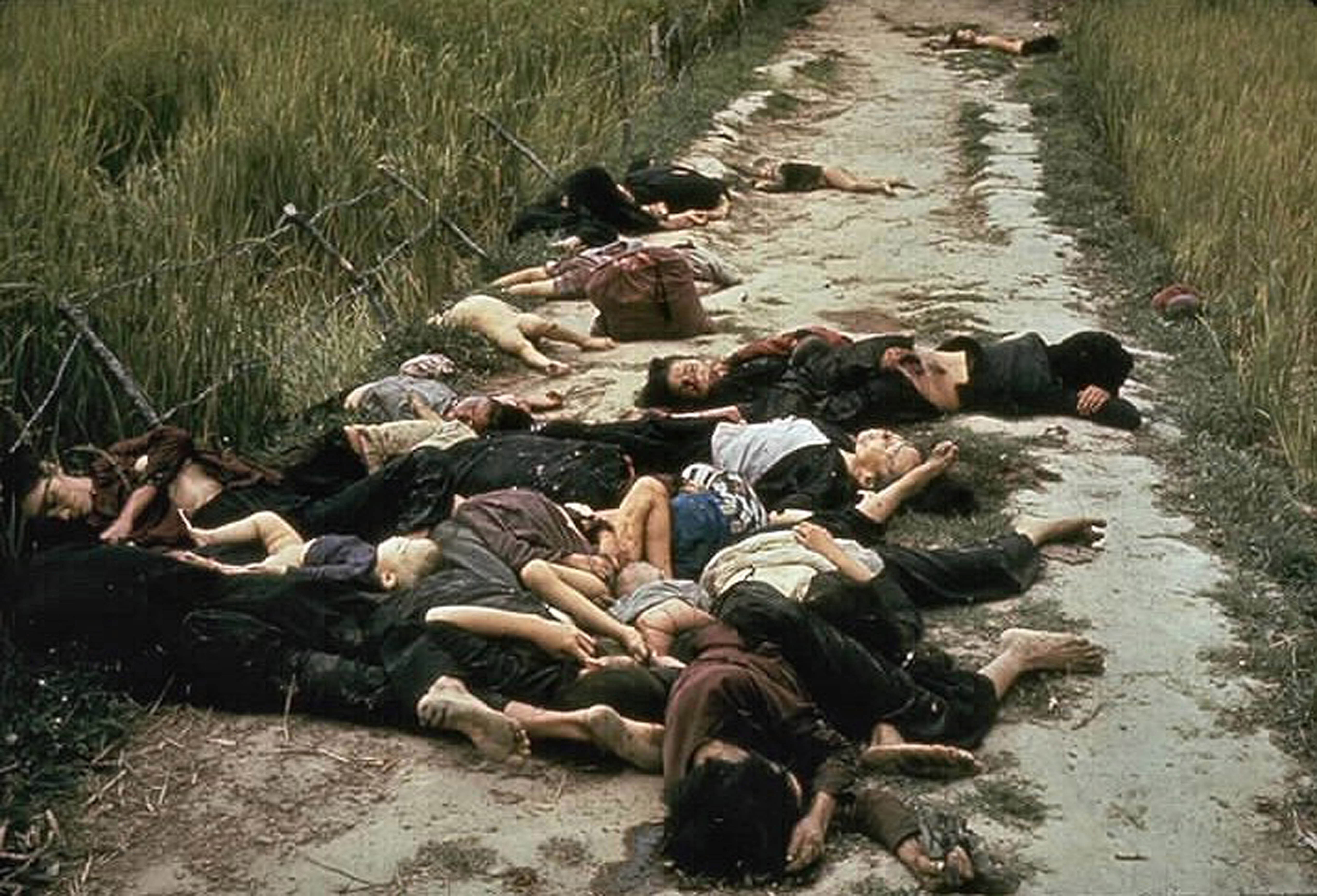
The My Lai Massacre, the mass murder of 347 to 504 unarmed citizens of the Republic of Vietnam (South Vietnam), almost entirely civilians and the majority of them women and children, perpetrated by US Army forces on March 16 1968. Bodies of some of the vi

A reader writes:

I’m sorry I missed the recent discussion about war photos. My contribution: I remember my eighth grade history teacher, in 1971, showing us photos her husband had taken as part of an American force that liberated a concentration camp in World War II. “These aren’t the worst,” she told us, “I can’t show you those. They are too terrible.” The photos she showed us were among the worst I’ve ever seen.

In April, 1979, shortly after W. Eugene Smith’s death, Popular Photography published some of his photos, including a few from the Pacific theater in World War II. It was the first time I had seen them, and I remember this one vividly. It’s hard to see how Smith’s photo from 70 years ago is so different from any of the photos you have posted. It was originally published in Life Magazine on August 28, 1944.

The iconic photo by AP photographer Nick Ut, of nine year old Kim Phuc, naked, running away from her village, her body burning from napalm, was published on the front page of the New York Times on June 9, 1972. The front page. Today they’ve gone so far off track they can’t even bring themselves to talk about torture.

Life Magazine and the New York Times didn’t shy away from publishing those photos, and neither should you. The alternative is that the only evidence of the Iraq war in twenty years will be photos of cheering Iraqis tearing down statues of Saddam.

Photos like these should disturb us, and shake us to our core, and give us nightmares, and the next time someone tries to drag us off to war, we should get out these photos and look at them and remind ourselves just how much war really costs, and remember that whatever we’re going to war about had better be so goddamn important that we can look at those photos and say, “Yes, even this will be worth it.”

Please, keep posting photos. Yes, they’re disturbing, but this is too important.

Another quotes Christian Caryl:

You can search the seven years of US broadcast news from Iraq almost in vain for images of dead US soldiers, or the grotesque effects of a suicide bombing on buildings or bodies, or the corpses of Iraqi families who had been riddled with bullets by nervous young Americans manning nighttime checkpoints.

Caryl isn’t wrong, but there’s a context here: Virtually every time a news organization published those photos, there was a massive and abusive pushback from readers and viewers, who saw every graphic photo as a simple case of exploitation. At the time the Iraq War started, I was a reporter in Connecticut. One of the local newspapers (not mine) published a full front page story on fighting, with a prominent photo of an American soldier being carried off in a stretcher after being wounded.

It was a difficult image to see, but there was nothing crass or tasteless about it. Yet readers in Connecticut – not exactly a hotbed of support for George W. Bush – reacted violently. The newspaper was accused of being unpatriotic; of exploiting a solider’s death; of throwing the corpse of a son or father on its front cover to sell newspapers (it actually wasn’t clear if the solider was dead), etc., etc. No voices were raised in support of the decision.

In a perfect world, a media outlet would simply ignore the criticisms and move forward, but that sort of violent reaction is going to take its toll on the people who decide what will be on the front page each day. Combine that with the 9/11 fear you and I both felt, a polarized public united only in its hatred of the media and a shaky bottom line for many outlets, and I can see why editors might be leery about publishing those images. Was it cowardly? Probably – but as Caryl writes, “Some outstanding (news) coverage resulted nonetheless, but little of it seems to have been absorbed by the public at large.”

I don’t excuse the failures of the media leading up to the invasion, but public opinion can sometimes be an immovable object. Journalism isn’t even close to an unstoppable force.

More Dish debate on the subject here and here.

(Photo: The My Lai Massacre was the mass murder of 347 to 504 unarmed citizens of the Republic of Vietnam, almost entirely civilians and the majority of them women and children, perpetrated by US Army forces on March 16 1968. Here are the bodies of some of the victims lying along a road. By Universal History Archive/Getty Images)

Sexism In Silicon Valley

Google software engineer Julie Pagano describes the “death by 1000 paper cuts” that comes from being a woman in the tech industry:

The cuts started early. I’m discouraged and humiliated in math classes throughout my school years to the point where I still get anxious doing math in front of others despite being good at it in private.  A high school teacher tells me that I shouldn’t go to college for engineering, but instead something nurturing (you know, what women are good for). My college classes have next to no women in them. A professor makes creepy comments about “geeky girls” during class. One of my few female classmates tells me she’s just doing this to prove her father wrong. …

Every time I try to push to make things better, I am guaranteed a patronizing response from someone. If I had a dollar for every time someone suggested that some demographics just aren’t biologically predisposed to be good at programming (even though research does not support this argument), I’d be rich.

Meanwhile, at the PyCon developers conference last week, an industry-wide firestorm ensued after a tech professional named Adria Richards shamed two men sitting behind her for making inappropriate comments during a presentation, which resulted in both her and one of the men being fired. Sarah Milstein has details:

[D]uring a keynote session, Adria heard some guys behind her making jokes that involved sexual language. The PyCon code of conduct states clearly, “Sexual language…is not appropriate for any conference venue.” Adria was bothered by the jokes, and referring to the code, she tweeted to the conference organizers, asking for help. They pulled aside the guys, who [apologized], and returned to the conference. Subsequently, PlayHaven, the guys’ employer and a sponsor of the conference, fired one of them. Adria then received a stream of virulent attacks and threats online. Her employer, SendGrid, was later subject to DDoS attacks demanding that she be fired, and they did so.

Matt Buchanan cites the incident as an example of the “biggest problem in technology”.