Year: 2013
The States Slowest To Support Marriage Equality
Contra Silver, Nate Cohn expects that it could take a long time for the South to come around:
With evangelicals slower to change their minds, Southern states should move at a slower pace than the national average. To date, support for gay marriage has increased at a roughly linear rate of 2 points per year. But it’s possible that increases in support could slow in the medium-term, as non-evangelical groups hit the point of diminishing returns. If evangelicals don’t pick up the slack by shifting faster on gay marriage, support for gay marriage could plateau. Parts of the South, Plains, and West would probably still have gay marriage bans, and the Supreme Court, despite its hopes to avoid a judgment, might be forced to make the final call.
The Anti-Equality Movement

Chait uses Maggie Gallagher to document its decline:
The surest sign of resignation is that Gallagher has redirected her focus from stopping gay marriage to preserving the dignity of her reputation and those of her fellow believers. She now presents her cause as a kind of civil rights movement to protect her fellow believers from the stigma of advocating bigotry and discrimination. “I worry when I get an email from a woman who’s a nurse in a hospital,” she told NPR, “who wrote a letter to the editor opposing gay marriage, and finds that she fears her job is in jeopardy.”
This leap toward leftist victimology is not new, but it sure is getting more intense, as the polling keeps bludgeoning the morale of those “defending” civil marriage from homosexual couples. When I was debating in Idaho, my debating partner, Doug Wilson, basically said that heterosexuals had already broken marriage – through no-fault divorce, “living in sin”, etc. – and so it was too late (and somewhat unfair) to take it out on the gays. He was reduced to what Bill O’Reilly has called “thumping the Bible.” But here’s what I don’t understand. Aren’t Christians supposed to be counter-cultural? Are they not supposed to be thrilled when they are ostracized or marginalized or held in contempt? Doesn’t Jesus predict exactly that and Paul celebrate it?
My view is that those who hold the view, in good conscience, that marriage should only be between a man and a woman, life-long, monogamous and procreative – have, and always have had, the option of leading by example rather than suppressing the rights of others. That’s the Christian, not Christianist, way forward. If their argument is so strong, they should not be worried by what presumably they think is a fad. Fads die out. All they really have to do is be true to their principles, convey them persuasively … and wait.
And yet they don’t. I wonder why.
(Photo: Opponents of same-sex marriage kneel in prayer as they arrive at the Supreme Court as they participate in the March for Marriage on March 26, 2013. The US Supreme Court hears arguments on California’s Proposition 8 ban on same-sex marriage. By Nicholas Kamm/AFP/Getty Images)
The View From Your Window

Anchorage, Alaska, 7 am
Kennedy’s Key Point
As reported by the WSJ:
Justice Kennedy, who has championed states’ rights at the court, says there’s no need to reach the equal-protection issue if the federal government had no authority to supersede state marriage laws in the first place.
That looks to me like a winning argument for Kennedy. And, possibly, for the court as a whole.
The Dam Breaks
You knew this issue was snowballing when Bill O’Reilly noted last night that among the most ferocious opponents of marriage equality in France are Muslims and that the actual arguments are deeply lop-sided. Money quote from Papa Bear:
The compelling argument is on the side of homosexuals. That is where the compelling argument is. We’re Americans, we just want to be treated like everybody else. That’s a compelling argument, and to deny that you’ve got to have a very strong argument on the other side. And the other side hasn’t been able to do anything but thump the Bible.”
Indeed. Or a tortuous reinvention of natural law. Meanwhile, a slew of Democratic senators have come out in favor of marriage equality over the past few days. Not exactly profiles in courage at this point, but opportunism is always a better guide to politics than principle. Thoreau is amazed:
The number and range of people coming out in favor of gay marriage right now is amazing. OK, maybe not so amazing, given the opportunistic politics of it. Still, I’m impressed by the very fact that supporting gay marriage is the politically opportunistic course of action. When shameless political cowards are all on the bandwagon, something has changed.
Tweet Of The Day
More detail here:
The question is whether or not the federal government under a federalism system has the authority to regulate marriage,” Justice Kennedy said during oral arguments. At another point, he disagreed with the lawyer’s contention that the law simply creates a single definition for federal purposes. “It’s not really uniformity,” the justice said, because same-sex couples would not have access to federal benefits that traditional couples have.
Justice Kennedy’s point echoed one made by his more liberal colleagues.
Justice Ruth Bader Ginsburg said the federal law effectively created a two-tiered system of marriage. “There are two kinds of marriage,” she said. “Full marriage and the skim-milk marriage.”
As soon as the transcript is released, I’ll start working on a second analysis. But this strikes me as a more important and winnable case than yesterday’s and a victory would be huge – for federalism and for equality. It would, for example, immediately grant social security benefits to my husband were I to be run over by a truck; it would enable bi-national gay couples who are married in an equality state to stay together. And it offers the potential for a liberal-conservative alliance – conservatives for federalism, liberals for equality.
Watching The Prop 8 Debate
The New Yorker has done a nice job matching up parts of yesterday’s audio with the only visuals we have, drawings:
How EJ Graff answers Scalia’s question:
Scalia is right to ask when, exactly, our marriages became a constitutional right. It became a constitutional right with the combination of Griswold v. Connecticut and Eisenstadt v. Baird, which allowed heterosexuals to snip the link between sex and babies by legalizing contraception, and Lawrence v. Texas, which Scalia rightly predicted would lead directly to same-sex marriage.
It became a constitutional right when thousands upon thousands of us started coming out to our families and having weddings, thereby enlisting cousins and nephews and sisters-in-law and stepfathers and neighbors to our side. It became a constitutional right as we told our myriad stories of love and commitment, of bereaved widowhood or denied military benefits, of unfair treatment and happy families. It became a constitutional right when you all realized you had nothing to fear from me and my gal.
My response?
The answer is surely that these forms of discrimination became unconstitutional once the collective consciousness of Americans recognized that the discrimination was unjust – and sometimes before. When Loving vs Virginia was decided, there was far more popular support for maintaining anti-miscegenation laws than there is now from keeping gays out of legal marriage. And once you’ve opened up equal protection beyond race, your only reliable guide is public consciousness and consensus. This is anathema to Scalia. But a constitution that cannot adapt to the constantly-changing society it regulates is, in the words of Scalia himself, “dead, dead, dead.”
The Agony Of Aleppo
The rivers are full of corpses. Increasingly, children tend to the wounded. But even child doctors are getting scarcer:
Three days after we filmed 11-year-old Yussef Mohamed treating an injured soldier he was killed by a government shell. Another young victim of Syria’s descent into civil war.
I know this video is 12 minutes’ long. But the coverage of this story has been so limited in the US, all I can say is that it matters. We may not be able to stop this in any effective way. But we can choose not to look away. And we can better understand the strategy behind the mass murder of so many civilians.
Dissents Of The Day
A reader quotes me:
“The end result would be 17 states with marriage equality recognized by the feds, and the debate could then continue democratically as it should state by state.” So you think rights should be voted on? Since when is it ever a good idea to leave the rights of a minority up to the whims of the majority? As Thomas Jefferson said in his 1st Inaugural: “Bear in mind this sacred principle, that though the will of the majority is in all cases to prevail, that will, to be rightful, must be reasonable; that the minority possess their equal rights, which equal laws must protect, and to violate would be oppression.”
Another writes:
I’ve been following your coverage of the same sex marriage debate fairly closely, and I must say that I simply don’t understand why you want a gradual approach to the issue. If you believe that same sex marriage is a right, which I do, why in the world do you think that it shouldn’t be given to everyone in EVERY state NOW? Earlier today you quoted MLK, linking, rightly I think, the current push for gay rights to the earlier movement for African American civil rights. I think MLK would be horrified by your gradualism. From his “I Have A Dream” speech:
We have also come to this hallowed spot to remind America of the fierce urgency of Now. This is no time to engage in the luxury of cooling off or to take the tranquilizing drug of gradualism. Now is the time to make real the promises of democracy.
He did not lead a movement that sought to overturn racial discrimination gradually; he wanted an end to segregation and discrimination immediately throughout the country. And I don’t believe that you should demand anything less on gay rights now. More to the point, I don’t believe that same-sex marriage rights should be limited to the coasts for the next decade plus while the rest of the country comes around. I’m glad that the right to marry whomever you please is spreading, but I believe that my gay brother in Alabama, my close lesbian friend in Georgia, and countless others in the South and the middle of the country should have the same right that you enjoy in New York and Massachusetts and DC.
Would a sweeping expansion of same sex marriage across the country cause a backlash? Probably. But is it worth weathering that backlash to ensure that everyone in this country has the right to marry the person they love? Absolutely.
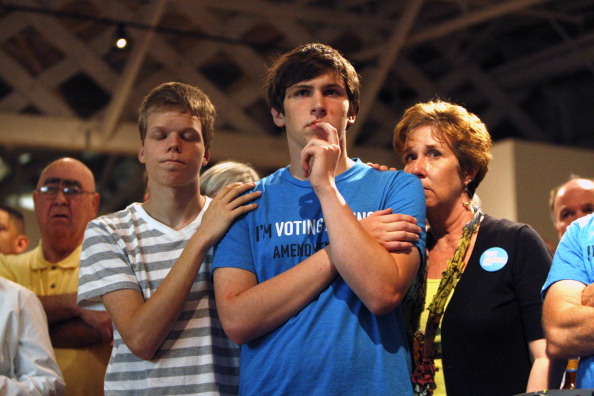
(Photo: Seth Keel, center, is consoled by his boyfriend Ian Chambers, left, and his mother Jill Hinton, during a concession speech during an Amendment One opposition party on Tuesday, May 8, 2012, at The Stockroom in downtown Raleigh, North Carolina. Voters approved the constitutional amendment 61% to 39% to define marriage solely as a union between a man and a woman, and civil unions and potentially other types of domestic partnerships will no longer be recognized legally by the state. By Travis Long/Raleigh News & Observer/MCT via Getty Images.)

