Despite the fact that most polls now show non-whites slightly more supportive of marriage equality than whites, the National Organization for Marriage has yet to get the message:

Despite the fact that most polls now show non-whites slightly more supportive of marriage equality than whites, the National Organization for Marriage has yet to get the message:
Dale Carpenter’s take-away from yesterday:
I could see a split decision, with three Justices willing to uphold Prop 8 on the merits (Scalia, Thomas, and Alito), at least four Justices (Roberts, Sotomayor, Kagan, and Breyer) and possibly six (add Kennedy and Ginsburg) voting to dismiss the case on some variant of jurisdictional grounds, and/or four willing to strike down Prop 8 on the merits if pushed to do so (Sotomayor, Kagan, Breyer, and Ginsburg). That means that we’ll most likely get a jurisdictional decision, with no clear win or loss for the ultimate cause, a vacated Ninth Circuit decision, and some large questions about the scope and effect of the District Court’s order.
David Boaz dismantles Jim DeMint’s latest burst of unreason here.
That’s Jon Rauch’s term for the three basic options the Court reviewed yesterday. I think he’s right to say the Justices didn’t seem very comfortable with any of them. Which is why they’re obviously looking for an off-ramp …

Monica Potts profiles families living in a Denver-area Ramada Inn:
When families in Jefferson County, which encompasses Denver’s western suburbs, lost their home in the recession, they flooded a market that had the lowest number of rental vacancies in ten years. … Unable to find another home and unable to find space in the county’s shelters, which hold fewer than 100 beds, the new poor disappeared into the suburban landscape wherever they could find a roof. With nowhere else to go, they turned the Ramada Inn into an impromptu [single room occupancy].
Charles Pierce fumes:
There is a useful trope still floating around that goes, “If X were happening to middle-class white people, we’d have a revolution.” Well, X is happening to middle-class white people and, I guarantee you, a substantial number of other middle-class white people, no matter how tenuous their own personal economic circumstances are, will blame the people living in the Ramada Inn for what happened to them.
(Photo: Izabella Nance, 7, works on a crossword puzzle in her motel room at the Old Town Inn March 5, 2009 in West Sacramento, California. Brittney Nance and her family were evicted from the house they were renting after her husband, Steve Nance, lost his job. The couple and their three children are living in a budget motel while they save enough money for deposit on a new rental home but are finding it difficult as they pay nearly $1200 a month for the motel room. All five live in a small studio sized room with most of their belongings. By Justin Sullivan/Getty Images)

Finally, a handful of journalists are beginning to tell the truth about the accelerating fusion of journalism with advertising:
One could say, “Oh, magazines. That industry has always been a brothel.” Which is true – although not of the news and public policy segments. And one could say, “Tut tut. TV was whoring itself to audiences long before anyone ever uttered the words ‘click bait.'” Which is also true.
The problem is, it is decreasingly useful to separate these industries by medium. Text, audio and video are rapidly converging. As journalism brands grow to look more like one another, we are seeing unmistakable signs of publishers slouching toward an ethical lowest common denominator.
Anyone who cares deeply about quality, independent journalism should pray for paywalls and other subscription models to take hold. Because in the world of the smart and the desperate, desperate always has the last word.
I was particularly taken by the remarks of this commenter, rebutting the argument that all this change is inevitable. It isn’t. And the change is not a new way for journalism; it’s euthanizing its critical, independent role in a democratic society:
You don’t think it matters that the industry that is responsible for the dissemination of information is increasingly ceding editorial control to PR firms simply to stay afloat?
Democracy is a market in which politicians design policies to get votes. Like any market, it relies on information and signals being reliably transmitted from producer to consumer and vice versa. In a situation where the producer can effectively block the signals that actually their policies are designed simply to siphon wealth from everyone else into the pockets of the rich, what do you think happens to that market? Yep, that’s right, you get a choice between red, blue and yellow versions of producers all with the same agenda.
We are reaching a point at which there will be many fewer actual media companies, and more and more companies which learn to mimic what used to be journalism in order to sell their products. We’ve gone from advertizing supporting journalism to journalism supporting corporate propaganda. At the rate we’re going, as the line between church and state is deliberately blurred by desperate media companies, we may end up with a handful of actual independent online magazines and newspapers and a vast industry of corporate propaganda designed to look like the real thing. If we’re lucky.
(Photo: one of Tom Scott’s Journalism Warning Labels)
Dexter Filkins checks in on Lebanon, which recently had its Prime Minister resign:
As the civil war in Syria has carried on, it has dragged more and more of Lebanon along with it. Terrified that it will lose its supply lines, Hezbollah has not been content to sit on the sidelines and watch Assad fall; its leaders have been sending fighters into Syria to fight for the Assad regime, actions that are supposed to be secret but that are widely known in Lebanon. That, in turn, has severely strained Hezbollah’s relations with other Lebanese, especially its Sunnis, who accuse Hezbollah of killing their brethren across the border. At least four hundred thousand Syrian refugees, most of them Sunnis, have gathered in Lebanon. The peace has held in Lebanon, but the Sunni anger is swelling.
“Well I’ve spent time with George Clooney and he’s the most interesting man on the planet. He can do it all. Yep, I guess what I’m saying is I’d have sex with him,” – Channing Tatum.
Once the American economy resumes its long-term growth path with full employment (it has not been on this path for the past 4 years), the economic pull from the US should return to where it had been before the economic crisis. However, the push from Mexico has been decreasing and should continue its downward path for the foreseeable future. One important cause is the sharp decline in Mexican birth rates during the past couple of decades.
Not long ago Mexico was a country with high birth rates that produced many young adults who had trouble finding jobs. Now, the Mexican total fertility rate (TFR)- the number of children born to a typical woman over her lifetime- has plummeted to about 2.25. This rate is only a little above the population replacement rate of 2.1. Unlike in the past, the number of young people in Mexico will no longer be growing rapidly over time, so that the numbers looking for work in the Mexican labor market will be on the decline.
The push from Mexico has also diminished because its economy has been growing at a good clip during the past 9 years. Excluding the large drop in 2009, the growth rate in real GDP has been over 4% per year. Mexico’s growth rate after 2009 considerably exceeds the American rate of under 2%, which is remarkable since about 80% of all Mexican exports go to the depressed American economy. One consequence is that the gap between earnings in Mexico and the United States is narrowing. This clearly reduces the demand to immigrate to America, especially under the difficult circumstances illegal immigrants face.
A reader counters a previous one:
“Unlike alcohol, where the proof is written on the bottle and assured by regulators, you can only gauge THC levels through trial-and-error or your dealer’s sales patter.” That’s another artifact of prohibition. I work for an edibles company here in Colorado, we’ve developed a method of adding very precise amounts of active THC in food that’s already been prepared. Our big sellers are bags of 25 candies that each have just ten milligrams of THC in them. An equivalent to e-cigarettes have also become popular among patients, which you can use to take very tiny puffs of vapor until you feel medicated enough and even the potency of the extract you vaporize can be controlled to some degree. Both my company (as well as all edibles manufacturers) and companies filling cartridges for vapor pens are byproducts of a thriving and regulated cannabis industry; neither is practical for the black market and neither can be done at home. Another byproduct of an industry is that there are a couple labs where I think anybody can take a sample of something to be tested for cannabinoid content.
Your reader is also incorrect in his supposition about the potency of black market pot.
It’s actually quite hard, and quite expensive to produce marijuana with much about 16% THC; 12% or 13% would be more likely for street weed, you might get as much as 8% in Mexican brickweed. It’s impossible to go above that in an outdoor grow, and indoors getting a plant to its full potential potency requires growing them inches from thousand watt floodlights but not letting them get above 75 degrees with the lights on. Not only does the expense produce diminishing returns but the air conditioning is incredibly conspicuous.
Further, the strains that can produce high potency tend to have much lower per-plant yields and black market growers grow for yield above all else. Breeding really has increased potential potency but high-end growing/breeding like that and black market growing are two very different worlds that don’t actually intersect much. The only major overall increase in the potency of black market marijuana happened when sinsemilla – growing only unpollinated female plants so they spend their energy creating THC-laden resin rather than seeds – became the standard, and that happened in the ’70s. Everything about increased potency on the street since then has been pure propaganda.
Update from a reader:
I thought the reader was not actually contradicting either of the points in the previous post (lack of dosage information and increased potency of weed since the 1970s are artifacts of prohibition), but he too casually dismisses as “propaganda” the notion that black market pot has increased in purity.
It’s common knowledge that cannabis quality and availability has increased steadily since the 1970s. The reader confuses the THC content of the plant with the purity of the product. In 1993, a New Yorker buying weed in Washington Square Park was likely to get a few grams of junk, seeds, and stems mixed in with his baggie. Today, black market product in the city is sold by reputable delivery services who compete to provide quality and variety. Whether this is a result of increased crop yields or increased THC content in the cannabis plant is immaterial: you will get a much larger dose of THC from a gram of 2013 delivery weed than from the same gram purchased on the street 20 years ago. A similar – and much more dangerous – phenomenon has occurred with harder drugs like heroin, where overdoses can lead to death.

As all of you contest fanatics noticed, we didn’t post the results yesterday at the normally scheduled time, due to the nonstop coverage of the SCOTUS hearings. But wait no longer:
I thought this one was going to be easy – just match up the design on the police cars and voila! After plumbing the endless world of local patrol car detailing, I still got nothin’. Champion, who manufactured the window through which the photo was taken, apparently distibutes only within the US, east of the Mississippi. Based on the landscape, my heart cries mid-Atlantic states. It’s a sizable river, so let’s say it’s the Susquehanna. It’s a small town, so let’s say, at random, Nescopek, PA.
Another reader:
I know I am probably thousands of miles off, but this looks like Atchison, Kansas, birthplace of Amelia Earhart. Atchison sits on the banks of the Missouri River. The police cars look familiar, the last remnants of shoveled snow from a recent snow storm remain and, well, it just looks like the place I am desperately trying to recall from memory. I figured why not guess?
Another:
First time I can at least muster even a half-assed guess. As an Omahan, I think it looks like a shot from somewhere along the Nebraska side of the Missouri River. Looks like a beautiful gloaming on the Loess Hills of Western Iowa. Unfortunately, a quick Google Earth trip up the Muddy Mo revealed no such location. On the bright side, following that great river from satellite photos is fascinating. The Flood of 2011 is evident and, despite its destruction, eerily beautiful. A hybrid view that includes state lines seems to indicate that some land may have changed hands too! (Though, I suppose these maps are only somewhat accurate.) At any rate, reading VFYW guesses on Tuesdays is something I always look forward to. I am happy to experience a VFYW from the Saturday end of things for once!
Another:
I think it is a view from the top level of the Livermore Falls, Maine town hall. Either the main lobby or one of offices behind the service counter. I’ve done some business there. The Androscoggin river is in the background.
Another:
Oh the hours I’ve spent Google-map-riverboating down every river in North America. Started up-river from Pittsburgh, headed all the way down the Ohio, then switched over to the Hudson, and then went over to the upper Mississippi … you get the idea. I sure hope someone was able to see the lettering on one of the two cop cars. And they say March Madness wastes valuable work time!
My guess: Second floor room of the No-Tell Motel, facing south, overlooking the Oil City Police Department impound lot, next to the mighty Allegheny River. Wrong, but I have to submit SOMEthing after all those hours!
Another:
This looks like Southeastern Ohio to me and given recent news, I would guess Steubenville. I would look for the exact location, perhaps the Juvenile Court Building, but I have to get my teams ready for the collegiate National Debate Tournament next week. It is sort of like March Madness, but for the cool kids.
Another gets on the right track:
First-timer here. Would do more research but I’m leaving tomorrow on a trip. That is absolutely a picture of the east side of the Hudson, probably somewhere in Westchester County. I’m going to guess it’s Tarrytown, and that the building near the water tower might be part of the abandoned GM plant there. If you were to stand near the police car, you would probably see train tracks – the Hudson Line of Metro-North – running along the river. The amount of snow also maps with what’s been going on in the area lately. It’s the remnants of the snowstorm we had on March 19.
Another:
I’m pretty sure the window is on the western side of the Hudson River. So I will go with Highland Falls, NY, outside of West Point.
Another nearly gets it:
This strongly resembles the Palisades, as seen from the NY side, just north of NYC. The police car’s logo is identical to the ones in my village, across the river. I will take a guess and say it’s Yonkers, since that is where the Palisades are highest – though it could also be Dobbs Ferry or Hastings on Hudson.
Another nails it:
As someone who lived in NYC for 12 years, I instantly recognized the Hudson River and the Jersey cliffs beyond, so I just scrolled up the Hudson until I saw the unmistakable slanted roofs of the factory sitting right on the shore of Hastings-on-Hudson. And while it is fun trying to investigate a VFYW photo clue by clue, scouring Google Maps for hours, I have to admit a certain thrill when you look at a photo (here, of a place I haven’t even visited) and just feel in your gut you know where it is:
Makes me miss New York.
Another:
I know exactly where this is. The town on the east bank of the Hudson where this must be from is Hastings-On-Hudson. Every time I go hiking upstate, I take the Metro-North Hudson Line from Grand Central. In the last year noticed the remnants of a rock slide on the New Jersey side of the Pallisades, which is described in this article.
Another points to a local news report of the slide on YouTube. Another sends the photo seen to the right. Another writes:
Sometimes you get lucky. On Monday, I took a very scenic train trip along the east bank of the Hudson River from Rhinecliff, NY into New York City. I was looking out the window when I saw the most distinctive feature of this VFYW: the recent scar of a rock slide along the Hudson Palisades. After recognizing that, the rest was easy.
By the way, I would like to share just one fact that my mother told me about the Hudson Palisades: It’s a fjord. How cool is that?
More than 150 readers correctly answered Hastings-on-Hudson, but only three of them have gotten difficult views in the past without yet winning. The most accurate entry of those three is the following:
I’ve spent hours on previous windows without making any progress, and so it was with great satisfaction that I recognized this week’s view the moment I saw it! I live in California these days, but I grew up in New York, and it’s hard to forget the Palisades. That light-colored streak in the cliff marks the site of a major rockfall in May of 2012. The fall liberated roughly 10,000 tons of rock from the cliff, the largest such event in at least the last 25 years.
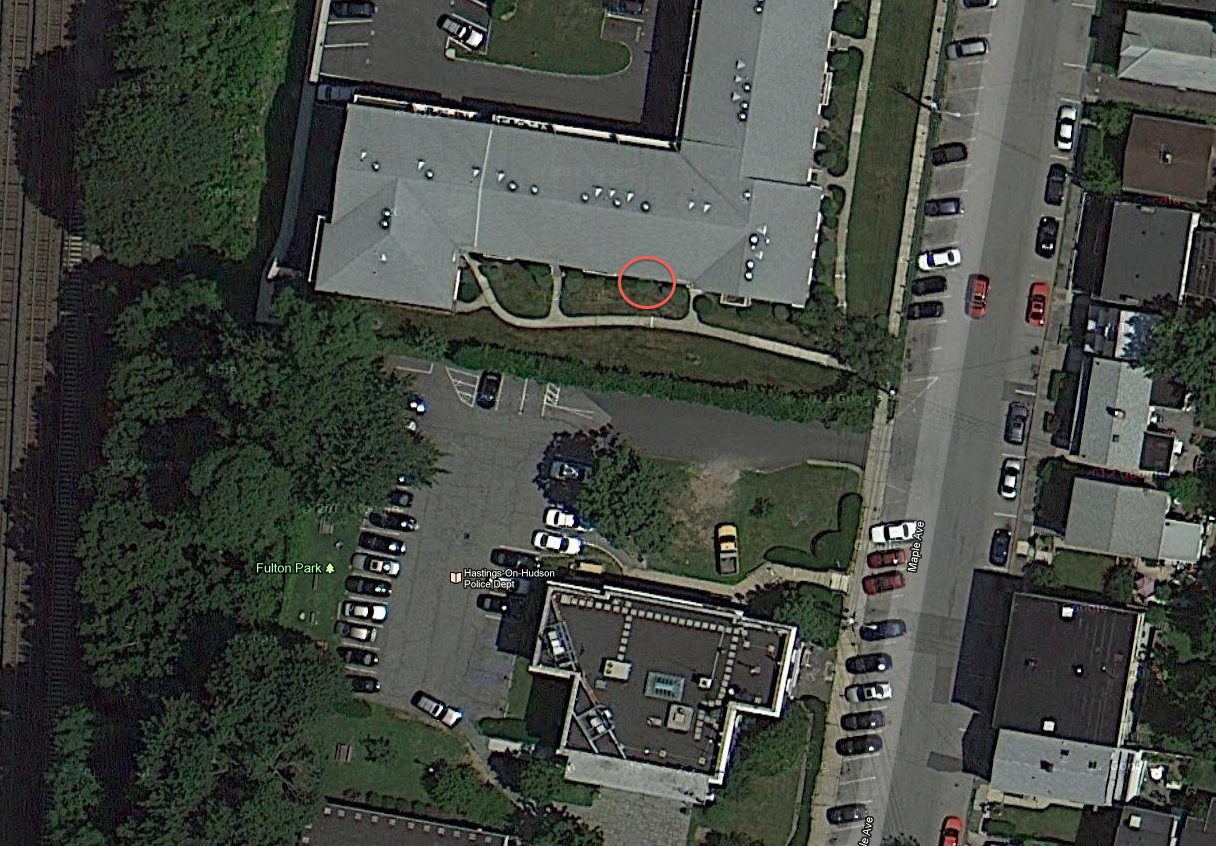
On to the actual window. The photograph was taken from the third floor (also the top floor) of the River Edge Apartments, looking south west across the Hudson River. I’ve attached an aerial view of the apartment complex and circled the correct window in red, but it’s partially obscured by the overhang of the roof and some tree
branches. Sorry, best I could do. I’ve also attached a street level view of the south-facing side of the building, but the correct window is again largely obscured, this time by the fire escape. The correct window is visible looking through the bars of the fire escape. I’ve done my best to circle it in red.
This marks my sixth correct entry in seven weeks. I’m sure you’ll have many correct entries from New Yorkers (and beyond) this week, but hopefully I’m moving up in the tie-breaker rankings!
And into the winner’s circle. From the submitter, for the record:
3rd floor of the building. I’m a Hastings resident. By the way, the Hastings farmer’s market moves back outside to the parking lot shown in my photo on April 13!
(Archive)



 The Dish