Barro describes coming out of the closet as a “duty”:
San Francisco Supervisor Harvey Milk got this right in 1978, when he admonished his fellow gays and lesbians to come out of the closet in order to build opposition to a ballot measure that would have banned gays and lesbians from teaching in public schools: “Come out to your relatives. I know that is hard and will upset them but think how they will upset you in the voting booth.”
This obligation is only stronger now that social acceptance of gays and lesbians is higher, meaning the cost of coming out has declined. And it lies particularly with those in positions of privilege and power, who have the resources to withstand negative reactions. Coming out was stressful for me like it is for most people, but let’s be real: Announcing that you’re gay in a wealthy family in a progressive suburb of Boston as you’re about to enter Harvard University is a pretty easy hand to play.
I’m afraid I have the same conviction, possibly burned more deeply by the memory of the plague. I remember one HRC dinner back in the day when I was asked to speak. I asked people who were out to their families, friends and co-workers to put their hands up. In a well-heeled, tuxedoed, bejeweled crowd, only about a third put up their hands. I asked who were not out – and another third went up. I then said, in words I reiterate today to anyone in the closet writing checks to gay groups, “Why don’t you leave right now and come back when you’ve done something for gay rights?”
If you’re reading this, and your hand went up as in the closet, my question stands.
(Photo: Openly gay pro boxer Orlando Cruz celebrates victory over Jorge Pazos at Kissimmee Civic Center on October 19, 2012 in Kissimmee, Florida. By J. Meric/Getty Images.)
Obviously, I can sympathize with his stance in 2002 and 2003. It was mine. His case for war was never as connected to the presence of WMDs as Bush’s, and more to the eradication of a tyrannical monster, and so he was less undermined by the falsity of the evidence he vouched for. But the denial here is phenomenal:
“When people say to me, you know, ‘Do you regret removing him?’ I say, ‘No, how can you regret removing somebody who was a monster, who created enormous carnage?'”
He added: “And if you look at what’s happening in the Arab Spring today, and you examine what’s happening in Syria — just reflect on what Bashar Assad, who is a twentieth as bad as Saddam, is doing to his people today, and the number of lives already lost, just ask yourself, ‘What would be happening in Iraq now if he had been left in power?'”
But the over 100,000 Iraqis who died were living in a country occupied by UK and US forces obligated by international law to keep order, not one governed by a despotic brutal dynasty whose record of slaughtering its own people is not in dispute. (And one twentieth as bad as Saddam? Ask the people of Homs.) And Blair’s argument that the Arab Spring proves that Iraq under Saddam could well have become another Syria if the Shiites had revolted again, while well-taken, nonetheless presumes some kind of Western responsibility to somehow minimize or direct forces of change we neither understand nor control. It’s a benevolent imperial impulse – without connections to vital national interests.
That was Blair’s error, as well as part of mine. What you see still in Blair is a refusal to think about unintended consequences. He retreats to an a priori moral defense of unseating a monster, without weighing the devastating ripples from that mighty fall. I remember thinking before the war started that it had to be worth it, purely because ridding the earth of a man who tortured children was so moral a thing it outweighed every other doubt. Self-righteousness blinded me to the extent my critical faculties were failing. I guess if Blair were to admit that, he would have to admit some responsibility for the mass slaughter and chaos the war fomented. That’s hard to do. But it tells you a lot about Blair that he cannot.
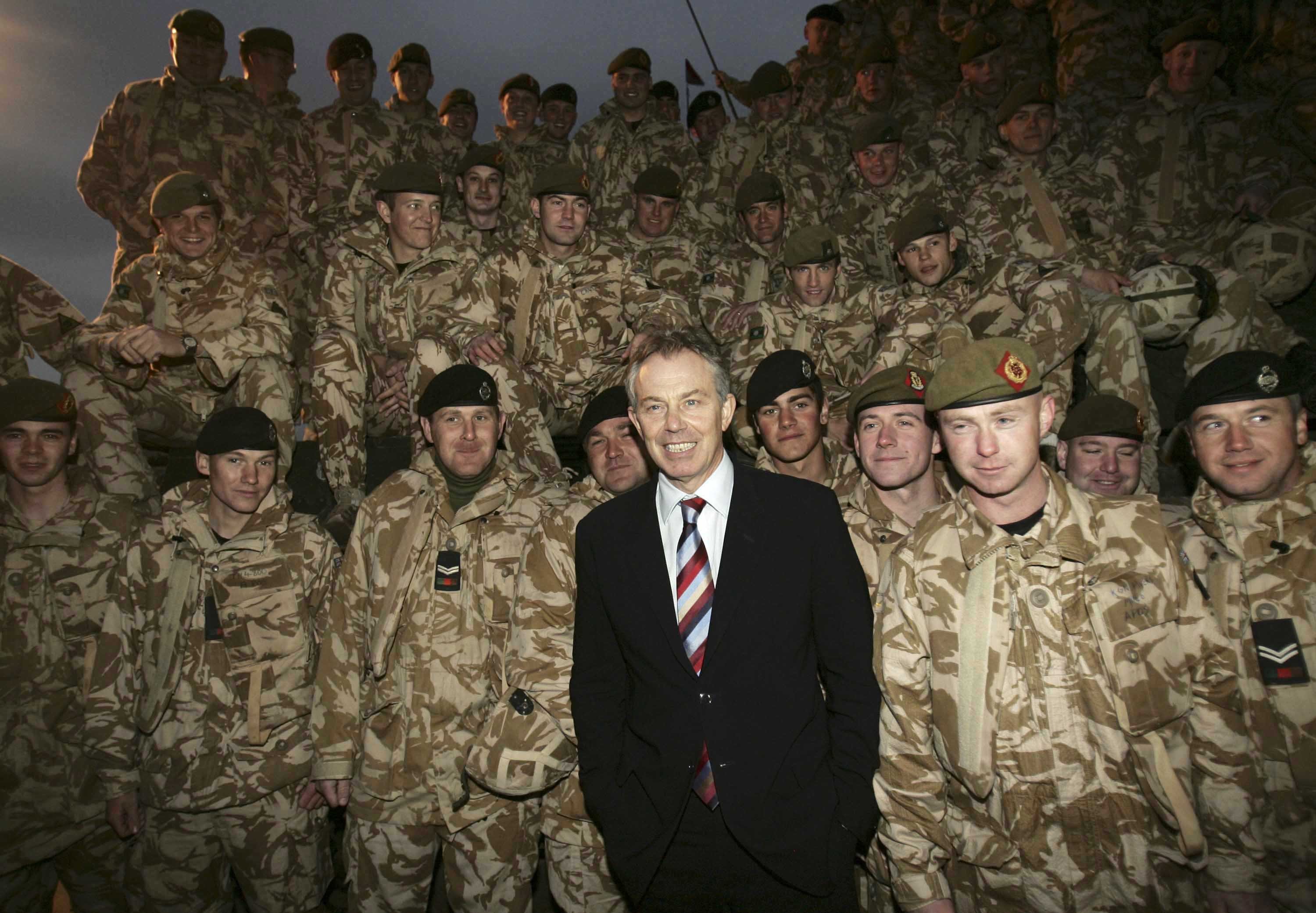
(Photo: Prime Minister Tony Blair meets with British soldiers on duty in Basra on December 17, 2006 in Iraq. By Peter Macdiarmid/Getty Images)
“There was nothing accomplished, so why should I remember it? … Are we still talking about the Americans? I don’t think we need to do any kind of celebrating or make an effort to remember that day. I think even the Americans wish they could forget it,” – Karrar Habeeb, a 22-year-old Iraqi carpenter.
It was heartening to see the NYT’s editorial on the Iraq War today, with its ringing conclusion:
The Iraq war was unnecessary, costly and damaging on every level. It was based on faulty intelligence manipulated for ideological reasons. The terrible human and economic costs over the past 10 years show why that must never happen again.
And where is the acknowledgment that the NYT, especially Judy Miller, played a critical role in reassuring skeptics that the WMD threat was real? I wish newspapers would hold themselves accountable in the same way they expect government officials to.
I’ve recently been considering this because my friends have been getting married lately. Taking the husband’s last name seems antiquated, keeping your original last names seems standoff-ish (much less what last names do your children get?), and hyphenated names seem like a future disaster where hyphenated people marry other hyphenated people (e.g. The Tikki Tikki Tembo Kerfluffle). Imagine three generations down the line of only people with hyphenated last names getting married. Bubbling-in last names for the SATs would be a mess.
Solution? Blended last names. Take the best of each last name and combine it to form a new family name. Yes, your family name wouldn’t last (tribalism is lame anyway), but imagine the fun! Say a Jones marries a Bloomberg. You could go Joomberg, Blones, Bloomes. The possibilities are endless. Couples could have fun picking their new last names, signifying their independence and new beginning, and you could go any number of different directions – ironic names that you regret later, serious names, names which hold a special significance, etc.
Bonus: Future genealogists would hate it. The improved record keeping of the 20th and 21st century would be complicated by fun, new puzzles for future historians.
Another:
My wife and I came up with a novel solution to the problem – we came up with a new name.
And no, I do not mean a hyphenated name. Our new last name is a combination of the two names that uses one instance of each letter to make a new last name while at the same time retaining the sounds of both. Thus Lohr and Miller became Mihloer. Our two children were the first to have the new name since it turns out to be a bit complex to change your own last name to something that isn’t your spouses. Children, on the other hand, can literally be given any name (see Louis CK for more on this [above]).
Despite the difficulties, we love it. We came at it from the perspective that all last names are invented (often arbitrarily based on trade or location) and are relatively young in the scheme of things. In some cultures, last names are transient. In Iceland, for instance, a man named Erik Gustavson could have a son named Gustav Erikson and daughter named Ingrid Erikdottir. So we decided to create something new – as in, our new family starts “now”. Whether our children keep their name (we have both a son and a daughter) because it’s special or go along with mainstream tradition is yet to be seen, but it is all very fun, sorta like a surname adventure!
Another wasn’t quite as creative:
I never planned to change my name directly to a husband’s and I married a man who would have been uncomfortable with a woman who would do it without thinking. In fact, as one of three sons himself, none of the three wives/daughters-in-law changed their names!
We did attempt to find a good combination of our two names, but none of the combos worked at all. We ended up trading last names for middle names, so I’m Myfirstname Hislastname Mylastname, and he’s Hisfirstname, Mylastname, Hislastname. In the end, he was the one who ended up giving up a name – his middle name. My mother had tired out by her fourth child and gave me no middle name, figuring I’d just lose it when I got married anyway.
For our children we decided that boys would have his last name and girls mine – the other as the middle name. Then we went on to have all boys, so no one knows about that plan unless we explain it. However, we met another family at school who has a daughter with the mom’s last name and a son with the dad’s last name. We also ran into an older woman in the neighborhood who had done the same.
In many ways, it’s easier. Before caller ID, I knew that calls for Mr. Mylastname or Mrs. Hislastname were solicitations and those imaginary people were never here. I don’t care at all if I’m called Mrs. Hislastname by kids at their schools or the like, nor does my husband mind the other. Our oldest son (early 20s) is pretty adamant that he wouldn’t want to marry someone who would want to change their name. I point out that it’s a choice, albeit one that should be made with thought.
Seth Masket points out that dramatic shifts are very rare:
The Democrats’ shift from being the party of white supremacy to the party of civil rights was pretty much a singular act in American political history. Parties rarely pull off a major shift on a hot-button issue (that’s what killed the Whigs in the 1850s), and indeed it was a very costly shift for the Democrats, breaking their electoral lock on the southern states and ultimately ending their four-decade run of controlling the House of Representatives. To be sure, parties do evolve slowly on some issues, but the parties are much better defined by consistency than change.
Rajiv Srinivasan claims that “our veterans today are in a far better place than they ever have been in any time in American history in terms of their healthcare and education benefits”:
There is a hawk-like manner in which our constituency — regardless of party affiliation — defends military benefits at seemingly all costs. For example, most of our pension and healthcare age targets were set in the 1950s when the life expectancy was significantly lower, as were healthcare costs. Yet to this day, military healthcare premiums haven’t risen since 1995 and a soldier who enlists at age 18 can still receive half his base pay for the rest of his life at age 38, during the prime of his working years.
My point is not necessarily that this is excessive; but simply that we can acknowledge that this country has made significant strides in veteran care where many previous generations of veterans have been forgotten. This certainly doesn’t mean the veteran social contract has been met. But rather, our societal focus must shift to areas that are often unable to be legislated—emotional stability; a sense of ownership in the community; a realization of purpose outside of the service.
The link-sharing community has launched “Explain Like I’m 5”:
The series, an educational comedy, consists of three episodes based on one of Reddit’s user created forums (subreddits) of the same name, where users (Redditors) strive to answer each other’s questions on complex subjects as simply and straightforwardly as possible. “It was more inspired by the content in the thread posts than actually quoting them or using them directly,” Erik Martin, Reddit’s general manager, told The Verge in a phone interview.
It is, I must say, rather adorable. It warmed even mine own cold, Internet-hardened heart. And it may prove to be a brilliant move for the property—Condé Nast has long prided itself for keeping its hands off the web’s most popular link dump, but it seems to have awoken to the notion there are tons of memes and whole subreddits ripe for the content-mining. Google ponied up the cash for the series (Reddit won’t say how much) and it debuted on YouTube.
Jessica Grose’s theory about why women still do the lion’s share of housecleaning:
I suspect that women are more driven to keep a clean house because they know they—before their male partners—will be judged for having a dirty one.
When I lived with two female roommates, I was much more of a slob. None of us was particularly responsible for the emotional tone of that apartment—no single one of us was more likely to be shunned for the state of our bathroom. But when I got married, the dust bunnies hopping across our floor started seeming like a personal affront. Although it was my husband’s father coming over, I was the one who insisted we clean. I was worried I would be judged for the beef jerky wrappers (on both aesthetic and gustatory grounds), despite the fact that my father-in-law has never once made a peep about the state of our abode. Somewhere lodged within me was the message that it was my responsibility.