Our Opinionated Media

1-On-MSNBC-Opinion-Dominates-Reporting

The Pew Research Center’s Project for Excellence in Journalism recently released their annual “State of the Media” report, which finds that opinion reporting on the big three cable networks is up:

On cable, the news structure of the three channels—the mix of interviews, packaged segments and live coverage—has changed. After relying on significantly distinct formats five years ago, the three rivals now look strikingly similar. … CNN, which has branded itself around reporting resources and reach, cut back between 2007 and 2012 on two areas tied to that brand—in-depth story packages and live event coverage. Even so, CNN is the only one of the three big cable news channels to produce more straight reporting than commentary over all. At the other end of that spectrum lies MSNBC, where opinion fills a full 85% of the channel’s airtime.

Paul Waldman argues that the decline of “straight reporting” isn’t necessarily something to worry about:

If MSNBC decides that analyzing, discussing, and debating the news is going to be their thing, and people watch it, that doesn’t do any harm. And indeed, you’ll learn more from an episode of one of MSNBC’s better talk shows than you will from a dozen reported packages about this week’s Trial of the Century or the latest snowstorm moving through the Midwest.

In Yglesias’ view, news consumers have never had it better:

Just ask yourself: Is there more or less good material for you to read today than there was 13 years ago? The answer is, clearly, more. Indeed, one thing the Pew report correctly emphasizes is that (as we at Slate are well aware) it’s hard to make lots of money selling ads online. But it’s hard primarily for the same reason that the Internet is such a bonanza for readers: There’s lots of competition and lots of stuff to read. A traditional newspaper used to compete with a single cross-town rival. Time would compete with NewsweekTime doesn’t compete with Newsweek anymore: Instead it competes with every single English-language website on the planet. It’s tough, but it merely underscores the extent of the enormous advances in productivity that are transforming the industry.

Ed Kilgore, meanwhile, zooms in on local coverage:

[I]t’s the data on local TV that’s really alarming. According to Pew, coverage of politics and government now accounts for an average of 3 percent of the airtime on local television “newscasts,” less than half the proportion registered in 2005. By comparison, 71% of newscast airtime is absorbed by crimes (or trials), traffic and weather, sports, and accidents/”bizarre events”/disasters. When combined with the cutbacks and disappearances afflicting print media, and the relatively small proportion of online content devoted to state and local government developments, you’ve got a host of governments operating virtually in the dark.

(Chart from the Pew Report)

Barack Obama vs George Washington

President Obama's Official Visit To Israel And The West Bank Day One

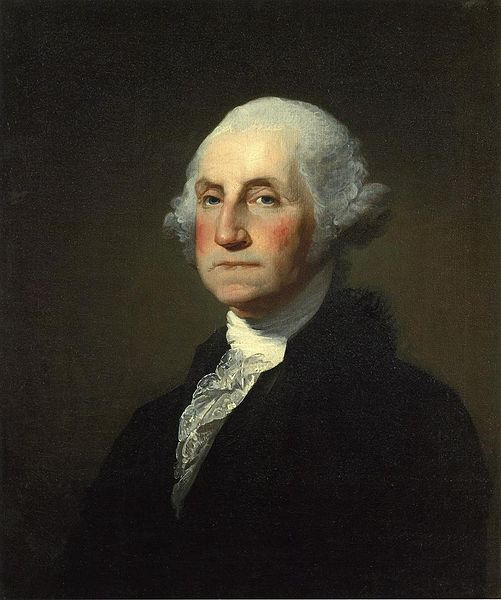
A reminder of the words of the first American president, George Washington, in his Farewell Address:

“The Nation, which indulges towards another an habitual hatred, or an habitual fondness, is in some degree a slave. It is a slave to its animosity or to its affection, either of which is sufficient to lead it astray from its duty and its interest …

501px-Gilbert_Stuart_Williamstown_Portrait_of_George_WashingtonA passionate attachment of one Nation for another produces a variety of evils. Sympathy for the favorite Nation, facilitating the illusion of an imaginary common interest, in cases where no real common interest exists, and infusing into one the enmities of the other, betrays the former into a participation in the quarrels and wars of the latter, without adequate inducement or justification.

It leads also to concessions to the favorite Nation of privileges denied to others, which is apt doubly to injure the Nation making the concessions; by unnecessarily parting with what ought to have been retained; and by exciting jealousy, ill-will, and a disposition to retaliate, in the parties from whom equal privileges are withheld. And it gives to ambitious, corrupted, or deluded citizens, (who devote themselves to the favorite nation,) facility to betray or sacrifice the interests of their own country, without odium, sometimes even with popularity; gilding, with the appearances of a virtuous sense of obligation, a commendable deference for public opinion, or a laudable zeal for public good, the base or foolish compliances of ambition, corruption, or infatuation,” – George Washington, in his Farewell Address.

And now, Barack Obama, as he arrives in Israel:

“So as I begin this visit, let me say as clearly as I can –the United States of America stands with the State of Israel because it is in our fundamental national security interest to stand with Israel. It makes us both stronger. It makes us both more prosperous. And it makes the world a better place. That’s why the United States was the very first nation to recognize the State of Israel 65 years ago. That’s why the Star of David and the Stars and Stripes fly together today. And that is why I’m confident in declaring that our alliance is eternal, it is forever – lanetzach.”

The concept of an “eternal”, and “unbreakable” alliance with any other single country is a statement George Washington would have regarded as deeply corrosive of foreign policy and domestic governance. To declare it in the language of the foreign country has even deeper resonance. It is now the governing principle of both political parties – and the primary reason we may once again be headed to war with unforeseeable consequences in the Middle East.

If anyone ever believed Obama was able to change that, or that any president can change that, they have been taught an important lesson. We’ve come a long, long way from George Washington’s vision of America. We have defined another, decades-old country half way across the world as integral to our own.

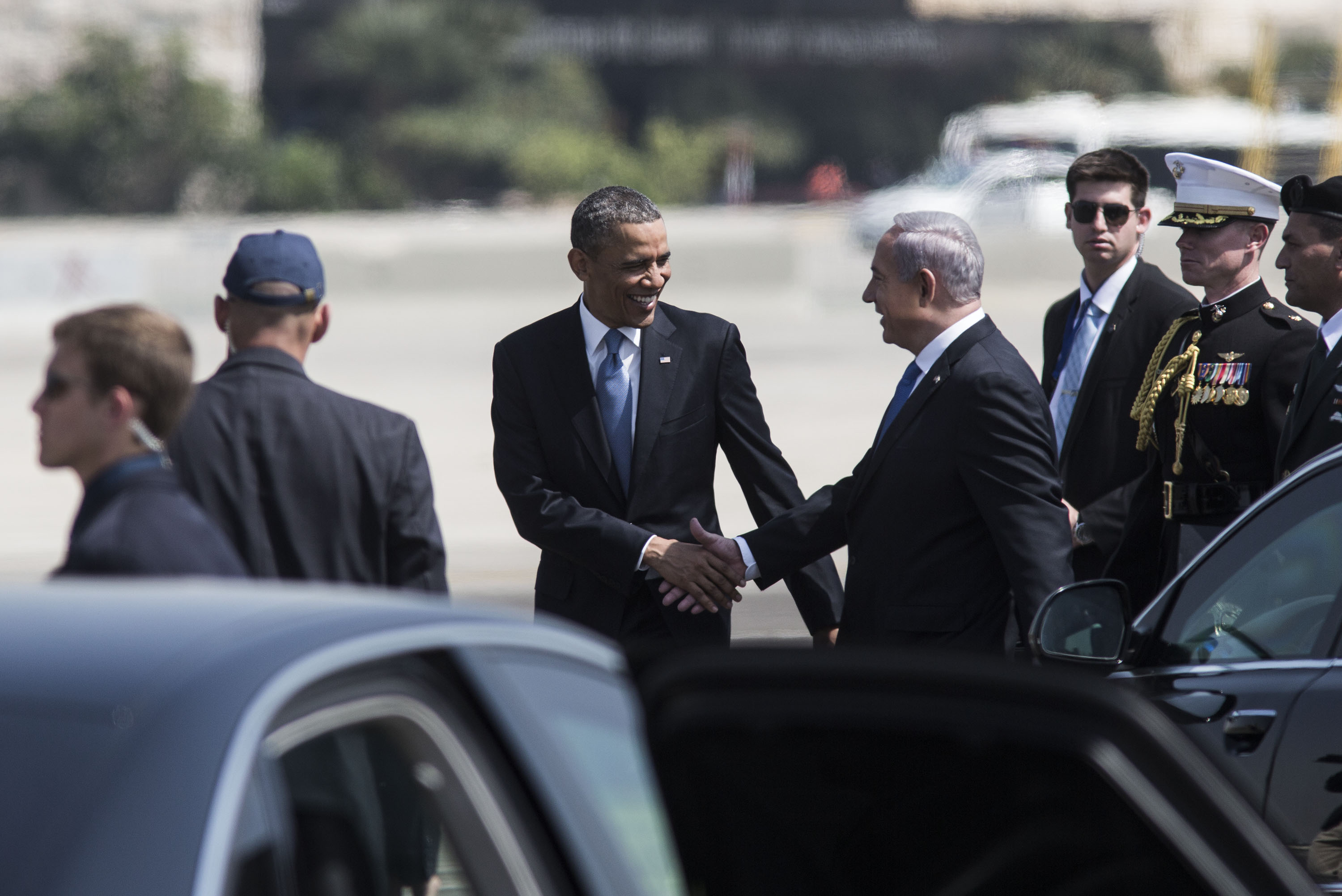
(Photo: President Barack Obama is greeted by Israeli Prime Minister Benjamin Netanyahu during an official welcoming ceremony on his arrival at Ben Gurion International Airport on March, 20, 2013 near Tel Aviv, Israel. By Marc Israel Sellem-Pool/Getty Images.)

From The Archive: The First Hathos Alert

I wrote on June 20, 2001:

John Derbyshire’s uncategorizable advice to his timid son is now up on National Review Online. Who else would encourage his offspring to fight back against a bully by bribing him with ice-cream and the words: “But I want to see the blood. Ice cream for blood.” The piece ends with the injunction that anyone who advocates single motherhood as a lifestyle option should be “sewn into a heavy leather sack with lots of broken glass and rolled down a l-o-n-g slope.” Leather? Have I created a monster? Derb has also just written what must be one of the weirdest discourses on fellatio I have ever read in New York Press. It begins: “I have been thinking about fellatio. No, no, don’t hit the back button. This is serious stuff. I have issues.” On that last sentence, I think we can all agree.

A colleague of mine – I can’t remember who, maybe they’ll email me to remind me – once coined the term “hathos” for the compulsive need to read something you find horrifying, yet irresistible. Read these pieces and you’ll know what I mean.

How Obama Became Netanyahu

Beinart explains.

Last night, I watched “The Gatekeepers“, a devastating documentary featuring several Shin Bet leaders over the last few decades. These men – the most hardened, realist, patriots – all acknowledge that the occupation is killing Israel’s soul, security and global support. All tactics, no strategy, as one puts it.

There is, it seems to me, no neutral ground on this. Either the settlements must be stopped and reversed or the US must cut its ties to Israel. Yet neither will happen ever. Perhaps there is some moral preening in opposing the settlements, as I do, while knowing that none of this matters, that the brutality will continue, and our complicity in it will be as “unbreakable” and “eternal” as the alliance Obama is currently toasting. But what else can one do?

The alternative for a writer like me is total disengagement, an acceptance that this deliberate immiseration and humiliation of an entire people is now simply part of what it means to be an American. My fear – and it is echoed by the former leaders of the Shin Bet – is that this acceptance will not end the reckoning that will come from doing nothing. Maybe Rabin was the last chance. But it is increasingly hard to believe otherwise.

Nostra Maxima Culpa

TO GO WITH AFP STORY "IRAQ-YEAR-2006"

Ezra apologizes for supporting the Iraq War. His key mistake:

Rather than looking at the war that was actually being sold, I’d invented my own Iraq war to support — an Iraq war with different aims, promoted by different people, conceptualized in a different way and bearing little resemblance to the project proposed by the Bush administration.

Chait also accounts for his mistakes:

The biggest single conceptual failure of my argument for war is that I gave absurdly little thought to the post-invasion phase. I was aware that the Bush administration was deploying far too few troops to the front for a workable occupation while blatantly lying about the war’s likely costs. I assumed that its real plan was to decapitate the Iraqi leadership, install a more pliant and less brutal military figure in Saddam’s place, and call it democracy.

In other words, I deemed the administration’s rhetoric about democracy to be a pack of lies. Now, I could accept this, because I assumed the successor regime would be less brutal than the psychotically cruel one that was being deposed. The quality of the regime was an important predicate for my support of the war — I would not have supported it had I believed it would make life harder for Iraqis, on the whole — but not the necessary rationale. I assumed these things because at the time Bush appeared — from the 2000 campaign through Florida through his push to cut taxes — to be a dishonest but ruthlessly effective figure. A messy, undermanned occupation would be politically fatal, I reasoned, therefore Bush wouldn’t actually undertake one.

Both critiques apply to me as well. Rumsfeld and Cheney were great at projecting confidence, competence and management skills. And we were all still traumatized by 9/11 and grappling with how to respond to it. But we know now they were as terrified as we were, and their fear drove them to abandon restraint or skepticism or competent military and intelligence advice.

This feels like an academic debate. But it isn’t. I have blood on my hands. However many times I try to wash them, the blood will not come off.

(Photo: An Iraqi carries the body of his grandson out of the morgue of a hospital in Baghdad 21 November 2006. The child was killed according to his grandfather when Iraqi and US forces raided Baghdad’s Shiite district of Sadr City to hunt for a kidnapped US soldier, the second such raid in two days. A shattered Iraq limped into 2007 after a year in which a bloody insurgency escalated into brutal sectarian war, forcing Washington to contemplate a major policy shift to halt total disintegration. By Ahmad Al-Rubaye/AFP/Getty.)

Obama’s Charm Offensive In Israel

President Obama's Official Visit To Israel And The West Bank Day One

Beinart sees the president’s trip to Israel as a belated attempt to improve his image in the country:

[T]his week’s trip will involve, if nothing else, a lot of talking to the Israeli people. In addition to visiting Yad Vashem, Israel’s Holocaust museum, and the graves of Theodor Herzl and Yitzhak Rabin, Obama will give a public speech in Jerusalem at which the White House has requested the presence of at least 1,000 Israelis. The idea is that by wooing ordinary Israelis first, Obama will find a more receptive audience when he unveils another initiative for Mideast peace. Administration aides are well aware that Netanyahu surrendered his first prime ministership after resisting demands for territorial withdrawal by Bill Clinton, a president widely admired in Israel. And they know that Yair Lapid, Netanyahu’s chief political rival, has criticized him for mismanaging the Obama relationship. A charm offensive, in other words, may do more to push Israel’s government in the direction of two states than a hard line.

Last week, Goldblog detailed the administration’s thinking:

During the first term, Administration thinking held that there was no point in sending the President to meet with Israelis and Palestinians on their home turf unless there was real progress in negotiations. Last year, this thinking shifted: Visiting the region while it was relatively quiet, without carrying a specific political agenda, grew to seem like a smart idea, in particular because many Israelis had grown suspicious of his intentions and would therefore benefit from direct exposure to the man, rather than his caricature.

Janine Zacharia believes that Obama’s campaign won’t make much headway:

Just as Defense Secretary Chuck Hagel—whose nomination was held up by those who worried he wasn’t pro-Israel enough—wasn’t running for Israeli defense minister, Obama isn’t running for Israeli office (or any office for that matter). And anyone who knows Israelis and their current mindset on the Palestinians (Palestinians, who?) knows that a little ego stroking isn’t going to get that population behind a peace deal. That doesn’t mean the trip couldn’t do some good. While the president is there ostensibly repairing the relationship with Israelis who’ve felt jilted, Obama may be sending an important signal to Tehran. The message: Just because I can’t stand Bibi doesn’t mean I won’t stand with him in preventing you from getting a nuclear weapon.

Aaron David Miller doesn’t expect much either, but doubts there will be another dust-up between the president and Bibi:

Netanyahu — much weakened in the new coalition government by two upstarts who have shifted the agenda from security to social and economic issues — may want to keep foreign policy prominent. And for this, he needs Obama. While he and Obama have differed over whether a military strike on Iran’s nuclear facilities is wise, there is still a good chance for coordination. The Israelis don’t want to strike unilaterally. Netanyahu is hoping that either through a credible deal on restricting Iran’s uranium enrichment or through U.S. military action, the Iranian nuclear program will be constrained, if not undermined, and Israel won’t have to act alone.

Another topic that’s sure to come up is what to do about Syria’s chemical weapon stockpile. Meanwhile, Steven Cook zeroes in on the ever-shrinking space for negotiations, especially on Jerusalem, still a central component of any negotations for a peace process:

There is nothing to negotiate. No longer can one look at the city and say, as an old Israeli friend declared to me in the early 1990s, “It’s clear. One part of the city is ours and the other part is theirs. We should share it.”  In the ensuing two decades, the Israelis have done everything possible to make the predominantly Arab parts of East Jerusalem little more than an enclave of Palestinian residents in a greater Israeli and Jewish municipality. Piece-by-piece the Israelis have filled in a jigsaw of new neighborhoods that ring the eastern part of the city.

Jay Newton-Small previews Obama’s next stop after Israel:

The President will wrap his tour in Jordan, where he’ll try to convince King Abdullah not to close his borders to Syrians fleeing the two-year-old civil war, even as Jordan’s economy buckles under the strain of 400,000 refugees with twice that number expected by year’s end. Jordan’s economy has also taken a hit as tourism has fallen off due to regional unrest and the perception of insecurity. To promote Jordan, Obama will play tourist for a day, visiting the ancient site of Petra with 500 international journalists in tow, demonstrating how safe – and appealing – Jordan’s tourist attractions remain. Jordan also hopes for more pledges of support from the U.S. for the Syrian refugees and for their own economic reforms.

(Photo: US President Barack Obama shakes hands with Israeli Prime Minister Benjamin Netanyahu during an official welcoming ceremony on his arrival at Ben Gurion International Airport on March 20, 2013 near Tel Aviv, Israel. By Ilia Yefimovich/Getty Images)

Was The Iraq Insurgency Inevitable?

FILES--IRAQ 3 YEAR ANNIVERSARY PACKAGE--

Michael Ware, arguably the most intrepid of all the reporters in the country, emphatically argues: no.

There were Sunni interlocutors ready to cooperate with the US as early as the summer of 2003. Ware spoke to them. The rigidity of the ideology fomented by Bremer et al – the tribes no longer existed, the insurgency was a myth, all Iraqis were elated by liberation – blinded the US to the sectarian opportunities and pitfalls that lay in front of them. They were perhaps influenced by such writers as Bill Kristol and Lawrence Kaplan who wrote before the invasion the following encouraging sentences:

Predictions of ethnic turmoil in Iraq are even more questionable than they were in the case of Afghanistan… Unlike the Taliban, Saddam has little support among any ethnic group, Sunnis included, and the Iraqi opposition is itself a multi-ethnic force… [T]he executive director of the Iraq Foundation, Rend Rahim Francke, says, “we will not have a civil war in Iraq. This is contrary to Iraqi history, and Iraq has not had a history of communal conflict as there has been in the Balkans or in Afghanistan…”

Bill Kristol has suffered not a whit from this grotesque misjudgment (and never apologized), while thousands of young Americans lie dead because of it. But to ignore sectarianism in Iraq – to declare it a non-issue beforehand –  remains the most serious misunderstanding of the whole enterprise – and thus made swift adjustment to reality harder. History can turn on moments like this one:

My friend [a Sunni former Baathist] said: ‘could you explain something for me?’

‘If I can, of course. You know that.’

‘Then tell me. I used US satellite imagery to kill Iranians in the eighties. Some of us did Ranger or Pathfinder training in the States. Al Qaeda? Never in this country. Right?’ he asked, rhetorically. ‘We had no great love for Saddam, and didn’t mind you taking him down. If you came for the oil, then take it; we have to sell it to someone. And, we’re happy if the occupier becomes a guest and we host US bases, akin to Germany and Japan.’

He paused.

‘So, how is it we end up on the opposite sides of this thing? I don’t get it. I just don’t get it.’

And there it was. Spoken. An insurgency.

The war’s ultimate goal, he told me, to much nodding approval around the room, was for the Sunnis to fight and negotiate their way to a seat at the table of power in the country. A seat they felt they’d been egregiously denied.

But in the weeks and then months I was being told such things, I could not find a single attentive ear within the US mission. Government authority then rested with the Coalition Provisional Authority of proconsul Paul L Bremer. Along with declaring so foolishly that the tribes of Iraq were effectively dead, CPA officials I encountered merely sniffed at the insurgents’ desire to converse. They would buckle under the heel of a new, soon-to-be democratic government. There was absolutely no palpable interest in encouraging a dialogue. Perhaps, even, quite the contrary.

Eventually, the rapprochement happened, and allowed us to leave with some face. But what if the “enemy” had been engaged as a potential ally in the summer of 2003? How many lives would have been saved? And what would we be saying now?

(Photo: US Marines from the 2nd battalion/8 MAR, prepare themselves after receiving orders to cross the Iraqi border at Camp Shoup, northern Kuwait, 20 March 2003. By Eric Feferberg/AFP/Getty Images.)

Netflix Adultery

Maureen O’Connor confesses:

Three weeks ago I cheated on my boyfriend. He was perhaps twenty feet away from me, sleeping in my bed with the door open while I betrayed his trust on the living room sofa. At one point, he woke up and walked right by. “You’re not watching House of Cards without me, are you?” he asked. “No,” I lied without hitting pause. With my ear buds in, you could say Netflix was actually inside of me as my boyfriend returned to bed. I stayed in the living room and kept watching.

A few days later I confessed my crime. “But when?” he asked, at first in disbelief. “Wait, that night you stayed up late? And I asked what you were doing, and you said ‘working’? Mauree-ee-een!” Feebly, I offered to re-watch the episodes. “It won’t be the same,” he said. Overwhelmed with guilt, I lied again: “I only watched two episodes! You can catch up!” I had watched five episodes in one night and finished the season.

Yes, my husband committed adultery while I was traveling recently in exactly the same way. But he made up for it by watching it with me again. Speaking of House of Cards, readers offer feedback on my recent review of the series. One quotes me:

“It has some clumsy compressions, some melodrama, and a main character so close to Shakespeare’s Richard III I wonder whether Kevin Spacey’s breaking the fourth wall isn’t some sly reference to Richard’s chillingly fun soliloquies to the audience.” Have you not seen the BBC original?  There, the Shakespearean models are patent.

“MacBeth” is evoked in the Scottishness of Ian Richardson’s Francis Urqhardt and the chilling complicity of his wife.  The direct address to the audience is even more pronounced, and it excites the same conspiratorial engagement that the device does in “Richard III.”  What’s more, Richardson’s performance is more comical/cynical and seductive/sexy than Spacey manages (or dares).

I can only imagine the American producers played down these aspects for an audience they thought would be less familiar with the Elizabethan precursors and less likely to appreciate a theatrical device on television.  It is the loss of the Netflix version.  It strikes me as perverse to jettison an aspect that made the original series so novel. We’ve seen any number of Shakespeare plays cast in modern dress, but far fewer modern political drama presented in Shakespearean drag.

Another:

For the life of me, I can’t recall if you had mentioned seeing Kevin Spacey as Richard III when he played the role in a traveling production of the Shakespeare play, or if you were aware that he had. Spacey and/or the writers are no doubt drawing on the experience. I had the good fortune to see the play in San Francisco. He was fantastic in the role.

Another:

Not subscribing to Netflix, I haven’t seen the new House of Cards. But your comments on this series reminded me of the greatness of the British original. I own a DVD set of the original series and watch it every few years. In the British version, the anti-hero, Francis Urquhart (“FU” – subtle, huh?) seems to me to clearly be a Tory. The genius of the show is the breaking of fourth wall, as you mentioned. But this occurs most effectively early in the series, when FU is taking us into his confidence. He’s truly delighted to be so clever, and his delight sweeps the viewer along, in effect making the viewer a co-conspirator. Of course, by the end he’s not the one who’s quite so clever or ruthless.

Moore Award Nominee

“I advise everyone to pay very close attention to [Republican Senate candidate] Dan Winslow’s platform. He has a 100 percent ranking from the gun lobby and he’s for the legalization of marijuana. He wants us armed and stoned,” – Elizabeth Warren. Update from a reader:

Elizabeth made her remarks at the annual St. Patrick’s Day Breakfast, which is Boston’s version of the White House Correspondents’ Dinner. It’s filled with politicians launching zingers at each other. “St. Patrick drove snakes out of Ireland … to Wall Street.” Nominating Dish awards out of these speeches would just be too easy, and not exactly fair.  Context matters.