“Whatever is vibrating on the iPhone just isn’t as valuable as the eye contact you are making right now,” – Douglas Rushkoff, in Present Shock.
Year: 2013
The Journey Home
After an airline mix-up, Freddie deBoer was forced to take the bus from Vegas to Indiana. He reflects on the experience:
My seatmate for a long while was a man named Muy. He spoke very little English. He told me he was going to Chicago. It occurred to me, in a vague way, that were he a promising young engineer from China, I might have worked with him in my campus’s oral English program, working on his prosodic quality, his phrasal stress, his morphosyntax. Instead he was from Mexico, trying to get from Las Vegas to Chicago via Greyhound bus.
In Kansas City, they wouldn’t let him get back on the bus.
He had missed a transfer somewhere. It seemed easy enough to do; I worried about it the whole time. I loaded up while he talked to them. It became clear that they wouldn’t let him back on. His leather coat was in the storage space above our seats. I grabbed it and came to get off the bus to give it to him. The Greyhound employees wouldn’t let me off the bus. They said if I got off the bus I wouldn’t be able to get back on, and I’d have to purchase a new ticket for the bus that left the next afternoon. I said to the guy, here, this is that guy’s leather jacket, he’s 25 feet away, can you bring it to him. But they wouldn’t. They just wouldn’t. I wanted nothing more than to just walk out past them and hand it to him. But I didn’t have enough money in my bank account to buy another ticket, and my suitcase was stored in the bus, and I was so tired. So I got back on and put his jacket back up in the storage. Then I had nothing to do but sit and think about it.
My politics exists to understand the difference between him and me, between both of us and the people who will never worry about how to get home. It is political. Perhaps if he were me, if he were white and spoke the English that power speaks like I do, he would have been able to get back on that bus, or to talk them into letting him have his leather jacket. But it’s not just political. It’s the way that human beings can help others, simply, at no costs to themselves, and don’t, every day, every day.
Organization Man
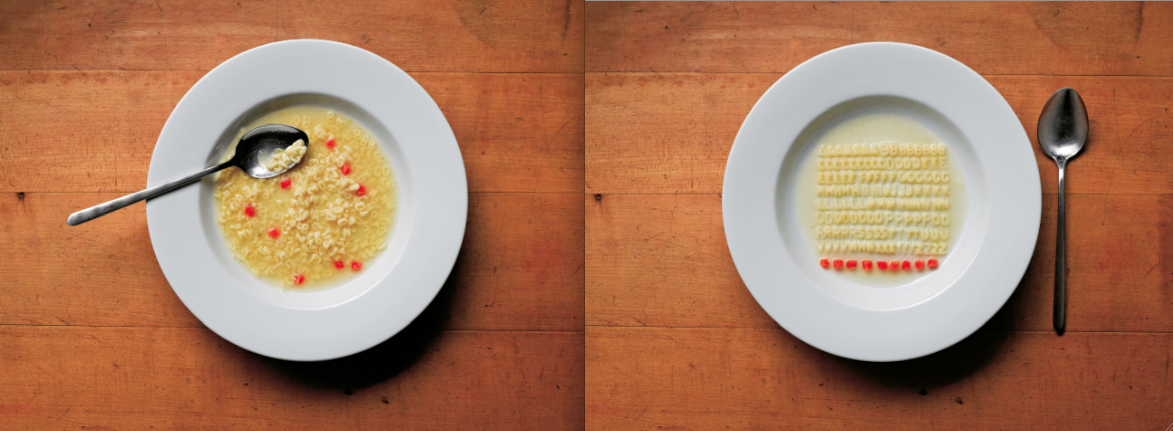
Ursus Wehrli specializes in organizing items, people, even paintings; his new book tackles life’s smaller moments. From an interview with the artist:
I think it speaks to our complicated world because our days are full of decisions and sometimes it is really hard to decide what is right, what’s wrong and we have to fight against the mess and the chaos. I wouldn’t say it is a manifesto for a neat world, but I’m happy if it makes people think about the balance between chaos and order. Of course, we realise we need both poles and it’s the balance that makes life worth living.
More on Wehrli’s process here.
(Image from The Art Of Clean Up, hat tip: Mark Frauenfelder)
From Warzone To Warzone
Elizabeth Ferris checks in on Iraqi refugees:
Today Iraqi refugees throughout the region face dwindling donor support, particularly as the needs of Syrian refugees increase. For the hundreds of thousands of Iraqis who remain in Syria, the situation is particularly dire. Some have been displaced within Syria. Some Iraqis have moved to other countries in the region (though they have faced an uncertain welcome by governments facing new inflows of Syrians.) Many — perhaps 100,000 — Iraqis have chosen to return to Iraq in the past year (though given the violence in Syria, it is hard to see this as a voluntary decision). Those that have returned to Iraq have either congregated in a hastily-constructed camp along the Iraq-Syrian border (which has often been closed) or have simply become [internally displaced persons (IDPs)].
The View From Your Window

Vienna, Austria, 4.30 pm
No Ear For Vinyl
Jason Heller has given up collecting LPs:
Like some people who say they have fibromyalgia or gluten intolerance, far more vinyl collectors think they’re audiophiles than actually are. Owning a decent turntable does not turn your ears into trembling flowers, unable to bear the bitmapped harshness of digital. It began to dawn on me—me, someone who had preached the sanctity of vinyl from my record-store pulpit for so long—that I couldn’t really tell the difference between a 7-inch and an MP3. Or rather, I could tell there was a slight difference, but it wasn’t enough to justify the huge portion of my income that I was spending on vinyl.
History As Hagiography
Sarah Marshall revisits an odd relic from America’s past – a series of grim “Bicentennial Minutes” that aired every night for two-and-a-half years during the 1970s. Her takeaway from the one starring Jessica Tandy (seen above):
No ambiguity hangs over the story: the Redcoats cut down the “Liberty Tree” not because they wanted firewood, but because it “bore the name of Liberty.” History has only one version, and it can be parceled into one-minute increments and sponsored by Shell, then slipped in before the evening news as testament to the fact that whatever happened today can’t be as bad as what happened two hundred years ago today.
Her feelings about America’s self-seriousness:
For Americans, our country’s legacy—and in particular the legacy of our founding has calcified into myth, and our Founding Fathers have become inhuman and larger-than-life. To have such an inflated sense of our own importance as a country is both a blessing and a curse; envisioning our forefathers as flawless men who could do no wrong, we are both ill-prepared to acknowledge our mistakes and somewhat overwhelmed at the prospect of living up to their example. If we regard our national history with more humility—and a keener eye for the wonderfully absurd—we may feel far more ready to contribute to it, knowing that, as anxious and overreaching misfits, we would fit in with our Founding Fathers far better than our schoolteachers would have us know.
The Cost Of Free Libraries
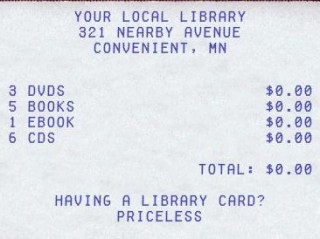
D. J. Hoek isn’t a fan of an image (seen below) that has been bouncing around social media recently:
[L]ibraries, as we know, do not exist for free. They cost their communities—whether composed of taxpayers, tuition-payers, donors, or a combination—a substantial amount of money. It’s well-intentioned to emphasize that libraries
provide materials and services without exacting immediate payment from users for each transaction. But today it is at best a mistake and at worst self-destructive to underrepresent the considerable ongoing investment that the members of a community make to have library collections, technology, personnel, and facilities available to them. … Rather than promote the “free library,” let’s remind our communities of their great investment and of the tremendous wealth of returns they derive from that investment: materials, specialized assistance, and programming. That doesn’t mean libraries are free. It means that the cost of libraries is worth every cent.
Claire Kelley considers one possible solution to library budget cuts:
As libraries respond to the challenges facing them, some have suggested adding a small circulation fee—something like fifty cents—to make up for cut funding. Last year in The Atlantic, Keith Michael Fiels, executive director of the American Library Association, responded to an Atlantic editorial that argued for instituting such a policy. He worried that collecting fees would be a barrier for entry for the people who needed library access most, and that the amount of revenue generated would be less than what public support and municipal budgets could provide.
Chart Of The Day
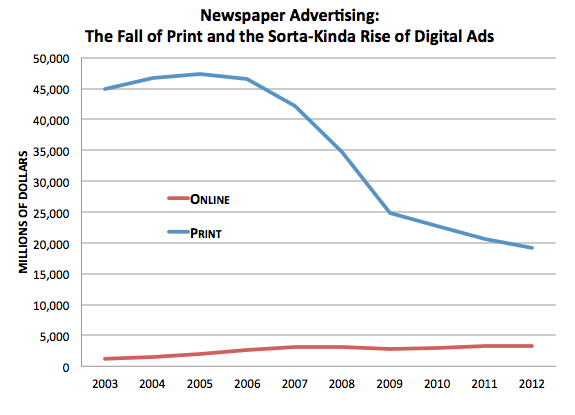
Derek Thompson passes along some bad news:
In 2012, newspapers lost $16 in print ads for every $1 earned in digital ads. And it’s getting worse, according to a new report by Pew. In 2011, the ratio was just 10-to-1.
Why Take His Name? Ctd
Readers continue the recent thread sparked by Jill Filipovic:
One of the most common complaints I hear from women who don’t want to change their name is the fear that their family name will “die out,” and I’ve heard the reverse from men as well. So I think the default last name of a newly married couple should be whichever one of their names is shared by the fewest guests at their wedding … and negotiations can go from there.
Another reader:
The truth is, it’s easier when you share a last name, and it’s a wonderful symbol of your shared life. That said, it doesn’t have to be *his* name; I have friends where the husband took her last name, where they both hyphenated. My husband and I chose a new last name – a shared family name.
Another:
When my wife and I first got together and were talking about marriage, without even prompting her, I said simply “Hey, what would you think about me taking your last name?” Why did I offer?
Because I come from a family of all boys. If my father has any concerns about “his name passing on”, he has three sons to do it for him. I know both of my younger brothers are far too close-minded to ever consider it themselves, so why not be the first one to go a different route?
She was surprised I offered, but as we talked about it, we at least got to a point where it wasn’t an assumption but a conscious choice of which direction we were going to go. We did ultimately decide to retain my name and she dropped her “maiden” name. (Notice we still call it a “maiden” name, a term that hasn’t been relevant for at least 500 years …)
Another:
This June I will have been married for 20 years. When my wife and I got married, she chose to continue to go by her maiden name. I wasn’t thrilled, probably because it threatened my manhood. Over the last 20 years my views on so many things have changed but not on this issue. The problem for me is that it feels like hedging your bets in case things go wrong or possibly infers, whether true or not, a lack of commitment, like we are not really a family but rather a group of individuals working together, at least for now. So the real issue for me (at this point in life) is not the woman taking the man’s name, but rather the family unit having separate names.
We will most likely be in the position in the near future of adopting a foster child and I wonder how she would feel if we told her she won’t be getting my last name or my wife’s. I can only think she would feel that maybe it’s because we might want to give her back some day. And if we don’t do that, whose name does she get and what does that mean to her? There is something about a unit of people calling themselves by the same name, family or group or otherwise, that seems to naturally pull us together.
One more:
Since I was a teenager I’ve adopted the quip: If I get married, the only way I’ll change my last name (my first name being Dorian) is if I marry someone with the last name ‘Gray.’ When I cavalierly explained this to my future husband, I got a stunned silence. I felt bad that it didn’t even occur to me that he would just assume that I’d take his name when we got married and thus be shocked that I announced that I wouldn’t be. “Are you ok with that?” I asked. “Uh, yeah I guess – it just never occured to me that you wouldn’t change your name,” he said.
I tried to explain that it’s very much a part of my identity, of who I was, that it’s the name of my business and had been for years so it wasn’t practical to change it, and not least of all, the whole connotation of ‘ownership.’ And then to make a point, I asked him if he’d be willing to change his last name to mine and he looked horrorstruck: “No!” “Well,” I said, “that is how I feel about not wanting to change mine.”
A lightbulb went off and I think he really saw what it meant for a person to give up their name.
More reader discussion at our Facebook page.
 The Dish