Frum, Greenwald And Iraq

US Secretary of Defense Donald Rumsfeld

Frum reflects, at length, on the Iraq War. This is where it gets really interesting:

The last time I saw Chalabi was in his London apartment, on the very eve of war. My little group arrived past midnight. Chalabi was listening to the evocative strains of Sufi music. He showed me a black-and-white photograph of seven men, wearing the clothes of the 1940s. They were the board of directors of a company his father had founded: a mixed group of Sunni, Shiite, and Christian, and even a Jew. Chalabi remarked that this picture was taken while Europe was tearing itself apart in genocidal violence. He didn’t add that it was taken shortly after British forces defeated a pro-Axis coup in Baghdad—but failed to prevent a murderous pogrom against Baghdad’s Jewish population.

I was less impressed by Chalabi than were some others in the Bush administration. However, since one of those “others” was Vice President Cheney, it didn’t matter what I thought. In 2002, Chalabi joined the annual summer retreat of the American Enterprise Institute near Vail, Colorado. He and Cheney spent long hours together, contemplating the possibilities of a Western-oriented Iraq: an additional source of oil, an alternative to U.S. dependency on an unstable-looking Saudi Arabia.

Greenwald claims this is proof the war was for oil, not against WMDs. But the two are not mutually exclusive. As for good faith, I’ve long since stopped believing that Dick Cheney believed there really were WMDs in Iraq – but I remain unsure about Bush. (As the archives show, I was seriously convinced by the WMD argument, because I wanted to be convinced, i.e. a useful idiot). But Glenn is not done with David, though:

Frum claims that he “was less impressed by Chalabi than were some others in the Bush administration”. But, as Ruben Bolling just reminded me, Frum wrote a long and angry defense of Chalabi in 2004 at National Review, hailing him as “one of the very few genuine liberal democrats to be found at the head of any substantial political organization anywhere in the Arab world”, and ended with this proclamation: “Compared to anybody [sic] other possible leader of Iraq – compared to just about every other political leader in the Arab world – the imperfect Ahmed Chalabi is nonetheless a James bleeping Madison.” James bleeping Madison. Whatever attributes characterized David Frum back in 2003 and 2004, a skeptic of Ahmed Chalabi was not one of them, his present-day suggestions notwithstanding.

(Photo: US Secretary of Defense Donald Rumsfeld (C) speaks to the media with Ahmed Chalabi (R), leader of the Iraqi National Congress, and Paul Bremer (L), top US civilian administrator in Iraq, prior to a meeting of the new Governing Council in Baghdad on September 6, 2003. By Rabih Moghrabi/AFP/Getty Images)

Is Iraq The GOP’s Vietnam?

Daniel McCarthy makes the case:

While Republicans wage a war on the past, Barack Obama has staked claim to the future—in the same way that Richard Nixon and Ronald Reagan once did. The reputation for competence in wielding power that Nixon (before Watergate) and Reagan accumulated now accrues to Obama’s advantage. He brought the troops home from Iraq—however reluctantly—and is on course to end the war in Afghanistan next year. His foreign policy, like Nixon’s and Reagan’s, involves plenty of military force. But like those Republicans, the incumbent Democrat has avoided debacles of the sort that characterized the administrations of Lyndon Johnson and George W. Bush.

Millman pushes back:

I’m unconvinced that Vietnam is the key reason why the Democrats lost their status as the majority party. Rather, I believe it was overwhelmingly domestic policy considerations – and particularly the nexus of race and crime – that overwhelmingly drove the “Silent Majority” into the arms of Richard Nixon, and, subsequently, motivated the Democrats of Macomb County, Michigan, to pull the lever for Ronald Reagan.

That doesn’t mean Vietnam was irrelevant, but in the absence of the currents of domestic social change, I suspect the Vietnam debacle would have looked more like, say, the Korean War, the memory of which did contribute to the Democrats’ losses in 1952 and 1956, but did not lead to a long-term realignment.

Larison’s view:

The war was instrumental in driving younger voters away from the GOP and into the Democratic coalition in 2006 and 2008, and most of them have remained there since then. Of course, Iraq was not the only thing about the Republican Party and mainstream conservatism that alienated Millennials, but it is correct to say that the Iraq war increased and hastened Millennial alienation from both. The important point is that the GOP was already going to be struggling to appeal to a more diverse, more liberal younger generation, and a foreign policy defined by the Iraq debacle has made that task even more difficult. So the sobering thing for Republicans to consider is that the Iraq war is a liability for them with Americans of all ages, and it has already proven to be a disaster for them with younger voters.

I wonder how that may affect the GOP’s clear desire for a new Middle East war against Iran. For the first time, I suspect, the party will be deeply split between the Paul and Rubio camps. Which is when it gets really interesting – and when America’s decision to remain the global hegemon for the indefinite future will come under the deepest strain.

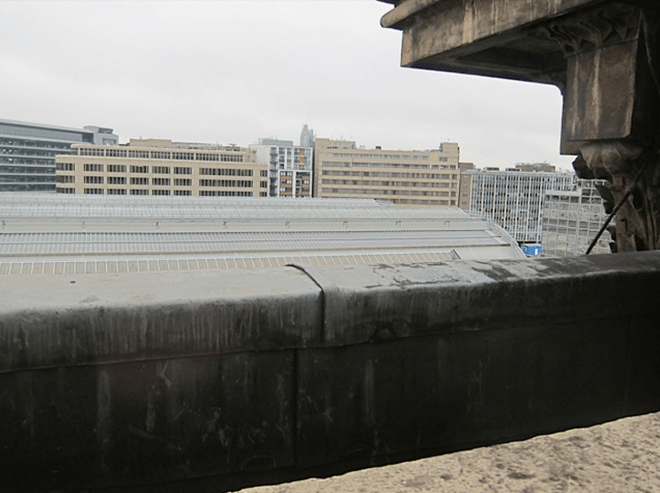
The View From Your Window Contest: Winner #145

Screen Shot 2013-03-16 at 3.59.30 AM

A reader takes a stab:

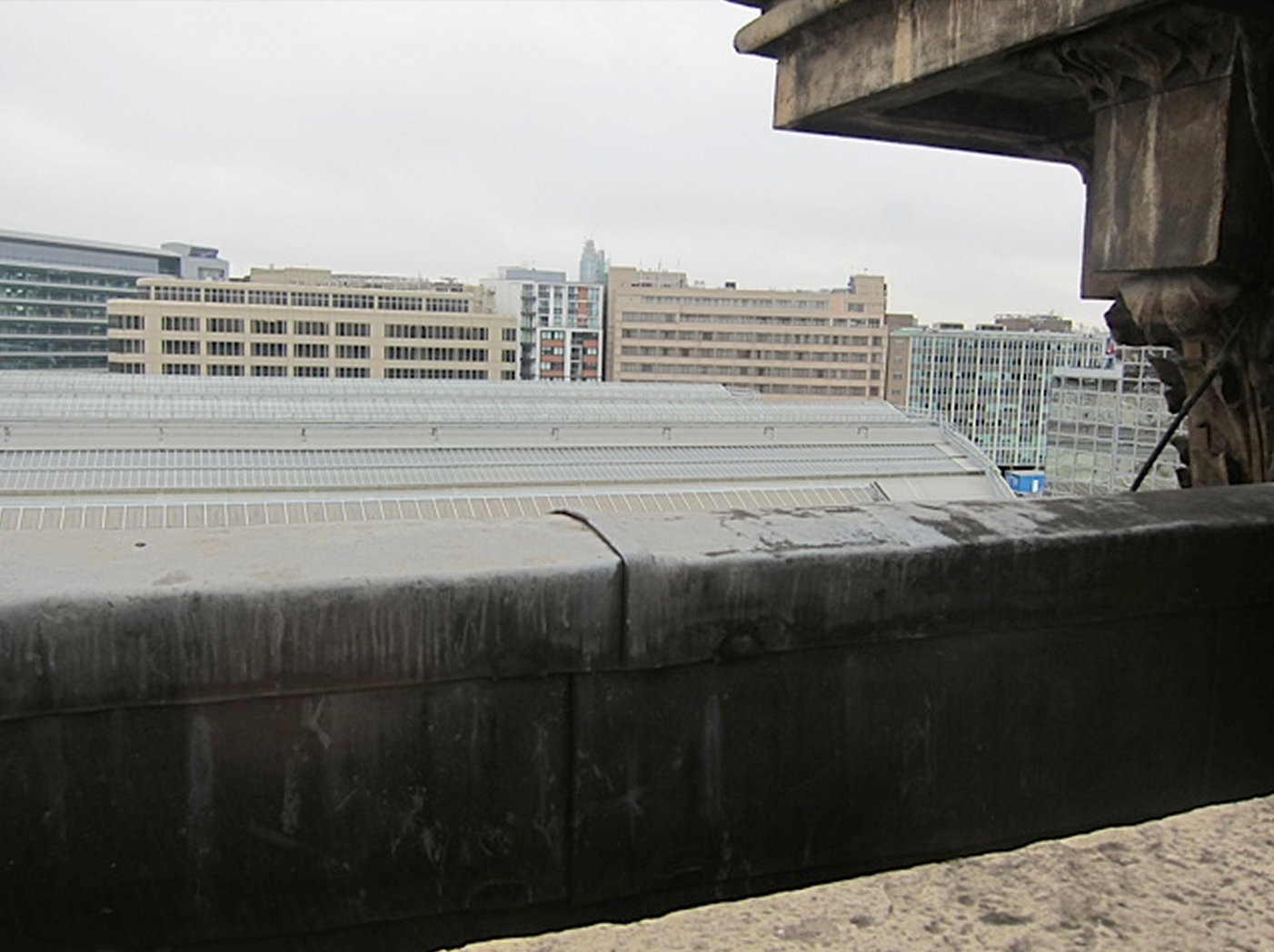
Some Eastern European city, height-restricted buildings, possible government tower (exempt from the restiction) on the horizon, with a tower crane, other cranes nearby. Possible train station roof below. Possible pre-Communist city reconstruction building from which the picture was taken. Aside from the gargoyle-faced building, nothing in the picture looks to have been built prior to about 1960, which again makes me wonder if this isn’t in some city that was either re-built after Dubya Dubya Two, or was the work of one of those Great Leap Forward-type master plan. The sky is grey, the buildings are grey, the people IN the buildings moods are grey …

Another:

This picture was taken just before the photographer flung himself over the edge. He was overcome by the sheer drabness of the view, and thought that his dead body would add, at least, a little touch of the unexpected to an otherwise banal, horrid place. His family, while quite distraught, quickly realized that this view could be in almost any city and vowed to remain exurban.

Another has a more specific guess:

The view from your window is located in Washington, DC.  The picture is looking westward and is overlooking Union Station. In the background is First St.  One of the buildings is the Federal Energy Regulatory Commission I think.

Another:

OK, the second I looked at this picture, I thought “Austin” because the building in the center of it looks an awful lot like the UT Tower and I think I see the Castilian dorms nearby. A photo of Austin seems like a logical picture for you to post this week, given that SXSW is wrapping up this weekend.

Another:

It’s a very tough photo, and I don’t see any landmarks of Buenos Aires, but some of the buildings could definitely be from there and the mix of old buildings with newer ones it’s pretty typical. In addition, the blue small structure you see on the right could be one of the newspapers’ kiosks you see everywhere in the city. And finally, since the new Pope is from there, that’s what I’m going with for this week.

Another:

The construction project in the deep background is probably the best clue. I searched online for skyscrapers under construction. After I delved a little deeper in to the promising ones, I’m guessing it’s the Shanghai Tower. The incongruous architecture in the foreground also suggests Shanghai, as the city is host to a surprising number of historic buildings. I would try to be more precise, but Shanghai’s images on Google Earth are full of smog. I think this contest is giving me an asthma attack.

Another:

Normally I don’t actively participate in the contest, but instead just read the award entry on Tuesday afternoon. This week, though, I had a really strong hunch that this was my hometown of Bangkok, Thailand. I did most of my growing up there before moving to the US for college. Now that I’m in medical school, I don’t get to go home as often, so it might just be a figment of my imagination that the building off in the distance is Baiyoke Tower 2, which I believe is the tallest building in the country.

The picture was taken from somewhere near one of the BTS train stops. I couldn’t figure out which one in particular, though, so I called up Mom and Dad who still live in Bangkok, and asked them to drive around the city trying to figure it out. They declined to do so.

Another:

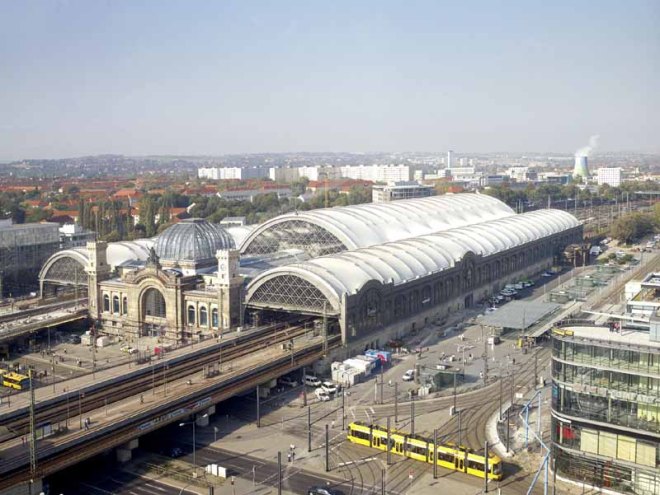
I came up with this guess in less than five minutes.  Whether or not I’m right, at least I had a plausible chain of reasoning.  The glimpse of parapet in the foreground reminded me of Gothic towers in Western Europe.  But buildings in the background are all modern.  So I started thinking about places in Europe where the old city was destroyed in WWII and was subsequently replaced with new construction.  That brought me to Dresden, Germany.  With a quick check of Google images, I found a picture of Dresden Station – which has long, arched roofs that seem to match those in the middle of the contest picture:
FP*146507

Another gets on the right, er, track:

We appear to be looking out over the kind of railway station roofing that’s very common throughout the railway approaches and termini of central London: Liverpool Street, Waterloo et al. And the grime on what appears to be ornate 18th or 19th century stonework in the right foreground is very familiar to anyone who’s lived in London. And is that the Nat West building in the distance? I fully expect to be wrong by well over 10,000 miles.

More like feet. Another gets even closer:

The roof in this week’s picture strongly suggests a current or converted railway station. The Musee d’Orsay in Paris was my first thought. It doesn’t appear to be it, nor any of the other Paris train stations. Given the size of the station (if it actually is one), the old stone of the building from which the photo was shot, and the density of the build-up around, the location is probably in the center of a major European city, one of the classical stations from the heyday of trains. I didn’t find an exact match searching between Rome and Glasgow, but will guess St Pancras Station in London.

Correct city. Another zeroes in:

Scottish ex-pat in Silicon Valley and first-time VFYW entry! This one just screamed “London railway terminus” at me. Why? The foreground old roof with lead flashing reminds me of so many British rooftops. The juxtaposition with the modern buildings in the background and the arched roof (almost certainly over a railway station) just screamed London at me. First thought was St. Pancras, but a quick Google proved me wrong. Victoria? Bingo!

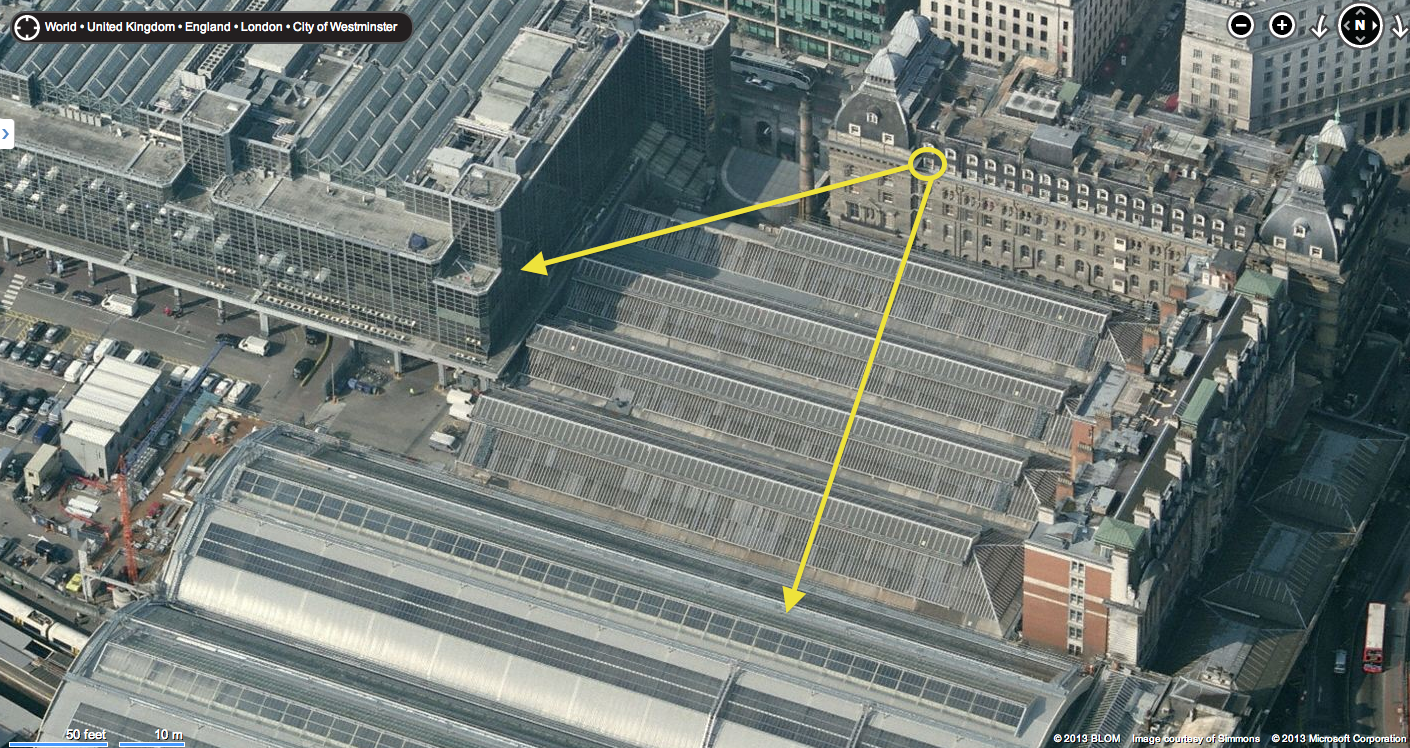
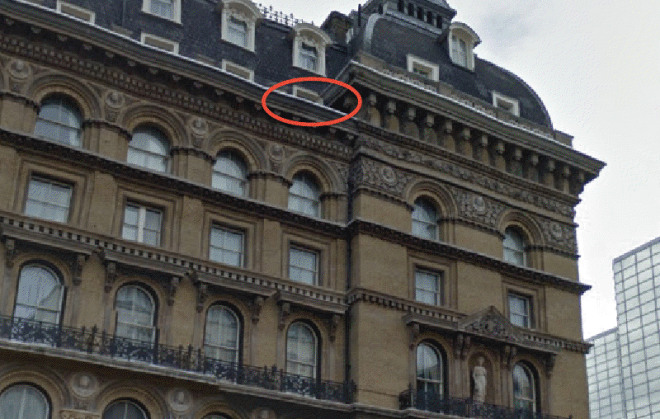
The photo is taken from the Grosvenor Hotel, overlooking the roof of Victoria Station, looking towards the buildings on Bridge Pl. From the height of the buildings, I would say something like the 5th floor counting with the British convention starting with the Ground Floor. I’ve circled my guess at the location on the enclosed pdf.

Grosvenor Hotel it is. A visual entry:

VictoriaStation-da09724

Another reader:

This will be easy for any London commuter so I assume you’ll get loads of responses. That’s the double arched glass canopy roof over the platforms at Victoria station, taken from up on the roof of the station building looking south-east towards Vauxhall.  I’m sure you’ll get loads of bods from the Torygraph giving you the exact location of where the photo was taken – their headquarters are in the office block above the station concourse.

You can see the Vauxhall tower in the distance with the crane on top – that’s the crane that was recently hit by a helicopter in heavy fog, with crane and helicopter coming down in the carpark of our Sainsbury’s on South Lambeth Road.  Our houseboat is moored on the Thames between that tower and Battersea Power Station. Best wishes from the UK, and keep up the great work.

Another visual entry:

angle-london

Another reader:

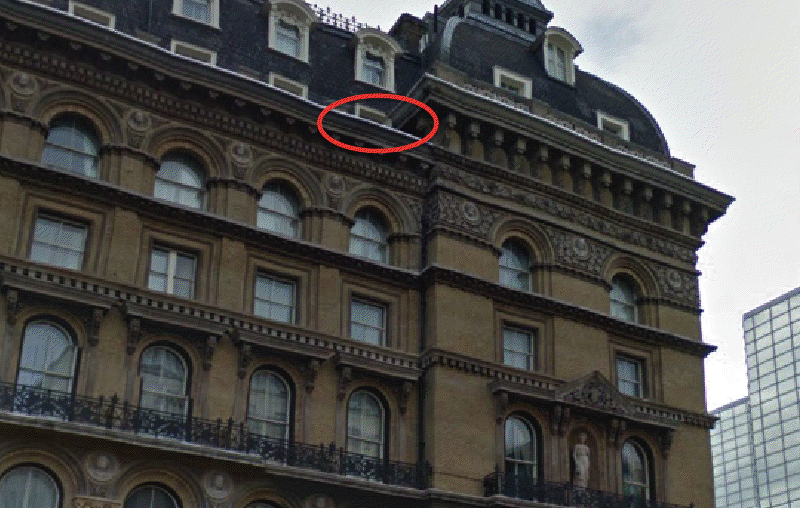
Amongst its various amenities, the Grosvenor Hotel offers the “Cora Pearl Experience” – an homage to the “infamous 19th Century Parisian Courtesan.”  Born to a humble background working as a street prostitute, Pearl eventually found wealth and notoriety as the companion to the rich and powerful of Europe – including Prince Napoleon and Prince Willem of Orange.  There’s also a cocktail named after her, the “Tears of Cora Pearl” – the only recipe I can find says that it is comprised of vodka, creme de cacao blanc, Domain de Canton, fresh strawberries and topped with champagne and 23 carat gold leaf.  I was going to say that I might celebrate with one, but like Cora Pearl herself, is probably a bit too rich for my blood.

Another visual entry:
circle-red

Another reader:

As a railways enthusiast and employee of Deutsche Bahn (German Rail), I was determined to solve this week’s VFYW upon seeing the unmistakable roof of a large train shed. Not immediately recognizing the surrounding buildings, I was able to quickly rule out Germany (I’m quite familiar with all of our train stations and their surroundings). Something about the modern architecture and the density said “London” to me, and being familiar with most of the city’s train stations I started my search there. St. Pancras was clearly out – its single-span train shed could not be mistaken for the two spans seen here. Neighboring King’s Cross was a possibility – it sports a two-span shed but a quick look at the adjacent buildings allowed me to rule it out as well. My next guess was Victoria, and lo and behold, the buildings matched!Screen shot 2013-03-16 at 6.46.48 PM
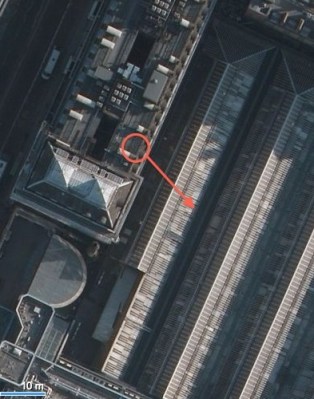
Then it was just a matter of finding the precise location of the photographer, who must have been standing on a roof of a neo-classical building on the side of the trainsheds opposite the buildings seen here. That pointed me to the Thistle Grosvenor Hotel. Counting the ribbing on the roof of the train shed helped me line up the photographer’s location along the parapet of the hotel. I’ve marked my estimation of the location in two of the attached photos, with the third showing the buildings seen in the background of the VFYW shot.

For what it’s worth, I’ve previously identified Boston, MA (September 2010), Warsaw (March 2012), Depoe Bay, OR (May 2012), and Bethany Beach, DE (July 2012), but have yet to win a contest. I also think that working for Europe’s largest railway company should earn me an extra point, should you need a tie-breaker!

The tie-breaker this week goes to the reader who guessed the room closest to the actual one:

This is my third hit in four weeks … either I’m getting the hang of this, or they’re getting easier! The grey architecture and even greyer weather suggested Britain to me, and as a British expat I’d feel fairly ashamed if a missed a British VFYW. The building in the foreground is clearly a train station, and so a few searches got me to the Grosvenor Hotel, near Victoria station in London. Based on photos on the web of the Grosvenor, I’m saying the room is one floor from the roof, which by my calculation will put the room in the 500 range. Room 601, according to a photo on tripadvisor, is at the northern end of the building, and from the same source room 421 is on the western side, so I’m guessing around room 514.

Details from the submitter:

This is taken from Room 508 of The Grosvenor Hotel, adjacent to Victoria Station, London. The wonderful thing about these back rooms is that the station roof muffles the sounds, such that the public address announcements sound like the adult voices in “Peanuts” cartoons – “wah wah weh wah weh…”

The best visual entry this week:

Grosvenor Hotel VFYW.002

One more reader:

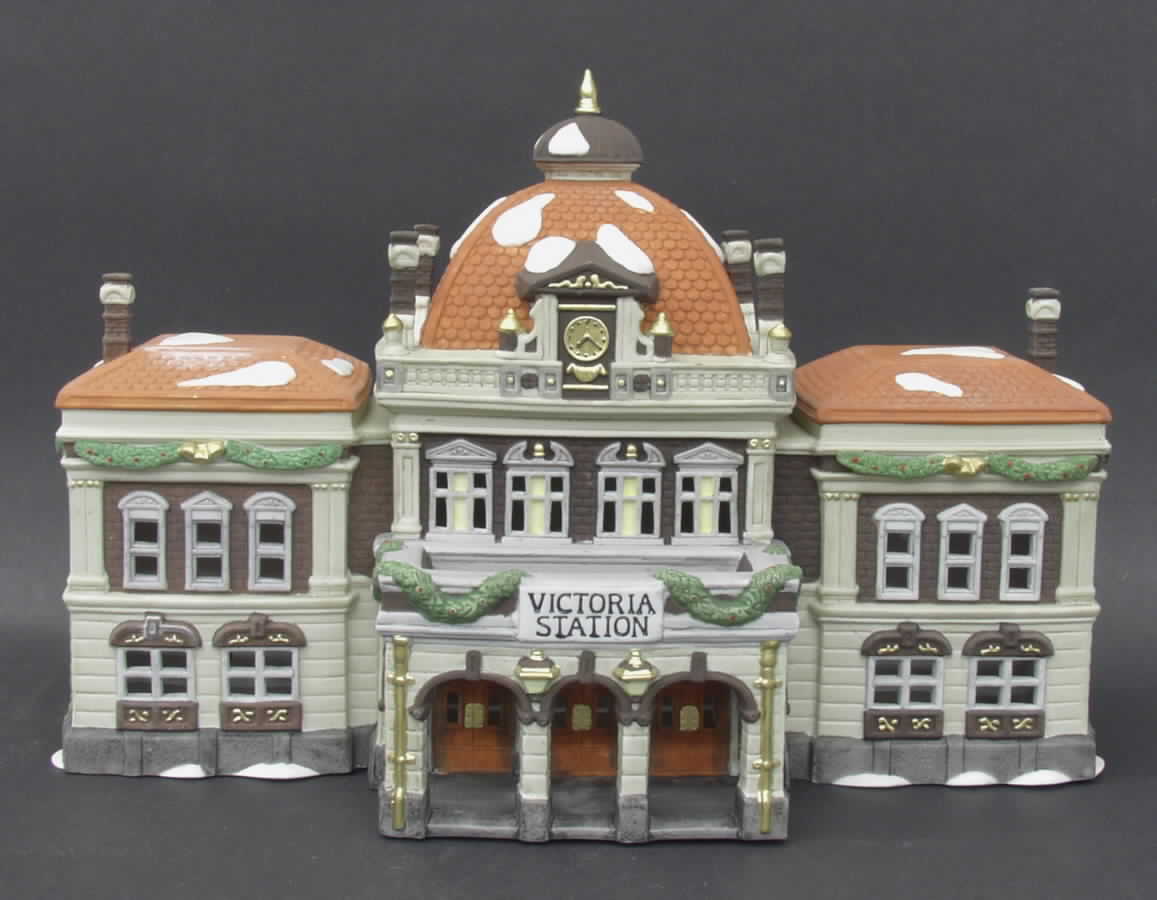
I’ve always been curious to see if the Dish team could find good contest views from otherwise well known cities like London and I think this one hits the spot. On a personal level, I love that it was taken at Victoria Station. As a kid my family had a set of decorative porcelain houses called Dickens Village which we would display at Christmas, and one of them was a miniature Victoria Station. That little station helped form my childhood image of London, and although in real life it proved far less adorable, it’s still the first train station that pops into my head when I think of the city.

Attached is an Ebay image of that miniature, marked bird’s eye views and an aerial shot of the hotel and station from way back in 1945:

Victoria Station Miniature - Copy

(Archive)

Quote For The Day III

“[W]hile I can appreciate the qualities in Pope Francis that so many people have found immediately attractive, I would trade all the humble mannerisms and charming gestures for the promise that the Mahonys and Sodanos of the church would be consigned, once and for all, to lives of penitence and silence,” – Ross Douthat.

How Activist Judges Could Save The GOP

Screen shot 2013-03-19 at 12.15.46 PM

Barro claims a SCOTUS ruling establishing a federal right to marriage in all 50 states would be best for the GOP:

A Supreme Court decision imposing gay marriage nationwide will not only make this problem go away, but it will also give Republican politicians a useful scapegoat to impotently shake their fists at. They can say they wish they could continue the fight against gay marriage, but alas, those judicial activists at the Supreme Court have made it impossible. And then, gradually, everyone who cares about stopping gay marriage will grow old and die, and we can stop talking about the issue.

When Republicans argue that a sweeping decision for gay marriage would sow longstanding division, they are comparing it to Roe v. Wade. But this analysis is wrong. Abortion remains a divisive political issue 40 years after Roe, but not because it was decided judicially. Abortion is a different kind of moral question than same-sex marriage, about what a life is, not what kinds of sexual morality the government ought to encourage; abortion supporters and opponents would not have reached consensus absent the Roe decision.

They may not have reached consensus but they might have had a chance at reaching compromise, as in most other Western democracies.

But Barro is onto something: for the purely cynical GOP elites, SCOTUS could indeed save them from an increasingly unpopular political position they cannot change – because it is God’s law and their base sees no distinction between politics and religion. But the evangelical faction? If there’s one thing that could resurrect their anti-gay passion and deepen their sense of victimhood would be SCOTUS over-reach. That’s why I still favor the federalist, slower path to equality – by changing consciousness, consciences and thereby votes in the states, which are, in the end, the core political unit for legal marriage in the US.

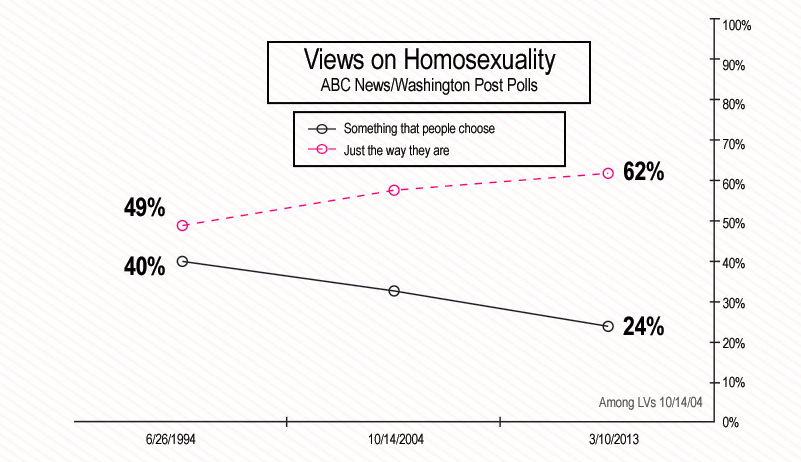
The one reservation that has struck me recently is whether I have become too attached to my own experience in this struggle over a quarter of a century and am under-estimating the current scale of the public shift – a shift that would make a clear SCOTUS position far less likely to provoke meaningful backlash. One surprise for me in the recent ABC/WaPo poll was that a clear majority of both pro-marriage equality and anti-marriage equality forces wanted to the Supreme Court to have the final say nationally:

Americans by nearly 2-1, 64-33 percent, say the legality of gay marriage “should be decided for all states on the basis of the U.S. Constitution” rather than by each state making its own law on the issue. That view, interestingly, is not much impacted by attitudes on the issue itself: Among supporters of gay marriage, 68 percent say the Constitution should rule; among opponents of gay marriage, 62 percent say the same.

Preference for a Constitution-based determination encompasses two-thirds or more of Democrats and independents, liberals and moderates alike; it’s lower, but still a majority, among conservatives (56 percent) and Republicans (54 percent).

This may mean that both sides simply want a swift and total victory. But that will mean swift and total defeat for one side, with no democratic recourse. So it doesn’t rule out backlash. But the sudden shift in support for equality and the staggering 81 percent of the under-30s supporting it, along with nearly 60 percent of all Americans, may be changing this issue faster than even I can quite absorb – and give the court considerably more lee-way in going big.

Of course, one could argue that one reason for limiting the reach of the court ruling is to make the GOP increasingly isolated, giving yet another tolerant generation a permanent attachment to the Democrats, as anti-gay forces fight furiously in state after state, branding the GOP indelibly as intolerant and anti-modern. Since they lived by the wedge issue for so long, why not make them slowly die on it for a few more election cycles? But this is a step too cynical for my taste. It is to out-Rove Rove – a sure sign that one has lost one’s moral bearings.

But still, if the argument against too sweeping a ruling is a conservative one, fearful of the court getting too far out in front of the popular will … then dramatically rising public support for equality weakens the case. I still hold the federalist position – but have to concede that I may be fighting an old battle rather than the new one. Perhaps it’s hard for an old warrior not to misread the new battlefield. But I’d rather do it the old-fashioned way. Because we’re winning in the best way possible: by actually changing minds and hearts of the people, not of one Justice.

Un-Dominion

In a review of two books about our relationship with dogs, What’s a Dog For? and The Puppy DiariesSue Halpern considers the power dynamics at play:

When humans breed dogs, we breed them for us—to suit our fancy, primarily, and sometimes to help us accomplish certain tasks. Snout-compressed dogs like the bulldog have been bred to appeal to a particular human aesthetic, even though this means that they sometimes have trouble breathing. The Cavalier King Charles, which in the twentieth century was rejiggered to resemble dogs in royal portraits, is, as a result, often born with a brain too big for its skull, with excruciating consequences. And bulldogs, as handsome as their oversized heads may be, are typically too large now to descend through their mother’s birth canal and require surgical extraction to be born. The soft mouth of the retriever is a human invention, and so is the tail of a pointer. The labradoodle—a cross between a poodle and a Labrador retriever—was initially made to create non-shedding guide dogs because the standard guide dogs—German shepherds, Labs, and golden retrievers—could not be used by people with allergies. …

The human–canine bond is inherently unequal. Like it or not, it is a power relationship.

And yet, I still feel my own dogs have power over me. I’m sure this is because we haven’t been the sternest disciplinarians; and because one of them is a beagle. They have different strategies for controlling humans. Dusty, the pure beagle, just insists on one simple thing: getting her way. If you’re late for her dinner, she will whine in a way that sears through the brain like the Time Warner Cable announcer. If you crate her, she will howl until the neighbors complain. She’s older than fifteen now and yet can stop a large grown man dead in his tracks if she decides she has found some elemental trace of a former pizza crust in a sidewalk crack. I know I have the power of food and medicine over her; but that’s about it. She seems to me to live in her own world, with us as her personal assistants and chefs. And, yes, of course, we ceremoniously and punctiliously follow after her sphincter and pick up her crap. I’m not sure even Marie Antoinette had such a service at hand.

Our other dog just guilts you into surrender. She’ll gaze at you with such tender love you are rendered completely helpless. She’ll just pee in the apartment if one of us is away too long. She worships Aaron as a sun-god, while I am the moon, something to see by during the nights of his physical absence. Now that I no longer have a boss, she easily has the most power over me of any other living creature, including my husband. I know this is all a terrible paradox and that their obedience should reflect what Cesar calls our “calm dominance.” But I tend to agree with Montaigne:

At home, he extended his perspective-leaping to other species. “When I play with my cat”, he wrote, “who knows if I am not a pastime to her more than she is to me?” He borrowed her point of view in relation to him just as readily as he occupied his own in relation to her. And, as he watched his dog twitching in sleep, he imagined the dog creating a disembodied hare to chase in its dreams – “a hare without fur or bones”, just as real in the dog’s mind as Montaigne’s own images of Paris or Rome were when he dreamed about those cities. The dog had its inner world, as Montaigne did, furnished with things that interested him.

To see the animal world not as something to be exploited, but to be engaged with, even taught by, was, of course, legendarily attributed to Saint Francis who saw animals as his brothers and sisters. Montaigne took it further, although the best historical book I’ve ever read on changing attitudes toward nature is Keith Thomas’s Man and the Natural World. He charts a shift in human consciousness toward animals that led to this disposition:

For 2,500 years it has been known to the students of nature that the more one learns about animals, the more wonderful they become. The observation stands confirmed by the instruments of both science and art, but the animals are most instructively perceived when they are seen, as they were by [American writer Henry Beston] from the beach on Cape Cod, as other nations complete in themselves, “gifted with extensions of the senses we have lost or never attained, living by voices we shall never hear.”

If you have ever gone whale-watching on the Cape you’ll know what I mean. You see not just another creature, but intimations of another world, another way of grasping – or mercifully not grasping – the whole, a model for us primates, as well as a mirror into our own species’ ugly aggression. And a constant element of surprise. Check out Ken Layne’s interview with Derek Lee of the Wild Nature Institute:

I’ve seen so many crazy things in my life: orcas toying with a bird, elephant seal bulls battling to the death, lions killing impala, grey whales exhaling in my face, a million shearwaters feeding over humpbacks, a million wildebeest migrating after the rains, dolphins making phosphorescent trails around our boat during a midnight sail, but I still wake up every day expectant of what new wonder the world is going to surprise me with.

Dissent Of The Day

A reader tires of our comprehensive coverage of “enhanced advertorial techniques”:

I don’t usually write, but your rants on ad-sponsored content are REALLY getting tired (and the latest dig at The Atlantic in an unrelated article dealing with telepresence robots was a little childish). Please stop bashing other companies that aren’t doing as well as you are and that are forced to resort to advertising to make money.  There are great people at The Atlantic and David Bradley and Co. are doing their best to stay in business and generate the same excellent content provided by Fallows, Goldblog, and others.  Traditional ads don’t generate sufficient revenue for those companies.  What’s more, I don’t particularly care if I’m being marketed to and manipulated, because I’m getting their service for FREE.

All else equal, I’d gladly take The Atlantic‘s model, where I have to deal with ads, manipulative or otherwise, than yours, where I have to pay.

Of course, because I enjoy your blog so much, all else isn’t equal here, but the point stands that you’re doing well in your new system (at least from my perspective) because of you and your team and in SPITE of your model, not the other way around.

You’ve done remarkably well for yourself, which is the primary reason your model is working. Good for you, and I of course remain a devoted Dishhead. That said, I have been meaning to pay for your service since your model went pay-for, but this “holier-than-thou” attitude makes me feel like I’ll just be feeding this ego/arrogance and perpetuating this non-stop torrent of bitterness. The whole thing seems a little transparent and self-serving, and I think you’re better than this.

Bitter?

My one and only concern is that in an era when advertisers have publishers by the short and curlies, that we do not give away the village in order to keep it. It’s the crafty fusion of advertising and editorial content that troubles me – and that risks the integrity of the core content. If we really are going to merge advertizing and journalism in the coming years, as seems an increasingly popular idea, I think it’s worth resisting and asking some core questions. Not out of smugness. It’s far too soon to declare our venture as a success. But because there are some principles at stake here, important ethical ones, and they are not being aired in the rest of the media – because no one wants to undermine their future commercial viability.

So I’m doing what only a truly independent blog can: raising an issue the MSM cannot or won’t. And it isn’t childish to note a simple example of how the decline of trust between publisher and reader caused by sponsored content can affect an otherwise good piece. If your magazine is partly under-written by IBM and your cover-story is about IBM’s brilliant new computer, you are doing the writers and editors a disservice by the appearance of a conflict of interest.