A History Of Plaudits

Megan Garber looks back at “how we liked things before we Liked things”:

Before telephones allowed for Gallop-style surveys, before SMS allowed for real-time voting, before the Web allowed for “buy” buttons and cookies, Roman leaders were gathering data about people by listening to their applause. And they were, being humans and politicians at the same time, comparing their results to other people’s polls — to the applause inspired by their fellow performers. After an actor received more favorable plaudits than he did, the emperor Caligula (while clutching, it’s nice to imagine, his sword) remarked, “I wish that the Roman people had one neck.”

(Image by Tom B from the blog Thumbs and Ammo, which replaces guns with some positive reinforcement)

A Free Education Until Employment

App Academy “offers a 9-week, 90-hours-a-week boot camp to turn programming novices into code jockeys.” Students don’t pay tuition until they get a job:

“We don’t want to charge up front because we feel pretty strongly about tying the payment to the outcome,” says [co-founder Kush] Patel. “If they can’t find a job, we’ve screwed up somehow.”

In tech hubs like Silicon Valley, he’s not wrong. Qualified programmers in cities like San Francisco and New York fend off recruiters as multiple companies bid for their services. New recruits signing up for App Academy promise to pay 15 percent of what they earn during their first year on the job, payable over the first six months after they start working. For the school, the math isn’t too shabby if they succeed at placing their students. If 15 students get jobs at $80,000 salaries, that works out to a $180,000 commission.

The Reputation Economy

Om Malik wonders what effect the ability to rate everything will have on employer-employee dynamics. He notes that freelance drivers for Uber, the app that connects people to luxury car service, protested after their “accounts were deactivated because of passenger feedback”:

It is easy to understand [Uber co-founder and CEO Travis Kalanick’s] standpoint – our customers don’t like these drivers, so we are cutting them out. And I can understand the drivers’ point of view: They have never been rated and discarded like this before, and are rightfully angry. … In the industrial era, labor unrest came when the workers felt that the owners were profitting wrongfully from them. I wonder if in the connected age, we are going to see labor unrest when folks are unceremoniously dropped from the on-demand labor pool. What are the labor laws in a world where workforce is on demand? And an even bigger question is how are we as a society going to create rules, when data, feedback and, most importantly, reputation are part an always-shifting equation?

Meanwhile, in an effort to highlight the benefits of this “state of connectedness,” Ryan Lawler points to a recent case in which an Uber driver was accused of sexual assault:

Do a quick search on Google or Google News for “cab driver rape” and you’ll find no shortage of articles detailing such cases. What stands out about the news stories in those links is the unfortunate and sad truth that sexual assaults by taxi drivers are not as unusual as they should be.

But Uber’s got something that regular taxi or limo services don’t have. So do SideCar and Lyft. They have an identity system that connects a driver to a ride. They have rating systems to help determine which drivers are doing a good job, and which aren’t. They have feedback systems through which unhappy passengers can report something that went wrong. And, in the case of a crime, they have time, date, and ride logs so they can quickly identify perpetrators. Which means, if you were a criminal and somehow got through the pre-vetting process for any of these new services, you’d have to be an absolute idiot to commit a crime while on the job.

The Iraq War Still Has Supporters

Iraq Mistake

Gallup found that 53% of Americans think the war was a mistake and 42% percent do not. Kevin Drum is puzzled:

How is it, ten years after the fact and with the benefit of hindsight, that 42 percent of the country still believes that invading Iraq wasn’t a mistake? What would it take to convince these people?

A HuffPost/YouGov poll asked a slightly different question: “All in all, considering the costs to the United States versus the benefits to the United States, do you think the war with Iraq was worth fighting, or not?” The response:

Only 24 percent of respondents to the new poll said they thought the war had been worth fighting, while 54 percent said it had not been. Another 22 percent said they were not sure. Three-quarters of Democrats and 55 percent of independents said the Iraq War was not worth fighting. But Republicans were more likely to say that it was worth the cost than it was not — by a 47 to 30 percent margin.

Climate Change Can’t Be Undone?

Joe Nocera makes the claim (NYT) that reducing emissions from Chinese coal plants “would do far more to help reverse climate change” than preventing the construction of the Keystone pipeline. Joe Romm fumes:

This notion that we can reverse climate change by cutting emissions is one of the most commonly held myths — and one of the most dangerous, as explained in this 2007 MIT study, “Understanding Public Complacency About Climate Change: Adults’ mental models of climate change violate conservation of matter.”

The fact is that, as RealClimate has explained, we would need “an immediate cut of around 60 to 70% globally and continued further cuts over time” merely to stabilize atmospheric concentrations of CO2 – and that would still leave us with a radiative imbalance that would lead to “an additional 0.3 to 0.8ºC warming over the 21st Century.” And that assumes no major carbon cycle feedbacks kick in, which seems highly unlikely.

He goes on to insist that this “doesn’t mean climate change is unstoppable — only that we are stuck with whatever climate change we cause before we get desperate and go all WWII on emissions.”

Choosing To Stay Home

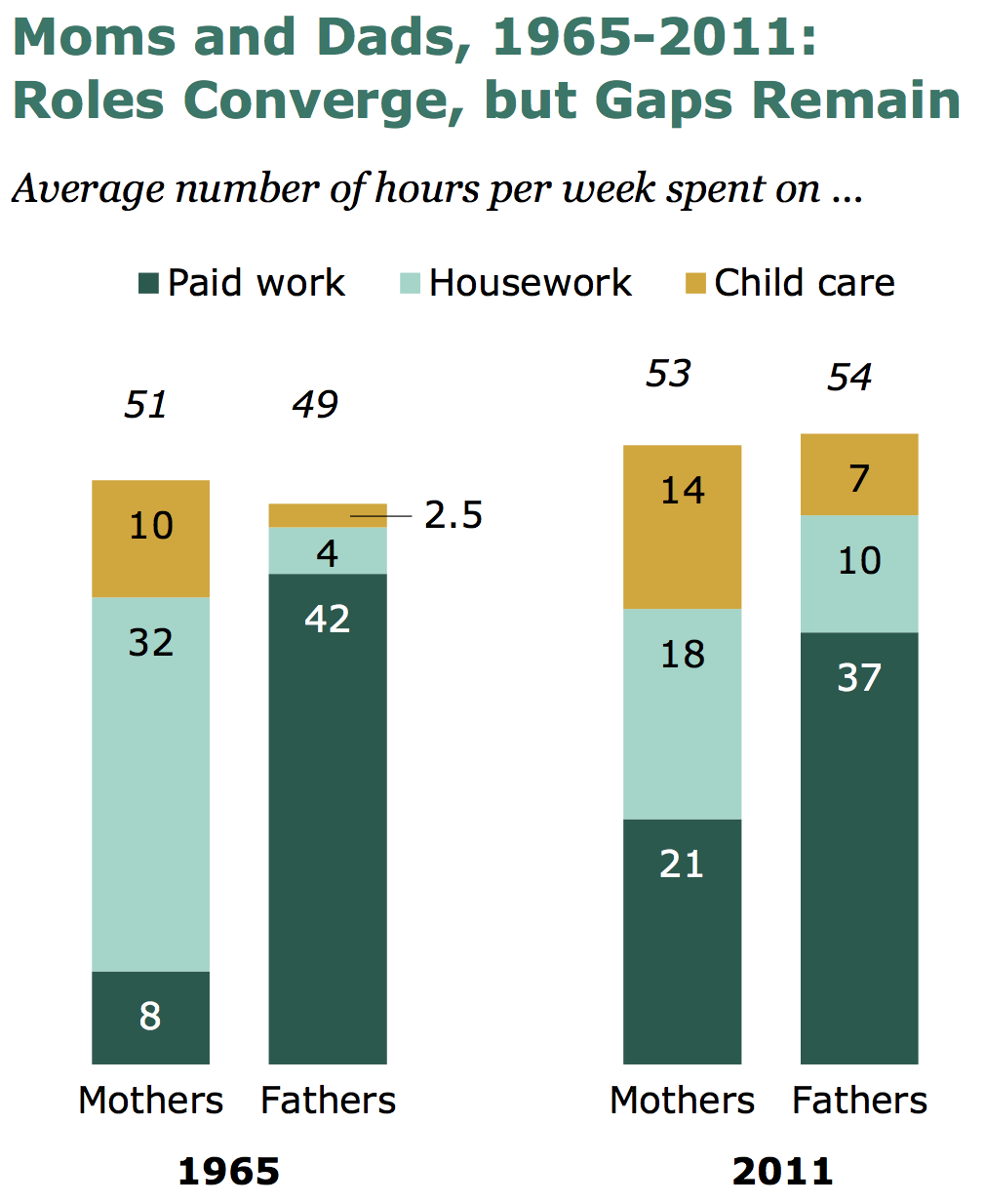
Work week by sex

Lisa Miller sticks up for feminist stay-at-home moms:

Feminism has never fully relieved women from feeling that the domestic domain is theirs to manage, no matter what else they’re juggling. There is a story, possibly apocryphal yet also believable, of an observer looking over Secretary of State Madeleine Albright’s shoulder during a Cabinet meeting in the late nineties. On the pad before her, the secretary had written not “paths to peace in the Middle East” but “buy cottage cheese.” (Albright declined to comment for this story, but while promoting a book in 2009, she told an audience that all her life she made it a point always to answer phone calls from her children, no matter what else she was doing. “Every woman’s middle name is guilt,” she said.)

Jessica Grose objects to the premise of Miller’s article and reframes the issue:

[W]hen you strip away the weird gender essentialism and the fact that the article is ginning up a trend where there is none, you do see the core of what the current “problem that has no name” is. It’s time. When you’re in a marriage where both people have not-extremely-lucrative careers and you throw a child into the mix, something, someone has to give. As Miller puts it, “When two people need to leave the house at 6 a.m., who gets the children ready for school? When two people have to work late, who will meet that inflexible day-care pickup time? And who, finally, has the energy for those constant transactions?” No wonder some families are deciding one parent will take on primary responsibility for the kids in this morass.

(Chart from Pew)

How Likely Is Immigration Reform?

Rand Paul has announced his support for a pathway to citizenship. Chait upgrades immigration reform’s chances:

If figures like Rubio look around and see other Republicans edging for the exits, they’ll in turn beat a retreat.

As of now, though, all the 2016 contenders can support a bill in the anticipation that their major rivals will be locked in to the same stance. The most plausible vehicle for a grassroots insurgent candidacy was Paul, who had harnessed his father’s grassroots appeal with shrewd cultivation of the party elite. With Paul signed up with the pro-reform cartel, nobody is going to make Rubio, Bush, or Ryan nervous, which means there’s little right now to stop a bill from passing the House this summer.

When Your Dog Gets A Personal Trainer

Joshua Rothman profiles “dog runners”:

The market for dog runners, [Running Paws manager Joshua] Stine explained, is more specialized than the market for dog walkers. Running Paws has four kinds of customers. There are owners of aggressive or over-active dogs—dogs “who need some type of physical or mental release.” There are fitness enthusiasts: “people who, I guess, kind of, in a sense, project onto their dogs. They like the idea that their dog is jogging while they’re at work.” Show-dog owners hire Running Paws to keep their dogs in shape: “Some of them have given us a huge amount of credit for the muscle tone, the overall fitness of their dogs.”

And then there are people with overweight dogs. Getting a dog in shape, Stine said, can be surprisingly easy. “Dogs being animals, they bounce back far more quickly to an athletic state than a person.”

Tick-Tock

Rob Tisinai identifies one reason various conservative politicians are suddenly voicing their support for marriage equality:

Imagine you’re a conservative. And you support marriage equality. And you’ve been silent. But now you realize this may be your last chance to say you supported same-sex marriage before it becomes the law of the land. How mortifying must it be to know you sided the angels with the great civil rights struggle of our day, but that no one will ever believe you?  To know you’re on the right side of moral history, but might be seen for the rest of your life as one of its opponents? To know you believe in the American ideals of freedom and human dignity, but sat out this historic struggle to turn America into a more perfect union?

How mortifying must it be to know you are right, but your silence now could brand you forever as having been deeply and morally wrong?