Sex Dystopia

Christopher Ryan paints a dark picture of the future of human sexuality:

Just as the 21st century saw friends replaced by Facebook friends, nature replaced by parks, ocean fisheries replaced by commercially farmed seafood, and sunshine largely supplanted by tanning salons, we’ll see sexual interaction reduced to mechanically provoked orgasm as human beings become ever more dominated by the machines and mechanistic thought processes that developed in our brains and societies like bacteria in a petri dish. Gender identity will fade away as sexual interaction becomes less “human” and we grow less dependent upon binary interactions with other people. As more and more of our interactions take place with non-human partners, others’ expectations and judgments will become less relevant to the development of sexual identity, leading to greater fluidity and far less urgency and passion concerning sexual expression.

It’s enough to make someone root for a major global meltdown:

Following the collapse of the consumerist, competitive mind-set that now dominates so much of human thought, we’d possibly be free to rebuild a social world more in keeping with our preagricultural origins, characterized by economies built upon sharing rather than hoarding, a politics of respect rather than of power, and a sexuality of intimacy rather than alienation.

Open-source Orgasm

Adult film star and sex educator Maggie Mayhem and her husband created the PSIgasm, a device to collect data on arousal:

[This research] was all done in the ’70s and nobody has done anything else since. It also means the only research we have on the orgasm comes from people who are able to have orgasms in a sterile lab, people with clipboards and lab coats staring at them. To me, that’s not a very round depiction of the human orgasm. …

This version has about 14 sensors. It has all the pressure gages in various places throughout the device and they’re detecting the pounds per square inch exerted by the muscles of the pelvis floor. It also picks up pretty much everything a lie detector test would get. That’s all the vital data: blood pressure, heart rate, respiration—these are all major parts of the orgasm cycle.

Her hopes for the project:

It’s research that I feel strongly we all have to do collectively, I’m hoping to make versions where people can anonymously upload their biodata. I’d like to make a collective living document that’s always evolving and everybody is participating in. We are all researching. It’s people exploring themselves.

Seat Strategery

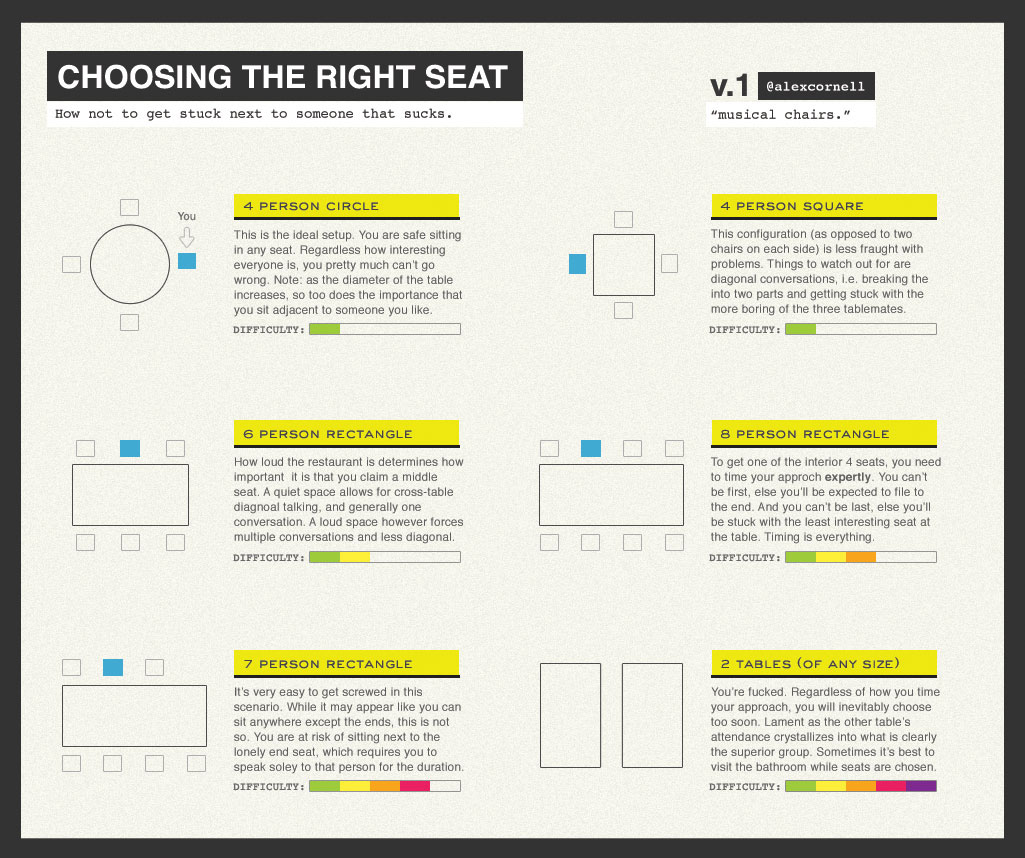
Alex Cornell maps some ideal seating arrangements for dinner guests. Some tips:

7 Person Rectangle: It’s very easy to get screwed in this scenario. While it may appear like you can sit anywhere except the ends, this is not so. You are at risk of sitting next to the lonely end-seat, which requires you to speak soley to that person for the duration of the meal.

2 Tables of Any Size: You’re fucked. Regardless of how you time your approach, you will inevitably choose too soon. Lament as the other table’s attendance crystallizes into what is clearly the superior group. Sometimes it’s best to visit the bathroom while seats are chosen, so any seating disasters are the result of chance, and not your own miscalculation.

A large version of his map here.

Doped Up Domesticity

In 1955, the first commonly prescribed tranquilizer, Miltown, burst onto the American scene, and “within a year, a staggering 1 in 20 Americans were regularly prescribed it”:

[Miltown] was a potent and prescription-only tranquilliser, most often used by women. Among American housewives, it became as fashionable as the latest style of dress or car. It was discussed at dinner parties and md30791written about in lifestyle magazines. Miltown was, from its birth, bound up with ideas of glamour, framed as part of an aspirational lifestyle choice which Hollywood starlets and suburban housewives alike could indulge in. Celebrities promoted its benefits, and bowls of Miltown were even rumoured to be passed around like canapés at Hollywood parties.

Such anecdotes spawned a flurry of Miltown cocktail recipes for star-struck housewives to copy. There was the ‘Militini’, a martini with a pill replacing the olive. Or those more daring drinkers could try a ‘Guided Missile’ – a double vodka and two Miltowns. The jewellers Tiffany’s even produced ruby- and diamond-studded pill-cases, while Cartier advertised a silver charm bracelet with a convenient holder designed for a single Miltown pill. This was a medicine like no other – until it was surpassed by its descendant, Valium. By 1974, an astonishing total of 53.4 million Americans were taking Valium – a quarter of the whole population.

(Image: 1959 Miltown ad via Deco Dog)

Pilgrims And Prohibition

They struggled against it just like we do today:

Our collective mythmaking about the Pilgrims and their pious conservatism does not make room for this image of the colony. Pilgrims are hard-working, religious, pious people to us, and Americans are intoxicated with this puritanical vision of past. We don’t see Plymouth as a party town, but as the birthplace of our best selves.

And yet alcohol was everywhere. The Mayflower had been stocked with more beer than water, as well as cider, wine, and aqua vitae, a form of distilled brandy. The first Thanksgiving included thanks for a successful barley crop, which allowed for the brewing of beer, and aqua vitae, or “strong water,” was used to smooth over discussions with the Wampanogs. Alcohol was essential to the survival of the colony, both as a drink and a currency, and a great deal of energy and time was dedicated to lawmaking and law enforcing surrounding the making, selling, and drinking of alcohol.

The Beatles And Chris Matthews

His show – where I’ve appeared regularly – has a 50th anniversary special on the Beatles this weekend. Joe Klein and Chuck Todd are among the nostalgics. Consider this just a plug for what is often the most honest political show on Sunday mornings, and the most entertaining. Who else but Chris would get all emotional about the Fab Four? Oh, and happy St Paddy’s Day, while I’m at it.

Reads Like A Dream

Francine Prose rejects the advice of a 7th grade teacher who cautioned students, “Never end a story with, ‘It was all a dream!’”:

Literature is full of dreams that we remember more clearly than our own. Jacob’s ladder of angels. Joseph saving Egypt and himself by interpreting the Pharoah’s vision of the seven fat and lean cows. The dreams in Shakespeare’s plays range as widely as our own, and the evil are often punished in their sleep before they pay for their crimes in life. Kafka never tells us what Gregor Samsa was dreaming when he awakens as a giant insect, except that the dreams were “uneasy.” Likely they were not as uneasy as the morning he wakes into.

She credits Tolstoy’s Anna Karenina with the boldest use of a dream in fiction:

Tolstoy showed it was possible to give a character a dream that strikes the reader as plausible, convincing, important enough to pay attention to, without being heavy-handedly symbolic or portentous. Or boring. What’s harder to recreate on the page is anything remotely resembling the experience of actually dreaming, with all the structural and narrative complexities involved, the leaps, contradictions, and improbable elements. Maybe that was my seventh-grade teacher’s problem: She’d read too many middle-school accounts of dreams that were nothing like dreams.