A New Pope: Your Thoughts

The Conclave Of Cardinals Have Elected A New Pope To Lead The World's Catholics

A reader writes:

I may be overly cynical, but the selection of this “First ever non-European” pope is underwhelming me.  It feels almost too well-crafted.  It is a perfectly sized micro-step towards progress that will keep the world’s press buzzing for some time.  It’s also about the safest pick you could imagine for a non-European.  It is still an old white guy from an Italian-influence Catholic country with a mature congregation.

Is this a big head fake?  The kind of seemingly, but not really, substantive move that is calibrated to allow the church to say “See! We modernized and became more inclusive!  The rest of you (women, gays) are just being churlish now. Bask in our progressiveness!”

Another snarks:

Best comment on the new pope that I’ve heard so far: Pope Francis – because when you need to hide a German, hire an Argentinian.

Another:

I think it is fair to assume Pope Francis is unlikely to change the Church’s teaching on birth control, gay rights, et al, but doesn’t bother me as a frustrated modern Catholic. The new pope’s humanity (something so lacking with Ratzinger), his opposition to clericalism, and the belief that he is an outsider ready to reform Vatican governance, suggests he could radically alter the make-up of the College of Cardinals during his tenure. Francis may not be the modernist reformer so many Catholics  desperately wish to see in the Vatican, but he may be the pope who aligns the chess pieces so such a reformer to follow him. That prospect alone gives me great hope for the Church.

There is one symbolic move Francis could make to greatly and quickly restore the Vatican’s credibility: Send Bernard Law home to deal with the consequences of what he let happen in the Boston Archdiocese.

I can deal with a church that is still behind the times on birth control and gay rights, as you’ve stated American Catholics are quite adapt at ignoring such doctrinal bollocks. What is unacceptable is protecting and enabling criminals who use the Church to torment children. Whatever else, if Francis can set a precedent that protecting pedophiles and protecting those who protect pedophiles will no longer be tolerated and can shift the College of Cardinals’ balance of power, his leadership will be a great leap forward for the Church.

Here’s hoping. Another:

I find this comment from a reader telling:

The Pope is the successor of the Apostle who was graced with faith, and still denied Christ, cowered in fear with the other male apostles in the upper room after Jesus’ death, and would have us still circumcising boys and eating kosher. Yet managed to serve God.

That is exactly the attitude that is the problem with the Catholic Church. “We are all sinners who are doing our best to humbly serve God.” I haven’t heard enough to pass judgment on what Bergoglio did or did not do during the Videla regime, but I do know that this sort of casual response makes it much easier for a non-believer such as myself to comprehend how the disease of child rape has become so pervasive inside the Church. The charge of colluding with fascist dictators to help inconvenient dissenters vanish into thin air is not to be shrugged off with fatuous comparisons to Peter the Apostle, and the suggestion that denying Christ for the sake of self-preservation is in any way comparable to what Bergoglio is accused of doing is insulting to human dignity.

I don’t know for certain if Bergoglio assisted fascists. I do know that the Catholic Church was very tolerant towards rightist regimes during the 20th Century: Franco in Germany, Salazar in Portugal, Pinochet in Chile, the Ustashe in the Balkans, not to mention the celebrating of Hitler’s birthday from the pulpit right up until 1945 in Nazi Germany.

Some of Hitch’s most convincing work was illustrating the direct link between Fascism and the Catholic Right, and his chapter on his time visiting Videla’s Argentina in his memoirs seems worth re-reading today. I wish he were here today to give us his take on Francis.

I can only speak for myself, but I think your reader’s dismissive attitude towards past misdeeds is precisely what the Church doesn’t need right now. I’m not big on infallibility, but I was hoping for the Catholic Church to put forward someone who could make a clean break from the hideous crimes and cover-ups. It’s early, I know, but right now I am not impressed.

I have to say my own skepticism is growing. But I do not want to pre-judge. The Dish will, however, try to get to the bottom of who he is and what he has done, in particular in relationship with the fascist junta.

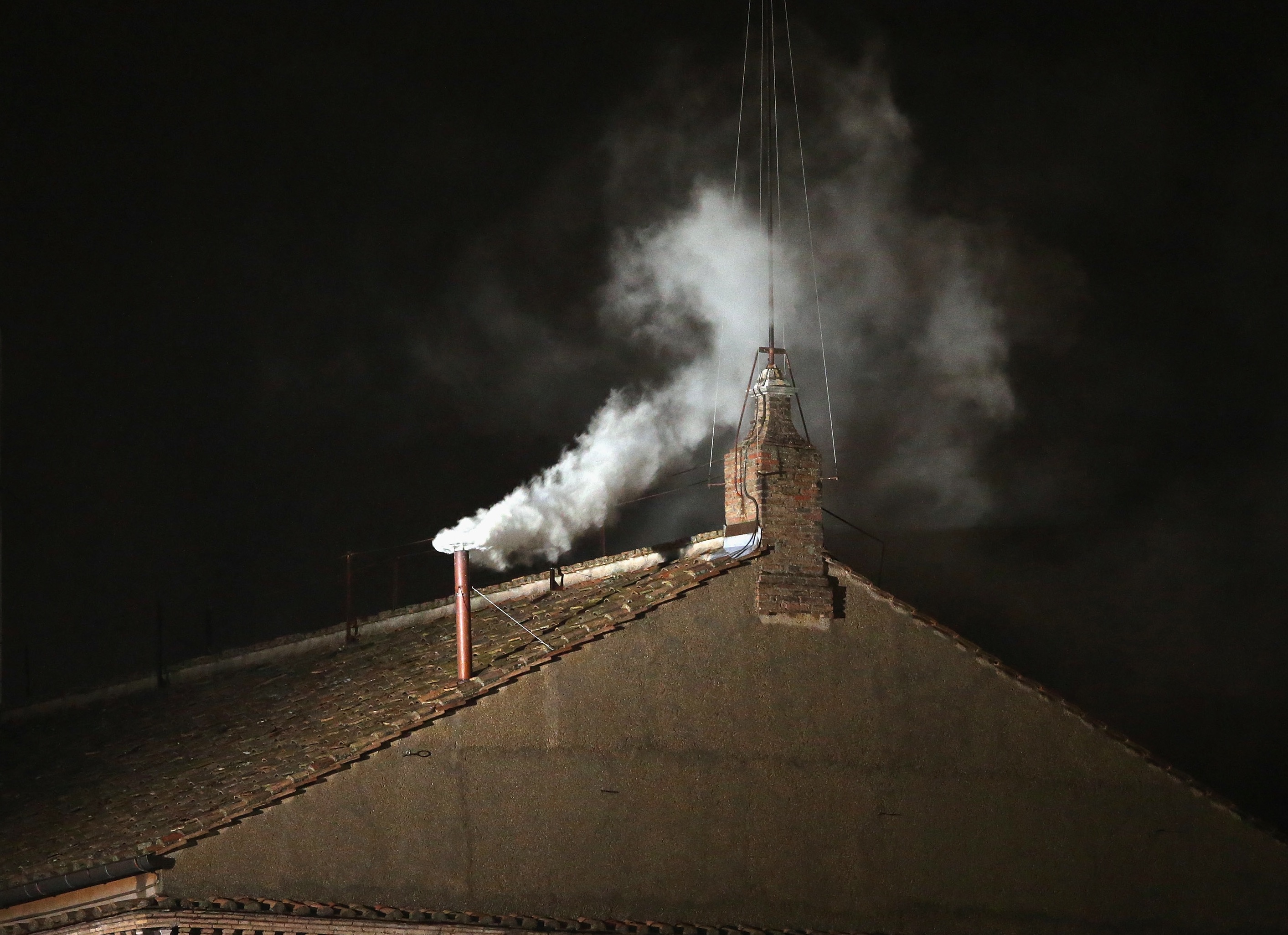
(Photo: White smoke emits from the chimney on the Sistine Chapel as a new Pope is elected on March 13, 2013 in Vatican City, Vatican. By Joe Raedle/Getty Images)


A Pope In Court?

It appears Francis – and not Benedict – may have to attend another court hearing to deal with a previous “crime against humanity” with respect to children under the Argentine dictatorship:

Tiempo Argentina is reporting that Bergoglio could be called to federal court to testify for the third time in a case involving crimes against humanity for his interaction with a pregnant woman named Elena de la Cuadra, and her husband, Hector Baratti, who were both kidnapped on February 23, 1977. According to Elena’s sister, Elena gave birth to a daughter who was then taken by Argentine authorities. At the time, Elena appealed to Bergoglio for help and received a letter saying that a bishop would intercede, but after a few months passed, the bishop reported that the baby had already been adopted by an important family and that the kidnapping could not be reversed. Despite the letter, Jorge Bergoglio has denied that he knew anything about kidnapped children until after the military dictatorship was overthrown.

Let me say on the record that I don’t believe that last statement. Which worries me.

But What If Three People Love Each Other? Ctd

Many readers counter the previous ones who opposed civil polygamy:

I find that the issue of polyamory suffers from being brought up almost exclusively in the context of the same-sex marriage debate. This makes it easy to dismiss, since no matter what your stance on polyamory, it is obviously a separate issue from same-sex relationships and must be considered on its own merits. I find myself unsure of my position. I’m deeply leery of the idea of granting polyamory a legally recognized status largely because of concerns over the exploitation of women in certain polygamous marriages, but on the other hand I see how this could be a standard that I’m applying unequally, seeing as how I support the right to two-person marriage despite the existence of domestic violence.

What I find much less convincing in the argument your reader put forward about the legal implications of multiple marriages. Yes, it would undoubtedly make things more complicated, but so what? If property still only corresponded to males we wouldn’t have to engage in tedious and costly division of property during divorce, but we don’t see this as a good reason to impose blatantly unfair standards in our laws. The debate over polyamory is worth having (on its own, not tied to unrelated marriage debates), but let’s have it on its merits.

Another reader:

A stable, committed triad could actually make raising children easier, three sets of hands being better than two, especially in an age when extended families often do not live close by. And perhaps it could even help cultivate stronger relationships between the adults: there would always be someone available to take care of the kids for date nights!

Another:

There is no reason to deny people the right to plural marriage. The same arguments used to deny acceptance or respect of gay relationships, much less marriage, are used in the same way for polygamists. Like working the old chestnut that gays are psychologically damaged and can never maintain healthy relationships, which is why we never see gays in long-term mutually beneficial relationships when society clearly doesn’t accept them, we have the current chestnut that polygamists are nothing but old, dictatorial white men who do nothing but marry 13-year-olds to build a harem of repressed women who bear them 40 children, all of whom live in a compound in the desert and lack modern education.

The fact is that as a society we have shunned the idea of plural marriage to the point where the behavior of pluralists is quite undesirable. The only way to accomplish polygamy without the daily damnation of a monogamous society is to live a sequestered life in the desert and marry within the tribe.

As far as polygamy creating a subculture of unmarried men, how sexist of us to assume that there aren’t men who would participate in a plural marriage to one woman! What if, as the other reader wrote, you end up with plural marriages that consist of one woman and two gay men?

Another:

Sorry, but how is that an “excellent counterpoint”? Civil law already deals with all sorts of permutations far more complex than any of those examples. All these issues can be dealt with when the relationships are formalized. To take the reader’s example, what if the man with the rare disease were unmarried, but had two children? Which of them would decide on his treatment? I mean, come on! We form business partnerships of many configurations every day. Civil law is certainly capable of dealing with these issues, and in fact does so already.

Another:

I’ve never quite understood your opposition to polygamy (outside of the obvious tactical need to distinguish gay marriage from plural marriage), especially on the grounds that it will destabilize society by reducing the number of available females. That assumes all multiple marriages will be polygynous, but if polyandry and group marriage are allowed, we could avoid those imbalances. It does worry me that polygamy, in societies where it dominates, has almost always been hand-in-hand with female subjugation. But this doesn’t seem a necessary relationship. And, in the choice between the freedom to structure our associations as we will, against the speculative fear of undermining women’s equality, freedom should at least be given a chance.

Another:

You bring up the point that polygamy, since it would largely be practiced by men with multiple wives, would leave too many men without mates, a dangerous situation. What if more lesbians were to marry than gay men? Wouldn’t that lead to the same state? If giving everybody a fair shake at marriage is to be considered a determining factor, does that mean that states should only grant as many licenses to all-male couples as they do all-female couples?

You also seem to equate sex and marriage. Men who wish to have sex with more than one woman already can. They can also have children with more than one woman. What they can’t do is give both those women (and the offspring they create) the rights and privileges attendent to marriage. And why not, assuming they are capable of maintaining their obligations to more than one woman and assuming that both women are open to the arrangement. In fact, one could say that polygamy, where all arrangements are out in the open, is more moral than the very common practice of spouse lying to and cheating on spouse.

If polygamy were legal, only a small percentage of people would opt for it. Not enough to affect anybody’s happiness any more than the option of same sex marriage denigrates the marriage of straight people.

Another:

Your reader’s questions about what will be done with survivor benefits and end-of-life decisions betrays a mind that has not thought much about either – much less polygamy. Already, we have situations where serial monogamy leads to multiple people being responsible for one another, and it’s very easy to list multiple beneficiaries on a pension plan or life insurance policy.

When my father-in-law died, both his first wife (my husband’s mother) and his second wife (my husband’s stepmother) received survivor benefits from Social Security, because they’d both been married to him for longer than the minimum requirement for benefits. Likewise, serial monogamy leads to blended families where it’s not always clear who should have final medical power, particularly if Mom had children by more than one husband, and is now divorced from both but living with her new beau.

The fact is that our marriage laws are terribly outdated, and need to be completely rethought. That’s why I’m in favor of leaving marriage to the religious institutions, and registering households in whatever configuration people want to live. If a same-gender couple, or a heterosexual couple, or an elderly couple who can’t have children, or any couple want to be responsible to and for each other, let them. If three people want to be responsible to and for each other, let them. If a gay man and his female best friend want to be responsible to and for each other, let them. Let’s stop worrying about who is screwing who, and just make it easier for people to be responsible in their relationships.

The Pope For The Great Recession?

ITALY-VATICAN-POPE-CRIB FIGURINE

Partially because of his Latin American heritage, Michael Sean Winters expects Francis to be an advocate for the poor in an era of global economic disruption and turmoil:

Bergoglio and the other bishops in Latin America have been relentless in questioning and criticizing those who exercise power in ways that marginalize the poor. The criticism of capitalism is trenchant: He called the IMF’s efforts to squeeze interest payments out of a struggling Argentine economy “immoral.” Here, Bergoglio stands in continuity with Benedict whose criticism of modern capitalism never made headlines but was there for anyone who cared to look. Catholicism does not propose any specific economic or political systems, but it must always criticize whatever systems insult human dignity.

Philip Jenkins argues along the same lines:

Bergoglio is … clearly an heir to the strong tradition of social-justice activism in the Latin American church. Again, this owes much to his Argentine background. If Argentina was once regarded as a hemispheric success story in economic development, its history since the 1950s has been much grimmer, with systematic decline and repeated bouts of hyperinflation, reaching catastrophic dimensions during the crisis of 1999 to 2002. In consequence, people who regarded themselves as citizens of a prosperous near-European economy faced ruin, the annihilation of their savings, and the loss of their jobs and homes.

Naturally, having lived through such a disaster, Bergoglio has placed the church’s social mission front and center in ways that a European would regard as alarmingly radical. Even more than the last two incumbents, Francis I will speak forcefully and critically about neoliberalism and global economic exploitation.

(Photo: Crib figurines’ artist Genny Di Virgilio works on a figurine depicting Pope Francis, the day after he was elected on March 14, 2013 in Naples. By STR/AFP/Getty Images)

For The Record

The Hugh O’Shaughnessy piece we linked to yesterday – the most damning when it comes to Francis’ relationship with the military junta – has been corrected:

• This article was amended on 14 March 2013. The original article, published in 2011, wrongly suggested that Argentinian journalist Horacio Verbitsky claimed that Cardinal Jorge Bergoglio connived with the Argentinian navy to hide political prisoners on an island called El Silencio during an inspection by human rights monitors. Although Verbitsky makes other allegations about Bergoglio’s complicity in human right abuses, he does not make this claim. The original article also wrongly described El Silencio as Bergoglio’s “holiday home”. This has been corrected.”

We will surely hear more from Verbitsky, whose reputation is very good in Argentina.

Assisi, Not Xavier

Confirmed:

Applause broke out in the Sistine Chapel for Bergoglio when he crossed the threshold of 77 votes, and again when he said “Accetto,” I accept, according to Dolan, who himself had been considered a candidate for the throne. Dolan told reporters that Bergoglio “immediately said, ‘I choose the name Francis in honor of St. Francis of Assisi,’ ” referring to a rich man’s son who took a vow of poverty.

From Pope Liberace to Pope Francis. That’s a lot of drag to put away.

How Racism Was Made, Ctd

kids-race

Readers continue the debate:

I take your point that you “don’t believe the law created racism any more than it can create lust or greed or envy or hatred.” I think, though, that this depends on how you define racism. It seems that what you’re describing is less racism than prejudice.  I agree that you cannot totally erase prejudice – that unconscious separation of those “like me” from those “unlike me” – from people’s psyches.  The origins of that are surely evolutionary, and were once very valuable on the savannahs of Africa.  But racism is an institutionalized system of discrimination based on prejudice.  In short, it’s prejudice plus power.  That is something that can and should be addressed in policy. In fact, there’s no other way to address it.

Another adds, “Government policy may not be able to “end” racism, but it can definitely reduce it to levels where it may be effectively extinguished.” Another:

It fascinates me how a guy who is clearly one of the most brilliant people out there still has this strange blind spot when it comes to the use of the term “race.” Maybe it’s because “race” took on a different connotation when you grew up in England than it does in the U.S.

Group loyalty may be part of our DNA. But what you fail to understand is that how the “groups” are determined is a separate question altogether. Each of us identifies with dozens of “groups” in a lifetime. Those loyalties change, they can be invoked in countless ways, and circumstances can alter them dramatically. All TNC – along with practically every historian of “race” in America – is trying to illustrate is that the way we’ve chosen to draw up “races” (i.e. groups) in America is not a part of nature. A mere survey of racial imaginings throughout the world will illustrate, for instance, that “the one drop rule” is distinctively American.

And not also Nazi? Or South African? Another:

I suspect that you and TNC may agree more, or at least disagree less, than you realize when it comes to his assertion that racism is created by policy. The issue is, I suspect, a difference in terminology rather than TNC’s “utopianism.” Note that both your and TNC’s uses are options in the following Dictionary.com definition:

rac·ism, [rey-siz-uhm] noun

1. a belief or doctrine that inherent differences among the various human races determine cultural or individual achievement, usually involving the idea that one’s own race is superior and has the right to rule others.

2. a policy, system of government, etc., based upon or fostering such a doctrine; discrimination.

3. hatred or intolerance of another race or other races.

In short, I think you and TNC are using the term racism in different but not contradictory, and even complementary, ways. And I am not sure TNC is suggesting that eliminating existing racist institutions or correcting past ones will eliminate human prejudice (although we are witnessing how these hatreds diminish as people of younger generations gain increasing exposure to difference, which would not be possible without the dismantling of policies that keep them separate from other groups).

Another reader:

I have a very distinct memory of being a small child, probably no older than 5 or 6, and, wanting to be more grown-up, announcing to my parents that I had a “girlfriend” (who of course was just some random fellow kindergartener in my class). They were amused. The punchline, of course, is that she was black (and I am white). At the time, it literally did not register that this aspect of her appearance had any significance whatsoever. I think anyone who works with small children will say my example is typical, and race is simply not important to a child who has not been taught racism. Clearly, then, racism is learned, not innate.

Along those lines, another sends the above photo:

I agree with TNC that racism is taught. I also take your point about evolutionary urges. The attached photo tells more than my words could ever muster. My granddaughter, Lilian, the white one on the left, has spent every week of her life interacting with Adrielle, the black baby to the right. We have been told that when Lilian is at her large community daycare, she wants to play with the black toddlers as her first choice. If racism can be taught, acceptance sure as hell can be taught as well. We chose the latter.

Slingshotting Onto TV


America’s favorite smartphone game is becoming a cartoon series:

“[Angry Birds] Toons” will release a new two minute and 45 second episode each week for 52 weeks. Broadcast episodes will run first on Saturday mornings and then go live in the app and on video on demand on Sunday. Angry Birds fans can also find the series on Samsung smart televisions and Roku set-top boxes. All of the ads will be 15 second pre-roll videos. “We know on mobile people consume content in snackable bites, so this is enough time to tell a story and still be accessible to users,” [Michele Tobin, Rovio’s head of brand partnerships and advertising in the US] said.

Kit Eaton notes the advantages of Rovio’s innovative app-inclusive distribution strategy:

This effectively gives the cartoon a distribution network of 1.7 billion “screens,” which equates to the number of times (in total) the Angry Birds apps have been downloaded. … This innovation is claimed to be creating one of the biggest TV “networks” ever.

I won’t watch, even though I’m still powering through Angry Birds Star Wars. The great trick of it is to engage you actively, not passively. The wit of the characters is best left alone as visual parts of the game you fill in. But maybe I’ve become some kind of purist addict. I turn the sound off as well. Angry Birds is a kind of therapy for multi-taskers. There is just one task: get three stars. Mentally, it’s like going to the gym and is part of my own self-medication as a long-distance-blogger.

Plus, for some reason, you want to do it more than you want to meditate for twenty minutes. And fifty minutes later, you wonder where your afternoon went.