Makeup For Music

This embed is invalid


Surveying the rise of auto-tune in the music industry, Lessley Anderson passes along a defense of the oft-used plug-in from its creator, Dr. Andy Hildebrand:

In interviews, Hildebrand handles the question of “is Auto-Tune evil?” with characteristic dry wit. His stock answer is, “My wife wears makeup, does that make her evil?” But on the day I asked him, he answered, “I just make the car. I don’t drive it down the wrong side of the road.” The T-Pains and Chers of the world are the crazy drivers, in Hildebrand’s analogy. The artists that tune with subtlety are like his wife, tasteful people looking to put their best foot forward.

Another way you could answer the question: recorded music is, by definition, artificial. The band is not singing live in your living room. Microphones project sound. Mixing, overdubbing, and multi-tracking allow instruments and voices to be recorded, edited, and manipulated separately. There are multitudes of effects, like compression, which brings down loud sounds and amplifies quiet ones, so you can hear an artist taking a breath in between words. Reverb and delay create echo effects, which can make vocals sound fuller and rounder. When recording went from tape to digital, there were even more opportunities for effects and manipulation, and Auto-Tune is just one of many of the new tools available.

A previous defense of auto-tune on the Dish is here.

The Brits Are Not Amused

Full warning: this comes from the Daily Mail:

At a mass in Buenos Aires last year, on the 30th anniversary of the invasion of the Falklands, the Pope referred to the British as ‘usurpers’ and called for the Argentine dead to be thanked. He said: ‘We come to pray for all who have fallen, sons of the Homeland who went out to defend their mother, the Homeland, and to reclaim what is theirs, that is of the Homeland, and it was usurped.’

‘The Homeland cannot exclude from its memory, anyone who was called; it has to take charge of so many hearts with scars, and say thank you to them, to those who stayed on the island or those submerged in the water, to all of them.’ At another anniversary service in 2008, he referred to those who sought to ‘de-Malvinise history and reality’.

Mental Health Break

Pogo goes to Kenya:

Previous Pogo on the Dish here. Update from a reader:

I just thought it might be worth mentioning that the girl singing in the video is named Ann. She is an orphan living at the Flying Kites children’s home in Njabini, Kenya. It’s a wonderful place that gives a lifetime home to orphaned children and runs a school for the local kids as well. My wife and I visited and volunteered there on our honeymoon and remain huge supporters. I’ve never met such a wonderful group of people and would encourage your readers to check them out.

Paul Ryan’s Shtick Begins To Wear Thin, Ctd

Noam Scheiber pinpoints why the press has turned on Ryan:

You can treat politics like a game, and you can assume reporters will, too. But you can’t go so far as to admit it’s a game. … The problem with Ryan’s new budget—in which he reverts to his pre-campaign position on Medicare cuts—is that it more or less concedes the whole campaign, with its righteous defense of Medicare, was a charade. Among the Washington press corps, this is a major no-no. Depending on the circumstances, reporters may be happy to enable these reinventions, but they are loath to acknowledge their role in them. Ryan basically rubbed their noses in it.

Earlier Dish on Ryan’s new budget here.

Crowdsourcing On Steroids, Ctd

A reader writes:

Can we discuss the Veronica Mars thing?  Because this is a Warner Bros property!  So what, everyone chips in their $100 or whatever, gets their t-shirt and whatnot, then buys a ticket to see the movie? So now the audience has paid to make the movie AND for the price of admission. For a WB movie. A huge corporation. Yes, they will be paying for advertising and distribution, but this is a con. They risk next to nothing and potentially reap all the profits on the back end.

That is, in my opinion, NOT what crowd sourcing is about.  I do love that it’s getting a movie made that otherwise would never see the light of day, but come on. Crowd sourcing should be to support independent ventures. (And speaking of which, keep up the good work; I’m already in for $100 and intend to give at least that each year because The Dish is an independent venture that I can get behind crowd-sourcing!)

Another adds:

And guess what happens with all the money collected on Kickstarter above and beyond the $2 million goal? There’s no transparency, so we don’t know.

Pope Francis vs Clerical Privilege

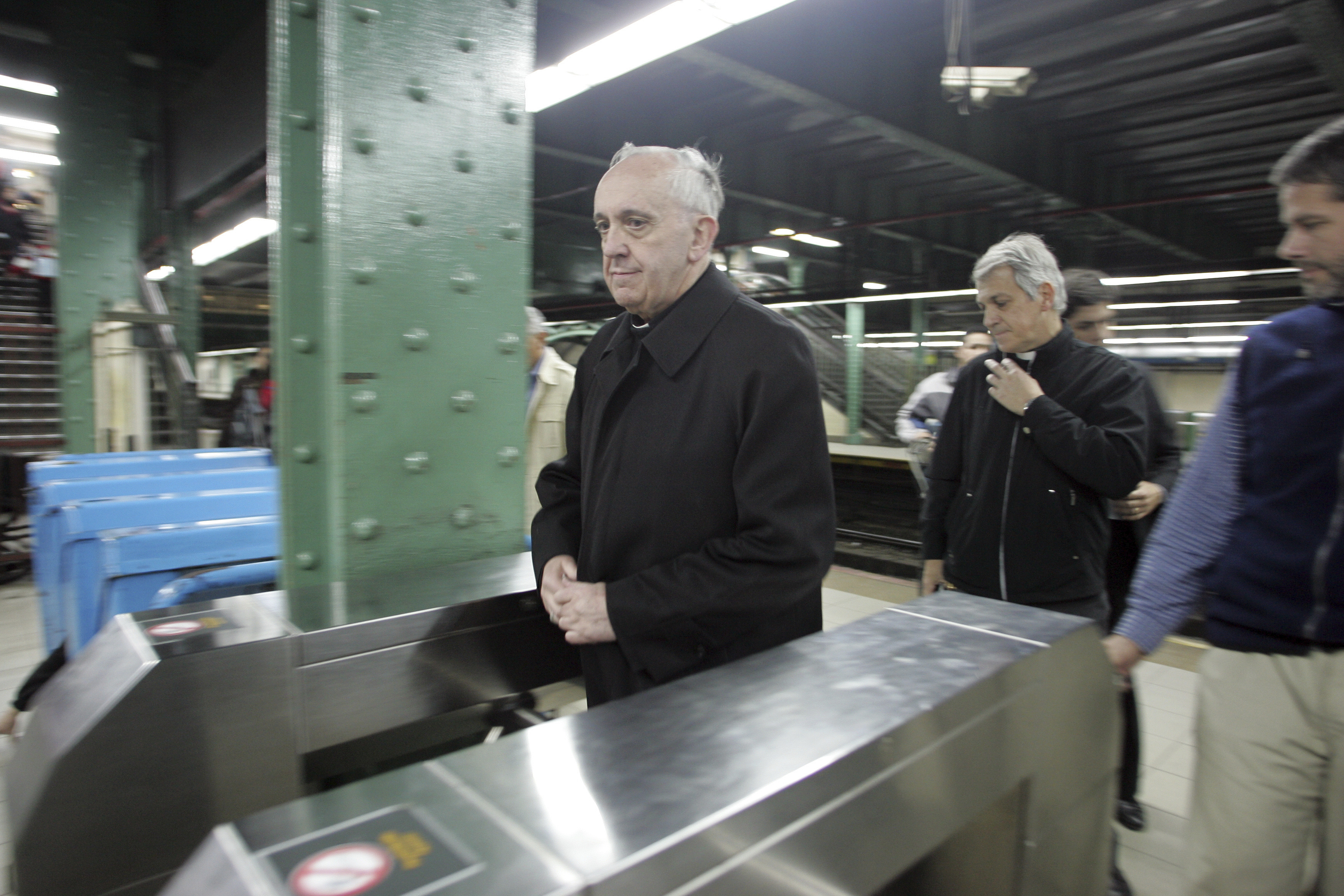
Cardinal Jorge Bergoglio Celebrates Tedeum in Buenos Aires

Garry Wills, whose new book against the priesthood has just come out, might find a strange ally in Pope Francis. In so far as the new Pope seems determined to tackle the untouchable, remote power of clericalism, he is exactly what the church needs to rid itself of abuses embedded in seeing priests as a caste apart, beholden to no-one. From an old, somewhat inspiring interview:

BERGOGLIO: Their clericalization is a problem. The priests clericalize the laity and the laity beg us to be clericalized… It really is sinful abetment. And to think that baptism alone could suffice. I’m thinking of those Christian communities in Japan that remained without priests for more than two hundred years. When the missionaries returned they found them all baptized, all validly married for the Church and all their dead had had a Catholic funeral. The faith had remained intact through the gifts of grace that had gladdened the life of a laity who had received only baptism and had also lived their apostolic mission in virtue of baptism alone. One must not be afraid of depending only on His tenderness… Do you know the biblical episode of the prophet Jonah?

Q: I don’t remember it. Tell us.

BERGOGLIO: Jonah had everything clear. He had clear ideas about God, very clear ideas about good and evil. On what God does and on what He wants, on who was faithful to the Covenant and who instead was outside the Covenant. He had the recipe for being a good prophet. God broke into his life like a torrent.

He sent him to Nineveh. Nineveh was the symbol of all the separated, the lost, of all the peripheries of humanity. Of all those who are outside, forlorn. Jonah saw that the task set on him was only to tell all those people that the arms of God were still open, that the patience of God was there and waiting, to heal them with His forgiveness and nourish them with His tenderness. Only for that had God sent him. He sent him to Nineveh, but he instead ran off in the opposite direction, toward Tarsis.

Q: Running away from a difficult mission…

BERGOGLIO: No. What he was fleeing was not so much Nineveh as the boundless love of God for those people. It was that that didn’t come into his plans. God had come once… “and I’ll see to the rest”: that’s what Jonah told himself. He wanted to do things his way, he wanted to steer it all. His stubbornness shut him in his own structures of evaluation, in his pre-ordained methods, in his righteous opinions. He had fenced his soul off with the barbed wire of those certainties that instead of giving freedom with God and opening horizons of greater service to others had finished by deafening his heart. How the isolated conscience hardens the heart! Jonah no longer knew that God leads His people with the heart of a Father.

(Photo: Argentine Cardinal Jorge Mario Bergoglio takes the Line A of the undergournd prior to the celebration of the traditional Tedeum mass at the Metropolitan Cathedral on May 25, 2008 in Buenos Aires, Argentina. By Emiliano Lasalvia/LatinContent/Getty Images.)

Bergoglio And Torture

One version of the story has it that Bergoglio intervened to save two radical lefty Jesuit priests, who were kidnapped by the junta and eventually found, drugged, tortured and terrorized. Another version is that Bergoglio basically sold them out as radicals to the junta. In a must-read interview with Horacio Verbitsky, he finds a way to reconcile the two accounts:

During the research for one of my books, I found documents in the archive of the foreign relations minister in Argentina, which, from my understanding, gave an end to the debate and show the double standard that Bergoglio used. The first document is a note in which Bergoglio asked the ministry to—the renewal of the passport of one of these two Jesuits that, after his releasing, was living in Germany, asking that the passport was renewed without necessity of this priest coming back to Argentina.

The second document is a note from the officer that received the petition recommending to his superior, the minister, the refusal of the renewal of the passport.

And the third document is a note from the same officer telling that these priests have links with subversion—that was the name that the military gave to all the people involved in opposition to the government, political or armed opposition to the military—and that he was jailed in the mechanics school of the navy, and saying that this information was provided to the officer by Father Jorge Mario Bergoglio, provincial superior of the Jesuit company. This means, to my understanding, a double standard. He asked the passport given to the priest in a formal note with his signature, but under the table he said the opposite and repeated the accusations that produced the kidnapping of these priests.

Read the whole thing. It exonerates Bergoglio in some ways but it’s very depressing over all. One of the two tortured priests told Verbitsky he suspected that Bergoglio had actually been directly involved in the torture and interrogations – because they involved theological questions of some erudition:

Verbitsky: They were tortured. They were interrogated. One of the interrogators had externally knowings [sic] about theological questions, that induced one of them, Orlando Yorio, to think that their own provincial, Bergoglio, had been involved in this interrogatory.

Amy Goodman: He said that—he said that Bergoglio himself had been part of the—his own interrogation, this Jesuit priest?

Verbitsky: He told me that he had the impression their own provincial, Bergoglio, was present during the interrogatory, which one of the interrogators had externally knowledge of theological questions.

My italics. If the new Pope was present during the torture and interrogation of a Jesuit dissident, then we have just returned to the days of the Inquisition. I pray to God this isn’t true.
As Shy As Benedict?

Cardinal Jorge Bergoglio Celebrates Tedeum in Buenos Aires

The Pope is a man of few words outside the pulpit – according to this revealing profile first published in 2005:

Of course, there is that Trappist silence. His press secretary, a young priest, spends his time interpreting what the Cardinal does not say. The other part of his job is to turn down, on Bergoglio’s behalf, interviews or invitations to write articles. The Archbishop of Buenos Aires has almost no published work, and seems to become less visible with each passing year.

Well that last bit just changed a little. But I have to say that one of the more striking things about his appearance in Saint Peter’s Square was his unexpected request for silent prayer. He is about as hardline as one would expect from the current Curia on sexual and gender issues, and he ran the Jesuits under his command with an iron theological fist. But this doctrinal orthodoxy and demand of total obedience is balanced by a real record of pastoral care and symbolic servitude. From the same profile:

Cardinal Bergoglio regularly travels to the furthest ends of his three million-strong diocese to visit the poor. He wants them in the neediest barrios, in the hospitals accompanying Aids sufferers, in the popular kitchens for children. To take one example: when, last year, a number of young people died in a fire in a rock club tragedy, Bergoglio went to their aid in the middle of the night, arriving before the police and fire service, and long before the city authorities. Since the tragedy, one of his auxiliaries has a ministry to the family and friends of the victims, and has not been backward in criticising the government for its response to the tragedy.

(Photo: Argentine Cardinal Jorge Mario Bergoglio celebrates the traditional Tedeum mass at the Metropolitan Cathedral on May 25, 2008 in Buenos Aires, Argentina. By Emiliano Lasalvia/LatinContent/Getty Images.)

The IED Arrives In Syria

The rebels are getting the hang of it (one more unforeseen consequence of the US interventions in Afghanistan and Iraq):

The 401 Syrian [IED] bomb attacks is still nowhere near the 3,000-plus attacks that occurred last year in Iraq, the birthplace of the improvised explosive device, let alone the 16,000 in Afghanistan. But they do underscore how the cheap, easily adaptable weapon has become a fixture of contemporary irregular warfare. And the data also provides a glimpse into how a durable insurgency, one with a significant terrorist component, is using the bombs.

Overall, 49 percent of the Syrian bombs — 197 of the 401 attacks — caused any casualties. That’s a higher success rate than in Afghanistan; although Assad’s forces don’t have the experience (or the gear) that U.S. troops have thwarting bomb manufacturers.